On This Page
Description
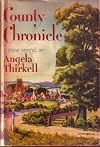
'You read her, laughing, and want to do your best to protect her characters from any reality but their own' New York Times The county of Barsetshire is aflutter with preparations. With the wedding of Lucy Marling and Sam Adams fast approaching, and Lucy's brother Oliver brooding over his ill-fated tendre for glamorous Jessica Dean, Mrs Marling calls for reinforcements. Help arrives in the form of charming writer Isabel Dale, still mourning the loss of her fiancé on D-Day - and in need of show more her own fresh start. Meanwhile, social barriers are crumbling at Omnium Castle, where theatrical rehearsals are bringing together the newly married Brandons and the impoverished Duke's children, Lady Cora and Lord Silverbridge. The stage is set for a season of new alliances, old friends and second chances. A sparkling and deeply affectionate portrait of post-war England, County Chronicle follows The Old Bank House in Angela Thirkell's beloved Barsetshire series. show lessTags
Recommendations





















Member Recommendations

Member Reviews
As usual, Thirkell's reactionary politics are a bit hard to take — she seems to have written this in the run-up to the 1950 election and loses no opportunity to throw in undiluted, bitter propaganda against "Them" (i.e. Attlee's Labour government). At one point a character reflects that there is nothing much to show for all the "millions" They have spent "except ... free hospitals". Thirkell doesn't seem to have any conception what a huge benefit the introduction of the NHS was for the majority of British people, nor what a miracle Attlee and Stafford Cripps had performed keeping the economy afloat and even growing despite the Americans pulling the plug on lend-lease. Unfortunately, it was the short-sightedness of people like Thirkell show more with their ideological dislike for Labour's "interference" in the traditional way of life of the middle-classes that brought Attlee down.
But I think this one is still worth reading, despite the far-right-Torygraph ethos that informs it. There is a new conviction in this book that we have to go on and live our lives as agreeably as we can, despite "Them"; there are all the usual Thirkell comic bonuses, like squabbling servants, frustrated authors, cantankerous old men, and thoughtless young ones; there is an unusually rich selection of splendid set-piece scenes (a wedding, a christening, a funeral, a garden-party at the Bishop's Palace, and a Conservative fete); there is even a surprising amount of proto-feminist reflection about the ways in which men make women's lives harder. (And of course we can get a wicked giggle out of Thirkell's rather unhappy choice of name for the one truly depraved and criminal family in the neighbourhood — the Thatchers!)
There seem to be rather more direct Trollope references here than in the previous Barsetshire books. As well as various descendants of Thornes, Dales and Greshams, we penetrate Omnium Castle to meet the direct descendants of Plantagenet Palliser, who have been kept rather out of the frame up to now. It clearly suits Thirkell's purpose to show us a great Duke reduced to living in penury in the servants' wing of the castle as an example of the evil effects of Labour government, but the Duke and his daughter Lady Cora are splendid new characters despite that. show less
But I think this one is still worth reading, despite the far-right-Torygraph ethos that informs it. There is a new conviction in this book that we have to go on and live our lives as agreeably as we can, despite "Them"; there are all the usual Thirkell comic bonuses, like squabbling servants, frustrated authors, cantankerous old men, and thoughtless young ones; there is an unusually rich selection of splendid set-piece scenes (a wedding, a christening, a funeral, a garden-party at the Bishop's Palace, and a Conservative fete); there is even a surprising amount of proto-feminist reflection about the ways in which men make women's lives harder. (And of course we can get a wicked giggle out of Thirkell's rather unhappy choice of name for the one truly depraved and criminal family in the neighbourhood — the Thatchers!)
There seem to be rather more direct Trollope references here than in the previous Barsetshire books. As well as various descendants of Thornes, Dales and Greshams, we penetrate Omnium Castle to meet the direct descendants of Plantagenet Palliser, who have been kept rather out of the frame up to now. It clearly suits Thirkell's purpose to show us a great Duke reduced to living in penury in the servants' wing of the castle as an example of the evil effects of Labour government, but the Duke and his daughter Lady Cora are splendid new characters despite that. show less
Deliciously delightful. Angela Thirkell does it again. Lots of characters as usual, but I've now reached the point where I don't have to refer to my Thirkell encyclopedia, so well do I know most of them.
Book opens with the contemplation of a marriage between two people of a "certain age" who, in the last book, arranged it as a matter of practicality but very soon find out that they both love each other very much. Other characters are at loose ends, like Isabel Dale, whose fiance died in the war and who now offers herself as a sort of extra daughter to the Marlings, or Lavinia Brandon, whose son and daughter-in-law simply won't find their own house and prefer living in hers. Life marches on for this lot of sensitive yet stiff-upper-lip show more people, and it's somehow very comforting to read. Always tinged with bits of irony that can be terribly funny but are never too harsh. show less
Book opens with the contemplation of a marriage between two people of a "certain age" who, in the last book, arranged it as a matter of practicality but very soon find out that they both love each other very much. Other characters are at loose ends, like Isabel Dale, whose fiance died in the war and who now offers herself as a sort of extra daughter to the Marlings, or Lavinia Brandon, whose son and daughter-in-law simply won't find their own house and prefer living in hers. Life marches on for this lot of sensitive yet stiff-upper-lip show more people, and it's somehow very comforting to read. Always tinged with bits of irony that can be terribly funny but are never too harsh. show less
County Chronicle is book 19 of 29 in Angela Thirkell’s Barsetshire series, which captures the life and times of the inhabitants of a fictional English county in the early 20th century. These novels are light satire of people in every echelon of society, and the political events of the day. In this post-World War II novel, Thirkell’s conservative politics and dogged adherence to Empire are a bit too much in evidence, but if the reader can look past that they will find a pleasant series of typical Barsetshire events. The book opens with the wedding of a couple well-known from previous novels, and another recently-married couple have twins. There are garden parties and fêtes, and the steady ebb and flow of romantic relationships in show more which the most fruitful lead to the usual two weddings at the end of the book.
By this point in the series, many characters have aged and some have died. One of my favorite older characters figured prominently in this novel, and her story resolved in a satisfying way. It was also refreshing to see a few younger characters playing more prominent roles, no doubt providing a foundation for the remaining books. show less
By this point in the series, many characters have aged and some have died. One of my favorite older characters figured prominently in this novel, and her story resolved in a satisfying way. It was also refreshing to see a few younger characters playing more prominent roles, no doubt providing a foundation for the remaining books. show less
More of the same but this one has even less of a plot than others. It really is a collection of incidents.
Ratings
Members
- Recently Added By
Author Information

47+ Works 8,526 Members
Awards and Honors
Distinctions
Series

Belongs to Publisher Series
Common Knowledge
- Canonical title
- County Chronicle
- Original publication date
- 1950
- People/Characters
- Sam Adams [in County Chronicle]; Mrs. Brandon; Isabel Dale; Amabel Marling; Lucy Marling; Lady Cora Palliser (show all 7); Lord Silverbridge
- Important events
- UK general election (1950)
- First words
- Miss Lucy Marling, as we all know, had a great deal of courage and a dogged perseverance that had helped her through many difficulties ...
- Quotations
- ‘While I was in Barchester, I bought a card index. You know, a kind of whatnot with very long drawers and you put A to C and X to Z on them and write things on cards and then don’t know where you’ve put them’.
... ... (show all)‘The other day [my secretary] was out and I wasted hours looking for one of our authors called Spenderton-Cook because she had put him under E.’
... ‘As a matter of fact it wasn’t [a mistake], at least not exactly. His name is Evan-Spenderton-Cook and sometimes he hyphens them all and sometimes he doesn’t. But I thought the secretary could have done a kind of cross-indexing if that’s the right word and put them in under everything.’
The Bishop's wife who was trying on a New Look beige afternoon dress with some aimless trimming was at a disadvantage as she had forgotten to put on her party corsets and was wearing a utility belt which gave her the appearan... (show all)ce of being an aunt of the Michelin tyre gentleman. Lady Norton, who was as always corseted from neck to knee, or at least appeared to be so, put up the face-a-main with which she was accustomed to terrify her acquaintance, looked the Bishop's wife up and down and said that it was a pity about Friday being market day. - Last words
- (Click to show. Warning: May contain spoilers.)And as the room was now empty they rose on strong wings towards their infinite eternel dwelling and were soon lost in the golden mist of the setting sun.
Classifications
Statistics
- Members
- 196
- Popularity
- 167,813
- Reviews
- 4
- Rating
- (4.00)
- Languages
- English
- Media
- Paper, Ebook
- ISBNs
- 5
- ASINs
- 9