On This Page
Description
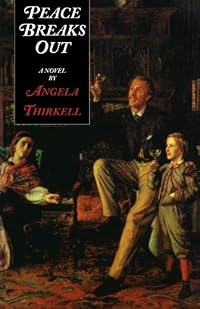
'You read her, laughing, and want to do your best to protect her characters from any reality but their own' New York Times When peace breaks out, it surprises and unsettles familiar wartime routines, and the residents of Barsetshire seem as disconcerted as they are overjoyed. Nevertheless, as the county's eligible young men return home, the social round regains its old momentum. Before long, everyone is spinning in a flurry of misunderstandings and engagements. The older generation, though, show more sees that the world will never be the same again. show lessTags
Recommendations

























Member Recommendations


Member Reviews
Thirkell's 1946 book, Peace breaks out, opens, as we might have guessed, in April 1945, a few days before VE Day, and its action continues through the 1945 general election, ending just after VJ Day in August. Thirkell's characters aren't exactly exultant about the end of the war - for many of them it messes up their plans for continuing with interesting war-work and getting their next promotion through; others seem to know very well that it won't mean an end to rationing and other government interference:
On the following Tuesday a day of national rejoicing burst by very slow degrees and barely recognised as such upon an exhausted, cross and uninterested world. Not much notice was taken in the country as everyone was busy, few young show more people were about and there was the usual dearth of beer.
Alternating with the narrator's gloom and doom about the state of England (for which she blames all foreigners, irrespective of which side they were on in the war, in pages and pages of xenophobic rant) we get an unexpectedly sunny romance plot full of set-pieces like tennis-parties, bring-and-buy sales, school sports and clerical infighting in the Close. It looks as though the charming David's days as a bachelor may be numbered, but we're left guessing until the end who will be the unlucky woman. It feels like an oddly unbalanced book, in which the plot really doesn't work together with the historical context at all, but there are still a lot of gems of detailed observation in between times to make it worth reading. show less
On the following Tuesday a day of national rejoicing burst by very slow degrees and barely recognised as such upon an exhausted, cross and uninterested world. Not much notice was taken in the country as everyone was busy, few young show more people were about and there was the usual dearth of beer.
Alternating with the narrator's gloom and doom about the state of England (for which she blames all foreigners, irrespective of which side they were on in the war, in pages and pages of xenophobic rant) we get an unexpectedly sunny romance plot full of set-pieces like tennis-parties, bring-and-buy sales, school sports and clerical infighting in the Close. It looks as though the charming David's days as a bachelor may be numbered, but we're left guessing until the end who will be the unlucky woman. It feels like an oddly unbalanced book, in which the plot really doesn't work together with the historical context at all, but there are still a lot of gems of detailed observation in between times to make it worth reading. show less
It’s 1945, and the end of the war is nigh. The people of Barsetshire have been struggling with air raid drills, evacuations, food rationing, and “the war effort” for so long, they can hardly envision how to function in a post-war world. Any day now, peace will be announced and cause all kinds of headaches. The trains might not be running, and shops will be closed, making it difficult to prepare the day’s meals. Well, that’s Angela Thirkell’s satirical take on it anyway. But even as VJ Day approaches, there are still church services every Sunday, a Bring and Buy Sale being planned, and a large cast of characters going about their daily lives pretty much as usual.
This novel, the fifteenth in the series, brings together show more several families and characters we’ve met before. Everyone is getting older, which puts them in new situations. Characters who were once children are now adults and getting into romantic entanglements, and as in many of the Barsetshire novels as they visit for Sunday lunch, a game of tennis, or a walk in the countryside, it’s just a question of who ends up with whom. If I have one criticism of this book, it’s that the cast of characters was so large, it was a while before I could keep everyone straight, and I had to consult secondary sources to refresh my memory on the family relationships. But other than that, it was an enjoyable way to pass the time. show less
This novel, the fifteenth in the series, brings together show more several families and characters we’ve met before. Everyone is getting older, which puts them in new situations. Characters who were once children are now adults and getting into romantic entanglements, and as in many of the Barsetshire novels as they visit for Sunday lunch, a game of tennis, or a walk in the countryside, it’s just a question of who ends up with whom. If I have one criticism of this book, it’s that the cast of characters was so large, it was a while before I could keep everyone straight, and I had to consult secondary sources to refresh my memory on the family relationships. But other than that, it was an enjoyable way to pass the time. show less
Angela Thirkell wrote novels set in Anthony Trollope’s fictional Barsetshire, but set ~100 years on, i.e. in her own time, and populated with descendants of Trollope’s characters. The obvious question is “why?”.
It is set just as WW2 is about to end. After six years of war, people are anxious about the upheaval and uncertainty peace will bring, exacerbated by their awareness that social norms are already beginning to change, so that they are no longer quite confident as to how to behave or address each other – interesting concepts that are repeated, but never really explored. It may capture the period and a particular set of people very well, but it is a very tedious read.
The book (I hesitate to say “story”) revolves around show more 19 year old Anne Fielding, who is being introduced to society, and finds it a little confusing as to who is related to whom – as did I.
The characters are like adult versions of those in Enid Blyton’s Famous Five, but without the adventure. There is some witty and even quite bitchy banter, but overall NOTHING happens, and in a dull way. It is disjointed, plodding and stilted (“quite the nicest mother one could have” – eugh). There are large chunks where people discuss, at length, who will travel in which car, what the train schedule is or exactly who will play tennis with whom. The minor aristocrats and upper middle class characters also have an odd obsession with viewing each other’s homes, especially the servants’ quarters and their private rooms.
Thirkell also follows Trollope’s annoying habit of giving peripheral characters utterly ludicrous names: e.g. Mr Manhole; Mr Cornstalk who lives in Barley Street; Lord Tadpole, and a village called Little Misfit.
There were a few good snippets buried in the tedium: “the country man’s eternal job of looking at other people working”; Miss S “refused to visit the dentist owing to some religious confusion about graven images”; someone who “takes a perverse pleasure in refusing comfort”; a conversation that was “highly profitable” because it was “was based on complete ignorance or fine crusted prejudice”; “Mrs B was more or less acquainted with everyone in a vague county way” and the importance of being an “old” family, but being in the village since Waterloo was relatively recent.
However, there are also some glaring irritations: “People weren’t usually like what you thought they were like” (commentary, not direct speech of a character); Rose saying “meagre” half a dozen times in a couple of pages, but never thereafter; some missing commas; randomly mentioning irrelevant characters just because they have a Trollopian surname, and “it’s me and George”.
I think this book will only appeal to those who can personally identify with it (my mother loves Thirkell, and I now understand why), or perhaps to historians wanting a slightly different angle on the period via a contemporary fiction. show less
It is set just as WW2 is about to end. After six years of war, people are anxious about the upheaval and uncertainty peace will bring, exacerbated by their awareness that social norms are already beginning to change, so that they are no longer quite confident as to how to behave or address each other – interesting concepts that are repeated, but never really explored. It may capture the period and a particular set of people very well, but it is a very tedious read.
The book (I hesitate to say “story”) revolves around show more 19 year old Anne Fielding, who is being introduced to society, and finds it a little confusing as to who is related to whom – as did I.
The characters are like adult versions of those in Enid Blyton’s Famous Five, but without the adventure. There is some witty and even quite bitchy banter, but overall NOTHING happens, and in a dull way. It is disjointed, plodding and stilted (“quite the nicest mother one could have” – eugh). There are large chunks where people discuss, at length, who will travel in which car, what the train schedule is or exactly who will play tennis with whom. The minor aristocrats and upper middle class characters also have an odd obsession with viewing each other’s homes, especially the servants’ quarters and their private rooms.
Thirkell also follows Trollope’s annoying habit of giving peripheral characters utterly ludicrous names: e.g. Mr Manhole; Mr Cornstalk who lives in Barley Street; Lord Tadpole, and a village called Little Misfit.
There were a few good snippets buried in the tedium: “the country man’s eternal job of looking at other people working”; Miss S “refused to visit the dentist owing to some religious confusion about graven images”; someone who “takes a perverse pleasure in refusing comfort”; a conversation that was “highly profitable” because it was “was based on complete ignorance or fine crusted prejudice”; “Mrs B was more or less acquainted with everyone in a vague county way” and the importance of being an “old” family, but being in the village since Waterloo was relatively recent.
However, there are also some glaring irritations: “People weren’t usually like what you thought they were like” (commentary, not direct speech of a character); Rose saying “meagre” half a dozen times in a couple of pages, but never thereafter; some missing commas; randomly mentioning irrelevant characters just because they have a Trollopian surname, and “it’s me and George”.
I think this book will only appeal to those who can personally identify with it (my mother loves Thirkell, and I now understand why), or perhaps to historians wanting a slightly different angle on the period via a contemporary fiction. show less
Goes along very well with the previous book in the series, Miss Bunting. Anne Fielding, her friend Robin Dale the schoolmaster, and a few new people, like siblings George and Sylvia Halliday, along with the whole Leslie family introduced in Wild Strawberries, are all finding themselves a bit out of sorts as the end of the war draws near. After 6 years of deprivation and stress, they can hardly believe that Peace will not be as disturbing as War. But aside from all that (culminating in a little rant by the author at the end of the book wherein one sentence lasts for more than a page), the concerns are much the same as usual. Who should marry whom? What is proper and polite? What would Miss Bunting have said?
David Leslie is back and up to show more his old tricks of flirtation, but starting to age so that everyone feels it's time he settled down. But who could ever keep him in order? show less
David Leslie is back and up to show more his old tricks of flirtation, but starting to age so that everyone feels it's time he settled down. But who could ever keep him in order? show less
I didn't think it was one of her better books. It took too long for me to get into it, and I gave up after about 50 pages.
3½ stars.
Ratings
Members
- Recently Added By
Lists

Favourite Virago Modern Classics
183 works; 38 members
Author Information

47+ Works 8,489 Members
Awards and Honors
Distinctions
Series

Belongs to Publisher Series
Virago Modern Classics (694)
Common Knowledge
- Canonical title
- Peace Breaks Out
- Original publication date
- 1946
- People/Characters
- Robin Dale; Anne Fielding
- First words
- About halfway between Little Misfit and High Rising the pleasant village of Hatch End, close under the steep downland, straggles along one side of the river Rising, separated from it by the road and the water-meadows.
- Quotations
- David, suddenly a prey to one of the waves of affectionate boredom that ... all his friends were apt to induce in him ... realised that he had no particular wish to go anywhere or see anybody.
Mr Scatcherd [an artist] took a large key from the pocket of his Norfolk jacket, blew into it, saying briefly "India-rubber; it's a wonder how many crumbs it makes", and unlocked the door.
Pictures appeared to be associated in most people's minds with a vast canvas of a ham, a lobster, a brace of teal, a flask of wine, a cheese with lifelike grubs on it, fresh strawberries with a giant ladybird, and a dead stag... (show all) thrown carelessly across the lot, while the thought of a small French masterpiece of two oeufs sur le plat produced a reverent hush.
He saw in his mind's eye the heads of the three young children in pen and ink on a postcard, reproduced by the thousand and sold all over the country under the title "Angel Faces", which he somehow felt he had seen somewhere.
George and David discovered that they had both been at the same aerodrome in 1942. "Our lot were at the sham aerodrome," said George. "The idea was that the German would bomb the fake one and kill us, while you chaps went on ... (show all)having hot baths and double rations of everything. Lord! How we hated you."
Mrs. Morland undid the parcel, put the books on a table where second-hand novels were being sold and pulling out a fountain pen signed them all. - Last words
- (Click to show. Warning: May contain spoilers.)But they were young and would not be unhappy for long.
Classifications
Statistics
- Members
- 223
- Popularity
- 145,681
- Reviews
- 6
- Rating
- (3.71)
- Languages
- English
- Media
- Paper, Ebook
- ISBNs
- 8
- ASINs
- 6