A Journey Round My Skull
by Frigyes Karinthy
On This Page
Description
The distinguished Hungarian author Frigyes Karinthy was sitting in a Budapest café, wondering whether to write a long-planned monograph on modern man or a new play, when he was disturbed by the roaring--so loud as to drown out all other noises--of a passing train. Soon it was gone, only to be succeeded by another. And another. Strange, Karinthy thought, it had been years since Budapest had streetcars. Only then did he realize he was suffering from an auditory hallucination of extraordinary show more intensity. What in fact Karinthy was suffering from was a brain tumor, not cancerous but hardly benign, though it was only much later--after spells of giddiness, fainting fits, friends remarking that his handwriting had altered, and books going blank before his eyes--that he consulted a doctor and embarked on a series of examinations that would lead to brain surgery. Karinthy's description of his descent into illness and his observations of his symptoms, thoughts, and feelings, as well as of his friends' and doctors' varied responses to his predicament, are exact and engrossing and entirely free of self-pity. A Journey Round My Skull is not only an extraordinary piece of medical testimony, but a powerful work of literature--one that dances brilliantly on the edge of extinction. show lessTags
Recommendations
















































Member Recommendations


Member Reviews
Some of the last melancholy pages of Simon Winder’s Danubia read as a lament for the dissolution of Hungarian intellectual life in the conflagration that consumed the Habsburg Dynasty, and before I read Karinthy’s story I imagined it in that milieu. Taken on its own terms, though, A Journey Around My Skull is a report of one man's disorientation and resignation and resilience, with moments of poetic self-awareness and wry humor and poignant insight and absurd silliness.
In 1930s Hungary, all eras and ages exist at the same time. After alerting his friends to his strange symptoms, Karinthy imagines them in the corner of a café, like a scrum of gyulas, the ancient Magyar counselors who met before a decisive battle to consult auguries show more and omens and advise the chieftain on the prudent course of action. A beggar with a hurdy gurdy passes by the window; a mechanic at the armaments factory devises a new surgical blade mounted on a swivel. Another friend reminds Karinthy that 20 years before he had written a play about an engineer who invents an aeroplane to fly without a pilot. Before the test flight, as he is wrestling with his fear, he is visited by his alter ego, a doctor from the north who proposes to remove by a delicate operation the part of the brain responsible for the fear of death, located at the back of the skull in the cerebellum. Laid up in his sick room later, Karinthy comforts himself by recalling how Silvio Pellico, jailed for 10 years by the Holy Roman Emperor Francis II, stoically resigned himself to his fate. After losing his sight, Silvio decides that he can endure a life of blindness, since he is old enough to have drawn from the world of light all he needs to sustain himself in darkness. Besides, he could finally work in peace without being disturbed.
A short interlude in the middle of the book relates a series of dreams Karinthy has while waiting for treatment: high up in a swaying skyscraper in New York City (a place he has never been) he sits across the table from someone he knows is Al Capone, who Karinthy suspects of having stolen it and hidden it in a wooden box—but it is unclear whether the two of them are pretending to ignore a tumor or the Lindbergh baby; a banquet of tasteless, chewy meat is held in his honor in Ankara; in the Alhambra, hunched over, he studies an anatomical atlas with a glass-like illustration of the human circulatory system that seems to throb and wobble the table.
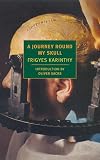
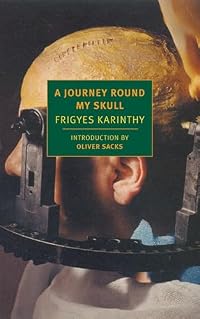
The cover of the NYRB edition of A Journey Around My Skull by Alice Attie shows a moon-scape head sutured with wire and clamped with threaded knobs to a hatch-marked contraption suggestive of railroad tracks. The cranial-machine vibe carries through the passage describing Karinthy’s surgery at the hands of a renowned surgeon in Stockholm (the whir of electric trephine, ‘the silent rush of liquid over a glass slab,’ ‘the sound of pumping and draining’) like a steampunk version of Ted Chiang’s “Exhalation,” or a scene from Terry Gilliam's "Brazil." show less
In 1930s Hungary, all eras and ages exist at the same time. After alerting his friends to his strange symptoms, Karinthy imagines them in the corner of a café, like a scrum of gyulas, the ancient Magyar counselors who met before a decisive battle to consult auguries show more and omens and advise the chieftain on the prudent course of action. A beggar with a hurdy gurdy passes by the window; a mechanic at the armaments factory devises a new surgical blade mounted on a swivel. Another friend reminds Karinthy that 20 years before he had written a play about an engineer who invents an aeroplane to fly without a pilot. Before the test flight, as he is wrestling with his fear, he is visited by his alter ego, a doctor from the north who proposes to remove by a delicate operation the part of the brain responsible for the fear of death, located at the back of the skull in the cerebellum. Laid up in his sick room later, Karinthy comforts himself by recalling how Silvio Pellico, jailed for 10 years by the Holy Roman Emperor Francis II, stoically resigned himself to his fate. After losing his sight, Silvio decides that he can endure a life of blindness, since he is old enough to have drawn from the world of light all he needs to sustain himself in darkness. Besides, he could finally work in peace without being disturbed.
A short interlude in the middle of the book relates a series of dreams Karinthy has while waiting for treatment: high up in a swaying skyscraper in New York City (a place he has never been) he sits across the table from someone he knows is Al Capone, who Karinthy suspects of having stolen it and hidden it in a wooden box—but it is unclear whether the two of them are pretending to ignore a tumor or the Lindbergh baby; a banquet of tasteless, chewy meat is held in his honor in Ankara; in the Alhambra, hunched over, he studies an anatomical atlas with a glass-like illustration of the human circulatory system that seems to throb and wobble the table.
The cover of the NYRB edition of A Journey Around My Skull by Alice Attie shows a moon-scape head sutured with wire and clamped with threaded knobs to a hatch-marked contraption suggestive of railroad tracks. The cranial-machine vibe carries through the passage describing Karinthy’s surgery at the hands of a renowned surgeon in Stockholm (the whir of electric trephine, ‘the silent rush of liquid over a glass slab,’ ‘the sound of pumping and draining’) like a steampunk version of Ted Chiang’s “Exhalation,” or a scene from Terry Gilliam's "Brazil." show less
In this book, Karinthy, a Hungarian writer, describes his diagnosis of and surgery to remove a brain tumor. Strangely enough, given the subject matter, it is a delightful read. Karinthy's sparkling personality and self-deprecating humor never desert him. He is a talented writer with an original way of saying things, and he never bores.
Poking a little fun at the world-reknowned surgeon who will operate on him he says, tongue in cheek: 'I found it a little humiliating that he was not interested in my own views about my condition. He probably regarded me as a layman who had no opinions on such matters, or perhaps, having heard that I was some kind of poet, he was on his guard against the vagaries of an overheated imagination.'
In fact, show more Karinthy tries to keep his imagination in check: 'When I put my questions, I used medical terms....I did not ask her what the cowering, terrified Being that lurked somewhere behind my tumour was so plaintively asking below the threshold of consciousness. I did not ask whether the patient screamed like a wild beast and struggled to escape when they split her skull open, whether her blood and brains came pouring out of the wound or whether at last the victim fainted on the torture rack, gasping for breath, with mouth open and staring eyes. Instead, I questioned her about the operation as if it had been some delicate experiment in physics or a job of repairs by a watchmaker.'
(This is about as gorey as the book gets, BTW).
As a writer, he came to realize that, 'for the first time in my life, I was to observe not for the sake of recording that personal vision which the artist calls 'truth'...but for the sake of reality, which remains reality even if we have no means of communicating its message. Never had I been so far from a lyrical state of mind as in this, the most subjective phase of my life. show less
Poking a little fun at the world-reknowned surgeon who will operate on him he says, tongue in cheek: 'I found it a little humiliating that he was not interested in my own views about my condition. He probably regarded me as a layman who had no opinions on such matters, or perhaps, having heard that I was some kind of poet, he was on his guard against the vagaries of an overheated imagination.'
In fact, show more Karinthy tries to keep his imagination in check: 'When I put my questions, I used medical terms....I did not ask her what the cowering, terrified Being that lurked somewhere behind my tumour was so plaintively asking below the threshold of consciousness. I did not ask whether the patient screamed like a wild beast and struggled to escape when they split her skull open, whether her blood and brains came pouring out of the wound or whether at last the victim fainted on the torture rack, gasping for breath, with mouth open and staring eyes. Instead, I questioned her about the operation as if it had been some delicate experiment in physics or a job of repairs by a watchmaker.'
(This is about as gorey as the book gets, BTW).
As a writer, he came to realize that, 'for the first time in my life, I was to observe not for the sake of recording that personal vision which the artist calls 'truth'...but for the sake of reality, which remains reality even if we have no means of communicating its message. Never had I been so far from a lyrical state of mind as in this, the most subjective phase of my life. show less
"– Volna egy ritka, szépen fejlett daganatom tanár úr részére, ha érdekli… gyűjtőknek való példány. Olcsón megszámítanám."
Régóta készültem, hogy elolvasom, aztán mindig csak sokadik maradt a listán. Felnőtt olvasmányaim egyik legelgondolkodtatóbbja...
Egy zseni balszerencséjének eredménye: az olvasóknak zseniális olvasmány. A kint és a bent témája - az anyag és az elme, a lélek harca, leírása. Önismeret és a személyiség feltárása a halál árnyékában. Hitetetlen bátorság kellett hozzá, hogy megírja és kiadja - és egyúttal ez volt az egyetlen módszere a túlélésre. A mindent felülmúló humor, a jókedv, az önmagunk kigúnyolása, a lelkierő, amibe kapaszkodhatunk - akár a show more legszürkébb hétköznapon vagy a legnagyobb életküzdelmek viharában...
"Az emberek rosszul mérik az időt – egyetlen mérték van, az átélés sebessége (…)"
És nem mindegy, hogy hány átélés, hányféle élmény fér bele - a milyenségén talán még mi is alakíthatunk... show less
Régóta készültem, hogy elolvasom, aztán mindig csak sokadik maradt a listán. Felnőtt olvasmányaim egyik legelgondolkodtatóbbja...
Egy zseni balszerencséjének eredménye: az olvasóknak zseniális olvasmány. A kint és a bent témája - az anyag és az elme, a lélek harca, leírása. Önismeret és a személyiség feltárása a halál árnyékában. Hitetetlen bátorság kellett hozzá, hogy megírja és kiadja - és egyúttal ez volt az egyetlen módszere a túlélésre. A mindent felülmúló humor, a jókedv, az önmagunk kigúnyolása, a lelkierő, amibe kapaszkodhatunk - akár a show more legszürkébb hétköznapon vagy a legnagyobb életküzdelmek viharában...
"Az emberek rosszul mérik az időt – egyetlen mérték van, az átélés sebessége (…)"
És nem mindegy, hogy hány átélés, hányféle élmény fér bele - a milyenségén talán még mi is alakíthatunk... show less
Who did the photo editing for this particular New York Review Book? My God, it's dreadful, and by far the most off-putting aspect of the book. The book itself is a fascinating autobiographical account by a well-known member of Hungary's pre-WW II literati who discovers that he has a brain tumor. The text itself is an interesting blend of travel writing, medical memoir, cultural observation, and philosophical inquiry. Karinthy is interested in the effect of his tumor on everything, not just himself. There's an interesting passage on the reporting of his surgery in the Budapest newspapers, and the effect it has on a number of his friends and coworkers. He was a popular figure at the time in Hungary (1936) because of both his books and show more journalism. In fact, because so many physicians were in his circle, he was actually impeded from getting a speedy diagnosis. Karinthy self-diagnosed rather early on. His medical friends, including his wife, when he told them of his conclusions were always 'Oh, come off it!' Today we have MRIs and CT scans. Diagnosis is fairly easy, if not simple. For Karinthy in his day there were no such technologies. The diagnosis was made by inference and it took a long time. The neurologist Oliver Sacks provides the introduction here. For him, a clinician who writes highly readable popular books about the brain, Karinthy's penchant for "long digressions, philosophical and literary" and "a certain amount of fanciful contrivance and extravagance" are faults. My view is otherwise. I see these flights as providing fascinating insight into the mental and emotional status of the writer. I adore Sacks' own books and have read them avidly, but here is a more literary alternative to his staunchly clinical narratives that I find both compelling and page-turning. Especially enjoyable are the glimpses of cafe society before WW II in Budapest, Hungary; the walks Karinthy takes through its streets. Karinthy survived his surgery and lived another two years before dying in 1938 of a stroke. He did not live to see the Anschluss or the German entry into the Sudetenland. He was never to know how the Nazi threat would unfold and all but destroy the continent. Naturally, he was seriously preoccupied; nevertheless, I find his obliviousness to the growing threat of fascism fascinating and it has made me wonder if it wasn't perhaps indicative of a broader mindset. The Spanish Civil War is never mentioned. There is no criticism of the Nazis here, just a sense of eerie foreboding when he finds himself passing through Germany on his way to Stockholm for the surgery (performed by the pioneering Olivecrona). Highly recommended though not for the squeamish or faint of heart. show less
In recognition of its thoroughness and accuracy, book store franchises shelve this memoir in the medical section, though it reads like literature. Frigyes Karinthy was a well known and much respected writer and humorist in Budapest in the 1930s when he began to suffer from intensifying auditory hallucinations. These disturbances initiate his progression through the medical establishments of Budapest, Vienna and Stockholm. In parallel, his symptoms accumulate, prompt various misdiagnoses (such as nicotine poisoning), assorted treatments of dubious value (topical applications of a mercury compound) and the gradual realization, on the part of all people concerned, that he has a tumor growing on his brain that will first blind and then kill show more him within the year if it is not removed.
Because of his prominence as a writer, rumor of his ill health travels widely and fast, which gives Karinthy the opportunity to be both self-reflective and socially observant. People from all walks of Hungarian life absorb the news of his affliction in different ways and Karinthy is careful to note how their behavior changes and how it makes him feel—not in a morose or self-pitying fashion; but matter-of-factly and with wit. There is space for his fear and suffering in the book; but the following excepts typify how he chooses to present it: “It got on my nerves, too, that I kept walking with my feet turned in and that, as my sight was bad, I could not see to correct my step and was constantly going into the gutter or knocking against the wall. And that I kept lurking shamefacedly in a corner or hiding for hours in a cold lavatory.” And “When I put my questions I used medical terms, culled from my reading. I did not ask her what the cowering, terrified Being that lurked somewhere behind my tumor was so plaintively asking me below the threshold of consciousness.”
Since Karinthy writes this account for serialized publication after his recovery, each of the chapters has a brisk, cohesive thrust and each of them benefits from the equilibrium and joy of someone on the far side of misfortune. Karinthy is also playful and experimental in the composition of his chapters, engaging with dreams and hallucinations and toying with time and simultaneous occurrences. The book never slows and is a fascinating time capsule, wonderfully stuffed by a winning and clever man. show less
Because of his prominence as a writer, rumor of his ill health travels widely and fast, which gives Karinthy the opportunity to be both self-reflective and socially observant. People from all walks of Hungarian life absorb the news of his affliction in different ways and Karinthy is careful to note how their behavior changes and how it makes him feel—not in a morose or self-pitying fashion; but matter-of-factly and with wit. There is space for his fear and suffering in the book; but the following excepts typify how he chooses to present it: “It got on my nerves, too, that I kept walking with my feet turned in and that, as my sight was bad, I could not see to correct my step and was constantly going into the gutter or knocking against the wall. And that I kept lurking shamefacedly in a corner or hiding for hours in a cold lavatory.” And “When I put my questions I used medical terms, culled from my reading. I did not ask her what the cowering, terrified Being that lurked somewhere behind my tumor was so plaintively asking me below the threshold of consciousness.”
Since Karinthy writes this account for serialized publication after his recovery, each of the chapters has a brisk, cohesive thrust and each of them benefits from the equilibrium and joy of someone on the far side of misfortune. Karinthy is also playful and experimental in the composition of his chapters, engaging with dreams and hallucinations and toying with time and simultaneous occurrences. The book never slows and is a fascinating time capsule, wonderfully stuffed by a winning and clever man. show less
Frigyes Karinthy (1887-1938) was an influential Hungarian novelist, playwright, poet and journalist. A Journey Round My Skull is a literary account of the development and successful removal of his brain tumor, which occurred near the end of his life. His symptoms begin insidiously, with auditory hallucinations, followed by headaches and vomiting of increasing severity, and loss of visual acuity. Despite these symptoms, which are suggestive of a brain tumor or another process that would cause increased intracranial pressure, the doctors in Budapest ignore his symptoms and fail to reach an accurate diagnosis. He eventually travels to Vienna, where clinicians there eventually reach the correct diagnosis. He undergoes surgery in Stockholm show more by a brilliant young neurosurgeon who prefers to operate on Europeans while they are awake, to minimize postoperative morbidity. Karinthy's description of the surgery is unforgettable, as he is conscious for all but the last portion of the procedure.
I was in awe of the clinicians who were able to accurately diagnose his tumor without the benefit of advanced radiographic tools such as CT or MRI scans, but I was also horrified by the time it took to reach an accurate diagnosis and to remove the tumor, and the ineptitude and brusqueness of most of the clinicians Karinthy encountered - including his own wife, who was a renowned psychiatrist. Also of interest is the varied reactions of his friends and colleagues to his illness, especially when the seriousness of his condition became apparent.
There are a number of digressions throughout the book, which were a bit distracting and seemed to contribute little, if anything, to this amazing story. Nonetheless, it was a very enjoyable read. show less
I was in awe of the clinicians who were able to accurately diagnose his tumor without the benefit of advanced radiographic tools such as CT or MRI scans, but I was also horrified by the time it took to reach an accurate diagnosis and to remove the tumor, and the ineptitude and brusqueness of most of the clinicians Karinthy encountered - including his own wife, who was a renowned psychiatrist. Also of interest is the varied reactions of his friends and colleagues to his illness, especially when the seriousness of his condition became apparent.
There are a number of digressions throughout the book, which were a bit distracting and seemed to contribute little, if anything, to this amazing story. Nonetheless, it was a very enjoyable read. show less
É estranho ler as memórias de um homem contando como um tumor cerebral afetou sua vida – especialmente quando sabemos que esse tumor acabou por matá-lo. Mais estranho é que isso é não só interessante, mas divertido, graças à escrita de Karinthy.
Members
- Recently Added By
Lists

Llibres que he llegit el 2023
38 works; 1 member
Author Information

All Editions
Some Editions
Awards and Honors
Notable Lists
Hungarian Big Read (77)
Series
Belongs to Publisher Series
Work Relationships
Is contained in
Common Knowledge
- Canonical title
- A Journey Round My Skull
- Original title
- Utazás a koponyám körül
- Original publication date
- 1937
- Original language
- Hungarian
Classifications
- Genres
- Biography & Memoir, Nonfiction
- DDC/MDS
- 362.196994810092 — Society, Government, and Culture Social problems and social services Social Welfare People with physical illnesses Services to people with specific conditions Diseases Other diseases
- LCC
- RC280 .B7 .K37 — Medicine Internal medicine Internal medicine Neoplasms. Tumors. Oncology
- BISAC
Statistics
- Members
- 357
- Popularity
- 87,916
- Reviews
- 13
- Rating
- (3.90)
- Languages
- 8 — Dutch, English, French, German, Hungarian, Italian, Spanish, Swedish
- Media
- Paper, Ebook
- ISBNs
- 25
- ASINs
- 3