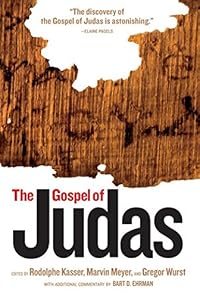
The Gospel of Judas
by Judas Gospel Author, Rodolphe Kasser (Editor), Marvin W. Meyer (Editor), Gregor Wurst (Editor)
On This Page
Description
When the bound papyrus pages of this lost gospel finally reached scholars who could unlock its meaning, they were astounded. Here was a gospel that had not been seen since the early days of Christianity, and which few experts had even thought existed--a gospel told from the perspective of Judas Iscariot, history's ultimate traitor. And far from being a villain, the Judas that emerges in its pages is a hero. In this radical reinterpretation, Jesus asks Judas to betray him. In contrast to the show more New Testament Gospels, Judas Iscariot is presented as a role model for all those who wish to be disciples of Jesus. He is the one apostle who truly understands Jesus. This volume is the first publication of the remarkable gospel since it was condemned as heresy by early Church leaders, most notably by St. Irenaeus, in 180.--From publisher description. show lessTags
Recommendations






Member Recommendations
Member Reviews
The Gospel of Judas by Rodolphe Kasser, Marvin Meyer, Gregor Wurst, Bart D. Ehrman feels like it was rushed to press. That isn't to say that it isn't good, but it feels like parts of it haven't been fully contemplated. When I was in college, we had to write an essay about metaphors and analogies etc. from Homer's Iliad. Almost every person in the class wrote about one particular quotation--namely, "A generation of men is like a generation of leaves; the wind scatters some leaves upon the ground, while others the burgeoning wood brings forth - and the season of spring comes on. So of men one generation springs forth and another ceases." Some of the essays were beautiful, but only one person considered the following question: "Are men show more really like leaves?" It seems obvious to do so, but only one person did. No one else had really questioned the validity of Homer's assertion.
This book's essays didn't really question "The Gospel of Judas." The writers assumed the Gospel is equally as valid as the ones that were included in the Bible as we know it. The essayists are so enthralled with its discovery and preservation, that it feels like they never reached the most interesting questions. That failing is most clear when one of the essayists writes that what is included and discarded from the Bible is arbitrary. Isn't it possible that there might be real reasons behind the exclusion or inclusion of one text over another, that there continues to be real religious dialogue about what should be included or excluded?
I agree that the gospel is a wonderful discovery, but where's the second part of the analysis. Is the Gospel of Judas equally as valid, as authenticated, as philosophically rich as those Gospel's included in our present day Bibles? What can we learn from it? I just don't think the essays push far enough. show less
This book's essays didn't really question "The Gospel of Judas." The writers assumed the Gospel is equally as valid as the ones that were included in the Bible as we know it. The essayists are so enthralled with its discovery and preservation, that it feels like they never reached the most interesting questions. That failing is most clear when one of the essayists writes that what is included and discarded from the Bible is arbitrary. Isn't it possible that there might be real reasons behind the exclusion or inclusion of one text over another, that there continues to be real religious dialogue about what should be included or excluded?
I agree that the gospel is a wonderful discovery, but where's the second part of the analysis. Is the Gospel of Judas equally as valid, as authenticated, as philosophically rich as those Gospel's included in our present day Bibles? What can we learn from it? I just don't think the essays push far enough. show less
This volume presents a full English translation of the surviving text of the Gospel of Judas from the Codex Tchacos, with evaluative and interpretive essays by several conspicuous modern scholars of Gnosticism, all of whom (except for Ehrman) were party to the edition presented. That word "surviving" is key, because, as Rodolphe Kasser details in his contribution, the Codex Tchacos was subjected to the most pernicious effects of antiquities speculators in the 20th century. Much of the text is now missing or illegible as a result of damage sustained in the last few decades.
Like the Nag Hammadi Codices, to which it is clearly kin, the Codex Tchacos appears to consist of Coptic translations of Greek texts. The Gospel of Judas is the third show more of these, and represents an expression of Sethian Gnosticism. Gregor Wurst, in his useful essay making the case for identifying this text with the "Gospel of Judas" mentioned by the ancient heresiologist Iranaeus of Lyon, suggests that it is one of the earliest such texts available to us today. In fact, I think he sets a false limit on how early it could be. He writes that it could not have been written earlier than the canonical Acts of the Apostles (ca. 93 C.E.), because it refers to the event of Judas' replacement among the twelve apostles. But surely this overlooks the possibility that Judas and Acts could share a narrative source -- or even (though I doubt it) both be grounded in prior facts! The earliness of the Gospel of Judas and its likely translation from a Greek original are reasons to hold out hope that a more complete version may someday be recovered.
Bart Ehrman's essay is a primer of wide scope regarding the contents of the Gospel of Judas, which presumes a minimum of prior knowledge on the part of the reader. (One conspicuous feature of the text that Ehrman fails to note is its strident rejection of ritual sacramentalism.) The concluding essay by Meyer is more sophisticated, and helpfully draws comparisons with other literature of ancient Gnosticism, as well as Hellenized Judaism and Middle Platonism. All of the essays are very accessible, and the whole book can be read in just a few sittings.
Even in its degraded present condition, the Gospel of Judas is treasure comparable to the most provocative of the Nag Hammadi texts, or to the Bruce Codex materials, preserving scripture that was valued by the Gnostics who were eventually suppressed by what became Christian orthodoxy. This book serves as a well-constructed introduction for popular audiences to the good news of the man who sacrificed Jesus. May they go and do likewise. show less
Like the Nag Hammadi Codices, to which it is clearly kin, the Codex Tchacos appears to consist of Coptic translations of Greek texts. The Gospel of Judas is the third show more of these, and represents an expression of Sethian Gnosticism. Gregor Wurst, in his useful essay making the case for identifying this text with the "Gospel of Judas" mentioned by the ancient heresiologist Iranaeus of Lyon, suggests that it is one of the earliest such texts available to us today. In fact, I think he sets a false limit on how early it could be. He writes that it could not have been written earlier than the canonical Acts of the Apostles (ca. 93 C.E.), because it refers to the event of Judas' replacement among the twelve apostles. But surely this overlooks the possibility that Judas and Acts could share a narrative source -- or even (though I doubt it) both be grounded in prior facts! The earliness of the Gospel of Judas and its likely translation from a Greek original are reasons to hold out hope that a more complete version may someday be recovered.
Bart Ehrman's essay is a primer of wide scope regarding the contents of the Gospel of Judas, which presumes a minimum of prior knowledge on the part of the reader. (One conspicuous feature of the text that Ehrman fails to note is its strident rejection of ritual sacramentalism.) The concluding essay by Meyer is more sophisticated, and helpfully draws comparisons with other literature of ancient Gnosticism, as well as Hellenized Judaism and Middle Platonism. All of the essays are very accessible, and the whole book can be read in just a few sittings.
Even in its degraded present condition, the Gospel of Judas is treasure comparable to the most provocative of the Nag Hammadi texts, or to the Bruce Codex materials, preserving scripture that was valued by the Gnostics who were eventually suppressed by what became Christian orthodoxy. This book serves as a well-constructed introduction for popular audiences to the good news of the man who sacrificed Jesus. May they go and do likewise. show less
Let's get this straight. I finished the text, not the entire book. I'm sure the essays that followed The Gospel of Judasare interesting and provide historical insight to the lost text, it doesn't further my pursuit of reading as many religious texts as I promised - a stupid idea last year, but I bought all these books so I better damn read them.
It's hard to "review" a religious text - especially one that is considered a "lost book" of the Bible. Especially hard when said "lost book" also has several lines of text missing. We also know the ending - "Judas answered them as they wished. And he received some money and handed him over to them."
So what this book offers is an unique insight to the times before Judas' betrayal. It even offers show more a hint that Jesus already knew and warned Judas of said betrayal: "But you will exceed all of them. For you will sacrifice the man that clothes me./Already your horn has been raised,/your wrath has been kindled,/your star has shown brightly/and your heart has [...]."
It's a new look at Judas Iscariot, the betrayer, as well as, Jesus the messiah. It's also no wonder why this text will never make it into any canon. Interesting read and you should definitely pick it up. show less
It's hard to "review" a religious text - especially one that is considered a "lost book" of the Bible. Especially hard when said "lost book" also has several lines of text missing. We also know the ending - "Judas answered them as they wished. And he received some money and handed him over to them."
So what this book offers is an unique insight to the times before Judas' betrayal. It even offers show more a hint that Jesus already knew and warned Judas of said betrayal: "But you will exceed all of them. For you will sacrifice the man that clothes me./Already your horn has been raised,/your wrath has been kindled,/your star has shown brightly/and your heart has [...]."
It's a new look at Judas Iscariot, the betrayer, as well as, Jesus the messiah. It's also no wonder why this text will never make it into any canon. Interesting read and you should definitely pick it up. show less
The Gospel of Judas, by its very name, sounds dangerous and heretical. What could the arch-traitor of history teach us?
Well, there isn't too much. To be fair, the text was in horrible condition when it was finally in the hands of researchers, and it took an astonishing effort to put the thing back together. There are still many gaps in the text, and a lot is speculation. But what remains is tantalizing, and makes you want more.
The book, some 50 incomplete verses in 40 pages provide a brief portrait of Gnosticism. Here's how the story goes: Judas, the one of the twelve disciples, was ordered by Jesus to 'betray' and kill him. Christ tells him some of the secrets of Holy and Secret Wisdom, mainly that:
1) the creator of the earth is not show more good, and not all-powerful.
2) That all creation is imperfect and inherently leading to suffering
3) Through death we might be separated from the imperfect physical bodies and move to a more perfect spiritual existence
Sounds a lot like some Eastern philosophies rather than the Christianity we know. No wonder books like these were suppressed! Such teaching is anti-authority, and criticizes institutions and churches for perverting Christianity.
The essays are a very useful addition and should not be passed over.
An fascinating start, but more study is needed. show less
Well, there isn't too much. To be fair, the text was in horrible condition when it was finally in the hands of researchers, and it took an astonishing effort to put the thing back together. There are still many gaps in the text, and a lot is speculation. But what remains is tantalizing, and makes you want more.
The book, some 50 incomplete verses in 40 pages provide a brief portrait of Gnosticism. Here's how the story goes: Judas, the one of the twelve disciples, was ordered by Jesus to 'betray' and kill him. Christ tells him some of the secrets of Holy and Secret Wisdom, mainly that:
1) the creator of the earth is not show more good, and not all-powerful.
2) That all creation is imperfect and inherently leading to suffering
3) Through death we might be separated from the imperfect physical bodies and move to a more perfect spiritual existence
Sounds a lot like some Eastern philosophies rather than the Christianity we know. No wonder books like these were suppressed! Such teaching is anti-authority, and criticizes institutions and churches for perverting Christianity.
The essays are a very useful addition and should not be passed over.
An fascinating start, but more study is needed. show less
A collection of papers, including the translated gospel known as the Gospel of Judas. Following the translation, biblical scholars discuss what we learned from the gospel, and how it fits into the group of religious practices lumped together under the term 'gnostic'. These writers posit that The Gospel of Judas is a work of the Sethian gnostics, and explain the basics of this particular believe system. Judas here is seen as a heroic figure, one who released Jesus from his earthly prison to return to his home among the divine. The book is well written, with only a minimum of jargon, so it is accessible by lay readers who don't have a graduate degree in theology. The chapter that discusses the finding of the gospel, and the subsequent show more abuse it went through that rendered it much less readable, is an interesting look at the practice of antiquarians, but adds little to the theological discussion; still, in this context, it is interesting to see how they are attempting to preserve what is left of this ancient document, and where they believe it came from. Other papers discuss the theology of the gospel, and contrast it to the theological views that came to be termed orthodox. This gospel was not a totally unknown entity prior to its discovery, having been mentioned in the works of Irenaeus, but now the authors compare what Irenaeus said in his work Against Heresies and the actual document. At least one of the authors concludes that this document is likely the same document Irenaeus was speaking against; this has helped them put a second century date on the writing, though the papyrus itself dates from sometime around the fourth century. Overall, an interesting work, and a relatively easy read. show less
While I'm a bit disappointed with myself for having taken so long to finally get around to reading this, I am equally disappointed with the essays offered as commentary in this book. Reading the actual text of the "Gospel of Judas" in full was a very interesting experience. It is certainly filled with insights and potential insights into the relationship between Platonism and Christianity in the first several centuries of the latter, and, of course, of the nature of the syntheses of these two philosophies in the various gnostic sects. Unfortunately, I think that these insights have far too much potential to be overlooked or forgotten about in favor of the sensationalism and nonsense that has steadily become the standard among academics show more who focus on early Christianity. I was particularly disappointed by Bart Ehrman's essay here, in which he does a great job of covering some of the basic facts and yet ends with nonsensical, controversial conclusions with no relation to the facts stated. show less
" Tu les surpasseras tous. Car tu sacrifieras l'homme qui me sert d'enveloppe charnelle. " Ce sont là les paroles que Jésus adresse à Judas, dans un évangile inconnu, arraché aux sables égyptiens. Un évangile doublement caché, à la fois par dix-sept siècles d'oubli mais aussi par la condamnation officielle de l'Eglise. Ecrit en copte, ce codex, qui a miraculeusement traversé les âges, a dû être rédigé lors du IIe siècle de notre ère. Son message est bouleversant, qui voit en Judas l'homme choisi par le Christ pour accomplir Son destin. C'est là tout l'univers fascinant des croyances qui s'ouvre, réservées jusqu'alors aux initiés qui luttèrent contre l'Eglise lors de la création de la chrétienté. Le manuscrit show more original est ici intégralement livré au public, avec un double appareil critique complet qui offrira à chaque lecteur de cheminer à son gré dans les profondeurs de ce texte troublant. show less
Members
- Recently Added By
Lists

Books written in uncommon languages
97 works; 8 members
Author Information
1 Work 1,124 Members

All Editions
Awards and Honors
Distinctions
Common Knowledge
- Original publication date
- 2006
Classifications
- Genres
- Religion & Spirituality, Nonfiction, History, General Nonfiction
- DDC/MDS
- 229.8 — Religion The Bible Apocrypha, pseudepigrapha, intertestamental works Pseudo gospels
- LCC
- BS2460 .J8 .G67 — Philosophy, Psychology and Religion The Bible The Bible New Testament Works about the New Testament Men, women, and children of the New Testament
- BISAC
Statistics
- Members
- 1,124
- Popularity
- 22,378
- Reviews
- 19
- Rating
- (3.48)
- Languages
- 9 — Catalan, Dutch, English, French, German, Hungarian, Norwegian (Bokmål), Portuguese, Spanish
- Media
- Paper, Ebook
- ISBNs
- 22
- ASINs
- 8
