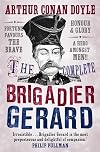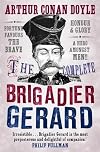
The Complete Brigadier Gerard
by Sir Arthur Conan Doyle
Brigadier Gerard (Collections and Selections — omnibus)
On This Page
Description
For the first time all of Conan Doyle's Brigadier Gerard stories appear in a single volume. This collection of historical short stories combines comedy, tragedy, pathos and irony.Tags
Recommendations







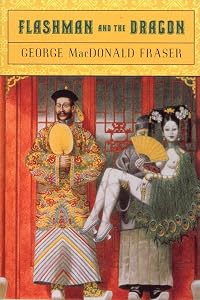



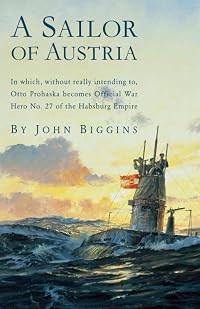

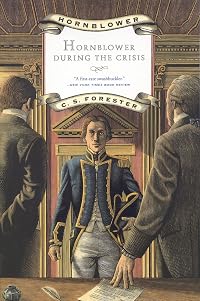
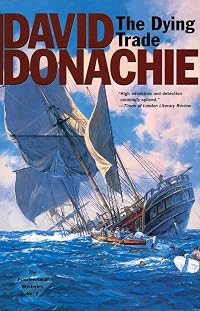

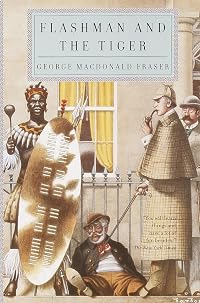

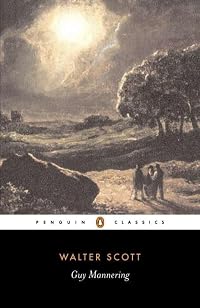
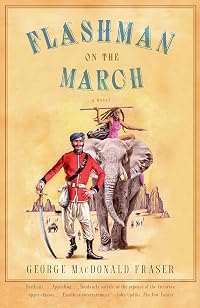

Member Recommendations
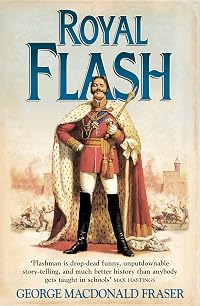
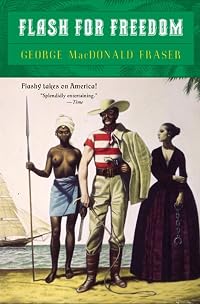
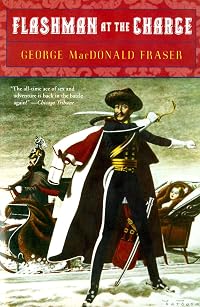
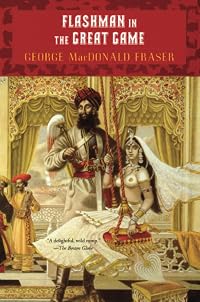
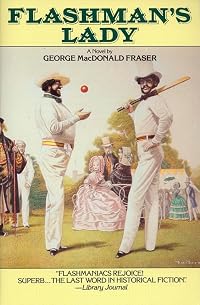
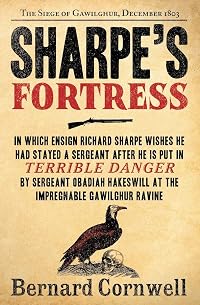
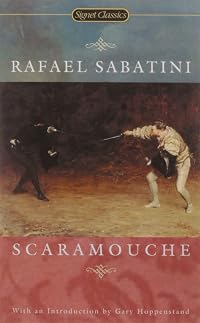
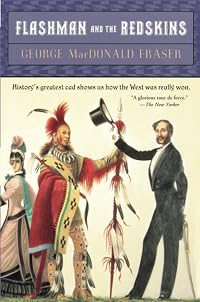
Lirmac Two flawed, swaggering narrators, Brigadier Gerard and Sir Harry Flashman are spiritual relatives who both enjoy fine horses, pretty girls and smart uniforms as much as honour and victory.
Member Reviews
I have read quite a lot of Doyle over the years and this is by far his most fun work. This book collects together all his Etienne Gerard short stories (plus one random story at the start about a differently named character but in the same style so I guess a sort of prototype of Gerard). The editor has added some historical context at the start of each story but I found this actually confused me far more than just reading the stories alone so I skipped them on a second read. The stories jump about in time and I found that this added to their charm.
The set-up is that you're sitting in a French café listening to an old man tell you tales of his youth as a mounted soldier in the Napoleonic wars. Gerard is an unreliable narrator on two show more fronts, one because you don't know how much he is exaggerating or making up in his stories (he's exceedingly vain), and two because he is an idiot and misconstrues certain situations which are clear to the audience, so you get this satirical humour at his expense. However personally I didn't enjoy these moments so much. It's hard to believe that Gerard is such an idiot when he shows so much cunning and quick thinking in dangerous or tricky situations. I think the idea is that he is gullible and too trusting, but it still didn't really gel with his clear intelligence shown in other situations. Sometimes the satire can almost be a little sour, as Gerard casually mentions the looting and 'womanising' that goes on during war as if it is perfectly acceptable, although he has the decency to not revel in death and generally goes out of his way not to kill people if possible. The stories certainly are funny, although they didn't make me laugh aloud, more just gently amused, but by far what I appreciate about them is how damn exciting they are. Although there is a little repetition of situation in a couple of the tales, mostly they are all surprisingly different and inventive and also incredibly thrilling as Gerard gets into some dangerous and seemingly impossible scrape and you excitedly read on to see how he will get out of this one.
I did skip one story because it is about fox hunting, although Gerard manages to mention how he killed the fox in practically every subsequent story, so I'm not sure how much I saved myself there. The joke seems to be that Gerard doesn't understand English 'sports' but thinks he does, but that joke will be somewhat lost on a modern audience. There is one particular story in which he is in England and there are several gags to this nature which I feel press the point a little too heavily and the joke gets tired. The first time I read these stories I was pretty furious that Doyle bothered to reintroduce the character of Bart only to kill him off, but since I was prepared a second time around, it didn't bother me that much. It also seemed clumsy that both Bart stories have villains who use the same scheme to trick the hero. Aside from that though, I really enjoyed these stories. show less
The set-up is that you're sitting in a French café listening to an old man tell you tales of his youth as a mounted soldier in the Napoleonic wars. Gerard is an unreliable narrator on two show more fronts, one because you don't know how much he is exaggerating or making up in his stories (he's exceedingly vain), and two because he is an idiot and misconstrues certain situations which are clear to the audience, so you get this satirical humour at his expense. However personally I didn't enjoy these moments so much. It's hard to believe that Gerard is such an idiot when he shows so much cunning and quick thinking in dangerous or tricky situations. I think the idea is that he is gullible and too trusting, but it still didn't really gel with his clear intelligence shown in other situations. Sometimes the satire can almost be a little sour, as Gerard casually mentions the looting and 'womanising' that goes on during war as if it is perfectly acceptable, although he has the decency to not revel in death and generally goes out of his way not to kill people if possible. The stories certainly are funny, although they didn't make me laugh aloud, more just gently amused, but by far what I appreciate about them is how damn exciting they are. Although there is a little repetition of situation in a couple of the tales, mostly they are all surprisingly different and inventive and also incredibly thrilling as Gerard gets into some dangerous and seemingly impossible scrape and you excitedly read on to see how he will get out of this one.
I did skip one story because it is about fox hunting, although Gerard manages to mention how he killed the fox in practically every subsequent story, so I'm not sure how much I saved myself there. The joke seems to be that Gerard doesn't understand English 'sports' but thinks he does, but that joke will be somewhat lost on a modern audience. There is one particular story in which he is in England and there are several gags to this nature which I feel press the point a little too heavily and the joke gets tired. The first time I read these stories I was pretty furious that Doyle bothered to reintroduce the character of Bart only to kill him off, but since I was prepared a second time around, it didn't bother me that much. It also seemed clumsy that both Bart stories have villains who use the same scheme to trick the hero. Aside from that though, I really enjoyed these stories. show less
Engaging, gripping, historically accurate and beautifully written, these stories deserve to be much more widely read. As a comic character, Brigadier Etienne Gerard is a flawed but thoroughly entertaining narrator worthy of his spiritual ancestor Sir Harry Paget Flashman; as a swashbuckler he is a worthy descendent of Charles de Batz-Castelmore d'Artagnan.
Humorous, interesting look at the French side of the Napoleonic Wars
Ratings
Members
- Recently Added By
Lists

Best Historical Fiction
620 works; 261 members

Short Story Collections and Anthologies
261 works; 42 members

Lesser known books of well known authors
39 works; 17 members

Favourite Books
1,819 works; 316 members

THE WAR ROOM
813 works; 24 members
Author Information

4,009+ Works 169,864 Members
The most famous fictional detective in the world is Arthur Conan Doyle's Sherlock Holmes. However, Doyle was, at best, ambivalent about his immensely successful literary creation and, at worst, resentful that his more "serious" fiction was relatively ignored. Born in Edinburgh, Doyle studied medicine from 1876 to 1881 and received his M.D. in show more 1885. He worked as a military physician in South Africa during the Boer War and was knighted in 1902 for his exceptional service. Doyle was drawn to writing at an early age. Although he attempted to enter private practice in Southsea, Portsmouth, in 1882, he soon turned to writing in his spare time; it eventually became his profession. As a Liberal Unionist, Doyle ran, unsuccessfully, for Parliament in 1903. During his later years, Doyle became an avowed spiritualist. Doyle sold his first story, "The Mystery of the Sasassa Valley," to Chambers' Journal in 1879. When Doyle published the novel, A Study in Scarlet in 1887, Sherlock Holmes was introduced to an avid public. Doyle is reputed to have used one of his medical professors, Dr. Joseph Bell, as a model for Holmes's character. Eventually, Doyle wrote three additional Holmes novels and five collections of Holmes short stories. A brilliant, though somewhat eccentric, detective, Holmes employs scientific methods of observation and deduction to solve the mysteries that he investigates. Although an "amateur" private detective, he is frequently called upon by Scotland Yard for assistance. Holmes's assistant, the faithful Dr. Watson, provides a striking contrast to Holmes's brilliant intellect and, in Doyle's day at least, serves as a character with whom the reader can readily identify. Having tired of Holmes's popularity, Doyle even tried to kill the great detective in "The Final Problem" but was forced by an outraged public to resurrect him in 1903. Although Holmes remained Doyle's most popular literary creation, Doyle wrote prolifically in other genres, including historical adventure, science fiction, and supernatural fiction. Despite Doyle's sometimes careless writing, he was a superb storyteller. His great skill as a popular author lay in his technique of involving readers in his highly entertaining adventures. (Bowker Author Biography) show less

Arthur Conan Doyle has a Legacy Library. Legacy libraries are the personal libraries of famous readers, entered by LibraryThing members from the Legacy Libraries group.
Some Editions
Series

Belongs to Publisher Series
Canongate Classics (57)
Work Relationships
Contains
Is abridged in
Was inspired by
Common Knowledge
- Canonical title
- The Complete Brigadier Gerard
- People/Characters
- Brigadier Etienne Gerard; Napoleon Bonaparte
- Important places
- France
- Important events
- Napoleonic Wars
Classifications
Statistics
- Members
- 216
- Popularity
- 151,214
- Reviews
- 3
- Rating
- (3.98)
- Languages
- English
- Media
- Paper, Audiobook, Ebook
- ISBNs
- 14
- ASINs
- 5