
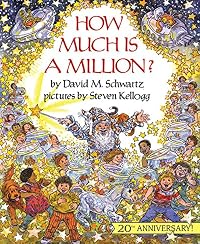
How Much Is a Million?
by David M. Schwartz (Author), Steven Kellogg (Illustrator)
Million by Schwartz
On This Page
Description
Text and pictures try to make possible the conceptualization of a million, a billion, and a trillion.Tags
Recommendations





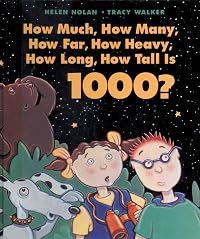
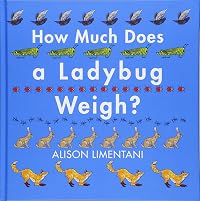

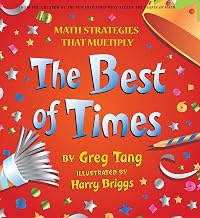

Member Reviews
How Much Is a Million? is a colourful picture book that seeks to make large numbers (million, billion, and trillion) more understandable to children. I first encountered this book as a child (I was the kind of hopelessly nerdy kid who was naturally good at and interested in math, so this book was perfect for me) and I still enjoy looking through it today. The author and illustrator use simple examples (how tall is a tower of kids standing on each other's shoulders, how big of a bowl is needed for goldfish, etc.) to demonstrate the size of the numbers. The illustrations are quirky and detailed and fun to look at (I especially love that the kids have a pet unicorn!). The author even includes a note at the end explaining the actual numbers show more and calculations in the book (possibly older children could enjoy reproducing these calculations or coming up with examples of their own). This is definitely a book I would recommend. show less
I think this book is a fantastic book! I truly believe it would grab many reader's attention, as it grabbed my attention as a young adult. It puts large numbers like a million and a billion into perspective. I enjoyed learning that counting to a million years would take about 23 days and counting to a billion would take about 95 years. I did not think about, until we discussed it in class, how David Schwartz, the author, came up with these measurements. I think that it is crucial to have the last page which explains how he did all his calculations. Although I did not think about it, I'm sure one of my students would ask, "How did he know that?" The only thing I did not particularly like was the ending. I turned the last page without show more even knowing it and was slightly surprised. Overall, I enjoyed this book, and I know my students/children would as well. show less
“How Much is a Million?” presents big numbers in a way that captivates young readers. David M. Swartz translates the numbers into terms and visuals that younger readers can comprehend. The book’s organization is well thought out and easy to follow, moving from a visual relating to one million, such as goldfish in a bowl, followed by the same visual but a billion and finally a trillion. One aspect that I love about this book is the author’s ability to couple nonfiction text with enchanting fictional illustrations in a way that doesn’t take away from the informational aspect of the text. The end of the book has an author’s note to explain how Swartz retrieved the information throughout the book, which establishes credibility. show more I am excited to present this book to my first graders during our place value unit! show less
Schwartz's humorous story helps children conceptualize how really, really big a million, a billion and a trillion are. The illustrations are very colorful and intricate, and have plenty of amusing characters and background details that children will enjoy discovering. The book shows children sitting down to count to a billion--and finishing 95 years later, as well as a billion children climbing on each other's shoulders and standing up past the moon. The text is the right size and the subject is explained well for the age range, and never gets too technical or obscure. It is a great introduction to numbers and uses examples children can imagine, like goldfish and tea cups and other children, to help them see how their sizes compare to show more bigger and bigger things. It even humorously asks at the end, "How much is a zillion?" show less
Children may struggle with the concpt of large numbers. They can be difficult to grap and visualize. With the struggle Schwartz has an entertaining book that sheds light on the topic of numbers. “How Much is a Million” makes big numbers understandable. When a Child hear million or billion, they do not really know how huge those number are. The way this book presents the concept is fun and playful. With fun pictures accompanying the simple sentences such a difficult topic becomes easy. By presenting the numbers in such a concrete hay children will develop a number sense which is crucial for future math concepts. Even as an adult now reading this book it still reminded me how big these numbers are and reading the small but shocking show more facts had me hooked to continue to finish the book. show less
This book aimed at elementary school kids tries to convey just how big a million, billion and a trillion are, by using several examples (height of x kids, a bowl for x goldfish, x number of stars). A very decent attempt, since such large numbers are so big, even to adults they are (almost) abstract.
What I personally loved, were the last pages, in which the author justifies his examples with actual mathematics.
What I personally loved, were the last pages, in which the author justifies his examples with actual mathematics.
I liked this book because it allows readers to explore number concepts in a very unique way. Often times we only address how much a hundred or a million looks like in math class, but presenting it in a story format is something not typically done. This allows for a cross between the subjects of reading and math, and that combination could potentially be powerful. The language in the book compares how much a million is to things relatable to children. For example, the author compares one million to tall buildings, high mountains, higher than airplanes, and a fish bowl the size of a whale. The author parallels these comparisons by using detailed illustrations that show these large amounts. One each page, there are paintings of children show more acting out these amounts who are being directed by a wizard. The wizard acts as the teacher in the plot, but is much more cool and interesting to follow than a classroom teacher. Essentially, the author takes readers out of their classroom and away from white boards and number blocks out to the whole world to serve as a greater ‘manipulative’ for understanding millions, billions, and trillions. The central idea of this book is numbers and using every day things to gain number sense. show less
Members
- Recently Added By
Lists

Brightly Beaming Curriculum Books
281 works; 8 members

Reading Rainbow
193 works; 10 members
Author Information

David M. Schwartz has brought his enjoyment of all things mathematical to millions with his award-winning books How Much Is a Million? and If You Made a Million. He speaks at more than 50 schools and conferences every year, generating more excitement about numbers and math than most people would think possible. David is also interested in nature show more and environmental issues, and he watches everything from stars in the night sky to birds in the rainforest. When at home, he can be found in Oakland, California. And yes, that's fewer than a googol popcorn kernels. show less

Stephen Kellogg was born in Norwalk, Connecticut on October 26, 1941. He attended the Rhode Island School of Design and majored in illustration. While in college, he won a fellowship to spend his senior year studying and working in Florence, Italy. Kellogg has illustrated over one hundred titles and written some of his own. Titles he has written show more include the Island of the Skog, which won the Michigan State Young Readers Award, and was included on Booklist's Books for Every Child and the CBC Books for Peace list, A Rose for Pinkerton!, Pinkerton, Behave!, and Tallyho, Pinkerton! (Bowker Author Biography) show less
Awards and Honors
Awards
Distinctions
Series

Common Knowledge
- Canonical title
- How Much Is a Million?
- Original publication date
- 1985
- People/Characters
- Marvelosissimo the Mathematical Magician; Robert; Grace; Elena; Sandro
- Dedication
- For Mom and Dad, who started me on the little numbers; for Judy, who made me pick up the pace; and for Mary Lou, who is one in a million.
--DMS
To Pam and Steve, with a million loving wishes.
--SK - First words
- If one million kids climbed onto one another's shoulders, they would be...taller than the tallest buildings, higher than the highest mountains, and farther up than airplanes can fly.
- Last words
- (Click to show. Warning: May contain spoilers.)If you put a trillion of our stars onto a gigantic roll of paper, it would stretch all the way from New York to New Zealand.
Classifications
Statistics
- Members
- 3,726
- Popularity
- 4,288
- Reviews
- 103
- Rating
- (3.94)
- Languages
- Czech, English, Spanish
- Media
- Paper, Audiobook, Ebook
- ISBNs
- 37
- ASINs
- 7