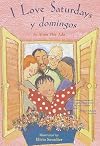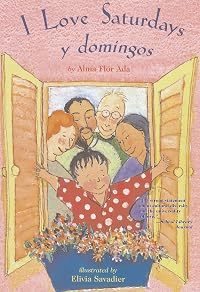
I Love Saturdays y domingos
by Alma Flor Ada 
On This Page
Description
A young girl enjoys the similarities and the differences between her English-speaking and Spanish-speaking grandparents.Tags
Recommendations
Member Reviews
A young girl celebrates her diverse family, and her multicultural heritage, in Alma Flor Ada's I Love Saturdays y Domingos, describing her Saturday visits with her father's parents - her European-American Grandma and Grandpa - and her Sunday (los domingos) visits with her mother's parents - her Mexican-American Abuelito y Abuelita. With activities and interests that mirror each other - sharing the history of their respective ancestors, playing with their pets, devising happy surprises for their favorite grandchild - the two sets of grandparents feature on facing pages of the book, allowing the narrator to switch back and forth between English, and a mixture of Spanish and English. The conclusion, in which both sets of grandparents show more attend the narrator's birthday party, and work together on a wonderful gift, highlights the ties of love that bind them all together.
I enjoyed this charming picture-book, both for its engaging story and for its dual narrative structure, which allows even those readers unfamiliar with the language to understand the various words and phrases in Spanish. Having already seen the same idea conveyed in English, they can easily guess what the Spanish portions means. I did feel at first - as I see a number of other reviewers have done - that the narrative favored Abuelito and Abuelita a little bit, showing them in a more positive light (Grandma and Grandpa watch a video of the circus with their granddaughter, while Abuelito and Abuelita take her to the circus itself; Grandma and Grandpa buy her some balloons, while Abuelito makes her a kite), but I think this may have been unconsciously done: an inadvertent result of the dual narrative mentioned above. Leaving that aside, I Love Saturdays y Domingos is still an engaging story, one I recommend to anyone looking for quality children's stories featuring multicultural and bilingual families. show less
I enjoyed this charming picture-book, both for its engaging story and for its dual narrative structure, which allows even those readers unfamiliar with the language to understand the various words and phrases in Spanish. Having already seen the same idea conveyed in English, they can easily guess what the Spanish portions means. I did feel at first - as I see a number of other reviewers have done - that the narrative favored Abuelito and Abuelita a little bit, showing them in a more positive light (Grandma and Grandpa watch a video of the circus with their granddaughter, while Abuelito and Abuelita take her to the circus itself; Grandma and Grandpa buy her some balloons, while Abuelito makes her a kite), but I think this may have been unconsciously done: an inadvertent result of the dual narrative mentioned above. Leaving that aside, I Love Saturdays y Domingos is still an engaging story, one I recommend to anyone looking for quality children's stories featuring multicultural and bilingual families. show less
I enjoyed reading this book for a variety of reasons. First, I like how Spanish words were incorporated into the book. The author weaves the definition of each word into the text in a way that doesn’t distract from the events taking place in the story. For example “Abuelita serves me a large glass of papaya juice and a plate of eggs called huevos.” I believe this is format is more enjoyable and creative than just having a glossary of Spanish words on the page. In addition, the Spanish words are in different font so they can easily be distinguished from English words. I also liked that the main character compares and contrasts the different cultural experiences she has with both sides of her family on Saturdays. She details her show more Saturday activities with the Caucasian side of her family and the Hispanic side of her family. This comparison is something that children reading this book will be able to relate to. This will especially appeal to children of mixed race and culturally diverse families. The message of this book is to accept and embrace differences. The main character acknowledges that both the two sides of her family are different and they each have their own culture. But she knows that the aspects of both of their cultures help create her own. In addition she knows that they both love her and they’re all her family. show less
I enjoyed reading this children’s book. It went through the life of one little girl visiting her grandparents; one American and one Hispanic. The book was written in in both Spanish and English. Two stories were being told and there was a clear shift from one to the other. Most of the times they were on the same pages. The Spanish words were written in bold and italics, which made it easier to point them out as the reader. The author made it so that the reader wouldn’t even have to look up the translations of the Spanish words because they were expressed on the next page in English. So the only task for me was to follow along with both sides. Even though each story was the same, the author made sure to add in some of the show more differences. For example, one family had a pet cat and the other had a pet dog. In another part of the book, the American grandparents took her to the aquarium and the Hispanic grandparents took her on the dock to see the fish. So she did the same things with them but it took place in two different environments. I really like how the author did this. There were 5 main characters, the girl, and both sets of grandparents and the story was told from her point of view. The plot was organized because the different activities she did with each grandparents matched up with the other. For example, the author talked about the aspect of look at fish with each grandparent on the same page. There was no real conflict in this story because it was just about the two different cultures. The pictures in the book were illustrated with water colors. The pictures were also placed randomly. I think this was a good idea because the storyline isn’t even straight forward, so why should the pictures be? The author made it very easy to distinguish which family was which, even based off of the different kinds of clothing each had on. The genre of this book would be contemporary realistic fiction because this is what some students go through on a daily basis. Their parents may not be the same exact race, so they experience both cultures. To me this book represented two different cultures coming together to show that they actually aren’t so different. show less
The book highlights the life of a girl who is bicultural and bilingual. She has English speaking grandparents who she visits on Saturdays, and Spanish speaking grandparents who she visits on Sundays. I liked this book for three reasons. First, the writing is unique because it is written using both Spanish and English. For example, “Los domingos, Abuelita serves me a large glass of papaya juice and a plate of eggs called huevous rancheros.” The organization of the text may help someone who is reading the book who may not understand one of the languages. On one page, the girl visits her English speaking grandparents, on the following page is when the girl visits her Spanish speaking grandparent. Both set of grandparents say the same show more thing, but just in different languages. Therefore, someone who is not proficient in one language can refer to the corresponding page to understand what is going on. Secondly, I like the point of view that the book is written in. Having the girl tell the story in first person point view helps the audience connect to the book more because the children can better relate to the girl. Lastly, the illustrations of the book make it feel more of a journal than a book. This also added to the readers experience because it could help them connect better to the story. Feeling as if one of their classmates have written the book rather than an author. For example, when she goes to the circus and sees elephants, the illustrator draws an elephant to go with her observations. That is something that an elementary school age child would do. They would draw the one specific thing that they wrote about. So the illustrations helped the audience connect more with the book than just connecting with the main character. show less
Summary:
I Love Saturdays y domingos is a children’s picture book that explores cultural diversity and the universality of love. The narrator is a little girl, who talks about her weekends spent with her grandparents. She spends every Saturday with Grandma and Grandpa who are European-American. She spends every Sunday/Domingo with Abuelita and Abuelito, who are Mexican-American. The story explores her weekends with her two different sets of grandparents, comparing similar activities that slightly differ because of their cultures. Although her grandparent’s cultures are very different, they are actually very alike in that they share the same love for their granddaughter. At the end of the story, the two families come together to show more celebrate the little girls birthday, singing both “Happy Birthday” and “Las Mananitas.”
Comments (arguments/opinions):
This book is a wonderful story and offers very colorful and detailed illustrations. It is a great example of multicultural or international literature. The entire story is in English but also incorporates Spanish words, phrases and even a song. It did a wonderful job portraying realistic characters and situations, as well as great comparisons and contrasts between different cultures. All of the characters are represented fairly as real people rather than as stereotypes. They even incorporate a part of the story where the grandparents tell about how they came to the United States and grew up as children. The illustrations also do a wonderful job capturing the families’ diversity and culture. The illustrations along with the words really make the story relatable and come alive. I think any child reading this story would gain a better understanding of how people and families can differ from one another. I think it does a great job showing how even though you might come from two very different families that the characteristics or personalities of your family can still be very similar. In this case, even though she grows up with a European-American family and a Mexican-American family, who both have very different cultures and backgrounds, they both have compassion and love for her and her family. The ending was a prime example that people with different backgrounds can come together and share similar experiences and work well together. show less
I Love Saturdays y domingos is a children’s picture book that explores cultural diversity and the universality of love. The narrator is a little girl, who talks about her weekends spent with her grandparents. She spends every Saturday with Grandma and Grandpa who are European-American. She spends every Sunday/Domingo with Abuelita and Abuelito, who are Mexican-American. The story explores her weekends with her two different sets of grandparents, comparing similar activities that slightly differ because of their cultures. Although her grandparent’s cultures are very different, they are actually very alike in that they share the same love for their granddaughter. At the end of the story, the two families come together to show more celebrate the little girls birthday, singing both “Happy Birthday” and “Las Mananitas.”
Comments (arguments/opinions):
This book is a wonderful story and offers very colorful and detailed illustrations. It is a great example of multicultural or international literature. The entire story is in English but also incorporates Spanish words, phrases and even a song. It did a wonderful job portraying realistic characters and situations, as well as great comparisons and contrasts between different cultures. All of the characters are represented fairly as real people rather than as stereotypes. They even incorporate a part of the story where the grandparents tell about how they came to the United States and grew up as children. The illustrations also do a wonderful job capturing the families’ diversity and culture. The illustrations along with the words really make the story relatable and come alive. I think any child reading this story would gain a better understanding of how people and families can differ from one another. I think it does a great job showing how even though you might come from two very different families that the characteristics or personalities of your family can still be very similar. In this case, even though she grows up with a European-American family and a Mexican-American family, who both have very different cultures and backgrounds, they both have compassion and love for her and her family. The ending was a prime example that people with different backgrounds can come together and share similar experiences and work well together. show less
Both the text (the narrative) and the colourfully fun illustrations of Alma Flor Ada's I Love Saturdays y domingos are evocative and engaging, a heartwarming presentation and depiction of a loving inter- and multiethnic extended family. The voice of the young narrator (a little girl who spends Saturdays with her European-American paternal grandparents and Sundays, los domingos, with her Mexican-American maternal grandparents) shines brightly and demonstrates the child's love and affection for both sets of grandparents, and the love the entire extended family has for one another. And although the grandparents do have some different cultural traditions, I Love Saturdays y domingos clearly demonstrates that while cultural differences show more exist, they are often only skin-deep; both sets of grandparents (both families) also have a great deal in common. This would be a perfect story to share with children whose families are multiethnic, or with children who are interested in knowing more about their own families' ethnic backgrounds. I could also imagine using I love Saturdays y domingos in a pre-school or grade one to three classroom setting, perhaps during a social studies or immigration unit.
The little girl's descriptions of her Sundays (her domingos) with her Mexican-American maternal grandparents contain quite a number of Spanish words and expressions. Personally, I love this aspect of the book, as I think it makes the story much more authentic-sounding (it would be strange, indeed, if the narrative were to feature only English words and expressions, as this might give a false impression of implied superiority of the English language, of European-American culture). As a person who loves languages, I enjoyed not only the liberal use of Spanish throughout the text, but also trying to figure out the meanings of the Spanish words and expressions, and their English counterparts (and for the most part, I was quite successful). However, I do wish that Alma Flor Ada had provided a Spanish/English glossary at the back of the book. Some of the Spanish vocabulary and expressions were/are not all that easy to figure out from just the context of the narrative itself and could likely prove a bit confusing and frustrating for both children and adults who do not speak or read Spanish, or whose knowledge of Spanish is limited. show less
The little girl's descriptions of her Sundays (her domingos) with her Mexican-American maternal grandparents contain quite a number of Spanish words and expressions. Personally, I love this aspect of the book, as I think it makes the story much more authentic-sounding (it would be strange, indeed, if the narrative were to feature only English words and expressions, as this might give a false impression of implied superiority of the English language, of European-American culture). As a person who loves languages, I enjoyed not only the liberal use of Spanish throughout the text, but also trying to figure out the meanings of the Spanish words and expressions, and their English counterparts (and for the most part, I was quite successful). However, I do wish that Alma Flor Ada had provided a Spanish/English glossary at the back of the book. Some of the Spanish vocabulary and expressions were/are not all that easy to figure out from just the context of the narrative itself and could likely prove a bit confusing and frustrating for both children and adults who do not speak or read Spanish, or whose knowledge of Spanish is limited. show less
I enjoyed this book for many reasons. First, since this was a bilingual story, the author organized the words and illustrations very well. She had the Spanish words italicized and underneath the english ones so the reader could easily differentiate the languages and print. The illustrations depicted actions above or below them and were very bright and detailed. There was an image of a mother elephant and a baby and in the print it says “La mamá elefanta y su elefantito.” The main character and her spanish grandparents went to the zoo. The words were very descriptive of the images shown. They match perfectly and the consistency of switching each page from her American to her Mexican-American grandparents was so smooth and executed show more in a neat manner. The language was very descriptive in other pages like when she had breakfast at both houses. At her grandparents house, she ate pancakes with honey and eggs. At her abuelita y abuelito’s house she ate papaya juice y huevos rancheros which showcased her various cultures and how she enjoys both so much. On another page, the main character counts in english with her grandparents and counts to ten with her abuelito y abuelita. Each page shows the similarities and differences among both sides, yet both love her so much and she is affectionate towards all of her grandparents. She accepts her culture and embraces both sides throughout the entire story which shows readers about the big idea which is bilingual children learning from both sides of their family and accepting diversity as a positive and beneficial trait to have. The events were extremely realistic and took place in traditional places most families would take their children such as the zoo. The characters are all very realistic. Between each character’s age, gender, and depiction of their culture, it seemed very believable and applicable to today’s world that it made me enjoy it so much. show less
Members
- Recently Added By
Lists

Children's picture books with kids of color
129 works; 15 members
Author Information

262+ Works 13,299 Members
Alma Flor Ada was born in 1938 in Cuba. She has authored several children's folktales including "Encaje de Piedra" which earned her the Marta Salotti Gold Medal, "The Gold Coin" which won the Christopher Award, and "Gathering the Sun" which received the Once Upon a World Award. "The Lizard and the Sun/La Lagartija y el Sol" won her a Gold Medal show more from the National Association of Parenting Publications, and she was awarded an Accolade from the American Folklore Association for "Mediopollito/Half-Chicken". Her title "Under the Royal Palms: A Childhood in Cuba" won the Pura Belpre Award. In addition to writing, she is a professor at the University of San Francisco. (Bowker Author Biography) show less
Alma Flor Ada is a LibraryThing Author, an author who lists their personal library on LibraryThing.
All Editions
Awards and Honors
Awards
Common Knowledge
- Original publication date
- 2004
Classifications
Statistics
- Members
- 759
- Popularity
- 36,868
- Reviews
- 82
- Rating
- (4.29)
- Languages
- English, French, German, Spanish
- Media
- Paper
- ISBNs
- 10
- ASINs
- 2