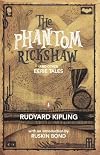
The Phantom Rickshaw
by Rudyard Kipling 
On This Page
Description
Contains the following stories: THE PHANTOM 'RICKSHAW MY OWN TRUE GHOST STORY THE STRANGE RIDE OF MORROWBIE JUKES THE MAN WHO WOULD BE KING "THE FINEST STORY IN THE WORLD."Tags
Recommendations
















Member Reviews
Four of the five stories by Kipling that manipulate the supernatural in at least some fashion or another find themselves often forgotten alongside the fifth, "The Man Who Would Be King," as it has endured as one of Kipling's most important experiments in narrative. It's not that the others are mediocre; they're quite good. Each of them. Especially discomforting to the reader's imagination is "The Strange Ride of Morrowbie Jukes." It's more of a pure adventure story than a tales of ghosts, but its focused story on a man in a pit of horrors is one of Kipling's most memorable efforts.
It is "The Man Who Would Be King," however, that is most remembered. Deservedly so. With its shifting perspective in narration, from the present to multiple show more pasts from the same character, Peachey, it's almost modernist in its effect. We, Kipling's readers, are put straight in amidst Peachey's tortured mind, his memories of catastrophe. And all he has to lead him back "home" is the ghostly presence of Daniel Dravot's severed head with the gold crown still in place. An adventure it was. And no matter the horror, there is still the appeal to take up the trail where Peachey and Dan left off. show less
It is "The Man Who Would Be King," however, that is most remembered. Deservedly so. With its shifting perspective in narration, from the present to multiple show more pasts from the same character, Peachey, it's almost modernist in its effect. We, Kipling's readers, are put straight in amidst Peachey's tortured mind, his memories of catastrophe. And all he has to lead him back "home" is the ghostly presence of Daniel Dravot's severed head with the gold crown still in place. An adventure it was. And no matter the horror, there is still the appeal to take up the trail where Peachey and Dan left off. show less
This is an odd one to review - simply because the Rudyard Kipling is a true English Gentleman when these stories were published - that is, the "White" people are civilized and good, and anyone not white is almost sub-human, with the darker the person the less human they are. This always brings up the question - should you judge a book by today's standards, or by the standards of the period the book was written in?
First, this is a book of short stories written by Kipling in the turn of the century. It has language that I wasn't familiar with, especially when it was pertaining to modes of transportation and the different classes of Indian People (I'm assuming most of these are now considered derogatory). I had to stop, figure out the show more context of the word within the story and than continue on.
The stories themselves are quite well written. The first one, the Phantom Rickshaw - was a true ghost story. The other three stories flirt with ghosts and death, but aren't really true ghost stories. "My True Ghost Story" was actually scary - and leaves a reader wondering about what actually happened at the end. "The Strange Ride of Morrowbie Jukes was also scary, but for a different reason, although this one I think shows Kipling's view of Englishman initiative and superiority over the native population. The last story was the one I did not like very much. It was well written, but the main characters were boorish and annoying and the story only worked because of Free-Masonry.
So overall - well written stories, although they are totally written in a different time. show less
First, this is a book of short stories written by Kipling in the turn of the century. It has language that I wasn't familiar with, especially when it was pertaining to modes of transportation and the different classes of Indian People (I'm assuming most of these are now considered derogatory). I had to stop, figure out the show more context of the word within the story and than continue on.
The stories themselves are quite well written. The first one, the Phantom Rickshaw - was a true ghost story. The other three stories flirt with ghosts and death, but aren't really true ghost stories. "My True Ghost Story" was actually scary - and leaves a reader wondering about what actually happened at the end. "The Strange Ride of Morrowbie Jukes was also scary, but for a different reason, although this one I think shows Kipling's view of Englishman initiative and superiority over the native population. The last story was the one I did not like very much. It was well written, but the main characters were boorish and annoying and the story only worked because of Free-Masonry.
So overall - well written stories, although they are totally written in a different time. show less
Times have changed and these tales aren't as firghtening as they once were. Instead they are a comforting place to return to, the days of our youth when a ghost story would keep us awake for hours.
Ratings
Members
- Recently Added By
Author Information

2,459+ Works 91,094 Members
Kipling, who as a novelist dramatized the ambivalence of the British colonial experience, was born of English parents in Bombay and as a child knew Hindustani better than English. He spent an unhappy period of exile from his parents (and the Indian heat) with a harsh aunt in England, followed by the public schooling that inspired his "Stalky" show more stories. He returned to India at 18 to work on the staff of the Lahore Civil and Military Gazette and rapidly became a prolific writer. His mildly satirical work won him a reputation in England, and he returned there in 1889. Shortly after, his first novel, The Light That Failed (1890) was published, but it was not altogether successful. In the early 1890s, Kipling met and married Caroline Balestier and moved with her to her family's estate in Brattleboro, Vermont. While there he wrote Many Inventions (1893), The Jungle Book (1894-95), and Captains Courageous (1897). He became dissatisfied with life in America, however, and moved back to England, returning to America only when his daughter died of pneumonia. Kipling never again returned to the United States, despite his great popularity there. Short stories form the greater portion of Kipling's work and are of several distinct types. Some of his best are stories of the supernatural, the eerie and unearthly, such as "The Phantom Rickshaw," "The Brushwood Boy," and "They." His tales of gruesome horror include "The Mark of the Beast" and "The Return of Imray." "William the Conqueror" and "The Head of the District" are among his political tales of English rule in India. The "Soldiers Three" group deals with Kipling's three musketeers: an Irishman, a Cockney, and a Yorkshireman. The Anglo-Indian Tales, of social life in Simla, make up the larger part of his first four books. Kipling wrote equally well for children and adults. His best-known children's books are Just So Stories (1902), The Jungle Books (1894-95), and Kim (1901). His short stories, although their understanding of the Indian is often moving, became minor hymns to the glory of Queen Victoria's empire and the civil servants and soldiers who staffed her outposts. Kim, an Irish boy in India who becomes the companion of a Tibetan lama, at length joins the British Secret Service, without, says Wilson, any sense of the betrayal of his friend this actually meant. Nevertheless, Kipling has left a vivid panorama of the India of his day. In 1907, Kipling became England's first Nobel Prize winner in literature and the only nineteenth-century English poet to win the Prize. He won not only on the basis of his short stories, which more closely mirror the ambiguities of the declining Edwardian world than has commonly been recognized, but also on the basis of his tremendous ability as a popular poet. His reputation was first made with Barrack Room Ballads (1892), and in "Recessional" he captured a side of Queen Victoria's final jubilee that no one else dared to address. (Bowker Author Biography) show less
Rudyard Kipling has a Legacy Library. Legacy libraries are the personal libraries of famous readers, entered by LibraryThing members from the Legacy Libraries group.
Some Editions
Series
Belongs to Publisher Series
Work Relationships
Common Knowledge
- Original publication date
- 1888
- Related movies
- The Man Who Would Be King (1975 | IMDb)
Classifications
Statistics
- Members
- 304
- Popularity
- 105,320
- Reviews
- 4
- Rating
- (3.59)
- Languages
- English, Hungarian, Italian
- Media
- Paper, Ebook
- ISBNs
- 53
- ASINs
- 39