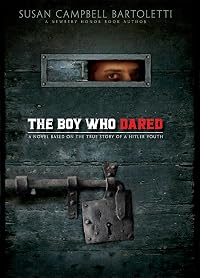
The Boy Who Dared
by Susan Campbell Bartoletti
On This Page
Description
In October, 1942, seventeen-year-old Helmuth Hübener, imprisoned for distributing anti-Nazi leaflets, recalls his past life and how he came to dedicate himself to bring the truth about Hitler and the war to the German people.Tags
Recommendations

















Member Recommendations


Member Reviews
Fantastic story about 14 year old Helmuth which is so gut-wrenching because it is based on true events. After reading so many holocaust books, I wonder what happened to the people who stood up against the Nazis - the ordinary, decent Germans who could see what was happening. This is one of those people. A boy who has access to a radio that can receive BBC broadcasts and so when he hears the BBC giving out information about their own losses, he starts to believe what they say over the propaganda and lies around him. He is driven to start writing pamphlets that reveal what he has heard and leaves them on shop windows and inphone boxes, so others will read them. Helmut realizes he can't do this alone; so he starts to reveal what he knows show more to others around him. But who can he trust? show less
The Boy Who Dared is an inspiring work of historical fiction based on the real life exploits of a German teenager who dared to defy Hitler's edicts during World War II and payed the ultimate price for his bravery. I'm sure most tweens and teens today have some awareness through their history classes of the atrocities committed by Hitler against the Jews, but I wonder how many know of the thousands of non-Jewish Germans who were tortured, imprisoned and even put to death for their beliefs. This book would be a great starting point for young people to learn more about the German Resistance movement. It also imparts a strong message about thinking for oneself and not becoming a blind follower, as well as standing up for what's right even show more in the face of impossible odds or even death.
Helmuth Hubener was a boy who did exactly that. I was very impressed by how intuitive he was. Even at a young age, Helmuth seemed to have an instinctive sense of right and wrong. He was never entirely comfortable with the things Hitler did and became even less so as Hitler imposed even more restrictions upon the German people. In school, Helmuth wrote what he had to to make it sound like he supported the Reich but hated every minute of it. He also was forced to join the Hitler Youth, but again was not comfortable with their activities. After graduating, Helmuth got an apprenticeship with a company where he was shocked to find forbidden books in the basement. He began borrowing them, and they continued to solidify his belief that Hitler was lying and he must do something to enlighten his fellow Germans. When Helmuth's brother came home from Reich Labor Service with an illegal radio he purchased on the black market, it proves too much of a temptation for Helmuth. Every night he listens to the BBC and learns the truth about what's really happening in the war. This only further fuels his anger until he comes up with the idea of producing pamphlets and flyers detailing the things he learns on the radio and passing them on to other people. He and three friends daringly acted alone as a small insular pocket of resistance against Hitler's reign of terror.
I can't even imagine how much courage it must have required to take a stand like that. I was only reading a fictionalized account of these events long after they happened and could still feel the fear and tension emanating off the pages of the book. I know that sometimes extraordinary circumstances can make ordinary people do things they might never have thought themselves capable of, but what makes this story so notable is the age of its protagonist. Helmuth began his subversive activities when he was only sixteen, and even before that, he was a very intelligent and articulate young man. Just these actions alone could be called heroic, but when he was arrested at the age of seventeen, he essentially fell on his own sword so to speak, taking as much of the blame upon himself as he could and even goading the judges, so that his friends lives might be spared. I think Helmuth's example of standing up for what's right is one that all teens can and should learn from.
The narrative of The Boy Who Dared jumps back and forth between Helmuth in prison on death row and past events starting in his early childhood leading up to his imprisonment. In my opinion, this added some suspense to the story because it kept me wondering how he got there and if there was any hope of him being pardoned. The book is written in present tense. I don't think I've ever read a book written like this, so it took me just a little while to get into it. Once I adjusted to the unfamiliar writing style, I was completely engrossed by the story. Although the author used her own imagination to fill in the missing pieces of Helmuth's life, I would say, based on her notes at the end of the book, that she did her homework extremely well, trying to bring as much authenticity to the story as possible. She even had the privilege of personally interviewing Helmuth's brother and one of the friends who also went to prison for helping him. By reading this book, I felt that I learned not only about the life of a heroic person, but a few other historical details as well (eg. I had no idea the guillotine was still in use during WWII or that there were Mormons in Germany at that time). If one pays attention, I think this book could also be a cautionary tale of taking care not to repeat the mistakes of the past. I have to say that I found Hitler's words very disconcerting, because of the fact that some politicians of the present day use similar rhetoric.
Overall, The Boy Who Dared was an amazing and inspiring story that I highly recommend. Although it has no truly objectionable content and I felt the author took care not to sensationalize any of the violence, the subject matter is still rather mature. As I mentioned earlier there is a palpable sense of fear which might lead younger and more sensitive readers to fret and worry with good cause for Helmuth's safety. They also may not understand and/or be disturbed by certain events in the story as well as the ending. For this reason, I recommend it for middle grades and up, but it is definitely a book from which both kids and adults alike can glean a great message. show less
Helmuth Hubener was a boy who did exactly that. I was very impressed by how intuitive he was. Even at a young age, Helmuth seemed to have an instinctive sense of right and wrong. He was never entirely comfortable with the things Hitler did and became even less so as Hitler imposed even more restrictions upon the German people. In school, Helmuth wrote what he had to to make it sound like he supported the Reich but hated every minute of it. He also was forced to join the Hitler Youth, but again was not comfortable with their activities. After graduating, Helmuth got an apprenticeship with a company where he was shocked to find forbidden books in the basement. He began borrowing them, and they continued to solidify his belief that Hitler was lying and he must do something to enlighten his fellow Germans. When Helmuth's brother came home from Reich Labor Service with an illegal radio he purchased on the black market, it proves too much of a temptation for Helmuth. Every night he listens to the BBC and learns the truth about what's really happening in the war. This only further fuels his anger until he comes up with the idea of producing pamphlets and flyers detailing the things he learns on the radio and passing them on to other people. He and three friends daringly acted alone as a small insular pocket of resistance against Hitler's reign of terror.
I can't even imagine how much courage it must have required to take a stand like that. I was only reading a fictionalized account of these events long after they happened and could still feel the fear and tension emanating off the pages of the book. I know that sometimes extraordinary circumstances can make ordinary people do things they might never have thought themselves capable of, but what makes this story so notable is the age of its protagonist. Helmuth began his subversive activities when he was only sixteen, and even before that, he was a very intelligent and articulate young man. Just these actions alone could be called heroic, but when he was arrested at the age of seventeen, he essentially fell on his own sword so to speak, taking as much of the blame upon himself as he could and even goading the judges, so that his friends lives might be spared. I think Helmuth's example of standing up for what's right is one that all teens can and should learn from.
The narrative of The Boy Who Dared jumps back and forth between Helmuth in prison on death row and past events starting in his early childhood leading up to his imprisonment. In my opinion, this added some suspense to the story because it kept me wondering how he got there and if there was any hope of him being pardoned. The book is written in present tense. I don't think I've ever read a book written like this, so it took me just a little while to get into it. Once I adjusted to the unfamiliar writing style, I was completely engrossed by the story. Although the author used her own imagination to fill in the missing pieces of Helmuth's life, I would say, based on her notes at the end of the book, that she did her homework extremely well, trying to bring as much authenticity to the story as possible. She even had the privilege of personally interviewing Helmuth's brother and one of the friends who also went to prison for helping him. By reading this book, I felt that I learned not only about the life of a heroic person, but a few other historical details as well (eg. I had no idea the guillotine was still in use during WWII or that there were Mormons in Germany at that time). If one pays attention, I think this book could also be a cautionary tale of taking care not to repeat the mistakes of the past. I have to say that I found Hitler's words very disconcerting, because of the fact that some politicians of the present day use similar rhetoric.
Overall, The Boy Who Dared was an amazing and inspiring story that I highly recommend. Although it has no truly objectionable content and I felt the author took care not to sensationalize any of the violence, the subject matter is still rather mature. As I mentioned earlier there is a palpable sense of fear which might lead younger and more sensitive readers to fret and worry with good cause for Helmuth's safety. They also may not understand and/or be disturbed by certain events in the story as well as the ending. For this reason, I recommend it for middle grades and up, but it is definitely a book from which both kids and adults alike can glean a great message. show less
The Boy Who Dared is a powerful historical novel based on the true story of Helmuth Hübener, a German teenager who stood up against the Nazis. Told through a series of flashbacks as Helmuth sits in a prison cell awaiting execution, the novel retraces his childhood, his growing doubts about Hitler’s regime, and his eventual decision to secretly spread anti-Nazi leaflets. Susan Campbell Bartoletti’s writing captures both the fear and the courage of a young man who refuses to stay silent in the face of injustice. It’s a gripping, emotional story that raises questions about morality, conscience, and the cost of bravery. Perfect for students interested in history, ethics, and resistance.
This is an excellent WW2 historical fiction book based on the true story of Helmut Guddat Hubener. Helmut was a German teenager during Hitler's war against Europe. Like all German teenagers, he was forced to join the Hitler Youth, an organization to promote allegiance to the German cause. Helmut decided early on that what Hitler was doing to destroy the Jews and take away the rights of the German people was wrong. He anguished over the necessity to support Hitler in his school essays in order to prevent harm to himself or his family. Every day he had to resist the urge to speak out against the Hitler regime.
The beginning of the end for him is when his older brother, serving in the German army, brings home a radio he purchased on the show more black market. Though he locks it in a closet, Helmut can't resist his curiosity and picks the lock. Every night after his grandparents go to bed, he brings it out and listens to the British broadcast. He quickly decides that the British are telling the truth and the Germans are lying. He secretly begins leaving pamphlets around town in the hopes of bringing the truth to the people. Of course he is caught. He remains resolute in his opinions in the face of the German judges and is sentenced to death at age 17.
The story is told in brief segments of Helmut awaiting his execution with longer flashbacks of the 10 years leading up to his sentencing. This was not a book on my radar for WW2 historical fiction and I'm glad I finally came across it. It's a must read for kids interested in the Holocaust and the German regime. Would also be an excellent choice for required classroom reading. show less
The beginning of the end for him is when his older brother, serving in the German army, brings home a radio he purchased on the show more black market. Though he locks it in a closet, Helmut can't resist his curiosity and picks the lock. Every night after his grandparents go to bed, he brings it out and listens to the British broadcast. He quickly decides that the British are telling the truth and the Germans are lying. He secretly begins leaving pamphlets around town in the hopes of bringing the truth to the people. Of course he is caught. He remains resolute in his opinions in the face of the German judges and is sentenced to death at age 17.
The story is told in brief segments of Helmut awaiting his execution with longer flashbacks of the 10 years leading up to his sentencing. This was not a book on my radar for WW2 historical fiction and I'm glad I finally came across it. It's a must read for kids interested in the Holocaust and the German regime. Would also be an excellent choice for required classroom reading. show less
{My thoughts} – Helmut Hubner is a young child that is growing up in the time when Hitler was becoming more well known. Helmut is a child that asks a lot of questions and he has since he was a young child. In school he becomes known as a child that is wise beyond his years and his teachers have hope for him. They hope that one day he will become somebody important.
Helmut starts questioning the way in which the German populations chooses to follow Hitler once he realizes how wrong the actions are. When he was a young boy he was sent to go buy bread, he was told he couldn’t buy from his families favorite Jewish baker anymore. He was told he could only buy at German shops. This continued to becoming eventually where Hitler would show more dictate what the German’s could and couldn’t do and his loyal followers would enforce it. If a German went up against Hitler and caused trouble they too were subject be being treated in inhuman ways and sometimes executed. It really depended on how bad the crimes were they were accused of doing.
Helmut decided that he had to do something and he dared to speak out against Hitler. He dared to tell the Germans the truth. He went about doing it by creating pamphlets that would speak the facts. The facts that Hitler was hiding from the Germans. He got his facts be illegally listening to a radio station that was German. He trusted his facts and did what he could to share them with others.
I think for a sixteen year old boy to stand up and fight for what he believed in in such a way is speaks volumes for how smart her was. I think that this depiction of what his life and his final days in prison were like was incredibly well written.
This book helps to show children that no matter your age, if you think things aren’t right and you want to try and change them, no matter the consequences of your actions, that it’s okay to try. That it’s okay to stand up for your beliefs. In the end Helmut Hubner’s story is being shared with the world. His teachers were right about him, he did become someone. He became someone incredible. He became the boy that dared to stand up to Hitler. show less
Helmut starts questioning the way in which the German populations chooses to follow Hitler once he realizes how wrong the actions are. When he was a young boy he was sent to go buy bread, he was told he couldn’t buy from his families favorite Jewish baker anymore. He was told he could only buy at German shops. This continued to becoming eventually where Hitler would show more dictate what the German’s could and couldn’t do and his loyal followers would enforce it. If a German went up against Hitler and caused trouble they too were subject be being treated in inhuman ways and sometimes executed. It really depended on how bad the crimes were they were accused of doing.
Helmut decided that he had to do something and he dared to speak out against Hitler. He dared to tell the Germans the truth. He went about doing it by creating pamphlets that would speak the facts. The facts that Hitler was hiding from the Germans. He got his facts be illegally listening to a radio station that was German. He trusted his facts and did what he could to share them with others.
I think for a sixteen year old boy to stand up and fight for what he believed in in such a way is speaks volumes for how smart her was. I think that this depiction of what his life and his final days in prison were like was incredibly well written.
This book helps to show children that no matter your age, if you think things aren’t right and you want to try and change them, no matter the consequences of your actions, that it’s okay to try. That it’s okay to stand up for your beliefs. In the end Helmut Hubner’s story is being shared with the world. His teachers were right about him, he did become someone. He became someone incredible. He became the boy that dared to stand up to Hitler. show less
When 16-year-old Helmuth Hübener listens to the BBC news on an illegal short-wave radio, he quickly discovers Germany is lying to the people. But when he tries to expose the truth with leaflets, he's tried for treason. Sentenced to death and waiting in a jail cell, Helmuth's story emerges in a series of flashbacks that show his growth from a naive child caught up in the patriotism of the times, to a sensitive and mature young man who thinks for himself.
A youth in Nazi Germany tells the truth about Hitler.Bartoletti has taken one episode from her Newbery Honor Book, Hitler Youth, and fleshed it out into a full novel.
A youth in Nazi Germany tells the truth about Hitler.Bartoletti has taken one episode from her Newbery Honor Book, Hitler Youth, and fleshed it out into a full novel.
I just don't know what to do with reviewing this book. It's probably well done for its type, but it's not the kind of book I like to read. When I talk about books that are crunchy, good-for-you type things - this is what I mean. It's the type of book that says to me,"Hey, did you ever doubt that WWII was a terrible time to be a German? Well, let me fill you in just how awful it was, whether you were a Jew or not." I pretty much already got that point from my history courses; I really don't need a fictionalized historical biography to ram the point home. The Caudill list recommends this for 6th-8th grade, but I can guarantee you if I read this at that age it would have freaked me out and I would have been in tears.
However - given all of show more that - there are 6th-8th graders who would absolutely adore this book; who would eat it right up and ask for more. I think there are teenagers who it would appeal to as well. Hence my dilemma on how to review it - I most emphatically did not like it, but I think it's a pretty good book. Not in the same league as Number the Stars or The Devil's Arithmetic, but well done and all the more powerful for being based on a real person's life. So, three stars it is, I guess.
Oh and the narration was fine, but not stellar. I found it somewhat flat in between the sections with dialogue, but I think that's a function of the writing style which fit better in my mind once I realized it was based on a true story. I found the choice to use German accents for all the dialogue interesting, but not off-putting.
Listened to Random House audio edition narrated by David Ackroyd. show less
However - given all of show more that - there are 6th-8th graders who would absolutely adore this book; who would eat it right up and ask for more. I think there are teenagers who it would appeal to as well. Hence my dilemma on how to review it - I most emphatically did not like it, but I think it's a pretty good book. Not in the same league as Number the Stars or The Devil's Arithmetic, but well done and all the more powerful for being based on a real person's life. So, three stars it is, I guess.
Oh and the narration was fine, but not stellar. I found it somewhat flat in between the sections with dialogue, but I think that's a function of the writing style which fit better in my mind once I realized it was based on a true story. I found the choice to use German accents for all the dialogue interesting, but not off-putting.
Listened to Random House audio edition narrated by David Ackroyd. show less
Members
- Recently Added By
Published Reviews
ThingScore 94
Bartoletti offers another perspective on the Holocaust, demonstrating that even if the effort proves unsuccessful, the courage and convictions of a minority should be motivation to speak the truth rather than remain silent.
added by Katya0133
The teen’s perspective makes this a particularly
gripping way to personalize the history.
gripping way to personalize the history.
added by Katya0133
[Bartoletti] does an excellent job of conveying the political climate surrounding Hitler's ascent to power.
added by Katya0133
Lists

Best Young Adult
399 works; 101 members

A Child's Book Tour of Germany
76 works; 5 members

THE WAR ROOM
813 works; 24 members
Author Information

25+ Works 8,021 Members
A former 8th-grade English teacher, Susan Campbell Bartoletti writes fiction and nonfiction for all ages. Black Potatoes is the winner of the ALA Sibert Award for Best Information book, the NCTE Orbis Pictus Award for Distinguished Nonfiction, and the SCBWI Golden Kite Nonfiction award. She lives with her family in Moscow, PA.
Awards and Honors
Awards
Distinctions
Notable Lists
Common Knowledge
- Canonical title
- The Boy Who Dared
- Original title
- The Boy Who Dared
- Original publication date
- 2008-02
- People/Characters
- Helmuth Hübener; Rudi Wobbe; Karl-Heinz Schnibbe; Gerhardt Kunkel; Hans Kunkel; Gerhard Duwer (show all 7); Hugo Hubener
- Important places
- Hamburg, Germany
- Important events
- World War II (1939 | 1945)
- Dedication
- For Joe
- First words
- It's morning. Soft gray light slips over the tall redbrick wall. It stretches across the exercise yard and reaches through the high, barred windows.
- Quotations
- Helmuth does not believe he was foolish. He did not risk his life in vain. God can bring good out of evil, but God can't do it alone. God needs people. People who will stand up. People who will dare to speak out. For wha... (show all)t has a man profited, if he has gained the whole world and lost his soul? That's what the Bible says. Helmuth feels something. His chest swells. A warm calmness fills him, and he knows that he has lived a life that stood for something.
The infamous Blood Tribunal. The highest, most feared court in Germany.
Helmuth's heart sinks. His lawyer doesn't work for him. He works for the Nazi government. - Last words
- (Click to show. Warning: May contain spoilers.)Above the tall redbrick execution shed, between the leafless tree branches, the moon is full, opalescent, and he remembers a night long ago:
Mutti tucking them in,
three brothers,
three dark heads nestled against white pillows,
white moonlight shimmering the walls,
and Helmuth is floating. - Original language
- English
Classifications
- Genres
- Tween, Kids, Fiction and Literature
- DDC/MDS
- 813.54 — Literature & rhetoric American literature in English American fiction in English 1900-1999 1945-1999
- LCC
- PZ7 .B2844 .B — Language and Literature Fiction and juvenile belles lettres Fiction and juvenile belles lettres Juvenile belles lettres
- BISAC
Statistics
- Members
- 1,940
- Popularity
- 10,966
- Reviews
- 90
- Rating
- (4.04)
- Languages
- English, French
- Media
- Paper, Audiobook, Ebook
- ISBNs
- 14
- ASINs
- 3