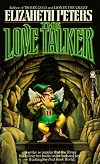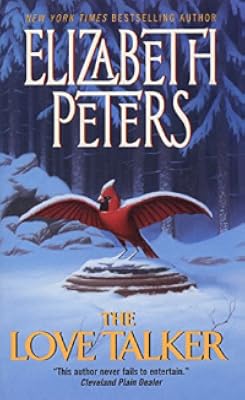
The Love Talker
by Elizabeth Peters
On This Page
Description
Laurie has finally returned to Idlewood, the beloved family home deep in the Maryland woods where she found comfort and peace as a lonely young girl. But things are very different now. There is no peace in Idlewood. The haunting sound of a distant piping breaks the stillness of a snowy winter's evening. Seemingly random events have begun to take on a sinister shape. And dotty old Great Aunt Lizzie is convinced that there are fairies about -- and she has photographs to prove it. For Laurie, show more one fact is becoming disturbingly clear: there is definitely something out there in the woods -- something fiendishly, cunningly, malevolently human -- and the lives of her aging loved ones, as well as Laurie's own, are suddenly at serious risk. show lessTags
Recommendations


















Member Reviews
The Love Talker feels more like a Barbara Michaels novel. I could also believe that Mary Stewart wrote it. There's very little romance, but there is a nice little mystery. I didn't expect some of the twists, but in hindsight the trace was laid to be followed. The main family had thoroughly likeable characters. I could relate to Laurie's trials with her elderly relatives and her half-brother. The book was a fun read.
9-18-2008
This is another old favorite of mine from Elizabeth Peters (aka Barbara Michaels), and I decided to listen to it on audiobook this time. It was as entertaining as I remembered, and the narrator is terrific.
Laurie is working on her dissertation in chilly Chicago when she receives an alarming letter from her Aunt Ida, hinting at oddities afoot at the old homestead in rural Virginia, peculiarities that involve Laurie’s other aunt, Lizzie. Eccentric Lizzie is well known for her flights of fancy already and no one has ever taken them too seriously, so the fact that Ida felt perturbed enough to write to Laurie is bothersome enough, and Laurie can’t help but worry. Her whimsical old aunt is apparently, incredibly, seeing fairies show more in the woods, and they don’t appear to be entirely benevolent.
After a serendipitous phone conversation with Doug, the half-brother Laurie hasn’t seen or spoken to in years, the siblings head home to the secluded Idlewood estate to find out exactly what’s going on. The aunts and their brother, Doug and Laurie’s Uncle Ned, all live together in the old house, and Laurie is uncomfortably aware that at their advancing ages they may not be able to live entirely on their own for too much longer. In fact, she becomes convinced that while she’s been away, someone or several someones have been taking considerable advantage of the old people, particularly of Lizzie. She has some astonishingly realistic photographs of what do indeed appear to be fairies, which have even Laurie – who is well aware of the notorious Cottingley hoax – perplexed. In addition, there is a mysterious young man living in a guest house on the property who seems to have weasled his way firmly into the lives and hearts of the old people, and both Laurie and Doug are suspicious of his motives.
As the malice seems to step up with the siblings’ arrival, Laurie begins to wonder who she can trust. Everyone seems to be keeping secrets as they all dance around each other with frustrating, reticent half-truths, and it’s only when Laurie finally gets a little too close to the heart of the matter that the whole pot boils over.
The odd title refers to Gan Ceanach (Gancanagh, Ganconer, Gan-Ceann), an Irish fairy whose name literally translates to ‘Love Talker’ in English. He’s known for hanging about in woods and glens, smoking his clay pipe and seducing young maidens with his enchanting voice before departing in a swirl of mist, leaving them to pine after him the rest of their days. As a character he doesn’t play any real role in this book so I suspect it was just an intriguing title to use.
Vintage Elizabeth Peters (although it seems more along the Barbara Michaels line and I wonder why she wrote it under the Peters name), fun and satisfying as always. show less
This is another old favorite of mine from Elizabeth Peters (aka Barbara Michaels), and I decided to listen to it on audiobook this time. It was as entertaining as I remembered, and the narrator is terrific.
Laurie is working on her dissertation in chilly Chicago when she receives an alarming letter from her Aunt Ida, hinting at oddities afoot at the old homestead in rural Virginia, peculiarities that involve Laurie’s other aunt, Lizzie. Eccentric Lizzie is well known for her flights of fancy already and no one has ever taken them too seriously, so the fact that Ida felt perturbed enough to write to Laurie is bothersome enough, and Laurie can’t help but worry. Her whimsical old aunt is apparently, incredibly, seeing fairies show more in the woods, and they don’t appear to be entirely benevolent.
After a serendipitous phone conversation with Doug, the half-brother Laurie hasn’t seen or spoken to in years, the siblings head home to the secluded Idlewood estate to find out exactly what’s going on. The aunts and their brother, Doug and Laurie’s Uncle Ned, all live together in the old house, and Laurie is uncomfortably aware that at their advancing ages they may not be able to live entirely on their own for too much longer. In fact, she becomes convinced that while she’s been away, someone or several someones have been taking considerable advantage of the old people, particularly of Lizzie. She has some astonishingly realistic photographs of what do indeed appear to be fairies, which have even Laurie – who is well aware of the notorious Cottingley hoax – perplexed. In addition, there is a mysterious young man living in a guest house on the property who seems to have weasled his way firmly into the lives and hearts of the old people, and both Laurie and Doug are suspicious of his motives.
As the malice seems to step up with the siblings’ arrival, Laurie begins to wonder who she can trust. Everyone seems to be keeping secrets as they all dance around each other with frustrating, reticent half-truths, and it’s only when Laurie finally gets a little too close to the heart of the matter that the whole pot boils over.
The odd title refers to Gan Ceanach (Gancanagh, Ganconer, Gan-Ceann), an Irish fairy whose name literally translates to ‘Love Talker’ in English. He’s known for hanging about in woods and glens, smoking his clay pipe and seducing young maidens with his enchanting voice before departing in a swirl of mist, leaving them to pine after him the rest of their days. As a character he doesn’t play any real role in this book so I suspect it was just an intriguing title to use.
Vintage Elizabeth Peters (although it seems more along the Barbara Michaels line and I wonder why she wrote it under the Peters name), fun and satisfying as always. show less
This is one of the very early Elizabeth Peters books, when Barbara Michaels was still finding her way with this new voice. It's not as polished as the later Peters books, or the Michaels books, but it's very enjoyable.
Laurie Carlson is in Chicago, laboring on her dissertation in mediaeval history, when a very alarming letter arrives from her great-aunt, Ida Morton. Great-aunt Lizzy, Ida's younger sister, has a new enthusiasm, fairies, and is acting even odder than usual. Can Laurie please come home? Ida, Lizzy, and their brother, Ned, effectively raised Laurie after her unreliable mother, Anna, lost interest in being a parent, and she can hardly say no.
But if she had any inclination to do so, moments later the phone rings, and it's her show more half-brother, Doug Wright. He's gotten a very similar alarming letter. Within twenty-four hours, they are arriving at the Morton estate in the Maryland countryside. And while something is definitely odd, no one wants to talk about it. Among the changes that have happened over the last two years is that the Mortons now have household help, a man who lives in a cottage on the estate and does basic chores, maintenance tasks Ned is no longer up to, as well as the driving now that all the Mortons are elderly enough to make it wiser to leave the driving to others. Jeff seems like a nice guy, and he certainly seems devoted to the Mortons.
But weird stuff really is happening. Laurie hears flute music at night, and sees strange lights floating through the garden. She and Doug catch Lizzy sleep-walking, trying to leave the house, on one of the nights Laurie hears the music.
When Laurie discovers Lizzy has disturbingly convincing pictures of the fairies, pictures she says were taken by "one of the Wilson girls," a family that rents land from the Mortons, and shortly thereafter Laurie is nearly run down by the Morton car seemingly driving itself, she and Doug become more and more alarmed.
The story gets further complicated by the fact that Doug and Laurie don't really know each other all that well, everything seems to be directed at Lizzy and there's no apparent motive for anyone to hurt a somewhat odd but sweet and harmless old lady, and some buried family secrets that no one wants to talk about.
Not quite up to her usual standard, but an enjoyable light read, or listen.
I borrowed this book from the library. show less
Laurie Carlson is in Chicago, laboring on her dissertation in mediaeval history, when a very alarming letter arrives from her great-aunt, Ida Morton. Great-aunt Lizzy, Ida's younger sister, has a new enthusiasm, fairies, and is acting even odder than usual. Can Laurie please come home? Ida, Lizzy, and their brother, Ned, effectively raised Laurie after her unreliable mother, Anna, lost interest in being a parent, and she can hardly say no.
But if she had any inclination to do so, moments later the phone rings, and it's her show more half-brother, Doug Wright. He's gotten a very similar alarming letter. Within twenty-four hours, they are arriving at the Morton estate in the Maryland countryside. And while something is definitely odd, no one wants to talk about it. Among the changes that have happened over the last two years is that the Mortons now have household help, a man who lives in a cottage on the estate and does basic chores, maintenance tasks Ned is no longer up to, as well as the driving now that all the Mortons are elderly enough to make it wiser to leave the driving to others. Jeff seems like a nice guy, and he certainly seems devoted to the Mortons.
But weird stuff really is happening. Laurie hears flute music at night, and sees strange lights floating through the garden. She and Doug catch Lizzy sleep-walking, trying to leave the house, on one of the nights Laurie hears the music.
When Laurie discovers Lizzy has disturbingly convincing pictures of the fairies, pictures she says were taken by "one of the Wilson girls," a family that rents land from the Mortons, and shortly thereafter Laurie is nearly run down by the Morton car seemingly driving itself, she and Doug become more and more alarmed.
The story gets further complicated by the fact that Doug and Laurie don't really know each other all that well, everything seems to be directed at Lizzy and there's no apparent motive for anyone to hurt a somewhat odd but sweet and harmless old lady, and some buried family secrets that no one wants to talk about.
Not quite up to her usual standard, but an enjoyable light read, or listen.
I borrowed this book from the library. show less
Doctoral candidate Laurie Carlton and her half-brother Doug Wright are summoned back to Idlewild, the 200-year-old mansion in rural Maryland where they spent summers. Great-Aunt Ida Morton is worried about her younger sister, aged 70, who imagines that fairies are haunting the estate. Doug suspects creeping dementia, but when Laurie sees the lights and hears the music, she realizes there’s more afoot.
The late Elizabeth Peters (one of the pseudonyms of Barbara Mertz) writes the most wonderful mysteries, and this is no exception. Plenty of twists and clever plotting makes this a five-star read.
The late Elizabeth Peters (one of the pseudonyms of Barbara Mertz) writes the most wonderful mysteries, and this is no exception. Plenty of twists and clever plotting makes this a five-star read.
Having been a die-hard Barbara Michaels fan for years, I was almost reluctant to read her Elizabeth Peters persona. I know they're more popular but I thought that the changes would turn me off a bit. After reading The Love Talker, I'd recommend it as a good place to start for anyone else making the transition. Supposably this book is the closest to her Barbara Michaels style while still being a little different.
Since the story borderlines on the paranormal, but it never goes there, I can't help but think that if Peters had followed the story of the hypnotizing evil fairy this book would have turned out better. If she used the Michaels name (as so many reviewers have already said this seems more like a Michaels book than a Peters), and show more the supernatural angle to it's full force, it would have a bit more oomph in the long run.
Baffling and strange, The Love Talker focuses on fairies so much at the beginning I feared it was borderline fantasy. Nothing wrong with that I suppose, but I never find much fantasy I enjoy. For some reason my mind has trouble wrapping around some of the more odd concepts, so when it does read that it just shuts off interest, perhaps to avoid a headache from thinking so hard? How sad. :)
It took me a few days to return, but when I did the book had decided to pick up pace and become more familiar. The main character is the typical strong heroine type, a sharp wit and intelligent determined, not fearful but not overly bold to the point of being unrealistic. There wasn't the usual love interest until the end, that aspect was a little more dilute than other works. Still, I never guessed the ending romantic triangle, which came as more of surprise than the mystery itself. For some reason I guessed who the assailant(s) was, even if I was surprised by one of the accomplices. I couldn't figure out the reason though so it's all still good.
The aunts and uncle were a little weird, with Lizzie being out there she was sometimes migraine inducing. Doug was cute and the typical male hero on the novel. There were enough red herrings to fool the reader, and each eccentricity only added to the novel's appeal. The end show-down was ballsy enough to succeed, and the wrap-up was bittersweet (even if it wasn't adumbrated enough)
The Love Talker held more humor than some of the other books I've read by her, cleverly placed irony that bought the book a special flavoring. I laughed out loud more than once, the book using a humor that complimented but didn't overshadow the story. Pacing was a little slow at first and it takes awhile to build up steam, but this isn't abnormal with Michaels/Peters. Very little violence and no creepy, real suspense factor, but a very good mystery nonetheless. I'm thrilled my expectations of the Peters name brought about the same coziness felt in the gothic mysteries from Michaels; now I get to read more from a beloved author, just under a different name - how could it get better than that? show less
Since the story borderlines on the paranormal, but it never goes there, I can't help but think that if Peters had followed the story of the hypnotizing evil fairy this book would have turned out better. If she used the Michaels name (as so many reviewers have already said this seems more like a Michaels book than a Peters), and show more the supernatural angle to it's full force, it would have a bit more oomph in the long run.
Baffling and strange, The Love Talker focuses on fairies so much at the beginning I feared it was borderline fantasy. Nothing wrong with that I suppose, but I never find much fantasy I enjoy. For some reason my mind has trouble wrapping around some of the more odd concepts, so when it does read that it just shuts off interest, perhaps to avoid a headache from thinking so hard? How sad. :)
It took me a few days to return, but when I did the book had decided to pick up pace and become more familiar. The main character is the typical strong heroine type, a sharp wit and intelligent determined, not fearful but not overly bold to the point of being unrealistic. There wasn't the usual love interest until the end, that aspect was a little more dilute than other works. Still, I never guessed the ending romantic triangle, which came as more of surprise than the mystery itself. For some reason I guessed who the assailant(s) was, even if I was surprised by one of the accomplices. I couldn't figure out the reason though so it's all still good.
The aunts and uncle were a little weird, with Lizzie being out there she was sometimes migraine inducing. Doug was cute and the typical male hero on the novel. There were enough red herrings to fool the reader, and each eccentricity only added to the novel's appeal. The end show-down was ballsy enough to succeed, and the wrap-up was bittersweet (even if it wasn't adumbrated enough)
The Love Talker held more humor than some of the other books I've read by her, cleverly placed irony that bought the book a special flavoring. I laughed out loud more than once, the book using a humor that complimented but didn't overshadow the story. Pacing was a little slow at first and it takes awhile to build up steam, but this isn't abnormal with Michaels/Peters. Very little violence and no creepy, real suspense factor, but a very good mystery nonetheless. I'm thrilled my expectations of the Peters name brought about the same coziness felt in the gothic mysteries from Michaels; now I get to read more from a beloved author, just under a different name - how could it get better than that? show less
Even though the subject is serious (attempted murder always is), Ms. Peters always injects a bit of humor and outrageousness to her plots and characters. It was fun to watch this one play out.
The romantic cover of the Dutch translation hides a thriller.
Liked the writing style, liked the character descriptions, liked the story.
The ending was weaker than the body of the text, which I thought is a pity.
Liked the writing style, liked the character descriptions, liked the story.
The ending was weaker than the body of the text, which I thought is a pity.
Members
- Recently Added By
Author Information

60+ Works 58,698 Members
Some Editions
Work Relationships
Is contained in
Common Knowledge
- Canonical title
- The Love Talker
- Original title
- The Love Talker
- Original publication date
- 1980
- People/Characters
- Laurie Morris; Douglas Morris; Ida Morris; Elizabeth Morris; Ned Morris; Jefferson Banes
- Important places
- Maryland, USA
- First words
- Once upon a time there was a nice big girl named Laura.
- Quotations
- She had no trouble falling asleep again; this time she dreamed she had pushed Little Lord Fauntleroy into a mud puddle. His black velvet suit was all nasty and dirty, and his weeping face was that of her brother.
Smil... (show all)ing, Laurie rolled over and sank into profound, satisfying slumber.
(p.32-33, end of Chapter 2)
[Sir Arthur Conan] Doyle had lived into the twentieth century, but he was a Victorian at heart; and when he babbled on about the bloom of childhood, he really meant virginity. It was an old theme in folklore. Only a virgin co... (show all)uld catch a unicorn. Witches often lost their powers after sexual intercourse. And only an innocent child could see the fairies. Just another example of the value men placed on that wholly meaningless physical feature. Women knew better; but in most periods of history they soon learned to pretend that it was equally important to them. If they didn't, their husbands and brothers and fathers beat the tar out of them.
(p.108, chapter 5) - Last words
- (Click to show. Warning: May contain spoilers.)"Laura," her aunt said, "please don't be vulgar."
Classifications
Statistics
- Members
- 564
- Popularity
- 52,532
- Reviews
- 11
- Rating
- (3.30)
- Languages
- Dutch, English
- Media
- Paper, Audiobook, Ebook
- ISBNs
- 23
- ASINs
- 3