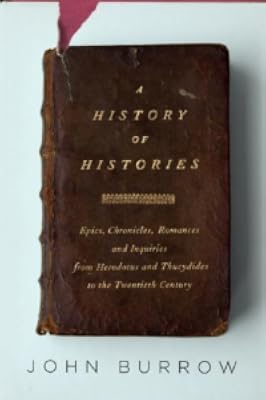
A History of Histories: Epics, Chronicles, Romances and Inquiries from Herodotus and Thucydides to the Twentieth Century
by J. W. Burrow
On This Page
Description
An analysis of the study of the past and its implications in the Western world, from ancient times to the present day, looks at the work of individual historians and how they presented the past in terms of their perspectives, beliefs, and historical periods.Tags
Recommendations
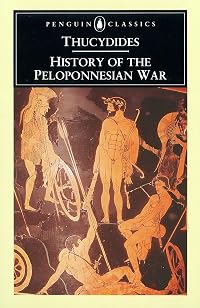
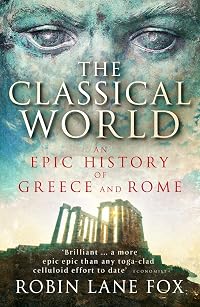
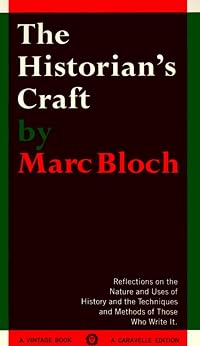
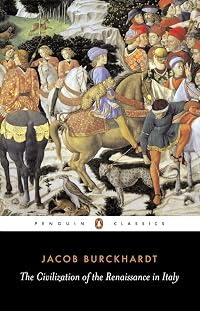






Member Recommendations

nessreader both about historiography- partly the lives of early history scholars, partly a discussion of their aims + styles.
Member Reviews
John W. Burrow is a professor of that somewhat orphaned discipline "history of ideas", or intellectual history. His earlier books include 'Evolution and Society: a study in Victorian Social Theory' (1966), 'A Liberal Descent: four Victorian Historians' (1981), which won the Wolfson Prize for History, 'Gibbon' (1984) and 'The Crisis of Reason: European Thought 1848-1914' (2000).
Burrow approaches 'A History of Histories' as an intellectual historian, and not a critic. That means you won't find critiques regarding historical accuracy. Instead Burrow emphasizes the general character of the historians achievement, relying on the work of specialized scholars and biographers: the biography lists many excellent "secondary" sources a few of show more which Burrow has relied heavily on. He is, in a sense, a popularizer of some the most important histories, his goal being to "give a sense of the experience of reading these histories and what may be enjoyable about them"; he assumes that you have not read or even heard of the works. Such an approach, which mixes interpretation and summary, allows Burrow to cover a great number of works across time - from Herodotus to the late 20th century - but at some cost: a reader may feel they understand the significance of a work, but a connected developing narrative seems unclear; and while there are many block quotes (in particular with the earlier authors), often one yearns for more of a taste of the work.
How can one create a narrative of a "history of histories"? Burrow examines the ideas of the past, and how today we stand in relation to those ideas as expressed in history books. These themes include the emerging conception of a distinct European identity contrasted with Asia; ideas of republican virtue in early Rome, supposedly corrupted by conquest and vice; the Bible's narrative of transgression, punishment and redemption; the idea of an early Germanic state of "freedom" as the ultimate basis for modern constitutional democracy; 19th century ideas of nationalism; 20th century divergences into many genres, none of which dominate.
At its best, 'A History of Histories' conveys the imaginative energies of some of the worlds most famous and important historians. Histories such as this really only matter if they send us off -- for the first or 10th time -- to read Gibbon's account of a Fall, Xenophon's travels through the desert or Parkman's epic of the New World. These works are kept alive because every new generation re-discovers their qualities, and that is why they still matter.
--Stephen Balbach, CoolReading ((c) 2008 by-nd) show less
Burrow approaches 'A History of Histories' as an intellectual historian, and not a critic. That means you won't find critiques regarding historical accuracy. Instead Burrow emphasizes the general character of the historians achievement, relying on the work of specialized scholars and biographers: the biography lists many excellent "secondary" sources a few of show more which Burrow has relied heavily on. He is, in a sense, a popularizer of some the most important histories, his goal being to "give a sense of the experience of reading these histories and what may be enjoyable about them"; he assumes that you have not read or even heard of the works. Such an approach, which mixes interpretation and summary, allows Burrow to cover a great number of works across time - from Herodotus to the late 20th century - but at some cost: a reader may feel they understand the significance of a work, but a connected developing narrative seems unclear; and while there are many block quotes (in particular with the earlier authors), often one yearns for more of a taste of the work.
How can one create a narrative of a "history of histories"? Burrow examines the ideas of the past, and how today we stand in relation to those ideas as expressed in history books. These themes include the emerging conception of a distinct European identity contrasted with Asia; ideas of republican virtue in early Rome, supposedly corrupted by conquest and vice; the Bible's narrative of transgression, punishment and redemption; the idea of an early Germanic state of "freedom" as the ultimate basis for modern constitutional democracy; 19th century ideas of nationalism; 20th century divergences into many genres, none of which dominate.
At its best, 'A History of Histories' conveys the imaginative energies of some of the worlds most famous and important historians. Histories such as this really only matter if they send us off -- for the first or 10th time -- to read Gibbon's account of a Fall, Xenophon's travels through the desert or Parkman's epic of the New World. These works are kept alive because every new generation re-discovers their qualities, and that is why they still matter.
--Stephen Balbach, CoolReading ((c) 2008 by-nd) show less
I have just one regret at reading this ambitious survey of 2500 years of the practice of history—my only contact with almost all of the historians surveyed has been through this book. That's nothing against John Burrow, who admirably covers an enormous range of work here, without imposing any kind of strained overall narrative. But it does leave me thinking that it's a shame how dependent we've become on this kind of work. We're not going to read 20 ancient great historians, 10 more medievals, and 30-some more moderns, in their entirety... not in our lifetimes, most of us. I'll be lucky if I make it to the end of my twice-started Herodotus. So, until I win the lottery or buy that reading chair on my retirement, there are books like this.
really interesting...i'm definitely going to go and give those classics a look
sprightly, vivacious and scintillating.
In "A history of histories" bespreekt John Burrow geschiedschrijvers vanaf de Griekse oudheid tot aan het heden. Hij kijkt hierbij naar de manier waarop historici in bepaalde perioden tegen het verleden aankeken en geeft daarbij aan welke geschiedschrijvers hij meer en minder interessant vind. Vooral de stukken over geschiedschrijvers die ik al gelezen heb vond ik interessant.
Jul 2, 2010Dutch
Ratings
Members
- Recently Added By
Author Information

7+ Works 1,079 Members
J.W. Burrow was, until his recent retirement, professor of European thought at Oxford University.
Some Editions
Awards and Honors
Awards
Series
Belongs to Publisher Series
Common Knowledge
- Original publication date
- 2007-12
- People/Characters
- Herodotus; Thucydides; Xenophon; Arrian; Curtius Rufus; Polybius (show all 40); Sallust; Livy; Plutarch; Appian; Cassius Dio; Tacitus; Flavius Josephus (37-c.100); Ammianus Marcellinus; Eusebius (preseumably Eusebius of Caesarea); Gregory of Tours; Bede ('Venerable Bede', Saint, Doctor of the Church, 673-735); Thomas Babington Macaulay; Geoffrey of Monmouth; William of Malmesbury; Matthew Paris; Geoffrey of Villehardouin; Jean Froissart; Giovanni Villani; Niccolò Machiavelli; Francesco Guicciardini; Edward Hyde, 1st Earl of Clarendon; David Hume (1711-1776); William Robertson; Edward Gibbon; Thomas Carlyle; Jules Michelet; Hippolyte Taine; William Stubbs; Henry Adams; Francis Parkman; Leopold von Ranke; Jacob Burckhardt (Carl Jacob Christoph, 1818-1897); William Hickling Prescott; Bernal Diaz
- Epigraph
- Great thanks, laud, and honour ought to be given unto the clerks, poets, and historiographs that have written many noble books of wisedome of the lives, passions, and miracles of holy saints, of histories of noble and famo... (show all)us acts and faites, and of the chronicles since the beginning of the creation of the world unto this present time, by which we be daily informed and have knowledge of many things of whom we should not have known if they had not left to us their monuments written.
--WILLIAM CAXTON (1484) - First words
- Why 'A History of Histories', or, more explicitly, why not 'The History of History'? (Introduction)
History—the elaborated, secular, prose narrative (all these qualifications are necessary) of public events, based on inquiry—was born, we can claim with confidence, in Greece between roughly 450 and 430 BC. (Prologue)
Classifications
Statistics
- Members
- 849
- Popularity
- 32,200
- Reviews
- 6
- Rating
- (3.94)
- Languages
- 5 — Chinese, English, Greek, Portuguese, Spanish
- Media
- Paper, Ebook
- ISBNs
- 12
- ASINs
- 3