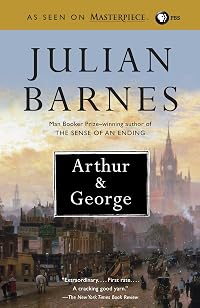
Arthur and George
by Julian Barnes
On This Page
Description
Arthur & George is based on the true story of two men. One is Arthur Conan Doyle, the other is George Edalji, a solicitor from Birmingham. Their nineteenth-century lives are worlds and miles apart, until a series of shocking events brings them together. In dubious circumstances, George is found guilty of harming animals and is sentenced to seven years' penal servitude, a future of ignominious obscurity. However, when Arthur, who is now one of the most famous men in the land as creator of show more Sherlock Holmes, hears of this racist miscarriage of justice he decides to clear George's name. Told against the backdrop of Arthur's family life, his own passionate affair with the woman who was to become the second Lady Conan Doyle and his wife's lengthy battle with TB, this extraordinary novel is a dazzling exercise in detection. show lessTags
Recommendations










Member Recommendations

Member Reviews
Few could create an enjoyable novel from this hybrid of biography, detective mystery, courtroom drama, and campaign for justice, whose themes include chivalry, systemic racism, judicial reform, English identity, courtly love, storytelling, faith, and spiritualism, with vastly different chapter lengths, and seamlessly flip-flopping tenses. But Barnes does.
“Arthur” is Conan Doyle, the creator of Holmes and Watson, and “George” is George Edalji, a young Birmingham solicitor, and the English-born son of a Parsee vicar and his Scottish wife.
The first hundred pages alternate between Arthur and George’s very different Victorian childhoods and early adulthoods, told in past and present tenses respectively. Barnes infers the minds of show more children and adults from known facts, and seeds themes for Arthur and George’s stories, preparing the ground for the Edwardian crime story and its consequent changes to the English legal system.
Foresight, hindsight, second sight
This is all about vision. From the opening sentence about a formative moment:
“A child wants to see.”
To the final three lines:
“What does he see?
What did he see?
What will he see?”
Image: Victorian spectacles at the Wellcome Collection (Source)
In a literal sense, there’s Arthur’s ophthalmological training and George’s extreme myopia - one of many ways they complement each other. But there is wilful blindness in intimate relationships and the legal realm, as well as questions about the veracity of the spiritualism that fascinates Arthur.
How to tell a story
It’s also about stories. George grows up with Bible stories and, though raised Catholic, it’s the mam’s telling of chivalric knights’ tales that captures Arthur’s imagination and sets his moral compass. And then there’s the case for prosecution:
“A story… made up from scraps and coincidences and hypotheses.”
When Arthur takes up George’s case, he visits Chief Constable Anson, who quotes an interview Arthur gave to a magazine:
“You cannot know which path to travel unless you first know the destination.”
But Anson disagrees:
“You cannot understand the ending until you know the beginning.”
It’s not just wordplay; it explains their fundamentally different approaches to George’s case.
Barnes keeps a foot in both camps. The book is split into four sections:
1. Beginning
2. Beginning with an Ending
3. Ending with a Beginning
4. Endings
The “Great Wyrley Outrages” - not a spoiler
The book reads like a novel, but is factual; it quotes real documents, newspapers, transcripts, and records, and the gist of the case is in the blurb.
The Edalji family live in a Shropshire village. They suddenly start receiving poison pen letters, sick “gifts”, threats, and all manner of hoaxes - some sent to them, others done in their name, over several years. Later, farm animals are mutilated. George is eventually charged and sentenced to 7 years penal servitude, despite the absence of significant evidence, motivation, or opportunity.
Arthur learns of the miscarriage of justice when he is bereft and uncharacteristically lacking focus. He is immediately convinced of George’s innocence, determined to prove it, to find the real culprit/s, and to obtain a full pardon and compensation for George.
Image: Letters relating to the case (Source)
Racism
“You’re not a right sort.”
The story concerns systemic racism, including at all levels of the justice system. Or not.
Arthur - and the reader - are in no doubt that race plays some part in the persecution, prosecution, and press coverage: snide comments about swarthy Orientals, “mixing of the blood”, mythical Hindoo [sic] practises, and “half-castes” being understandably vilified around the world.
But George is adamant that race is not a factor. I didn’t understand his view, other than wishful thinking, perhaps influenced by this exchange with his father, quite early on, when, unusually, a white family in the village receives a poison pen letter:
“‘This proves it is not merely race prejudice.’
‘Is that a good thing, Father? To be hated for more than one reason?’”
Image: The Edalji family (George, top left) (Source)
(In)Justice and faith
“I pride myself on being an unofficial Englishman.”
Both men care deeply about justice. For Arthur, defending the underdog is the chivalric duty of an Englishman (although technically he’s Scottish).
George is fascinated with rules, systems, and predictable outcomes; his faith drifts from the church to the sanctity of the law. He clings blindly to that faith, despite what happens. He rejects his father’s portrayal of him as a spiritual martyr, but comes to see himself as a secular one: salvation is not via death, into heaven, but via his earthly trials, onto The Criminal Appeal Act of 1907, and eventually, the creation of the Court of Appeal.
More and less
+ The early biographies of each man would make two good essays in their own right. I wanted to know more about “the mam” (Arthur's mother) and all of George’s family, but that would have been out of place here.
+ There was a curiosity of life in the vicarage that was raised in the trial, and subsequently, but which was never plausibly explained. Anson made nasty and unlikely assumptions about it, but no one else offered a sensible alternative.
- The three-day trial is told in detail (65 pages), and is very well done, but as one who rarely reads or watches courtroom dramas, if felt a little long as an unbroken chapter.
- The final section, looking at an occasion related to Arthur’s fascination with spiritualism and George’s scepticism, was a necessary part of the story, but I don’t think it added enough to justify 50 pages.
True story (minor spoiler in the paragraph below the photo)
Image: George (Source)
George was clearly not guilty beyond reasonable doubt, plus the police broke rules, probably tampered with evidence, and exaggerated, embellished, and distorted statements. But perhaps the most shocking aspect is that the Home Office report, which Arthur campaigned for, reached the contradictory conclusion that George was innocent, but no part of the legal system did anything wrong, so he was not due any compensation for serving time for a crime he did not commit.
• British Heritage page about the case, HERE.
• The Wikipedia page for George Edalji, HERE.
• Arthur’s actual report, HERE.
• New information that came to light in 2015 (ten years after Barnes wrote this), HERE.
Bonus fact: Arthur chose the format for his initial Sherlock Holmes stories as a compromise between serializations, where missing a single one could ruin the story, and shallow freestanding tales. Self contained stories within a broader narrative arc are now common on page and screen.
Image: Arthur (Source)
Quotes
• “A gentle failure of a man.”
• “[She] had not realized that courtship… could be so strenuous, or so resemble tourism.”
• “She had an open, generous nature, a lovely head of curls, and a small income of her own.” (Sounds like Jane Austen)
• “Knowing women less, he is able to idealize them more.”
• “The telephone is the chosen instrument of the adulterer.”
• “In his view it was an Englishman’s inalienable right to tell others, especially those of a nosy inclination, to mind their own business.” show less
“Arthur” is Conan Doyle, the creator of Holmes and Watson, and “George” is George Edalji, a young Birmingham solicitor, and the English-born son of a Parsee vicar and his Scottish wife.
The first hundred pages alternate between Arthur and George’s very different Victorian childhoods and early adulthoods, told in past and present tenses respectively. Barnes infers the minds of show more children and adults from known facts, and seeds themes for Arthur and George’s stories, preparing the ground for the Edwardian crime story and its consequent changes to the English legal system.
Foresight, hindsight, second sight
This is all about vision. From the opening sentence about a formative moment:
“A child wants to see.”
To the final three lines:
“What does he see?
What did he see?
What will he see?”
Image: Victorian spectacles at the Wellcome Collection (Source)
In a literal sense, there’s Arthur’s ophthalmological training and George’s extreme myopia - one of many ways they complement each other. But there is wilful blindness in intimate relationships and the legal realm, as well as questions about the veracity of the spiritualism that fascinates Arthur.
How to tell a story
It’s also about stories. George grows up with Bible stories and, though raised Catholic, it’s the mam’s telling of chivalric knights’ tales that captures Arthur’s imagination and sets his moral compass. And then there’s the case for prosecution:
“A story… made up from scraps and coincidences and hypotheses.”
When Arthur takes up George’s case, he visits Chief Constable Anson, who quotes an interview Arthur gave to a magazine:
“You cannot know which path to travel unless you first know the destination.”
But Anson disagrees:
“You cannot understand the ending until you know the beginning.”
It’s not just wordplay; it explains their fundamentally different approaches to George’s case.
Barnes keeps a foot in both camps. The book is split into four sections:
1. Beginning
2. Beginning with an Ending
3. Ending with a Beginning
4. Endings
The “Great Wyrley Outrages” - not a spoiler
The book reads like a novel, but is factual; it quotes real documents, newspapers, transcripts, and records, and the gist of the case is in the blurb.
The Edalji family live in a Shropshire village. They suddenly start receiving poison pen letters, sick “gifts”, threats, and all manner of hoaxes - some sent to them, others done in their name, over several years. Later, farm animals are mutilated. George is eventually charged and sentenced to 7 years penal servitude, despite the absence of significant evidence, motivation, or opportunity.
Arthur learns of the miscarriage of justice when he is bereft and uncharacteristically lacking focus. He is immediately convinced of George’s innocence, determined to prove it, to find the real culprit/s, and to obtain a full pardon and compensation for George.
Image: Letters relating to the case (Source)
Racism
“You’re not a right sort.”
The story concerns systemic racism, including at all levels of the justice system. Or not.
Arthur - and the reader - are in no doubt that race plays some part in the persecution, prosecution, and press coverage: snide comments about swarthy Orientals, “mixing of the blood”, mythical Hindoo [sic] practises, and “half-castes” being understandably vilified around the world.
But George is adamant that race is not a factor. I didn’t understand his view, other than wishful thinking, perhaps influenced by this exchange with his father, quite early on, when, unusually, a white family in the village receives a poison pen letter:
“‘This proves it is not merely race prejudice.’
‘Is that a good thing, Father? To be hated for more than one reason?’”
Image: The Edalji family (George, top left) (Source)
(In)Justice and faith
“I pride myself on being an unofficial Englishman.”
Both men care deeply about justice. For Arthur, defending the underdog is the chivalric duty of an Englishman (although technically he’s Scottish).
George is fascinated with rules, systems, and predictable outcomes; his faith drifts from the church to the sanctity of the law. He clings blindly to that faith, despite what happens. He rejects his father’s portrayal of him as a spiritual martyr, but comes to see himself as a secular one: salvation is not via death, into heaven, but via his earthly trials, onto The Criminal Appeal Act of 1907, and eventually, the creation of the Court of Appeal.
More and less
+ The early biographies of each man would make two good essays in their own right. I wanted to know more about “the mam” (Arthur's mother) and all of George’s family, but that would have been out of place here.
+ There was a curiosity of life in the vicarage that was raised in the trial, and subsequently, but which was never plausibly explained. Anson made nasty and unlikely assumptions about it, but no one else offered a sensible alternative.
- The three-day trial is told in detail (65 pages), and is very well done, but as one who rarely reads or watches courtroom dramas, if felt a little long as an unbroken chapter.
- The final section, looking at an occasion related to Arthur’s fascination with spiritualism and George’s scepticism, was a necessary part of the story, but I don’t think it added enough to justify 50 pages.
True story (minor spoiler in the paragraph below the photo)
Image: George (Source)
George was clearly not guilty beyond reasonable doubt, plus the police broke rules, probably tampered with evidence, and exaggerated, embellished, and distorted statements. But perhaps the most shocking aspect is that the Home Office report, which Arthur campaigned for, reached the contradictory conclusion that George was innocent, but no part of the legal system did anything wrong, so he was not due any compensation for serving time for a crime he did not commit.
• British Heritage page about the case, HERE.
• The Wikipedia page for George Edalji, HERE.
• Arthur’s actual report, HERE.
• New information that came to light in 2015 (ten years after Barnes wrote this), HERE.
Bonus fact: Arthur chose the format for his initial Sherlock Holmes stories as a compromise between serializations, where missing a single one could ruin the story, and shallow freestanding tales. Self contained stories within a broader narrative arc are now common on page and screen.
Image: Arthur (Source)
Quotes
• “A gentle failure of a man.”
• “[She] had not realized that courtship… could be so strenuous, or so resemble tourism.”
• “She had an open, generous nature, a lovely head of curls, and a small income of her own.” (Sounds like Jane Austen)
• “Knowing women less, he is able to idealize them more.”
• “The telephone is the chosen instrument of the adulterer.”
• “In his view it was an Englishman’s inalienable right to tell others, especially those of a nosy inclination, to mind their own business.” show less
I regard late 19th/early 20th century spiritualism as an embarrassing phase in western thought. For example the portrayal in Queen Lucia by E.F. Benson shows the villagers' craving for excitement and spookiness and their willingness to be duped. But this book made me reconsider. One of our protagonists is a medical doctor and quite sure that scientific discoveries will be followed by spiritual discoveries. The superstition of the past will be swept away by new understanding based on research and observation. Yes, he allows, 99% of mediums are fakers. But that means that 1% are genuine and that is a great thing. I am less embarrassed by the whole thing after reading that.
The coverage of the animal slashings and court proceedings I found show more too much to bear so skipped ahead. show less
The coverage of the animal slashings and court proceedings I found show more too much to bear so skipped ahead. show less
Julian Barnes uses an elegant and readable writing style to create the dual fictional lives of Sir Arthur Conan Doyle and George Edalji in this his tenth novel. The result is a compelling narrative that at once is both interesting as fictional biography and as a detective story. Personally, I found the mystery and Doyle's investigation into its' source was more interesting, but the rest of the novel was well enough told to almost keep up with the suspense created by the mystery. The combination was one of the best novels I have read all year and would certainly make any ten-best list I might create, if I were so inclined. The author uses an interesting narrative technique switching back and forth between the two protagonists as they show more grow up completely unaware of each other until the moment when their lives become inextricably intertwined, in no small part due to the fame of Doyle's most famous creation, Sherlock Holmes. What happens subsequently as their lives continue to their unique personal conclusions is summed up in the final sections of the novel. Certainly this is a more than satisfying read for several winter nights. show less
Arthur & George intertwines the stories of two historical figures: Arthur Conan Doyle, who you all know, and George Edalji, who you all should. As George becomes the victim of a ruthless smear campaign (and worse) while he struggles to make it as an Edinburgh solicitor (also publishing an excellent little book on railway law for the educated man on the train), Arthur marries his wife, invents Sherlock Holmes, and embarks on an affair. Barnes is adept, and I was drawn in almost instataneously: both characters come alive, but especially George. I think mostly because so many bad things happen to him, really allowing us to see his character from every possible angle. Arthur's not quite so fully fleshed out, but despite the title it's show more really George's novel, so that's okay.
I like well-written, literary novels, and I like well-plotted, gripping novels. But (if I'm going to make a wide and probably inaccurate generalization) it's rare that a novel has both characteristics. Arthur & George knocks it out of the park on both pitches. As I said, both leads are strongly characterized, and Barnes is simply marvelous to read as a writer; his prose is very strong and very insightful. But at the same time, I was very nearly always on the edge of my seat, wanting to know what happened next, especially during the trial sequences. It's a detective novel in some ways, but it's a detective novel that has something to say about how we look for truth and how we hold up in the face of it. Absolutely fantastic, I was hooked all the way through, and I can't recommend it enough. The best book I've read in ages.
added May 2014:
I always like to ask my students what they thought of the books we read when the semester is over, though this semester I did not allow for as much time/space as I did in the past, so the comments are consequently less detailed. In any case, my impression of the reception of Arthur & George is vaguely positive: they felt it was slow to start, and were frustrated with the lack of resolution, though I think I got them to at least comprehend why that was the case with our discussion of postmodernism:
I like well-written, literary novels, and I like well-plotted, gripping novels. But (if I'm going to make a wide and probably inaccurate generalization) it's rare that a novel has both characteristics. Arthur & George knocks it out of the park on both pitches. As I said, both leads are strongly characterized, and Barnes is simply marvelous to read as a writer; his prose is very strong and very insightful. But at the same time, I was very nearly always on the edge of my seat, wanting to know what happened next, especially during the trial sequences. It's a detective novel in some ways, but it's a detective novel that has something to say about how we look for truth and how we hold up in the face of it. Absolutely fantastic, I was hooked all the way through, and I can't recommend it enough. The best book I've read in ages.
added May 2014:
I always like to ask my students what they thought of the books we read when the semester is over, though this semester I did not allow for as much time/space as I did in the past, so the comments are consequently less detailed. In any case, my impression of the reception of Arthur & George is vaguely positive: they felt it was slow to start, and were frustrated with the lack of resolution, though I think I got them to at least comprehend why that was the case with our discussion of postmodernism:
- "Drop Arthur and George"
- "I think you should teach Adam Bede, Arthur & George and Frankenstein (which I had already read in high school but didn't get that much out of at the time) again definitely"
- "Arthur & George and Between the Acts were my least favorites as the 'density' of the text and slow pace made it really hard to get through."
- "I really liked Frankenstein, The Thing in the Forest, Sherlock Holmes, and Arthur and George."
This is a bit of a slow burner. It takes over half the book before the two protagonists come together. Arthur is Arthur Conan Doyle, while George is the son of a Shropshire vicar who becomes a solicitor. he also happens to not be white and is the victim of a miscarriage of justice. It is this miscarriage that brings the two together, with Arthur putting his Sherlock Holmes hat on and investigating the conviction. The story starts with short chapters of each character's life, such that you develop a picture of them and they are fully formed before they come together. this ground work means that the second half of the book accelerates based on the effort put into the foundations during the first half.
It does beg the question how valid is show more the English Justice system, as the case appears, from this account, to be entirely manufactured, and the genuine culprit is not brought to court. This isn't one of those cases where you feel the same couldn't happen again now. While set in the past it remains entirely relevant. show less
It does beg the question how valid is show more the English Justice system, as the case appears, from this account, to be entirely manufactured, and the genuine culprit is not brought to court. This isn't one of those cases where you feel the same couldn't happen again now. While set in the past it remains entirely relevant. show less
This tells the intersecting stories of Sir Arthur Conan Doyle, the noted writer, and George Edalji, a solicitor who was wrongfully convicted of mutilating livestock. Doyle takes up Edalji's case to obtain him a free pardon and compensation. Along the way, there is a great deal to ponder. We become closely acquainted with the thought processes of both men: the careful, correct Edalji and the booming, passionate Doyle; their respective family situations; their very different experiences of fame. Edalji considers his sentence to be not just a sentence on him, but on his family as well, while Doyle wishes everyone would just shut up already about Sherlock Holmes. (When Doyle takes the case and publishes articles about it, the story is show more picked up around the world with variations on the headline "Sherlock Holmes investigates".)
This book is full of big ideas and little details. I particularly enjoyed the account of Doyle's time in Portsmouth (Southsea, to be precise), a place I'd recently visited and which has a collection of Doyle memorabilia in its city museum. I also loved that Edalji published a book of railway law for passengers---what a useful idea! Everyone should have a copy of something like that, and there should be one for air travel as well if there isn't already.
I thoroughly enjoyed this book and am already planning to reread it, this time with a pen and notebook handy to write down memorable passages. show less
This book is full of big ideas and little details. I particularly enjoyed the account of Doyle's time in Portsmouth (Southsea, to be precise), a place I'd recently visited and which has a collection of Doyle memorabilia in its city museum. I also loved that Edalji published a book of railway law for passengers---what a useful idea! Everyone should have a copy of something like that, and there should be one for air travel as well if there isn't already.
I thoroughly enjoyed this book and am already planning to reread it, this time with a pen and notebook handy to write down memorable passages. show less
I picked up this book at a library sale because I initially misremembered Julian Barnes for Julian Fellowes. When I read the synopsis though, I put it in my bag. From the opening words, I knew I made a good choice.
“He was able to walk, and could reach up to a door handle. He did this with nothing that could be called a purpose, merely the instinctive tourism of infancy.” p. 1
From a character perspective, George is the stronger and I wondered just how the hell he would make it through life with his backward and terrified nature. The campaign of pranks and harassment was really bizarre. I could easily imagine how frightening it would be. Disturbing. The animal mutilations were worse. Sickos. All during those episodes though, I show more wondered if we were seeing George accurately. Could he be really responsible, but either lying about it or subject to fugue states that he was unaware of? At the end, I decided that he probably was truly innocent, but what a weirdo he was. I didn’t have that much sympathy for him. People like that are natural victims and I think he brought some of it on himself.
Two things I wanted more clarity on were the reasons the police suspected him in the first place and why Doyle took on the case. The prejudice against the Edalji family was pretty clear, but not the reasons for it except the obvious; that dad was Indian and that made George a half-caste (and just how G could go so far through life not realizing this fact is really mind-boggling). Anson kept implying he had more information about the crimes, but wouldn’t share it so we’re left pretty much in the dark. And what made Doyle decide to help George out of the probably hundreds of other requests? He says something like he was just struck by the miscarriage of justice, but really? Eh, I’d have liked more concrete answers to both questions.
Basically the story of Arthur and George is one of contrasts; philosophical v. literal. George can barely think in the abstract while Arthur rarely leaves it, except, weirdly, when he’s writing fiction. He must be very persuasive, because it seems his very traditionally-minded and religious wife is convinced in the end, that spiritism is not evil and seems to embrace it. If such an event of mass-mediums really happened after Doyle’s death, I see why Barnes put it in, but I didn’t really like it. It didn’t seem to wrap up anything. In terms of Doyle’s beliefs, I can see how it fits, but as a story epilogue it was strange. As strange as these words from Jean to George at her and Arthur’s wedding reception -
“I expect we shall be interrupted at any moment, and in any case I was not intending to explain. You may never know what I mean. But I am grateful to you in a way you cannot guess. And so it is quite right that you are here.” show less
“He was able to walk, and could reach up to a door handle. He did this with nothing that could be called a purpose, merely the instinctive tourism of infancy.” p. 1
From a character perspective, George is the stronger and I wondered just how the hell he would make it through life with his backward and terrified nature. The campaign of pranks and harassment was really bizarre. I could easily imagine how frightening it would be. Disturbing. The animal mutilations were worse. Sickos. All during those episodes though, I show more wondered if we were seeing George accurately. Could he be really responsible, but either lying about it or subject to fugue states that he was unaware of? At the end, I decided that he probably was truly innocent, but what a weirdo he was. I didn’t have that much sympathy for him. People like that are natural victims and I think he brought some of it on himself.
Two things I wanted more clarity on were the reasons the police suspected him in the first place and why Doyle took on the case. The prejudice against the Edalji family was pretty clear, but not the reasons for it except the obvious; that dad was Indian and that made George a half-caste (and just how G could go so far through life not realizing this fact is really mind-boggling). Anson kept implying he had more information about the crimes, but wouldn’t share it so we’re left pretty much in the dark. And what made Doyle decide to help George out of the probably hundreds of other requests? He says something like he was just struck by the miscarriage of justice, but really? Eh, I’d have liked more concrete answers to both questions.
Basically the story of Arthur and George is one of contrasts; philosophical v. literal. George can barely think in the abstract while Arthur rarely leaves it, except, weirdly, when he’s writing fiction. He must be very persuasive, because it seems his very traditionally-minded and religious wife is convinced in the end, that spiritism is not evil and seems to embrace it. If such an event of mass-mediums really happened after Doyle’s death, I see why Barnes put it in, but I didn’t really like it. It didn’t seem to wrap up anything. In terms of Doyle’s beliefs, I can see how it fits, but as a story epilogue it was strange. As strange as these words from Jean to George at her and Arthur’s wedding reception -
“I expect we shall be interrupted at any moment, and in any case I was not intending to explain. You may never know what I mean. But I am grateful to you in a way you cannot guess. And so it is quite right that you are here.” show less
Members
- Recently Added By
Published Reviews
ThingScore 100
Barnes’s suave, elegant prose — alive here with precision, irony and humaneness — has never been used better than in this extraordinary true-life tale, which is as terrifically told as any by its hero Conan Doyle himself.
added by simon_carr
For all the numerous retellings of Conan Doyle's life, it is hard to imagine that Barnes's semi-fictional version could be bettered in texture or acuity. In his elegant mini-chapters, he unpacks the writer's extraordinary rites of passage: his famous failure as an ophthalmologist; his work on a whaling ship; his sporting prowess - batting for the MCC, skiing Alpine passes; his heroism in the show more Boer War. show less
added by simon_carr
Lists

1001 Books You Must Read Before You Die
1,448 works; 1,136 members

Booker Prize
491 works; 62 members

Fiction Featuring Real People
81 works; 17 members

International IMPAC Dublin Literary Award
179 works; 6 members
Booker Prize Shortlist: Titles Read
103 works; 10 members

Man Booker Prize Longlist 2005
17 works; 3 members

BBC Radio 4 Bookclub
341 works; 13 members

Books Read in 2016
4,666 works; 197 members

Llibres que he llegit el 2018
46 works; 1 member

Books Read in 2018
4,360 works; 110 members

221B Baker Street and Beyond
66 works; 1 member

Lectures del 2023
7 works; 1 member

Books Read in 2024
4,727 works; 128 members

Best Mysteries With a Historical Setting
292 works; 160 members

Books Read in 2025
4,128 works; 98 members

Books Read in 2026
2,161 works; 70 members

Fiction with Men's Given Names in the Title
302 works; 11 members

Five star books
1,767 works; 109 members
Talk Discussions
Past Discussions
Group Read: Arthur & George by Julian Barnes in 75 Books Challenge for 2018 (February 2018)
Author Information

89+ Works 43,199 Members
Julian Barnes was born in Leicester, England, on January 19, 1946. He received a degree in modern languages from Magdalen College, Oxford University in 1968. He has held jobs as a lexicographer for the Oxford English Dictionary, a reviewer and literary editor for the New Statesmen and the New Review, and a television critic. He has written show more numerous works of fiction including Arthur and George, Pulse: Stories, The Noise of Time, and England, England. He received the Somerset Maugham Award in 1980 for Metroland, the Geoffrey Faber Memorial Prize in 1985 and a Prix Medicis in 1986 for Flaubert's Parrot, and the Man Booker Prize in 2011 for The Sense of an Ending. He also writes non-fiction works including Letters from London, The Pedant in the Kitchen, and Nothing to Be Frightened Of. He received the Shakespeare Prize by the FVS Foundation in 1993, the Austrian State Prize for European Literature in 2004, and the David Cohen Prize for Literature in 2011. He writes detective novels under the pseudonym Dan Kavanaugh. His works under this name include Duffy, Fiddle City, Putting the Boot In, and Going to the Dogs. (Bowker Author Biography) show less
Some Editions
Awards and Honors
Awards
Distinctions
Series
Belongs to Publisher Series
Gallimard, Folio (4793)
Work Relationships
Has the adaptation
Common Knowledge
- Canonical title
- Arthur and George
- Original title
- Arthur and George
- Alternate titles*
- Arthur en George
- Original publication date
- 2005
- People/Characters
- Arthur Conan Doyle; George Edalji; Louisa (Hawkins | nicknamed Touie); Jean Conan Doyle (Leckie)
- Important places
- Great Wyrley, Staffordshire, England, UK; Staffordshire, England, UK; India; Edinburgh, Scotland, UK
- Related movies
- Arthur & George (2015 | IMDb)
- Dedication*
- to P.K.
- First words
- A child wants to see. It always begins like this, and it began like this then. A child wanted to see.
- Quotations
- George Edalji died at 9 Brocket Close, Welwyn Garden City, on 17th June 1953; the cause of death was given as coronary thrombosis.
"A barrister, however competent, cannot make bricks without straw."
Litchfield Meek gave George a worldly smile. "In my years in the courts, Mr. Edalji, I've seen bricks made from all sorts of materials. Some you didn'... (show all)t even know existed. Lack of straw will be no hardship to Mr. Disturnal."
Wood did not understand why his employer was so insistent upon disguise; first material, then psychological. In his view it was an Englishman's inalienable right to tell others, especially those of a nosy inclination, to mind... (show all) their own business.
"It means, my dearest Jean, that no one has done anything wrong. It means that the great British solution to everything has been applied. Something terrible has happened, but nobody has done anything wrong. It ought to be ret... (show all)rospectively enshrined in the Bill of Rights. Nothing shall be anybody's fault, and especially not ours."
If these are indeed the spirits of Englishmen and Englishwomen who have passed over into the next world, surely they would know how to form a proper queue? - Last words
- (Click to show. Warning: May contain spoilers.)What will he see?
- Original language
- English
- Disambiguation notice
- This is the book; do not combine with film/video
*Some information comes from Common Knowledge in other languages. Click "Edit" for more information.
Classifications
Statistics
- Members
- 5,203
- Popularity
- 2,646
- Reviews
- 184
- Rating
- (3.70)
- Languages
- 20 — Catalan, Czech, Danish, Dutch, English, French, German, Galician, Italian, Norwegian (Bokmål), Polish, Portuguese, Romanian, Russian, Serbian, Slovenian, Spanish, Swedish, Thai, Turkish
- Media
- Paper, Audiobook, Ebook
- ISBNs
- 76
- UPCs
- 1
- ASINs
- 23