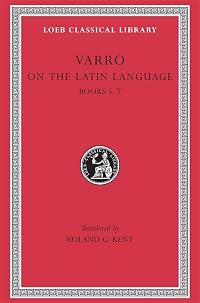
Varro: On the Latin Language, Volume I, Books 5-7 (Loeb Classical Library No. 333)
by Varro
102 Members (4.50)
On This Page
Description
Of more than seventy works by Varro (116-27 BCE) we have only his treatise On Agriculture and part of his On the Latin Language, a work typical of its author's interest not only in antiquarian matters but also in the collection of scientific facts, and containing much of very great value to the study of the Latin language. Varro (M. Terentius), 116-27 BCE, of Reate, renowned for his vast learning, was an antiquarian, historian, philologist, student of science, agriculturist, and poet. He was show more a republican who was reconciled to Julius Caesar and was marked out by him to supervise an intended national library. Of Varro's more than seventy works involving hundreds of volumes we have only his treatise On Agriculture (in Loeb number 283) and part of his monumental achievement De Lingua Latina, On the Latin Language, a work typical of its author's interest not only in antiquarian matters but also in the collection of scientific facts. Originally it consisted of twenty-five books in three parts: etymology of Latin words (books 1-7); their inflexions and other changes (books 8-13); and syntax (books 14-25). Of the whole work survive (somewhat imperfectly) books 5 to 10. These are from the section (books 4-6) which applied etymology to words of time and place and to poetic expressions; the section (books 7-9) on analogy as it occurs in word formation; and the section (books 10-12) which applied analogy to word derivation. Varro's work contains much that is of very great value to the study of the Latin language. The Loeb Classical Library edition of On the Latin Language is in two volumes. show lessTags
Recommendations





Member Reviews
Members
- Recently Added By
Author Information

53+ Works 443 Members
Series
Belongs to Publisher Series
Loeb Classical Library (333)
Common Knowledge
- Original title
- Dé Linguá Latíná
- Original publication date
- 43 BCE (ca.) (ca.)
- Dedication
- Ad Ciceronem
- First words
- I. 1. QUEMADMODUM vocabula essent imposita rebus in lingua Latina, sex libris exponere institui. De his tris ante hunc feci quos Septumio misi: in quibus est de disciplina, quam vocant ετυμολογικήν: quae contra e... (show all)a dicerentur, volumine primo, quae pro ea, secundo, quae de ea, tertio. In his ad te scribam, a quibus rebus vocabula imposita sint in lingua latina, et ea quae sunt in consuetudine apud poetas.
I. 1. IN what way names were applied to things in Latin, I have undertaken to expound, in six books. Of these, I have already composed three before this one, and have addressed them to Septumius; in them I treat of the branc... (show all)h of learning which is called Etymology. The considerations which might be raised against it, I have put in the first book; those adduced in its favour, in the second; those merely describing it, in the third. In the following books, addressed to you, I shall discuss the problem from what things names were applied in Latin, both those which are habitual with the ordinary folk, and those which are found in the poets. - Last words
- (Click to show. Warning: May contain spoilers.)110. In secundis tribus quos ad te misi item generatim discretis, primum in quo sunt origines verborum locorum et earum rerum quae in locis esse solent, secundem quibus vocabulis tepora sint notata et eae res quae in temporibus fiunt, tertius hic, in quo a poetis item sumpta ut illa quae dixi in duobus libris soluta oratione. Quocirca quoniam omnis operis de Lingua Latina tris feci partis, primo quemadmodum vocabula imposita essent rebus, secundo quemadmodum ea in casus declinarentur, tertio quemadmodum coniungerentur, prima parte perpetrata, ut secundam ordiri possim, huic libro faciam finem.
(Click to show. Warning: May contain spoilers.)110. In the second three which I sent to you, the subjects are likewise divided off: first, that in which the origins of words for places are set forth, and for those things which are wont to be in places; second, with what words times are designated and those things which are done in times; third, the present book, in which words are taken from the poets in the same way as those which I have mentioned in the other two books were taken from prose writings. Therefore, since I have made three parts of the whole work "On the Latin Language", first how names were set upon things, second how the words are declined in cases, third how they are combined into sentences--as the first part is now finished, I shall make an end to this book, that I may be able to commence the second part. - Original language
- Latin
Classifications
Statistics
- Members
- 102
- Popularity
- 318,097
- Rating
- (4.50)
- Languages
- Czech, English, Latin
- Media
- Paper, Ebook
- ISBNs
- 7