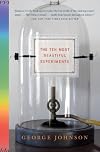
The Ten Most Beautiful Experiments
by George Johnson
On This Page
Description
The ten most fascinating experiments in the history of science--moments when a curious soul posed a particularly eloquent question to nature and received a crisp, unambiguous reply. Johnson takes us to those times when the world seemed filled with mysterious forces, when scientists were dazzled by light, by electricity, and by the beating of the hearts they laid bare on the dissecting table. For all of them, diligence was rewarded. In an instant, confusion was swept aside and something new show more about nature leaped into view. In bringing us these stories, Johnson restores some of the romance to science, reminding us of the existential excitement of a single soul staring down the unknown.--From publisher description. show lessTags
Recommendations














Member Reviews
I remember sitting through the many science classes in high school -- biology, chemistry, physics, and so on -- listening to the teachers lecture on different theories and then having us put them to use. Interesting stuff, but we were working with already-proven theories: how many calories in such and such food, how does a prism bend light, a2 + b2 = c2. Honestly, back then I just wanted to get through the classes, so I just accepted the theories and moved on.
Now that I'm older, my mind wants to know why this theory is correct, how did it come about. So when I randomly pulled George Johnson's book "The Ten Most Beautiful Experiments" off a bookstore shelf, I was intrigued. And how can you not when the description in the dust jacket show more reads: "...and [Sir Isaac] Newton carefully inserting a needle behind his eye to learn how light causes vibrations in the retina."? (That hooked the horror fiend in me.)
Johnson takes a chronological approach to the experiments, beginning with Galileo's experiments with accurately measuring the speed at objects move, Newton's use of prisms and the aforementioned needle to determine what makes color, and onward through Faraday's making the connection between magnetism and electricity and Millikan's work discovering the electron. But, instead of just stating the theory, Johnson provides the back stories, what sparked the scientists to push the envelope farther, what obstacles they had to overcome, how the mindsets at their points in history affected their experiments. And that's the fascinating part, walking with each scientist step by step through the trials, successes and failures to reach some new insight into how the world works.
On a few occasions, I did find myself re-reading sections to make sure I understood what was going on. I'm not a scientist so certain facts were glossed over as if I should have known them, such as the speed of light in A.A. Michelson's study of the velocity of the Earth. In spite of that, "The Ten Most Beautiful Experiments" is fascinating and well worth a read. show less
Now that I'm older, my mind wants to know why this theory is correct, how did it come about. So when I randomly pulled George Johnson's book "The Ten Most Beautiful Experiments" off a bookstore shelf, I was intrigued. And how can you not when the description in the dust jacket show more reads: "...and [Sir Isaac] Newton carefully inserting a needle behind his eye to learn how light causes vibrations in the retina."? (That hooked the horror fiend in me.)
Johnson takes a chronological approach to the experiments, beginning with Galileo's experiments with accurately measuring the speed at objects move, Newton's use of prisms and the aforementioned needle to determine what makes color, and onward through Faraday's making the connection between magnetism and electricity and Millikan's work discovering the electron. But, instead of just stating the theory, Johnson provides the back stories, what sparked the scientists to push the envelope farther, what obstacles they had to overcome, how the mindsets at their points in history affected their experiments. And that's the fascinating part, walking with each scientist step by step through the trials, successes and failures to reach some new insight into how the world works.
On a few occasions, I did find myself re-reading sections to make sure I understood what was going on. I'm not a scientist so certain facts were glossed over as if I should have known them, such as the speed of light in A.A. Michelson's study of the velocity of the Earth. In spite of that, "The Ten Most Beautiful Experiments" is fascinating and well worth a read. show less
A look at ten elegant and important experiments in the history of science, from Galileo measuring the force of gravity by rolling balls down inclined planes to Robert Millikan determining the charge of an electron by observing the movements of tiny electrically charged drops of oil. In each chapter, the author describes not just the experiment itself, but other related experiments, the context of prevailing scientific belief at the time, and a few interesting facts about the researchers' lives. And yet, for me, it somehow still feels like we're only being offered a tiny, incomplete glimpse of the subject at hand. It's a very short book -- 180 pages for a prologue, an afterword, and all ten experiments -- and maybe it's just not possible show more to do full justice to an entire field of science in that amount of space. Still, the book does a fairly good job of demonstrating the way that science works at its best, how one beautifully designed experiment can reveal something new and profound about how the universe works, and the process by which reasonable but wrong assumptions about the world are reluctantly but inevitably replaced with a better understanding.
One word of warning, though. These experiments may be scientifically beautiful, but some of them are viscerally disturbing. It's very difficult to read about William Harvey examining the beating hearts of (temporarily) still-living animals, or Isaac Newton poking needles into his own eye sockets without wincing. show less
One word of warning, though. These experiments may be scientifically beautiful, but some of them are viscerally disturbing. It's very difficult to read about William Harvey examining the beating hearts of (temporarily) still-living animals, or Isaac Newton poking needles into his own eye sockets without wincing. show less
Johnson's Ten Most Beautiful Experiments is a charming concept with a very different angle from the usual pop-science fare. Beginning with Galileo's work with falling objects and proceeding chronologically through to Millikan's oil-drop experiment to determine the charge of the electron, he provides brief descriptions of what he considers to be not necessarily the most important, but the most beautiful, experiments in the history of science.
Unfortunately, while Johnson's descriptions of the experiments are clear and simple, he fails to provide adequate context in many cases. This didn't bother me other than intellectually; my background is in physics, so I know the context and could just sit back and enjoy a familiar story well-told, show more while kibbitzing about the choices, but for people less familiar with the context this could be a more serious problem. Johnson did a good job of providing the context leading up to each experiment, but stopped there, so anything following on from, say, Faraday's work with light and magnetic fields was omitted. I was most annoyed by this omission in the case of Newton's work with prisms, where there wasn't a word about later work, such as Herschel's equally beautiful demonstration that sunlight continues beyond the visible range (by placing a thermometer beyond the red end of the spectrum, in the infrared range, and noting the temperature increase.) Similarly, to a reader unfamiliar with the electromagnetic nature of light, the lack of later context of Faraday's work would have rendered that section mystifying.
i have my quibbles about some of the selections, as most readers presumably do; Harvey and Pavlov, in particular, seem to have been selected more on the basis of a continuing body of work than for a particular, striking experiment. I would have omitted one or both of them, and included Rutherford's discovery of the nucleus (which, to his credit, Johnson does mention in the epilogue on the "eleventh most beautiful experiment".)
Despite its flaws, this was an interesting book, and the reader left confused by the lack of context could certainly supplement that by further reading on the particular areas that interested them. show less
Unfortunately, while Johnson's descriptions of the experiments are clear and simple, he fails to provide adequate context in many cases. This didn't bother me other than intellectually; my background is in physics, so I know the context and could just sit back and enjoy a familiar story well-told, show more while kibbitzing about the choices, but for people less familiar with the context this could be a more serious problem. Johnson did a good job of providing the context leading up to each experiment, but stopped there, so anything following on from, say, Faraday's work with light and magnetic fields was omitted. I was most annoyed by this omission in the case of Newton's work with prisms, where there wasn't a word about later work, such as Herschel's equally beautiful demonstration that sunlight continues beyond the visible range (by placing a thermometer beyond the red end of the spectrum, in the infrared range, and noting the temperature increase.) Similarly, to a reader unfamiliar with the electromagnetic nature of light, the lack of later context of Faraday's work would have rendered that section mystifying.
i have my quibbles about some of the selections, as most readers presumably do; Harvey and Pavlov, in particular, seem to have been selected more on the basis of a continuing body of work than for a particular, striking experiment. I would have omitted one or both of them, and included Rutherford's discovery of the nucleus (which, to his credit, Johnson does mention in the epilogue on the "eleventh most beautiful experiment".)
Despite its flaws, this was an interesting book, and the reader left confused by the lack of context could certainly supplement that by further reading on the particular areas that interested them. show less
If there is anything I love as much as science, its...ummmm, science history! There is something charming about science of yesteryear that is simply missing in the commercialized version of it today. It's endearing the way many things we consider common sense were discovered, the way Newton dissected the concept of 'color,' or Galileo's work on calculating gravity and acceleration. I like to picture them in dusty, sun-lit rooms, their clothes ruffled and their surroundings in disarray as they bend over some absurd and strangely beautiful device that is completely alien to everyone except the scientist themselves, finessing out some quandary that few people would bother would bother even wondering about. Maybe they electrocute show more themselves, or funnel toxic gases into their nostrils. Maybe their experiment works perfectly and everything they wanted to prove is exemplified before their eyes, or maybe it all falls apart and they accidentally discover something even more magnificent. Or maybe it's all crap and we are left with an artifact the well-off will pay thousands of dollars to display in their ugly art-deco houses. Regardless, it is all rather more compelling than the soulless, corporate-sponsored science that makes up the majority of scientific study today.
These Victorian-age scientists make up the vast majority of George Johnson's book. As the title suggests, it collects what he considers the 10 most beautiful experiments of the past. The definition of beautiful is vague in this instance, but essentially every entry in the list is just plain interesting, one way or another, be it an elegant machine, a remarkable idea, or ground shaking implications. I wish the book had been a bit longer, at only 160 pages, only about 15 pages (with illustrations) are dedicated to each entry. It feels like a very brief overview, and this is compounded by Johnson's tendency to meander from the topic a bit. I even found myself forgetting which scientist I was reading about a couple times when he deviated from the topic long enough.
I don't know. The book is in no way bad, but having finished it I find myself wishing it were better. It's a serviceable overview of 10 fantastic experiments, the science is great and the author has some interesting commentary from time to time. BUT! But, well, unlike the experiments themselves, it didn't blow my mind or anything. Good but not great, only read it if you really like science, or want a quick overview with minimal commitment required. show less
These Victorian-age scientists make up the vast majority of George Johnson's book. As the title suggests, it collects what he considers the 10 most beautiful experiments of the past. The definition of beautiful is vague in this instance, but essentially every entry in the list is just plain interesting, one way or another, be it an elegant machine, a remarkable idea, or ground shaking implications. I wish the book had been a bit longer, at only 160 pages, only about 15 pages (with illustrations) are dedicated to each entry. It feels like a very brief overview, and this is compounded by Johnson's tendency to meander from the topic a bit. I even found myself forgetting which scientist I was reading about a couple times when he deviated from the topic long enough.
I don't know. The book is in no way bad, but having finished it I find myself wishing it were better. It's a serviceable overview of 10 fantastic experiments, the science is great and the author has some interesting commentary from time to time. BUT! But, well, unlike the experiments themselves, it didn't blow my mind or anything. Good but not great, only read it if you really like science, or want a quick overview with minimal commitment required. show less
It was an interesting overview of what felt like arbitrarily selected experiments. They were all quite imaginative, given the times and the materials available to the experimenters. I couldn't help but notice the complete absence of women in the book, however. Surely Madame Curie's work merited inclusion. Or Lise Meitner's. Or... you get the idea. *grumble*
The table of contents was not promising. The book promises the ten "most" beautiful experiments but doesn't have Rutherford discovering the nucleus? But it does have Galvani chopping up frogs to find out if they transmit electricity.
But as I read, I came to appreciate Johnson's idiosyncratic selections. Rather than reading the Nth treatment of classic experiments, he presents some very interesting and well-told vignettes. Especially of Galvani and the frogs. And Pavlov, who turns out to have loved his dogs.
Still, some of the vignettes, like Harvey Lavosier, were less engaging. And at some point, and this is a comment about the entire science history genre, you just do not want to spend the amount of effort the books requires to try to show more understand theories of two fluids pumped by the heart, phlogiston, and caloric just to learn how they were discovered to be wrong.
A final thought: someone should write a book on ten experiments that failed -- and discovered something much more important as a result. Michelson and Morley would be in it, not sure the other nine, which is why someone should write it. show less
But as I read, I came to appreciate Johnson's idiosyncratic selections. Rather than reading the Nth treatment of classic experiments, he presents some very interesting and well-told vignettes. Especially of Galvani and the frogs. And Pavlov, who turns out to have loved his dogs.
Still, some of the vignettes, like Harvey Lavosier, were less engaging. And at some point, and this is a comment about the entire science history genre, you just do not want to spend the amount of effort the books requires to try to show more understand theories of two fluids pumped by the heart, phlogiston, and caloric just to learn how they were discovered to be wrong.
A final thought: someone should write a book on ten experiments that failed -- and discovered something much more important as a result. Michelson and Morley would be in it, not sure the other nine, which is why someone should write it. show less
In the author's preamble to The Ten Most Beautiful Experiments, I was slightly alarmed to see Cormac McCarthy thanked for his help composing the manuscript of this scientific history. Presumably this is a different Cormac McCarthy, but one does wonder.
JOHNSON: Now then, Cormac, where were we. Chapter Eight; new paragraph. Quote: ‘Edward Morley, a chemist at neighboring Western Reserve University, was as meticulous a scientist as Michelson. The two men agreed that it would be pointless to make another attempt to detect the Earth's absolute motion unless they could first confirm Fresnel's hypothesis – that the celestial backdrop is fixed in space with only pinches of aether dragged along by transparent objects.’ Just read that back show more for me, would you?
MCCARTHY: The sky was clear and Michelson's heart was clear and only in the far west the clarity was broken where the last cloudbank bled over the land like a jugged hare; and yet all was in motion, heart, blood and sky, spiraling forever into the measureless void and haling the ether along with it like the caul over a miscarried infant's soft and innocent head. Innocent? Nay – rife with original sin.
Michelson spat on the ground, and the parched land accepted his meager gift.
—Reckon Fresnel might have been on to something after all, Morley said, studying the westering sun.
JOHNSON: Perhaps we should take a break.
(Edit – as has been pointed out to me, it was in fact almost certainly the Cormac McCarthy. See e.g. here.)
Distracting Acknowledgements aside, this is an engaging, if slight, description of ten key experiments from across the sciences: Harvey's demonstration that blood circulates through the body, Newton's refraction of light, Michelson-Morley, Pavlov's dogs, and so on. As with any such selection, there are some surprising omissions (no double-slit experiment?), but, more fundamentally, and although the writing is decent, the chapters are a little too short and they fail to generate the sort of excitement that following these efforts should have generated.
The chapters also function as mini-biographies of the scientists involved, and in part this book is a love-letter to the ‘great men’ (they're all men) who have driven science forward through insight combined with exhaustive slog. One of the things we're left wondering at the end is whether this kind of single moving spirit may be anachronistic now: Johnson notes that there were 439 names on the paper announcing the discovery of the top quark. So lots more beautiful experiments to come, we can be sure – but most of them are likely to have been designed by committee. show less
JOHNSON: Now then, Cormac, where were we. Chapter Eight; new paragraph. Quote: ‘Edward Morley, a chemist at neighboring Western Reserve University, was as meticulous a scientist as Michelson. The two men agreed that it would be pointless to make another attempt to detect the Earth's absolute motion unless they could first confirm Fresnel's hypothesis – that the celestial backdrop is fixed in space with only pinches of aether dragged along by transparent objects.’ Just read that back show more for me, would you?
MCCARTHY: The sky was clear and Michelson's heart was clear and only in the far west the clarity was broken where the last cloudbank bled over the land like a jugged hare; and yet all was in motion, heart, blood and sky, spiraling forever into the measureless void and haling the ether along with it like the caul over a miscarried infant's soft and innocent head. Innocent? Nay – rife with original sin.
Michelson spat on the ground, and the parched land accepted his meager gift.
—Reckon Fresnel might have been on to something after all, Morley said, studying the westering sun.
JOHNSON: Perhaps we should take a break.
(Edit – as has been pointed out to me, it was in fact almost certainly the Cormac McCarthy. See e.g. here.)
Distracting Acknowledgements aside, this is an engaging, if slight, description of ten key experiments from across the sciences: Harvey's demonstration that blood circulates through the body, Newton's refraction of light, Michelson-Morley, Pavlov's dogs, and so on. As with any such selection, there are some surprising omissions (no double-slit experiment?), but, more fundamentally, and although the writing is decent, the chapters are a little too short and they fail to generate the sort of excitement that following these efforts should have generated.
The chapters also function as mini-biographies of the scientists involved, and in part this book is a love-letter to the ‘great men’ (they're all men) who have driven science forward through insight combined with exhaustive slog. One of the things we're left wondering at the end is whether this kind of single moving spirit may be anachronistic now: Johnson notes that there were 439 names on the paper announcing the discovery of the top quark. So lots more beautiful experiments to come, we can be sure – but most of them are likely to have been designed by committee. show less
Members
- Recently Added By
Published Reviews
ThingScore 75
Most scientific aesthetes gaze fondly upon equations or arrangements of facts. A few, like the science writer George Johnson, also see beauty in the act of research. Johnson’s new book, “The Ten Most Beautiful Experiments,” is an appealing account of important scientific discoveries to which a variation of Keats applies: occasionally, beauty yields truth.
added by jlelliott
Lists

Best Science Books for Non-Scientists
113 works; 57 members

Books Read in 2012
816 works; 34 members
Author Information

9+ Works 2,125 Members
George Johnson was born in 1952, in Fayetteville, Ark. He has worked for newspapers in Albuquerque, N.Mex. and Minneapolis, Minn., and is a science writer for the New York Times. His first book, Architects of Fear: Conspiracy Theories and Paranoia in American Politics (1984), won a special achievement award in nonfiction from the Los Angeles show more chapter of International PEN. Many of Johnson's other books evidence thoughtful, spiritual examinations of the relation between man and science. Fire in the Mind: Science, Faith and the Search for Order (1995) is about the diversity of ideas in New Mexico. Johnson draws parallels between Los Alamos and the worshipful view of scientific discovery and the high desert, a sacred place for the Tewa Indians and Hermanos Penitentes. (Bowker Author Biography) show less
Some Editions
Awards and Honors
Notable Lists
Common Knowledge
- Original publication date
- 2008
- People/Characters
- Michael Faraday; Galileo Galilei; Luigi Galvani; James Prescott Joule; William Harvey; Antoine Lavoisier (show all 21); Marie-Anne Paulze Lavoisier; Albert A. Michelson or AA. A. Michelson; Robert Millikan; Isaac Newton; Ivan Pavlov; Alessandro Volta; J. J. Thomson; Benjamin Thompson, Count Rumford of the Holy Roman Empire; William Thomson, 1st Baron Kelvin; Robert Symmer; Wilhelm Roentgen; Joseph Priestley; Edward Morley; Ada Byron Lovelace; Robert Hooke
- Important places
- Europe
- Epigraph
- When Albert Einstein was an old man and sat down to write a short volume of autobiographical notes - "something like my own obituary" - he remembered the day his father showed him a compass. Turning it this way and that, the ... (show all)boy watched in wonder as the needle pointed insistently north. "I can still remember - or at least believe I can remember - that this experience made a deep and lasting impression upon me," Einstein wrote. "Something deeply hidden had to behind things."
- First words
- Prologue
On a clear winter morning several years ago, I drove up a hill to St. John's College to play with electrons.
When you throw a rock, catch a ball, or jump just hard enough to clear a hurdle, the older, unconscious part of the brain, the cerebellum, reveals an effortless grasp of the fundamental laws of motion. - Last words
- (Click to show. Warning: May contain spoilers.)The eleventh most beautiful experiment may be yet to come.
- Publisher's editor
- Segal, Jon (Knopf); Sulkin, Will (Jonathan Cape and Bodley Head)
Classifications
Statistics
- Members
- 611
- Popularity
- 47,748
- Reviews
- 17
- Rating
- (3.42)
- Languages
- 8 — English, French, German, Greek, Italian, Portuguese, Russian, Spanish
- Media
- Paper, Ebook
- ISBNs
- 15
- ASINs
- 7