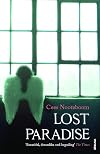
Lost Paradise
by Cees Nooteboom
On This Page
Description
Alma, a young Brazilian women recovering from a traumatic and brutal attack, sets out from Sao Paulo and winds up in Australia, where Dutch novelist Erik Zontag, in Perth for a literary conference, stumbles upon a winged woman curled up in a closet in an empty house.Tags
Recommendations























Member Reviews
Like an angel, this book flew right over my head.
It's a svelte little thing, just 150 pages, and the prologue got my hopes up, all metatextual and clever. But the real meat of the story, what little there is, falls flat to me. Neither character is particularly vivid, their inner conflicts are vague and confused—which is realistic, true to life, but not very interesting to read about.
Nooteboom's prose is that fine stuff you'll find in literary fiction which, in its most concentrated moments, reaches either utter genius or insane pretension.
Take this passage:
Sparse but beautifully constructed, there's no fat. Using simple action sentences, we perfectly understand the sense of both modern ignorance and ancient, natural menace. It's great.
Now let's take a look at this one.
By contrast, this passage is unclear, ridiculous, and eyeroll-inducing. These are supposed to be the thoughts of a woman in her twenties, and yet I feel for all the world as though I'm lying in bed after an ill-advised fling with my English professor and enduring a navel-gazing soliloquy on "pornography of the mind." I mean, good god.
This dovetails with the whiffs I got of "men writing women syndrome," as when Nooteboom took a moment to describe the pert breasts of a passenger on an airplane and then in the next chapter wrote about a woman being raped in a Brazilian slum; it's hard to put your finger on why these things are so jarring sometimes, but the only explanation I can give is that his treatment of women feels uniquely short-sighted, as though they are not real people or, if they are, their inner lives are surely dominated by thoughts and feelings about men.
I like some of the ideas Nooteboom plays with but frankly I think they're done much better elsewhere, like Angels in America or Revolt of the Angels, which also take them much further.
____________________
Global Challenge: Netherlands show less
It's a svelte little thing, just 150 pages, and the prologue got my hopes up, all metatextual and clever. But the real meat of the story, what little there is, falls flat to me. Neither character is particularly vivid, their inner conflicts are vague and confused—which is realistic, true to life, but not very interesting to read about.
Nooteboom's prose is that fine stuff you'll find in literary fiction which, in its most concentrated moments, reaches either utter genius or insane pretension.
Take this passage:
No lowlander can sleep with impunity in the mountains. The window, which has been left slightly ajar, lets in the cold night air. The man in the bed works his way through a seriesshow more
of dreams, none of which he will remember. In the silence, which he does not notice, an owl hunts its prey and a startled deer plunges into the black syntax of the forest, where Erik Zondag will take a walk tomorrow without identifying the deer's track's. When he wakes, he will see a snowy mountain range lit by the first rays of the sun—a row of sharp, gleaming-white teeth, daubed here and there with blood.
Sparse but beautifully constructed, there's no fat. Using simple action sentences, we perfectly understand the sense of both modern ignorance and ancient, natural menace. It's great.
Now let's take a look at this one.
Is there such a thing as pornography without the porn? Simply an idea in your head, without a graphic image? Pure pornography of the mind, or of a situation, in which a lie changes every move, kiss, caress and climax into something else, something obscene and perverse? I think about this, and yet at the same time I lie here and wait for him to utter one of his infrequent words, for him to touch me again and make me forget my thoughts.
By contrast, this passage is unclear, ridiculous, and eyeroll-inducing. These are supposed to be the thoughts of a woman in her twenties, and yet I feel for all the world as though I'm lying in bed after an ill-advised fling with my English professor and enduring a navel-gazing soliloquy on "pornography of the mind." I mean, good god.
This dovetails with the whiffs I got of "men writing women syndrome," as when Nooteboom took a moment to describe the pert breasts of a passenger on an airplane and then in the next chapter wrote about a woman being raped in a Brazilian slum; it's hard to put your finger on why these things are so jarring sometimes, but the only explanation I can give is that his treatment of women feels uniquely short-sighted, as though they are not real people or, if they are, their inner lives are surely dominated by thoughts and feelings about men.
I like some of the ideas Nooteboom plays with but frankly I think they're done much better elsewhere, like Angels in America or Revolt of the Angels, which also take them much further.
____________________
Global Challenge: Netherlands show less
»Wer hat bloß die Engel aus der Welt verbannt, obwohl ich sie noch immer um mich spüre?« Ein überraschender Gedanke für eine junge Frau, die am eigenen Leib erfahren mußte, daß unsere Welt mehr mit der Hölle als mit dem Paradies zu tun hat. Alma ist eines Abends auf einer ziellosen Fahrt durch São Paulo vergewaltigt worden. Um das Geschehene zu verkraften, reist sie mit ihrer Freundin Almut in das Land ihrer gemeinsamen Kindheitsträume, nach Australien. Dort begegnet sie in der Leere der Wüste einer Stille, die sie versöhnt. Doch die Traumzeit ist längst vergangen, die mvthische Welt der Aborigines versunken. Also nimmt Alma Abschied von den Reservaten des Garten Eden und macht die Welt zu ihrer Wüste - nicht ohne darin show more Spuren zu hinterlassen. Für den niederländischen Journalisten, dem sie bei einem Festival in Perth begegnet, ist sie auf jeden Fall eine Offenbarung des Himmels.
»Erst einmal und vor allem eine Liebesgeschichte. Der holländische Großmeister auf der Höhe seines ganzen Könnens.«
--Martin Lüdke, Frankfurter Rundschau show less
»Erst einmal und vor allem eine Liebesgeschichte. Der holländische Großmeister auf der Höhe seines ganzen Könnens.«
--Martin Lüdke, Frankfurter Rundschau show less
Sometimes a book is built around a premise so airy, so fragile, that any attempt at analysis threatens to scatter it to the wind. Such a book is Lost Paradise by Dutch writer Cees Nooteboom. This short novel describes the lives of two people who encounter each other under very odd circumstances and almost immediately lose touch, and then encounter each other again a few years later under different and somewhat less odd circumstances. Alma is a beautiful young woman from Brazil struggling to overcome the lingering psychological effects of a brutal sexual assault. Erik Zondag is a Dutch literary critic of middle age whose life has reached a point where he's wondering what it's all about. Their paths cross in Perth, Australia, where Alma show more has gone to absorb Aboriginal culture and Erik is attending a conference. Alma, seeking work, has accepted a role in the "Angel Project" in which people dressed as angels are positioned around Perth and those willing to pay a fee are given a map of the city with the locations marked. Erik does the tour and when he sees Alma dressed in her angel outfit is stricken with a kind of wonder and can't get her out of his mind. A few years later they meet again in a spa, where Erik has gone to take the cure and Alma is working as a masseuse. One can easily imagine that a book called Lost Paradise pays homage to Milton, and that is the case here. Nooteboom's thinly drawn narrative evokes many lost paradises--Alma's lost innocence, Erik's loss of direction, the spiritual and territorial losses of the Aboriginals--but the book itself never places these losses in a broader emotional context or gives us any reason to hope that Erik and Alma will make something meaningful of their chance encounter. Lost Paradise is itself a bit of an oddity: a book that shortchanges its characters by ending too soon and perhaps too abruptly. It's almost as if the author had done what he could and decided it was time to move on to other things. show less
No início de Paradijs Verloren, o narrador-autor conta suas sensações em um vôo para Berlim enquanto tenta ler o título do livro que uma bela mulher folheia. Esse tema será retomado no epílogo, em que surge uma idéia importante: o paraíso, esse ligar sem mal entendidos, não é um lugar em que possa existir a arte, é um lugar chato.
O romance em si começa com a história de Alma, uma brasileira descendente de alemães que, sentindo-se deprimida, sai para andar de carro uma noite. Se carro enguiça em Paraisópolis, favela paulistana que Cees Nooteboom conheceu de perto. Quando fala do que se segue, o narrador não minimiza nem detalha, parece apenas incrivelmente triste. Ele não diz as palavras que estão em qualquer resumo show more do livro: estupro brutal. Ele alterna a própria voz com a de Alma quando fala da violência que entrou em sua vida e que foi apenas um incidente para os homens que riram e depois se afastaram conversando, retornando às próprias rotinas. Ela se culpou, não do que os outros a culparam, de ter ido a um lugar tão perigoso, mas do eufemismo poético que ela usou para lidar com o trauma: a nuvem negra.
Sua melhor amiga, Almut, convence-a a viajar para a Austrália, país dos sonhos das duas desde a infância. Lá elas fazem bicos para se manter enquanto conhecem a cultura aborígene, pela qual sempre se interessaram, e Alma tem um relacionamento com um elusivo pintor aborígene, cuja tela a emocionou tanto em uma galeria de arte. Alma pensa no Sickness Dreaming Place enquanto reflete quão autêntica pode ser uma cultura após o turismo em massa, e os dois conversam e ficam em silêncio em uma casa isolada, discutindo essa cultura para a qual muito era sagrado mas nada foi preservado em livros.
Finalmente, as duas viajam para Perth para participar do Angel Project. Alma, formada em História da Arte, sempre foi apaixonada pela imagem de anjos.
Na segunda parte do livro, o crítico de arte holandês Eric Zontag decide passar alguns dias em um spa austríaco e reencontra Alma. Ele a tinha conhecido em Perth, onde foi participar de uma conferência. Ele encostou nas asas da mulher sentada em um armário e ela falou com ele. Como Alma acabou trabalhando no spa, não sabemos. E a possibilidade de reencontro é incerta.
O livro termina em um tom melancólico que me faz pensar na sua caracterização, tão freqüente, como uma novela de redenção. É uma novela sobre isolamento e reencontro, sobre reinvenção e sobre um mundo em que as pessoas gostariam de acreditar em anjos.
O título em holandês é uma inversão do título da obra de Milton, importante no livro. A inversão se mantem nas traduções para o inglês, espanhol, alemão, francês e italiano, mas é perdida na tradução brasileira, o que é uma pena. Admirei muito a mistura de coloquialidade e poética nesse livro, e gostaria de ler o original.
É curioso ler em português um livro que foi escrito em holandês mas cujos personagens são brasileiros e estão presumivelmente falando em português. show less
O romance em si começa com a história de Alma, uma brasileira descendente de alemães que, sentindo-se deprimida, sai para andar de carro uma noite. Se carro enguiça em Paraisópolis, favela paulistana que Cees Nooteboom conheceu de perto. Quando fala do que se segue, o narrador não minimiza nem detalha, parece apenas incrivelmente triste. Ele não diz as palavras que estão em qualquer resumo show more do livro: estupro brutal. Ele alterna a própria voz com a de Alma quando fala da violência que entrou em sua vida e que foi apenas um incidente para os homens que riram e depois se afastaram conversando, retornando às próprias rotinas. Ela se culpou, não do que os outros a culparam, de ter ido a um lugar tão perigoso, mas do eufemismo poético que ela usou para lidar com o trauma: a nuvem negra.
Sua melhor amiga, Almut, convence-a a viajar para a Austrália, país dos sonhos das duas desde a infância. Lá elas fazem bicos para se manter enquanto conhecem a cultura aborígene, pela qual sempre se interessaram, e Alma tem um relacionamento com um elusivo pintor aborígene, cuja tela a emocionou tanto em uma galeria de arte. Alma pensa no Sickness Dreaming Place enquanto reflete quão autêntica pode ser uma cultura após o turismo em massa, e os dois conversam e ficam em silêncio em uma casa isolada, discutindo essa cultura para a qual muito era sagrado mas nada foi preservado em livros.
Finalmente, as duas viajam para Perth para participar do Angel Project. Alma, formada em História da Arte, sempre foi apaixonada pela imagem de anjos.
Na segunda parte do livro, o crítico de arte holandês Eric Zontag decide passar alguns dias em um spa austríaco e reencontra Alma. Ele a tinha conhecido em Perth, onde foi participar de uma conferência. Ele encostou nas asas da mulher sentada em um armário e ela falou com ele. Como Alma acabou trabalhando no spa, não sabemos. E a possibilidade de reencontro é incerta.
O livro termina em um tom melancólico que me faz pensar na sua caracterização, tão freqüente, como uma novela de redenção. É uma novela sobre isolamento e reencontro, sobre reinvenção e sobre um mundo em que as pessoas gostariam de acreditar em anjos.
O título em holandês é uma inversão do título da obra de Milton, importante no livro. A inversão se mantem nas traduções para o inglês, espanhol, alemão, francês e italiano, mas é perdida na tradução brasileira, o que é uma pena. Admirei muito a mistura de coloquialidade e poética nesse livro, e gostaria de ler o original.
É curioso ler em português um livro que foi escrito em holandês mas cujos personagens são brasileiros e estão presumivelmente falando em português. show less
An exquisite tale full of symbolism, sensuality and taste.
I finished the book in just one sitting and after I turned the last page, I felt as if I had savoured an expensive rare bitter sweet chocolate.
Two seemingly disconnected stories in two separate parts.
In the first one, Alma and Almut from Brazil decide to make their dream come true and travel to Australia, a country which has always been fascinating to them. Once there, they change in different and unexpected ways, and while Alma is able to confront her inner demons, Almut feels disappointed and misses Sao Paulo.
In the second, Erik, a German literary critic travels to a spa to improve his health and meets someone from his past, a person he was never able to forget.
Angels in all show more forms are present along the story, connecting all the characters and leading them to a breathtaking conclusion.
Nooteboom addresses to the reader before each part, a gesture I found intimate and delightful, I just loved the humility in which he exposed what his characters meant to him and how they kept living on their own, even after he had written the last page.
Stunning novel, brief, dreamlike and smooth, as an angel kiss. Not to be missed.
***MIGHT CONTAIN SPOILERS***
"I left the heaviness of the tropics, where all is motion and noise, to arrive at this stillness."
"You are a secret, even if you don't realise it."
"Sometimes I would sooner ask a question than know the answer."
"When I stand outside here, I do not just see the stars, I hear them."
"I have arrived. And when I leave, I will not need to take anything with me. I have everything."
"The triumph comes from realising - if only for a moment - that you are at once mortal and immortal."
"Angels can't be with people." show less
I finished the book in just one sitting and after I turned the last page, I felt as if I had savoured an expensive rare bitter sweet chocolate.
Two seemingly disconnected stories in two separate parts.
In the first one, Alma and Almut from Brazil decide to make their dream come true and travel to Australia, a country which has always been fascinating to them. Once there, they change in different and unexpected ways, and while Alma is able to confront her inner demons, Almut feels disappointed and misses Sao Paulo.
In the second, Erik, a German literary critic travels to a spa to improve his health and meets someone from his past, a person he was never able to forget.
Angels in all show more forms are present along the story, connecting all the characters and leading them to a breathtaking conclusion.
Nooteboom addresses to the reader before each part, a gesture I found intimate and delightful, I just loved the humility in which he exposed what his characters meant to him and how they kept living on their own, even after he had written the last page.
Stunning novel, brief, dreamlike and smooth, as an angel kiss. Not to be missed.
***MIGHT CONTAIN SPOILERS***
"I left the heaviness of the tropics, where all is motion and noise, to arrive at this stillness."
"You are a secret, even if you don't realise it."
"Sometimes I would sooner ask a question than know the answer."
"When I stand outside here, I do not just see the stars, I hear them."
"I have arrived. And when I leave, I will not need to take anything with me. I have everything."
"The triumph comes from realising - if only for a moment - that you are at once mortal and immortal."
"Angels can't be with people." show less
When you pick up a novel that is unique, you want it to be an interesting experience. Half the time you end up with a questionable one instead of an enjoyable one and wish you had picked up something else. That is not the case with this book, which was beautifully written, well thought out and perfect in its uniqueness. It was a quick read, but a wonderful one. The two stories told seem totally unrelated to each other until you realize the connection and once that hits you everything has come together in one perfect package. The perfect story for those who enjoy wandering and experiencing what the world gives them or for those who just want to sit in a comfortable chair and let a character do the wandering for them.
When I stand outside here, I do not just see the stars, I hear them.
My first Nooteboom and it was a good one. This book is in two parts, two stories, separate stories, but they're related. And as the title might suggest he taps into the energies from Paradise Lost. I've never read Milton's Paradise Lost but I'm sure there are some theme overlaps or a game of theme tag going on in this book. But then maybe not. Like I said, I never read Milton though there are a few excerpts of his epic poem scattered in this book.
What might you find in this book? Lost souls searching for meaning, Aborigines, spas, and angels... beautiful angels. Angels you can make love to while their wings flap.
Nooteboom is a clever writer and his words are delicate. show more He makes you think without giving you a headache. He makes you laugh. And he makes you just say, "Damn!" while shaking your head and smiling.
How much thinking can you do without ever leaving the room? I took a trip in my head and ended up back where I started - in the stillness. show less
My first Nooteboom and it was a good one. This book is in two parts, two stories, separate stories, but they're related. And as the title might suggest he taps into the energies from Paradise Lost. I've never read Milton's Paradise Lost but I'm sure there are some theme overlaps or a game of theme tag going on in this book. But then maybe not. Like I said, I never read Milton though there are a few excerpts of his epic poem scattered in this book.
What might you find in this book? Lost souls searching for meaning, Aborigines, spas, and angels... beautiful angels. Angels you can make love to while their wings flap.
Nooteboom is a clever writer and his words are delicate. show more He makes you think without giving you a headache. He makes you laugh. And he makes you just say, "Damn!" while shaking your head and smiling.
How much thinking can you do without ever leaving the room? I took a trip in my head and ended up back where I started - in the stillness. show less
Members
- Recently Added By
Author Information

195+ Works 7,652 Members
Some Editions
Awards and Honors
Series
Belongs to Publisher Series
L'eclèctica (123)
suhrkamp taschenbuch (3808)
Work Relationships
Has as a commentary on the text
Common Knowledge
- Canonical title
- Lost Paradise
- Original title
- Paradijs verloren
- Original publication date
- 2004
- Important places*
- Australien
- Dedication*
- Für Antje Ellermann-Landshoff
- First words*
- Dash 8-300. Ich bin weiss Gott schon mit allen möglichen Flugzeugen geflogen, aber eine Dash war noch nie darunter.
- Last words*
- (Click to show. Warning: May contain spoilers.)Die Zeilen, um die es ging, hatte sie mit Bleistift unterstrichen.
- Original language*
- Niederländisch
*Some information comes from Common Knowledge in other languages. Click "Edit" for more information.
Classifications
- Genres
- General Fiction, Fiction and Literature
- DDC/MDS
- 839.31364 — Literature & rhetoric German & related literatures Other Germanic literatures Netherlandish literatures Dutch Dutch fiction 20th Century 1945-1999
- LCC
- PT5881.24 .O55 .P3713 — Language and Literature German, Dutch and Scandinavian literatures Dutch literature Individual authors or works 1961-2000
- BISAC
Statistics
- Members
- 343
- Popularity
- 92,810
- Reviews
- 17
- Rating
- (3.28)
- Languages
- 12 — Catalan, Danish, Dutch, English, French, German, Italian, Portuguese, Romanian, Russian, Spanish, Swedish
- Media
- Paper, Audiobook, Ebook
- ISBNs
- 24
- ASINs
- 5