
On This Page
Description
Richard Brautigan was a literary idol of the 1960s and 1970s whose comic genius and iconoclastic vision of American life caught the imagination of young people everywhere. He came of age during the Haight-Ashbury period and has been called "the last of the Beats." His early books became required reading for the hip generation, and on its publication Trout Fishing in America became an international bestseller. An indescribable romp, the novel is best summed up in one word: mayonnaise. This show more new edition includes an introduction by the poet Billy Collins, who first encountered Brautigan's work as a student in California. show lessTags
Recommendations









































Member Reviews
More often spoken of in reverential tones than read, I suspect. So it comes as some surprise to me on finally reading Richard Brautigan’s fish tale to discover that it is entirely readable, playful in the extreme, and refreshingly undated. Of course it is entirely likely that the book has had so much influence on the two (or three) generations of writers that came after it that all of its eccentricity and absurdist turns just look like old hat these days. Not entirely. I definitely think it is still worth reading and shall endeavour to speak of it in reverential tones myself in order to promote that activity.
What exactly Trout Fishing in America is remains open to debate. It may not be a conventional novel, but there are so many books show more out there that aren’t conventional novels that its unconventionality hardly distinguishes it. What stands out is that it is filled to bursting with what you might call left-turn similes, i.e. similes that appear headed in one direction and suddenly take another tack. It is also, surprisingly, filled with a lot of actual trout fishing. So that must put it in the running against Moby Dick as one of those books that come to define America.
And so, gently recommended. show less
What exactly Trout Fishing in America is remains open to debate. It may not be a conventional novel, but there are so many books show more out there that aren’t conventional novels that its unconventionality hardly distinguishes it. What stands out is that it is filled to bursting with what you might call left-turn similes, i.e. similes that appear headed in one direction and suddenly take another tack. It is also, surprisingly, filled with a lot of actual trout fishing. So that must put it in the running against Moby Dick as one of those books that come to define America.
And so, gently recommended. show less
Brautigan offers up a modern form of the novel in that there is no linear plot and the character of both people and events includes absurdist elements. The cumulative effect is a critique of American myth, especially the collision of frontier archetypes and market consumerism. Brautigan's take on this countercultural critique is to present it with humour: his amusement seems no less sincere than his criticism, aimed both at himself and fellow citizens. His sense of the absurd also works, the primary example being that Trout Fishing in America appears in episodic chapters as, by turns, the book itself; an elliptically described character; a hotel; an archetypal activity of the self-made man, wresting life from nature; and juvenile show more graffiti.
It scans quickly, nevertheless includes nice turns of phrase and whimsical description. Reminiscent of some Robbins and Pynchon in narrative voice (or given the timeline: anticipates those writers). Nice primer for one of Brautigan's poetry collections. show less
It scans quickly, nevertheless includes nice turns of phrase and whimsical description. Reminiscent of some Robbins and Pynchon in narrative voice (or given the timeline: anticipates those writers). Nice primer for one of Brautigan's poetry collections. show less
This was the first book that really showed me how a writer can make reality take a left turn while everyone else kept straight on. There is a childlike beauty and simplicity in these pages and even though it is a few years since I read it, it is never far from my mind.
The sight of a trout river, (in New Zealand there are many. many such rivers) a picture of a trout, someone wearing one of those shorty green fishing vests and sometimes just the idle fancy.
I recently read about Richard Brautigan's sad end by his own hand and how his body lay unfound for many months. In my mind I can put those two things together. It is like he used up all his magic in one book and when he ran short many years later he had no choice but to end it all.
If show more only he had known that his name would still be spoken many years later and his books still read.
Such a beautiful book and such a sad man. show less
The sight of a trout river, (in New Zealand there are many. many such rivers) a picture of a trout, someone wearing one of those shorty green fishing vests and sometimes just the idle fancy.
I recently read about Richard Brautigan's sad end by his own hand and how his body lay unfound for many months. In my mind I can put those two things together. It is like he used up all his magic in one book and when he ran short many years later he had no choice but to end it all.
If show more only he had known that his name would still be spoken many years later and his books still read.
Such a beautiful book and such a sad man. show less
It's been close to a decade since I read this gem and I was not disappointed when I re-visited it. This book freaking holds up. Zany off the wall humor perfect for Vonnegut fans; this collection of short recollections, stories, and essays is sure to leave readers grinning. From the Kool Aid Wino to The Hunchback Trout, these stories stick with you. Most are related to the author's childhood and fishing habits and I'll be damned if they're not funny and reminiscent of a very different world (this was written in the seventies). It's a quick, funny, and charming. Essential American reading.
It really is a fantastic little book. The first thing I thought when I started reading it, without any knowledge about what to expect, was: 'What is this cr*p?' The language is weird, the title of the book is used to describe a person, there seems to be no protagonist, and all the stories end without a point. But after three of the short stories, I got sucked in. The weird 'jargon', the funny descriptions of people and places all add up to a unique atmosphere. As I've understood, there is a deeper, post-modern meaning to the book, but even without understanding this in total, taking the book for what it appears to be (a unique, funny, uncohesive, absurd view on reality) is enough to like it very much.
I feel the need to somewhat defend this book. Yes, it didn't always make sense. In fact, it rarely did. But I did laugh at more than a couple of passages and it was interesting even if I did have to question Brautigan's sanity (and I felt like mine was in question after a bit of reading). But I don't feel robbed spending the time I spent reading it. It clocks in at just over 100 pages, so it's maybe an hour or two read, so you don't have much to lose. Plus, the ending of the book has to be one of the odder, funnier endings I've read in a long time, if ever. Even better, he indicates a page or two previous that he's ending the book in just that way. That alone is worth the price of admission to me.
This is not my favorite of his work. It’s comprised of brief episodes of traveling and fishing with random interstices. Everything seems to revolve around the ideas of freshwater fish, fishing, camping, and/or lakes, streams, and creeks. Whatever his main purpose in writing this was, it escapes me, and there is very little actual structure, especially lacking any overarching structure save for the already mentioned ideas, which leaves me with almost nothing to grasp onto as a reader. However, there is still some value here in reading. One of the more striking images that comes to mind is that of the stacked sections of streams stored in a yard for sale.
We wondered what was wrong with the camp. If perhaps a camping plague, a sure show more destroyer that leaves all your camping equipment, your car and your sex organs in tatters like old sails, had swept the camp just a few days before, and those few people who were staying at the camp now, were staying there because they didn’t have any sense. [pg.62]
The book is peppered with striking bits of strange such as the previous quotation. Weird is the order of the day here of course but most of it comes off as utter nonsense at least to me. There is a metaphor that I did particularly like appearing on page 7.
Mr. Norris un-zipped his sleeping bag and went outside with a gigantic hound-like flashlight. […]
“Hey, you guys!” Mr. Norris shouted. “Come back here. You forgot something.” […]
“What do you mean?” one of them said. They both looked very sheepish, caught in the teeth of the flashlight. [pg.75]
Chef’s kiss, I really dig it. I did have some favorites among the chapters pretty much limited to Room 208, Hotel Trout Fishing in America (pg.66) and Footnote Chapter to “Red Lip” (pg.100). The latter is my favorite as there is a slight narrative present enough for me to latch onto. I also really enjoyed a section of the chapter titled “The Lake Josephus Days”.
[W]e stopped at Mushroom Springs and had a drink of cold shadowy water and some photographs taken of the baby and me sitting together on a log.
I hope someday we’ll have enough money to get those pictures developed. Sometimes I get curious about them, wondering if they will turn out all right. They are in suspension now like seeds in a package. I’ll be older when they are developed and easier to please. Look there’s the baby! Look there’s Mushroom Springs! Look there’s me! [pg.78]
It is both a recognition of looking back on a family outing as an older person maybe even in old age and a subtle hint at when “the baby” is older, how will the relationship be then, like when sitting on that log? It blends memory, nostalgia, concern for the relationship with a child in the future, and the memorialization of a younger self in both the text and subtext. Anyway, that’s why I like this bit.
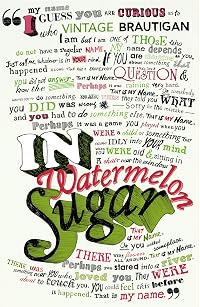
Would I recommend this one? Well, not to someone unfamiliar with Brautigan’s work, to them I would recommend something like Willard and his Bowling Trophies then In Watermelon Sugar instead then comeback to this one after you check out some of his poetry as well.
[T]here was a little Trout Fishing in America epitaph by Alonso Hagen. It said something like:
“I’ve had it.
I’ve gone fishing now for seven years
And I haven’t caught a single trout.
I’ve lost every trout I ever hooked.
They either jump off
or twist off.
or squirm off
or break my leader
or flop off
or fuck off.
I have never even gotten my hands on a trout.
For all its frustration,
I believe it was an interesting experiment
in total loss
but next year somebody else
will have to go trout fishing.
Somebody else will have to go out there.” [pg.85] show less
We wondered what was wrong with the camp. If perhaps a camping plague, a sure show more destroyer that leaves all your camping equipment, your car and your sex organs in tatters like old sails, had swept the camp just a few days before, and those few people who were staying at the camp now, were staying there because they didn’t have any sense. [pg.62]
The book is peppered with striking bits of strange such as the previous quotation. Weird is the order of the day here of course but most of it comes off as utter nonsense at least to me. There is a metaphor that I did particularly like appearing on page 7.
Mr. Norris un-zipped his sleeping bag and went outside with a gigantic hound-like flashlight. […]
“Hey, you guys!” Mr. Norris shouted. “Come back here. You forgot something.” […]
“What do you mean?” one of them said. They both looked very sheepish, caught in the teeth of the flashlight. [pg.75]
Chef’s kiss, I really dig it. I did have some favorites among the chapters pretty much limited to Room 208, Hotel Trout Fishing in America (pg.66) and Footnote Chapter to “Red Lip” (pg.100). The latter is my favorite as there is a slight narrative present enough for me to latch onto. I also really enjoyed a section of the chapter titled “The Lake Josephus Days”.
[W]e stopped at Mushroom Springs and had a drink of cold shadowy water and some photographs taken of the baby and me sitting together on a log.
I hope someday we’ll have enough money to get those pictures developed. Sometimes I get curious about them, wondering if they will turn out all right. They are in suspension now like seeds in a package. I’ll be older when they are developed and easier to please. Look there’s the baby! Look there’s Mushroom Springs! Look there’s me! [pg.78]
It is both a recognition of looking back on a family outing as an older person maybe even in old age and a subtle hint at when “the baby” is older, how will the relationship be then, like when sitting on that log? It blends memory, nostalgia, concern for the relationship with a child in the future, and the memorialization of a younger self in both the text and subtext. Anyway, that’s why I like this bit.
Would I recommend this one? Well, not to someone unfamiliar with Brautigan’s work, to them I would recommend something like Willard and his Bowling Trophies then In Watermelon Sugar instead then comeback to this one after you check out some of his poetry as well.
[T]here was a little Trout Fishing in America epitaph by Alonso Hagen. It said something like:
“I’ve had it.
I’ve gone fishing now for seven years
And I haven’t caught a single trout.
I’ve lost every trout I ever hooked.
They either jump off
or twist off.
or squirm off
or break my leader
or flop off
or fuck off.
I have never even gotten my hands on a trout.
For all its frustration,
I believe it was an interesting experiment
in total loss
but next year somebody else
will have to go trout fishing.
Somebody else will have to go out there.” [pg.85] show less
Members
- Recently Added By
Lists

Animals in the Title
498 works; 11 members

Dishonourable Mentions of 2014
80 works; 23 members

Blue Pyramid 1,276 Best Books of All Time
1,248 works; 32 members

BitLife
212 works; 4 members

Canon de la narrativa universal del s. XX (cicutadry)
499 works; 3 members

NTS Book Channel
316 works; 1 member
Author Information

50+ Works 14,825 Members
Some Editions
Awards and Honors
Series

Belongs to Publisher Series
Reihe Hanser (73)
Work Relationships
Common Knowledge
- Original title
- Trout Fishing in America
- Original publication date
- 1967
- Dedication
- For Jack Spicer and Ron Loewinsohn
- First words
- The cover for "Trout Fishing in America" is a photograph taken late in the afternoon, a photograph of the Benjamin Franklin statue in San Francisco's Washington Square.
- Last words
- (Click to show. Warning: May contain spoilers.)P.S. Sorry I forgot to give you the mayonaise.
Classifications
Statistics
- Members
- 2,005
- Popularity
- 10,504
- Reviews
- 43
- Rating
- (3.73)
- Languages
- 19 — Czech, Dutch, English, Estonian, Finnish, French, German, Hungarian, Italian, Japanese, Lithuanian, Norwegian (Bokmål), Farsi/Persian, Portuguese, Russian, Slovak, Spanish, Swedish, Turkish
- Media
- Paper, Audiobook, Ebook
- ISBNs
- 57
- UPCs
- 1
- ASINs
- 33