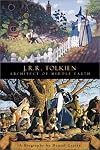
J.R.R. Tolkien: Architect of Middle Earth: A Biography
by Daniel Grotta
On This Page
Description
J. R. R. Tolkien is one of the most beloved and enigmatic writers of the twentieth century, yet surprisingly little is known about the personal life of the author of The Hobbit and Lord of the Rings . After a traumatic childhood, Tolkien experienced the bloody trenches of World War I, then lived most of his life as an Oxford scholar in a cloistered academic community. In this fascinating illustrated biography, author Daniel Grotta examines how much of Tolkien's personal experience fired his show more incredible imagination and led to the creation of Middle-earth and its inhabitants. This edition features full-color illustrations by the Brothers Hildebrandt, whose conceptions of Middle-earth and its denizens have brought Tolkien's life's work to vivid life for legions of fans around the world. show lessTags
Recommendations












Member Recommendations
Member Reviews
I was reading this while waiting for my doctor to give a regular physical exam. He remarked that he had read it and recalled that it portrayed Tolkien a very Christian. Indeed, it does and thus neatly dovetails Tolkien with fellow Inklings, like C. S. Lewis.
However, this biography is much more than that. I especially like this 1975 work for clearly indicating how the master philologist needed to create The Hobbit and LOTR in order to flesh out the Elvish tongue. It was language and the handmade myth that truly compelled him.
"As Tolkien worked on Elvish, he discovered some very important principles that were later to lead him into writing both The Hobbit and The Lord of the Rings. As he created his language, he realized that language show more presupposed a mythology. In his view, language developed from a desire to relate experience, and not merely to convey information. To tell the past is history; but explain the past, and to make it meaningful to the present, is mythology. Suddenly, Tolkien realized that Elvish was useless as a language unless it too had a mythology, or a meaningful history to explain its origin and justify its existence.”
Thus, this mytho-philoligical imperative led to the development of Middle-earth’s people, stories, and sorrows. He constructed his myths to fully invent the Elvish language.
Also, definitely, the author makes convincing arguments that Tolkien’s youth and moving from South Africa to a transforming Sarehole in England had much more to do with the birth of The Hobbit and LOTR than WWI or even WWII. Also, I had no idea “dwarves” was a thoroughly defended misspelling.
This books gives such detail on England in South Africa (Orange Free State), Oxford and English university history and systems as well as copyright laws between England and America that the book has very much a microhistory feel, making it feel modern like it belong on the shelf next to Mark Kurlansky, etc. show less
However, this biography is much more than that. I especially like this 1975 work for clearly indicating how the master philologist needed to create The Hobbit and LOTR in order to flesh out the Elvish tongue. It was language and the handmade myth that truly compelled him.
"As Tolkien worked on Elvish, he discovered some very important principles that were later to lead him into writing both The Hobbit and The Lord of the Rings. As he created his language, he realized that language show more presupposed a mythology. In his view, language developed from a desire to relate experience, and not merely to convey information. To tell the past is history; but explain the past, and to make it meaningful to the present, is mythology. Suddenly, Tolkien realized that Elvish was useless as a language unless it too had a mythology, or a meaningful history to explain its origin and justify its existence.”
Thus, this mytho-philoligical imperative led to the development of Middle-earth’s people, stories, and sorrows. He constructed his myths to fully invent the Elvish language.
Also, definitely, the author makes convincing arguments that Tolkien’s youth and moving from South Africa to a transforming Sarehole in England had much more to do with the birth of The Hobbit and LOTR than WWI or even WWII. Also, I had no idea “dwarves” was a thoroughly defended misspelling.
This books gives such detail on England in South Africa (Orange Free State), Oxford and English university history and systems as well as copyright laws between England and America that the book has very much a microhistory feel, making it feel modern like it belong on the shelf next to Mark Kurlansky, etc. show less
http://nhw.livejournal.com/1030238.html#cutid2
It is two-thirds the length of Carpenter's book, and one third the quality. Grotta admits rather grumpily (indeed, perhaps even peevishly!) that he was not given much access by the Tolkien family, but is gracious enough to recommend that the interested reader should get Carpenter's book as well - I doubt if Carpenter would have or indeed should have returned the compliment! For the non-British reader he offers perhaps a bit more external perspective on what England was like in the early twentieth century, and he has more of the detail on the Ace vs Ballantyne affair, but he makes several annoying errors of detail which make it difficult to really trust the rest of his findings. Also the book show more is irritatingly repetitive in places. I would hesitate even to recommend it for the completist. show less
It is two-thirds the length of Carpenter's book, and one third the quality. Grotta admits rather grumpily (indeed, perhaps even peevishly!) that he was not given much access by the Tolkien family, but is gracious enough to recommend that the interested reader should get Carpenter's book as well - I doubt if Carpenter would have or indeed should have returned the compliment! For the non-British reader he offers perhaps a bit more external perspective on what England was like in the early twentieth century, and he has more of the detail on the Ace vs Ballantyne affair, but he makes several annoying errors of detail which make it difficult to really trust the rest of his findings. Also the book show more is irritatingly repetitive in places. I would hesitate even to recommend it for the completist. show less
Good biographical information on Tolkien without getting bogged down in minutiae. The book is less stellar when it comes to literary analysis, as the book was written without a lot of information from the posthumous works.
Not bad, exactly, just forgettable.
What I liked best: Not too long, not too detailed, just enough to get a sense of what kind of man Tolkien was. Explanations of idiosyncrasies of English institutions that have puzzled me for years: Oxbridge university "system," Army regimental "system." Explanation of what the deal was with the first paperback edition. What Tolkien's professional/scholarly contributions were and why one hardly hears of them.
What I liked least: poor editing (dropped letters, misspellings); odd typeface (esp. letter spacing, punctuation & diacritical marks); repetition without further development; strange half-page text-boxing of the text; illustrations of scenes from Tolkien's fiction that have nothing to do with show more anything in this biography, and that are better suited for a young child's book of Mother Goose rhymes (esp. Rivendell; OMG that is an awful, sickly saccharine depiction).
What disappointed me: Grotta thinks Tolkien had a certain conception of the connection between language and myth, and that this connection is important to the broader meaning of Tolkien's fiction. But Grotta barely explains the connection or develops his argument about its significance.
What I couldn't care less about: Tolkien's ancestral history, difficulties of writing an "unauthorized" biography, growth of Tolkien fan clubs. show less
What I liked best: Not too long, not too detailed, just enough to get a sense of what kind of man Tolkien was. Explanations of idiosyncrasies of English institutions that have puzzled me for years: Oxbridge university "system," Army regimental "system." Explanation of what the deal was with the first paperback edition. What Tolkien's professional/scholarly contributions were and why one hardly hears of them.
What I liked least: poor editing (dropped letters, misspellings); odd typeface (esp. letter spacing, punctuation & diacritical marks); repetition without further development; strange half-page text-boxing of the text; illustrations of scenes from Tolkien's fiction that have nothing to do with show more anything in this biography, and that are better suited for a young child's book of Mother Goose rhymes (esp. Rivendell; OMG that is an awful, sickly saccharine depiction).
What disappointed me: Grotta thinks Tolkien had a certain conception of the connection between language and myth, and that this connection is important to the broader meaning of Tolkien's fiction. But Grotta barely explains the connection or develops his argument about its significance.
What I couldn't care less about: Tolkien's ancestral history, difficulties of writing an "unauthorized" biography, growth of Tolkien fan clubs. show less
Do not bother with this book. Any value it might once have had has evaporated with the very great increase in our knowledge of Tolkien's life and work.
Did you know Tolkien was born in South Africa and kidnapped as a child? An interesting look at the life of one of the last centuries great writers.
Ratings
Members
- Recently Added By
Author Information

7 Works 943 Members
Some Editions
Common Knowledge
- Canonical title*
- Tolkien
- Original title
- The Biography of J.R.R. Tolkien: Architect of Middle Earth
- Alternate titles
- J. R. R. Tolkien: Architect of Middle Earth: A biography; J.R.R. Tolkien; J. R. R. Tolkien, Architect of Middle Earth
- Original publication date
- 1976
- People/Characters
- J. R. R. Tolkien; C. S. Lewis; Mabel Tolkien; Father Francis Xavier Morgan; Rayner Unwin; Donald Swann (show all 8); Kenneth Sisam; Edith Tolkien
- Important places
- University of Oxford, Oxford, Oxfordshire, England, UK; Exeter College, University of Oxford, Oxford, Oxfordshire, England, UK; University of Leeds, Leeds, England, UK
- Important events
- Publication of "The Hobbit" (1937); Publication of "The Lord of the Rings" (1953)
- Dedication
- For Jola...
- First words
- PROLOGUE:
THE OLD PROFESSOR
Working at his typewriter in his garage study, painstakingly recording the history of the First and Second Ages of Middle-earth, Professor Tolkien must have seemed like Bilbo Bagg... (show all)ins himself at Rivendell, carefully chronicling in the Red Book of Westmarch his fantastic adventures. - Last words
- (Click to show. Warning: May contain spoilers.)"Well done, Professor!," he said addressing the bust as if it were a living person. "You've written a smashing good yarn!"
(Click to show. Warning: May contain spoilers.)This biography is not written for scholars or academics alone, but for those who enjoy and admire Tolkien. - Original language*
- English
*Some information comes from Common Knowledge in other languages. Click "Edit" for more information.
Classifications
- Genres
- Biography & Memoir, Literature Studies and Criticism, Fantasy
- DDC/MDS
- 828.91209 — Literature & rhetoric English & Old English literatures English miscellaneous writings English miscellaneous writings 1900- English miscellaneous writings 1900-1999 English miscellaneous writings 1900-1945 Individual authors not limited to or chiefly identified with one specific form.
- LCC
- PR6039 .O32 .Z65 — Language and Literature English English Literature 1900-1960
- BISAC
Statistics
- Members
- 907
- Popularity
- 29,690
- Reviews
- 6
- Rating
- (3.36)
- Languages
- 6 — Catalan, English, German, Italian, Polish, Spanish
- Media
- Paper
- ISBNs
- 20
- ASINs
- 11