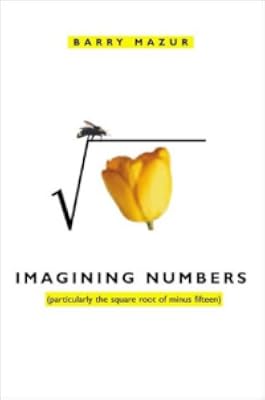
Imagining Numbers (Particularly the Square Root of minus Fifteen)
by Barry Mazur
On This Page
Description
A tour of the creative side of mathematics describes the first use of imaginary numbers in sixteenth-century Italy and the subsequent two-hundred-year effort to perfect the process, citing the words of key Renaissance thinkers.Tags
Recommendations




Member Reviews
I never thought I'd see a book about imaginary numbers that i didn't like.
If you know your mathematics, you'll see that that is a carefully constructed sentence. When I say i, I am not referring to me, as in the author; I'm referring to i, as in, the square root of -1. i of course is not a sentient creature; it does not have likes and dislikes. But if it did, I think it would find this volume as disappointing as I do.
Understand: I have a degree in mathematics. But that was a third of a century ago, and we never did much with complex numbers anyway. I hoped this would be a chance to re-learn, and maybe to learn some interesting sidelights.
Of course, anyone hoping to find serious mathematics in a popular book runs a high risk of show more disappointment. The cover description talks about poetry, not complex numbers. But this was just so... airy. Pages and pages and pages about the imagination, and imagining things. But i, and the imaginary and complex numbers, despite their name, are not imaginary. The fact that you can't have 23i apples notwithstanding, complex are real -- and so important that the so-called "fundamental theorem of algebra" is all about complex numbers and solutions to algebraic equations.
The point is, a good mathematics book builds. It starts with simple mathematics (not wild philosophy) and adds things to it. That's true whether it's designed for the common reader or for post-doctoral researchers. The building in this book is not mathematical.
And there are some minor errors. For example, page 48 talks about double negatives -- e.g., in mathematics, the product of two negative numbers is a positive. Mazur analogizes this to language, were a double negative is a positive. But this isn't always true. Yes, in (standard) English, to say "I am not not going to the store" means "I am going to the store." But in many other languages, "I am not not going to the store" is an emphatic: "I'm definitely not going to the store" -- and, indeed, this is true in English dialects as well; "I ain't got no money" does not mean "I have money"; it means "I don't have money at all."
In retrospect, I am not the audience for this book; I wanted mathematics. You have every right to want something else. But if you want mathematics, get something else and leave this for the poets. i really does get left out of this book for far too long.
Bottom line, dear author: next time, please cut to the math! show less
If you know your mathematics, you'll see that that is a carefully constructed sentence. When I say i, I am not referring to me, as in the author; I'm referring to i, as in, the square root of -1. i of course is not a sentient creature; it does not have likes and dislikes. But if it did, I think it would find this volume as disappointing as I do.
Understand: I have a degree in mathematics. But that was a third of a century ago, and we never did much with complex numbers anyway. I hoped this would be a chance to re-learn, and maybe to learn some interesting sidelights.
Of course, anyone hoping to find serious mathematics in a popular book runs a high risk of show more disappointment. The cover description talks about poetry, not complex numbers. But this was just so... airy. Pages and pages and pages about the imagination, and imagining things. But i, and the imaginary and complex numbers, despite their name, are not imaginary. The fact that you can't have 23i apples notwithstanding, complex are real -- and so important that the so-called "fundamental theorem of algebra" is all about complex numbers and solutions to algebraic equations.
The point is, a good mathematics book builds. It starts with simple mathematics (not wild philosophy) and adds things to it. That's true whether it's designed for the common reader or for post-doctoral researchers. The building in this book is not mathematical.
And there are some minor errors. For example, page 48 talks about double negatives -- e.g., in mathematics, the product of two negative numbers is a positive. Mazur analogizes this to language, were a double negative is a positive. But this isn't always true. Yes, in (standard) English, to say "I am not not going to the store" means "I am going to the store." But in many other languages, "I am not not going to the store" is an emphatic: "I'm definitely not going to the store" -- and, indeed, this is true in English dialects as well; "I ain't got no money" does not mean "I have money"; it means "I don't have money at all."
In retrospect, I am not the audience for this book; I wanted mathematics. You have every right to want something else. But if you want mathematics, get something else and leave this for the poets. i really does get left out of this book for far too long.
Bottom line, dear author: next time, please cut to the math! show less
This is an interesting little book and I thoroughly enjoyed it.
It sets out to help the user understand and, more importantly, visualise, imaginary numbers (i.e. the square-root of -1). The author tries to use poetic analogies, and historical perspective, as well as a lot of maths, to achieve this.
Mazur does a great job with the maths. The explanations are so clear and the author gently leads the reader forward to interesting insights, and even encourages you to reach for a pen and paper to help with the understanding. He also details the historical story of how the leap was made away from the linear integer line to be able to see how imaginary numbers exist on the complex plane.
For me the poetic analogies were the weakest aspect of this show more book. They did provide a break and a contrast, but it's the lucidity of the maths and gentle progress towards deeper understanding which makes this a good book. show less
It sets out to help the user understand and, more importantly, visualise, imaginary numbers (i.e. the square-root of -1). The author tries to use poetic analogies, and historical perspective, as well as a lot of maths, to achieve this.
Mazur does a great job with the maths. The explanations are so clear and the author gently leads the reader forward to interesting insights, and even encourages you to reach for a pen and paper to help with the understanding. He also details the historical story of how the leap was made away from the linear integer line to be able to see how imaginary numbers exist on the complex plane.
For me the poetic analogies were the weakest aspect of this show more book. They did provide a break and a contrast, but it's the lucidity of the maths and gentle progress towards deeper understanding which makes this a good book. show less
This book talks about imagination & the history of how complex numbers were imagined & understood by the mathematicians who first came across them. It is readable and well-written. It is maybe a bit repetitive.
Literally a case of "mathematics for poets." The gentlest of intros to imaginary and complex numbers. It certainly doesn't explain things like raising one complex number to the power of another.
I want to read it again.
Ratings
Members
- Recently Added By
Author Information

7+ Works 401 Members
Barry Mazur is Gerhard Gade University Professor at Harvard University.
Common Knowledge
- Canonical title
- Imagining Numbers (Particularly the Square Root of minus Fifteen) (Particularly the Square Root of minus Fifteen)
- Original publication date
- 2003
- People/Characters
- Rafael Bombelli; Girolamo Cardano; Scipione de Floriano Dal Ferro
- Dedication
- To Gretchen
- First words
- Preface -- 1, 2, 3,... The "counting numbers" are part of us.
[Chapter I -- The Imagination and Square Roots] -- I. Picture this. Picture Rodin's Thinker, crouched in mental effort.
Classifications
- Genres
- Science & Nature, Nonfiction, General Nonfiction, Philosophy
- DDC/MDS
- 512 — Natural sciences & mathematics Mathematics Algebra
- LCC
- QA255 .M39 — Science Mathematics Mathematics Algebra
- BISAC
Statistics
- Members
- 328
- Popularity
- 97,374
- Reviews
- 5
- Rating
- (3.21)
- Languages
- English, Italian, Spanish
- Media
- Paper, Ebook
- ISBNs
- 7
- ASINs
- 3