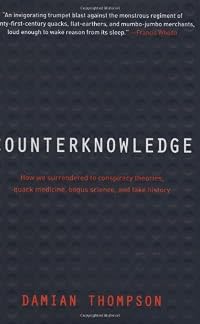
Counterknowledge: How We Surrendered to Conspiracy Theories, Quack Medicine, Bogus Science and Fake History
by Damian Thompson
On This Page
Description
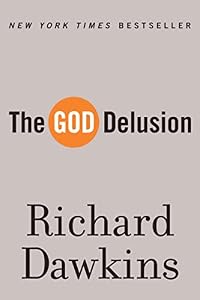
From conspiracy theories to alternative medicine, people are experiencing an epidemic of untrue descriptions of the world. Following in the footsteps of Richard Dawkins's "The God Delusion" and Sam Harris's "The End of Faith," this work is a defense of scientific proof in an age of fabrication.Tags
Recommendations



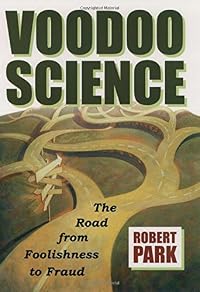
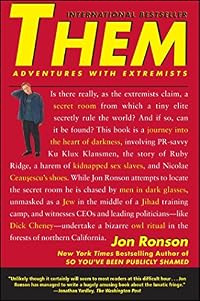
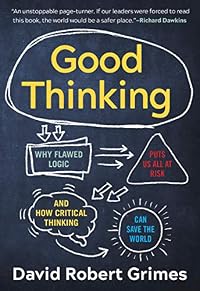

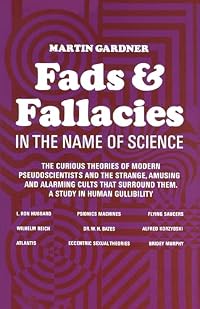






















Member Recommendations

Member Reviews
Did you ever see the Mel Gibson film Conspiracy? It was a comedy in which Gibson played a paranoid conspiracy theorist who just happened to get it right which, according to the hundred monkeys with one hundred typewriters approach, he was bound to do at least once.
In this enlightened 21st Century, many of those who laughed at Mad Mel and dismiss Greek myths and mediaeval miracles have no problem believing many more than six unbelievable things before breakfast: in other words, they are Counterknowledge enthusiasts.
Counterknowledge is misinformation presented as fact and believed by millions, but which is actually factually incorrect, or highly unlikely, but improbable either way.
Thompson pinpoints three areas in particular which are show more sp corrupted by Counterknowledge that the fact is often given the same respect as the scientifically proven fact.
The Catholic Church may have given the nod to Darwin’s theories of evolution, but they are anathema to many fundamentalists, both Christian and Muslim, who believe in Creationism, a pseudoscience that undermines scientific discoveries.
Psuedohistory has also seen a massive revival, thinks – in part – to Dan Brown’s Da Vinci Code: it may be a mere novel, but 40% of Americans now believe conspiracy theories involving Jesus, and that the [Catholic] Church is concealing information.
Complementary and Alternative Medicine [CAM] has never been so popular since Quacks were outlawed in Britain in 1868: the ‘worried well’ [i.e. Middle-class hypochondriacs] have espoused the services of chiropractors, homeopaths, reflexologists, aromatherapists and acupuncturists with enthusiasm.
“The US government knew in advance about the plan to crash a passenger jet into the World Trade Center. There is a link between childhood autism and the MMR triple vaccine against measles, mumps and rubella. A Chinese fleet circumnavigated the globe in the early 15th century, reaching America 70 years before Columbus.”
If any of the above statements make you see red, this book will merely be preaching to the converted. If however you agree with Dan brown, think Graham Hancock is a reputable researcher, believe the structure of a cell too complex to have evolved though natural selection, and slavishly follow the nutritional advice of Patrick Holford, please read Counterknowledge.
Well researched, excellently written and eminently readable, this book on ‘conspiracy theories, quack medicine, bogus science and fake history’ is an asset to any library. show less
In this enlightened 21st Century, many of those who laughed at Mad Mel and dismiss Greek myths and mediaeval miracles have no problem believing many more than six unbelievable things before breakfast: in other words, they are Counterknowledge enthusiasts.
Counterknowledge is misinformation presented as fact and believed by millions, but which is actually factually incorrect, or highly unlikely, but improbable either way.
Thompson pinpoints three areas in particular which are show more sp corrupted by Counterknowledge that the fact is often given the same respect as the scientifically proven fact.
The Catholic Church may have given the nod to Darwin’s theories of evolution, but they are anathema to many fundamentalists, both Christian and Muslim, who believe in Creationism, a pseudoscience that undermines scientific discoveries.
Psuedohistory has also seen a massive revival, thinks – in part – to Dan Brown’s Da Vinci Code: it may be a mere novel, but 40% of Americans now believe conspiracy theories involving Jesus, and that the [Catholic] Church is concealing information.
Complementary and Alternative Medicine [CAM] has never been so popular since Quacks were outlawed in Britain in 1868: the ‘worried well’ [i.e. Middle-class hypochondriacs] have espoused the services of chiropractors, homeopaths, reflexologists, aromatherapists and acupuncturists with enthusiasm.
“The US government knew in advance about the plan to crash a passenger jet into the World Trade Center. There is a link between childhood autism and the MMR triple vaccine against measles, mumps and rubella. A Chinese fleet circumnavigated the globe in the early 15th century, reaching America 70 years before Columbus.”
If any of the above statements make you see red, this book will merely be preaching to the converted. If however you agree with Dan brown, think Graham Hancock is a reputable researcher, believe the structure of a cell too complex to have evolved though natural selection, and slavishly follow the nutritional advice of Patrick Holford, please read Counterknowledge.
Well researched, excellently written and eminently readable, this book on ‘conspiracy theories, quack medicine, bogus science and fake history’ is an asset to any library. show less
Counterknowledge was a very quick read -- I finished it in about two hours, and a very worthwhile read. This book is a rise to arms against the misinformation that clouds modern day thinking. Rather than speaking out against the institutions that purport this wrong-thinking, the book speaks out for a new Enlightenment and respect for the methodologies that modern science values. The book presents its arguments in a sound, logical manner that makes it easy reading while not devaluing the importance of its message in the least.
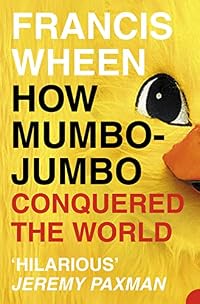
In many ways this is a complementary volume to Andrew Keen's 2007 book The Cult of the Amateur and, going back a little earlier, Francis Wheen's 2004 polemic How Mumbo Jumbo Conquered the World: all three are concerned with how, in the name of in other contexts laudable principles like democracy and freedom of speech, we're selling out to the ignorant, the biased, the secret corporation shills, the bullies, and the batshit crazy. It's a fairly short book, and it romps lightly and very readably through a limited set of areas in which public knowledge is being devastated by other people's agendas. Much of this material has been covered in greater depth elsewhere; this is no hostile criticism, because Thompson's book serves as an ideal show more introduction for those who haven't read the fuller treatments. What makes this book valuable, though, is Thompson's refusal to be browbeaten by political correctness; or, at least, the blanket application of that concept to stuff that people would rather not admit. His treatment of the mangling of science and promotion of rankest pseudoscience in the Islamic cultures is especially enlightening (it led me to Pervez Hoodbhoy's much more detailed treatment in Islam and Science), as is his demolition of "Afrocentric history", far too much of which is plain mythology (I rushed out and bought Mary Lefkowitz's Not Out of Africa for a more detailed treatment, and should be reading it shortly). His discussion of HIV/AIDS-denialism is also good.
And sometimes it's funny, too. show less
And sometimes it's funny, too. show less
The author warns us: 'Credulous thinking is spreading through society as fast and silently as a virus, and no one has a clue how long the epidemic will last'. Indeed and, such book is therefore more than welcomed, just because it is an attempt among others to debunk all the bullshit circling around -from alternative medicine to conspiracy theories and fake history to creationism. That Damian Thompson here points fingers and laughs surely is very enjoyable and entertaining. However, as for his goal of answering the question regarding how and why we came to such triumphing mumbo jumbo, I have to admit that, he delivers a poor essay. He hints at some serious issues (postmodernism and its fallacious legacy, the shameful agendas and show more converging interests of some businesses and institutions with quacks and other cranks, the tireless lobbying of ideologically motivated people, doubtful egalitarianism etc.) but, sadly, he never really dwells deeply into his subject. The whole in the end is just one of those fast read, far too light on an issue too serious to be thus treated. A good overview and some nice hints but, not as deep as I wished it could be. show less
Extremely interesting, eminently readable and cogently argued. However, I felt Thompson didn't fully substantiate the line he draws between counterknowledge and religious faith: I broadly agree with him on this point, but he did seem to be begging the question a bit.
Generally reasonable polemic against bad science and bad history. Thompson ranges across a variety examples, but it's clear that he has some particular axes to grind (Afrocentric history, Islamic creationism, nutritionist Patrick Holford). He seems tempted to present counterknowledge as a new problem, but it clearly isn't: just a problem exploded out of control due to modern communications. I enjoyed is argument, but his conclusions fell flat.
Outstanding. You can read this book in two hours -- it's readable, concise, and devastating. It makes me ashamed to own one of Patrick Holford's books.
Members
- Recently Added By
Author Information

5 Works 420 Members
Damian Thompson was educated at Presentation College, Reading, and Oxford University. He was religious affairs correspondent for The Daily Telegraph
Common Knowledge
- Canonical title
- Counterknowledge: How We Surrendered to Conspiracy Theories, Quack Medicine, Bogus Science and Fake History
- Original publication date
- 2008
- First words
- The US government knew in advance about the plan to crash passenger jets into the World Trade Center.
- Last words
- (Click to show. Warning: May contain spoilers.)It will be their fault if the sleep of reason brings forth monsters.
- Blurbers
- Ballard, J.G.; Wheen, Francis; Brown, Craig
Classifications
- Genres
- Nonfiction, Science & Nature, Sociology, General Nonfiction, Religion & Spirituality, History
- DDC/MDS
- 001.96 — Computer science, information & general works Computer science, knowledge & systems Knowledge and learning in general Aliens/UFOs Errors, delusions, superstitions
- LCC
- BF773 .T46 — Philosophy, Psychology and Religion Psychology Psychology
- BISAC
Statistics
- Members
- 252
- Popularity
- 128,189
- Reviews
- 8
- Rating
- (3.57)
- Languages
- English, Spanish
- Media
- Paper, Ebook
- ISBNs
- 8
- ASINs
- 4