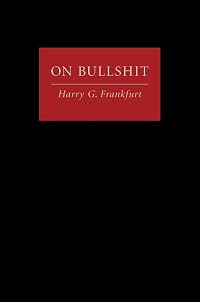
On Bullshit
by Harry G. Frankfurt
On This Page
Description
Most people are rather confident of their ability to recognize bullshit and to avoid being taken in by it, yet we have no clear understanding of what bullshit is, why there is so much of it, or what functions it serves--and we lack a conscientious appreciation of what it means to us. In other words, as Harry Frankfurt writes, "we have no theory." Frankfurt, one of the world's most influential moral philosophers, attempts to build such a theory here. With his characteristic combination of show more philosophical acuity, psychological insight, and wry humor, he argues that bullshitters misrepresent themselves not as liars do, that is, by deliberately making false claims. Rather, bullshitters seek to convey a certain impression of themselves without being concerned about whether anything at all is true. They quietly change the rules governing the conversation so that claims about truth and falsity are irrelevant. Frankfurt concludes that although bullshit can take many innocent forms, excessive indulgence in it can eventually undermine the practitioner's capacity to tell the truth in a way that lying does not. Liars at least acknowledge that it matters what is true. By virtue of this, Frankfurt writes, bullshit is a greater enemy of the truth than lies are. show lessTags
Recommendations


Member Recommendations
Member Reviews
What is bullshit? The philosopher Harry G. Frankfurt lies here some good foundations to a better understanding of bullshit -so widespread nowadays yet, surprisingly, poorly understood because not properly defined or theorised. Such a short philosophical essay is thus necessary; it's also punchy and very pertinent. Indeed, framing bullshit as something very precise and peculiar (that is, different from bluff or lies in its key relationship to truth) the definition offered by the author encompasses not only bullshit per se but, also gives an hint towards the reason for bullshitters to think the way they do and, the impact not only on the gullible but society at large. I insist on 'gives an hint' because, sadly, Frankfurt just flies over show more his topic without going deeper than I think he should. Nonetheless, it's punchy enough for examples to spring in the mind while reading his concerns. Indeed, from alternative medicine to conspiracy theories and antievolutionary stances, what is the future of a society where, a complete lack of concern with truth (e.g. to the point of affecting one's whole way of thinking to suit the bullshit being entertained) is accepted, tolerated and spread even by our 'elites' (medias, politicians etc.)? A tiny little book, but a great food for thoughts. show less
In this, the Darkest Timeline, you're probably familiar with the essence of Frankfurt's argument about bullshit. Truth-tellers and liars share a common foundation that the truth exists, and that it matters. Liars sincerely want the something other than the truth to be believed, at least long enough for them to make use of the advantage. By contrast, bullshit has no concern with external reality. Instead bullshit is a kind of performative game, allowing the bullshitter to enhance his social status, without concern for the truth or falsity of his statements.
There's a bit at the end that I think captures the essence of Frankfurt's arguments, which move smoothly from Augustine to Wittgenstein. "Rather than seeking primarily to arrive at show more accurate representations of a common world, the individual turns towards trying to provide honest representations of himself. Convinced that reality has no inherent nature, which he might hope to identify as the truth about things, he devotes himself to being true to his own nature." Sound like a certain very orange POTUS?
More narrowly, I think it'd be an interesting experiment to assign On Bullshit to writing-intensive college course. So much of academic writing is bullshit, in the sense that it is about performing "I am a knowledgeable expert" rather than about making real claims. Professors are just much better at it than students. I'd be fascinating in a class that allowed a student to be wrong, but hit them with the banhammer if they used bullshit. Any takers? show less
There's a bit at the end that I think captures the essence of Frankfurt's arguments, which move smoothly from Augustine to Wittgenstein. "Rather than seeking primarily to arrive at show more accurate representations of a common world, the individual turns towards trying to provide honest representations of himself. Convinced that reality has no inherent nature, which he might hope to identify as the truth about things, he devotes himself to being true to his own nature." Sound like a certain very orange POTUS?
More narrowly, I think it'd be an interesting experiment to assign On Bullshit to writing-intensive college course. So much of academic writing is bullshit, in the sense that it is about performing "I am a knowledgeable expert" rather than about making real claims. Professors are just much better at it than students. I'd be fascinating in a class that allowed a student to be wrong, but hit them with the banhammer if they used bullshit. Any takers? show less
A delightful little treatise on the semantics of the word and how it differs from other words used to describe mendacity. The author, a Princeton Professor, argues that there are key differences between a lie and bullshit. A liar and a truth-teller play on different sides of the same game. A liar must acknowledge that truth exists in order to defy it. A bullshitter, on the other hand, has no interest in the truth and is only interested in furthering his own agenda. He could just as likely tell a truth without knowing it as a lie. If and unnamed American president were to swear to the Canadian prime minister that something is true that he doesn't know for sure just to win an argument, then that president would be a bullshitter. That's a show more pretty poor example, though, as no American president would ever do such a thing. show less
One of the most salient features of our culture is that there is so much bullshit. Everyone knows this. Each of us contributes his share. But we tend to take the situation for granted. Most people are rather confident of their ability to recognize bullshit and to avoid being taken in by it....
With this opening statement, Harry Frankfurt, professor of philosophy emeritus at Princeton U., begins his inquiry into "what bullshit is, why there is so much of it, or what functions it serves...My aim is simply to give a rough account of what bullshit is and how it differs from what it is not…."
Originally published in 1986 in the journal Raritan Quarterly Review, this essay was published in book form in 2005, making it easily available to lay show more readers. It's just an itty bitty thing, slightly smaller than a mass-market paperback, and running only to 67 pages. But it spent nearly a half-year on the New York Times Best Seller List. Philosophers, it seems, are not alone in their interest in bullshit. And given the character of the current U. S. president and the Republican Party in general, now is the time to poke around in it.
It is surreal: A serious, academic analysis of the term "bullshit," defining it, differentiating it from possible synonyms, and focusing on applications and intent. Frankfurt concludes that neither truth nor falsity are the focus of bullshit. Rather, persuasion is the focus. A liar typically knows the truth and endeavors to misrepresent it convincingly. But a bullshitter is indifferent to truth, casually mixing fact and fiction to achieve his or her goal. Truth is beside the point. show less
Just about as good, as illuminating, and as dryly humorous as a philosophical treatise called "On Bullshit" should be. An exercise in ironic description, Frankfurt takes pains to distinguish bullshitting from ordinary lying, though his book is often as good as the sources he picks. Longfellow and St. Augustine and telling anecdotes about Wittgenstein seem like good sources, but he leans on the OED much more than is advisable. c'mon Harry, you're a professor! You should know that that's a freshman blunder!
But the book itself, whose most important argument might be that liars, despised though they are, have more respect for truth than mere bullshit artists, who tend to disregard the distinction between truth and falsehood more-or-less show more entirely, is both interesting and thought provoking. This one was written back in 2005, but you could say that it's really more relevant than ever now that you-know-who is leading the free world. A fun, recommendable read, but it might make you feel a bit nauseous for reasons that the author couldn't have foreseen. show less
But the book itself, whose most important argument might be that liars, despised though they are, have more respect for truth than mere bullshit artists, who tend to disregard the distinction between truth and falsehood more-or-less show more entirely, is both interesting and thought provoking. This one was written back in 2005, but you could say that it's really more relevant than ever now that you-know-who is leading the free world. A fun, recommendable read, but it might make you feel a bit nauseous for reasons that the author couldn't have foreseen. show less
The first time I sat down with On Bullshit, the book's tiny size fooled me into assuming the essay inside was a light read. When I found myself halfway through but without much interest in what I'd read, I regrouped. I moved to a room with fewer distractions, turned back to the first page and approached the work with a little more respect.
And an hour later, I finished Frankfurt's readable and insightful (albeit at times tedious) thesis on the definition and motivation for contemporary society's BS. I was especially drawn to his deconstruction of lying vs BS-ing (lying recognizes the truth -- and then ignores it; BS is sloppier). And the most useful revelation: "[BS] is unavoidable whenever circumstances require someone to talk without show more knowing what he is talking about."
I do regret that the author didn't adapt the essay to a general audience by including a preface and some background about the people he quotes. And the publisher could have assisted the reader by formatting the text with some space on the page, or a chapter break, in the several places where Frankfurt makes sudden transitions.
Overall, a recommended read on a growing aspect of communication. show less
And an hour later, I finished Frankfurt's readable and insightful (albeit at times tedious) thesis on the definition and motivation for contemporary society's BS. I was especially drawn to his deconstruction of lying vs BS-ing (lying recognizes the truth -- and then ignores it; BS is sloppier). And the most useful revelation: "[BS] is unavoidable whenever circumstances require someone to talk without show more knowing what he is talking about."
I do regret that the author didn't adapt the essay to a general audience by including a preface and some background about the people he quotes. And the publisher could have assisted the reader by formatting the text with some space on the page, or a chapter break, in the several places where Frankfurt makes sudden transitions.
Overall, a recommended read on a growing aspect of communication. show less
Emeritus moral philosopher Frankfurt wrote a light magazine article disguised as a scholarly paper, which Princeton University Press proceeded to issue as a duodecimo hardcover with an austere, treatise-like cover styling. Surely there is an element of bullshitting involved in the very production of this enormously successful object. It has been through many printings since 2005, and is almost certainly far more owned than read -- despite the fact that it can be polished off in less than a half hour.
Frankfurt claims to offer a "theoretical understanding" of bullshit, commencing with a study of "the structure of its concept." In practice, nearly the whole book -- everything up to the final seven or eight short pages -- consists of show more lexical comparisons and fussing over various denotative and connotative approaches to the term "bullshit." In the end, however, a few significant issues are raised, or at least implied. Is bullshitting an appropriate implementation of an antirealist intellectual agenda? Does the bullshitter affirm or degrade his self-worth by his disregard for verity? Under conditions of sufficient ignorance, can sincerity and honesty be completely non-intersecting? show less
Frankfurt claims to offer a "theoretical understanding" of bullshit, commencing with a study of "the structure of its concept." In practice, nearly the whole book -- everything up to the final seven or eight short pages -- consists of show more lexical comparisons and fussing over various denotative and connotative approaches to the term "bullshit." In the end, however, a few significant issues are raised, or at least implied. Is bullshitting an appropriate implementation of an antirealist intellectual agenda? Does the bullshitter affirm or degrade his self-worth by his disregard for verity? Under conditions of sufficient ignorance, can sincerity and honesty be completely non-intersecting? show less
Members
- Recently Added By
Lists

Wisdom
31 works; 5 members

Filosofía - Clásicos
217 works; 1 member

Works Cited in The Life and Death of Democracy by John Keane
278 works; 1 member
Author Information

17+ Works 4,843 Members
Harry G. Frankfurt is professor emeritus of philosophy at Princeton University. His many books include On Inequality and the #1 New York Times bestseller on Bullshit (both Princeton).
Awards and Honors
Work Relationships
Common Knowledge
- Canonical title
- On Bullshit
- Original publication date
- 1986-10-01
- Dedication
- To Joan, truly
- First words
- One of the most salient features of our culture is that there is so much bullshit.
- Last words
- (Click to show. Warning: May contain spoilers.)Our natures are, indeed, elusively insubstantial—notoriously less stable and less inherent than the natures of other things. And insofar as this is the case, sincerity itself is bullshit.
- Original language
- English
Classifications
Statistics
- Members
- 3,499
- Popularity
- 4,773
- Reviews
- 71
- Rating
- (3.38)
- Languages
- 17 — Chinese, Danish, Dutch, English, Finnish, French, German, Italian, Japanese, Norwegian (Bokmål), Polish, Portuguese, Russian, Croatian, Spanish, Swedish, Turkish
- Media
- Paper, Audiobook, Ebook
- ISBNs
- 41
- UPCs
- 3
- ASINs
- 10