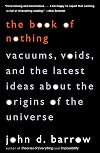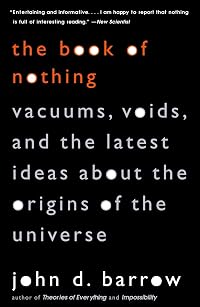
The Book of Nothing: Vacuums, Voids, and the Latest Ideas about the Origins of the Universe
by John D. Barrow
On This Page
Description
John Barrow examines and explains every aspect of nothingness. From the zeros of mathematicians to the void of philosophers, from Shakespeare to the null set, from the ether to the quantum vacuum, this book illustrates the fact that nothing is real. Barrow begins with the origins of zero in ancient India, its rocky reception in Europe, and the early abhorrence and eventual acceptance of the concept of the void by Christianity. He traces the notion through the work of writers and thinkers show more from the ancient Greeks to our own time. He looks at mathematics, cosmology, theology, and physics to uncover the nothing that is at the heart of most things. Finally, he discusses recent concepts of nothing, which are having profound effects on our search for the origins and overall structure of the universe. show lessTags
Recommendations



Member Reviews
"...ma, lungo la nostra linea d'universo, nella nostra parte d'universo, alla fine ci sarà uniformità, senza stelle e senza vita, per sempre, a quanto pare. Noi non ci saremo. E forse è un bene, dopotutto.", un finale piuttosto inquietante per un saggio, vero? Non vi preoccupate, non si tratta di uno di quei testi apocalittici sul 2012, ma di un serissimo saggio che analizza il concetto di nulla dalle origini fino alle sue più estreme conseguenze.
E' sorprendente come un concetto a noi così familiare abbia tardato così tanto ad affermarsi nelle menti degli uomini, ma è sorprendente soprattutto il fatto che, per quanto mentalmente il nulla ci sia chiaro, siamo ancora lontani dal capire la sua realtà fisica e l'influsso che show more esercita sull'esistenza.
Il saggio è una lunga cavalcata attraverso i concetti di zero, di vuoto e di nulla attraverso i vari filtri dello scibile umano, da quello filosofico, passando per quello matematico, fino a quello fisico e cosmologico (ambito d'elezione dell'autore), e ci mostrerà come il nulla può essere tantissime cose fuorché "niente". show less
E' sorprendente come un concetto a noi così familiare abbia tardato così tanto ad affermarsi nelle menti degli uomini, ma è sorprendente soprattutto il fatto che, per quanto mentalmente il nulla ci sia chiaro, siamo ancora lontani dal capire la sua realtà fisica e l'influsso che show more esercita sull'esistenza.
Il saggio è una lunga cavalcata attraverso i concetti di zero, di vuoto e di nulla attraverso i vari filtri dello scibile umano, da quello filosofico, passando per quello matematico, fino a quello fisico e cosmologico (ambito d'elezione dell'autore), e ci mostrerà come il nulla può essere tantissime cose fuorché "niente". show less
If you want to fill your head with trivia to use as a neat party trick, read and retain interesting facts from The Book of Nothing. There is a plethora to chose from. You can start with knowing that a guy named Al-Kharizmi came up with the practice of grouping numerals in threes, separated by commas. Sound familiar? William Shakespeare, if you read his works carefully, explores the concept of nothing in Hamlet, Macbeth, and King Lear. The study of nothing helped scientists to understand barometric pressure. I could go on and on.
In short, The Book of Nothing is the exploration of the concept of nothing from every angle, but with a subtle sense of humor. Don't believe me? Read the notes section of The Book of Nothing and you'll see. show more Barrow's comments are great.
The deepest pleasure I gleaned from reading The Book of Nothing was the myriad of quotations Barrow used from every walk of life. To illustrate his points Barrow quoted philosophers, educators, historians, musicians, artists, playwrights, mathematicians, the BBC, activists, scientists, psychologists, physicists, astronomers, comedians, even a Canadian naval radio conversation (which was my favorite, in case you were wondering). show less
In short, The Book of Nothing is the exploration of the concept of nothing from every angle, but with a subtle sense of humor. Don't believe me? Read the notes section of The Book of Nothing and you'll see. show more Barrow's comments are great.
The deepest pleasure I gleaned from reading The Book of Nothing was the myriad of quotations Barrow used from every walk of life. To illustrate his points Barrow quoted philosophers, educators, historians, musicians, artists, playwrights, mathematicians, the BBC, activists, scientists, psychologists, physicists, astronomers, comedians, even a Canadian naval radio conversation (which was my favorite, in case you were wondering). show less
Certainly not nothing, very substantial, starting of with the Greeks through the middle ages to relativity and the whole crew. Some of the mathematical bits were beyond me but otherwise all very clear.
Come away with the impression of the Greeks having a real enquiring mind, then as in the title of the book the church came along and forced the western mind to close for 1000 years and more. Then things opened up again, people started asking real questions again, not just accepting authority. And the pace increased exponentially and is still going on: relativity, quantum theory, AI and more
Come away with the impression of the Greeks having a real enquiring mind, then as in the title of the book the church came along and forced the western mind to close for 1000 years and more. Then things opened up again, people started asking real questions again, not just accepting authority. And the pace increased exponentially and is still going on: relativity, quantum theory, AI and more
From the zeros of the mathematician to the void of the philosophers, from Shakespeare to the empty set, from the ether to the quantum vacuum, from being and nothingness to creatio ex nihilo, there is much ado about nothing at the heart of things. Recent exciting discoveries in astronomy are shown to shed new light on the nature of the vacuum and its dramatic effect upon the explanation of the Universe.
This remarkable book ranges over every nook and cranny of nothingness to reveal how the human mind has had to make something of nothing in every field of human enquiry.
This remarkable book ranges over every nook and cranny of nothingness to reveal how the human mind has had to make something of nothing in every field of human enquiry.
Ahhh... yes... a wonderful book... How To explain the un-explainable... I find due to the the huge range of interests I explore constantly and the sheer number of books I find per week that I read the back cover, Contents, then read thru the Index for the threads of thought-streams that I flow with... and with good books like this one I find I eventually read the whole book but not necessarily in the same order the Contents invites in a linear fashion... A book well worth exploring... Thank you John D Barrow...
Ahhh... yes... a wonderful book... How To explain the un-explainable... I find due to the the huge range of interests I explore constantly and the sheer number of books I find per week that I read the back cover, Contents, then read thru the Index for the threads of thought-streams that I flow with... and with good books like this one I find I eventually read the whole book but not necessarily in the same order the Contents invites in a linear fashion... A book well worth exploring... Thank you John D Barrow...
Barrow writes nothing but spendidly interesting and authoritative books. In this case, it is as if he was asked to keep the presentation down to the freshman level.
Members
- Recently Added By
Author Information

38+ Works 6,161 Members
John D. Barrow is a scientist who writes accessibly about astrophysics and cosmology for both the general reader and the expert. Born in 1952, in London, England, Barrow earned a B.S. degree with first-class honors from the University of Durham in 1974. Three years later he received his doctorate from Magdalen College, Oxford. He was a junior show more research lecturer in astrophysics at Oxford University from 1977 to 1980 and became a lecturer in astronomy at the University of Sussex in Brighton in 1981. With coauthor Joseph Silk, Barrow published The Left Hand of Creation: The Origin and Evolution of the Expanding Universe in 1983. The book, which explains particle physics and its application to the creation and evolution of the universe, quickly won praise for its lucid style. Barrow delved further into this topic in 1994 with The Origin of the Universe. In this work he explored such questions as the possibility of extra dimensions to space, the beginning of time, and how human existence is part and parcel of the origin and composition of the universe. Barrow's other books include Pi and the Sky; Theories of Everything; and The World Within the World. He has also contributed many articles to such professional journals as New Scientist, Scientific American, and Nature. (Bowker Author Biography) John D. Barrow is research professor of mathematical sciences at Cambridge University. His previous books include "Between Inner & Outer Space", "The Universe That Discovered Itself", & "The Origin of the Universe". He lives in England. (Bowker Author Biography) show less
Some Editions
Common Knowledge
- Original publication date
- 2000
- Epigraph
- From time to time young men have brought me, for my advice, pieces of work, pretty well completed but with no title. This amazes me, for to me the title is the compass-setting by which the whole development is steered. Of cou... (show all)rse, I may change it on second thoughts, but then whatever emerges in the end is schizophrenic -- one cannot serve two masters. --John L. Synge, "Talking About Relativity"
- Dedication
- In Memory of Dennis Sciama
- First words
- 'Because it's not there' might be reason enough to write a book about Nothing, especially if the author has already written one about Everything. (Preface)
'Nothing', it has been said, 'is an awe-inspiring yet essentially undigested concept, highly esteemed by writers of a mystical or existentialist tendency, but by most others regarded with anxiety, nausea, and panic.' - Last words
- (Click to show. Warning: May contain spoilers.)Perhaps it's good that we won't be there after all.
Classifications
Statistics
- Members
- 663
- Popularity
- 43,536
- Reviews
- 15
- Rating
- (3.58)
- Languages
- 7 — Czech, English, Hungarian, Italian, Polish, Romanian, Spanish
- Media
- Paper, Ebook
- ISBNs
- 18
- ASINs
- 9