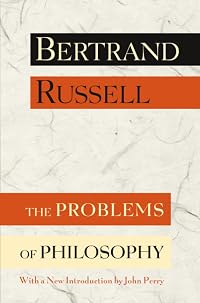
The Problems of Philosophy
by Bertrand Russell
On This Page
Description
Regarded as one of the most significant thinkers of the twentieth century, Bertrand Russell was a British philosopher who helped establish the discipline of analytic philosophy. In the enormously ambitious volume The Problems of Philosophy, Russell sets forth the chief issues and dilemmas that he considered to be most worthy of the time and effort of contemporary philosophers.Tags
Recommendations















Member Reviews
The title’s a misnomer – the book is almost exclusively about epistemology, or theory of knowledge. This reflects the narrowing of philosophy’s scope in the English-speaking world 100 years ago, eventually making itself more or less a subdiscipline of linguistics (a self-imposed constriction which has only fairly recently been loosened). But Russell treats his subject with characteristic lucidity; the clarity and precision of his logic and phrasing have a certain austere beauty, if that’s the right word. And his formulation and theoretical contributions have their own value, as do his observations and critiques. Unfortunately he rarely shows his considerable wit in this relatively early work.
To a large extent this is a show more restatement and synthesis of classical British Empiricist epistemology with some refinements and twists of Russell’s own, which are the products of his work in mathematics and logic as well as his critical evaluations of earlier philosophers’ ideas. The result is a very clear, concise, precise, but also carefully worked-out and thorough theory of knowledge. His distinction of knowledge by acquaintance vs. by description, and his treatments of induction, a priori knowledge, knowledge of universals, and what he calls intuitive knowledge (i.e. of self-evident things) are particularly valuable. It’s interesting to note that Russell thinks Plato was largely on track with his Theory of Forms (Ideas), while Kant blew it in his epistemology and Hegel blew it in general. You might say Russell’s agreement with Plato makes him a neo-empiricist, at least at this point in his career.
In the second last chapter he explains why his scope is so limited, substantially paralleling A.J. Ayer’s contention that nothing meaningful can be said and nothing known about metaphysics; and that philosophy is only properly concerned with clarifying terms and statements, and with assessing the validity of arguments. Russell doesn’t exactly say this and perhaps doesn’t go quite this far, but he’s close.
Then in the last chapter he takes a bold leap and makes a number of statements about the purpose and value of philosophy and how life should be lived. Having avoided ethics and largely avoided metaphysics while working through theory of knowledge with his constricted logical precision, he now abandons rational argument in favor of rhetoric and dives headlong into the fearful abyss. Needless to say he doesn’t attempt to prove anything he says in this chapter as he’s spent much of the book trying to demonstrate why these types of statements are indefensible. Maybe there’s more consistency and validity in this chapter than what I see and I’ve just missed it, but it seems pretty out of tune with the rest of the book. It’s nevertheless still pretty well written and fairly compelling. It would have been nice if Russell had tried to treat this material by the same methods he used previously, or else had tried to explain what alternate approach was reasonable and why. Apparently even Bertrand Russell had some hair to let down, but it does seem like an odd coda to a rigorously logical and self-limited piece of early 20th c. analytic philosophy. show less
To a large extent this is a show more restatement and synthesis of classical British Empiricist epistemology with some refinements and twists of Russell’s own, which are the products of his work in mathematics and logic as well as his critical evaluations of earlier philosophers’ ideas. The result is a very clear, concise, precise, but also carefully worked-out and thorough theory of knowledge. His distinction of knowledge by acquaintance vs. by description, and his treatments of induction, a priori knowledge, knowledge of universals, and what he calls intuitive knowledge (i.e. of self-evident things) are particularly valuable. It’s interesting to note that Russell thinks Plato was largely on track with his Theory of Forms (Ideas), while Kant blew it in his epistemology and Hegel blew it in general. You might say Russell’s agreement with Plato makes him a neo-empiricist, at least at this point in his career.
In the second last chapter he explains why his scope is so limited, substantially paralleling A.J. Ayer’s contention that nothing meaningful can be said and nothing known about metaphysics; and that philosophy is only properly concerned with clarifying terms and statements, and with assessing the validity of arguments. Russell doesn’t exactly say this and perhaps doesn’t go quite this far, but he’s close.
Then in the last chapter he takes a bold leap and makes a number of statements about the purpose and value of philosophy and how life should be lived. Having avoided ethics and largely avoided metaphysics while working through theory of knowledge with his constricted logical precision, he now abandons rational argument in favor of rhetoric and dives headlong into the fearful abyss. Needless to say he doesn’t attempt to prove anything he says in this chapter as he’s spent much of the book trying to demonstrate why these types of statements are indefensible. Maybe there’s more consistency and validity in this chapter than what I see and I’ve just missed it, but it seems pretty out of tune with the rest of the book. It’s nevertheless still pretty well written and fairly compelling. It would have been nice if Russell had tried to treat this material by the same methods he used previously, or else had tried to explain what alternate approach was reasonable and why. Apparently even Bertrand Russell had some hair to let down, but it does seem like an odd coda to a rigorously logical and self-limited piece of early 20th c. analytic philosophy. show less
I actually read this twice, almost three times. I came to this by way of an article I'd read somewhere in the last three months, which article made a distinction between 'knowledge by acquaintance' and 'knowledge by description.' Russell addresses this matter in Chapter V. So, that's what I'd read first, online (you can find the whole book online, albeit riddled with typos, which make for rather slow going at times). Once I'd read that chapter, I had to read the book.
According to many Goodreads reviews of Russell's PoP, this is a fairly easy book. Easy, they say? Easy!
Hardly. (At least not easy for those, like me, who've never really studied philosophy.) I'd like to raise a finger of defiance here to these 'Easy Readers,' these Dennis show more Hoppers and Peter Fondas on their Harley Davidsons of the mind, roaring down the information superhighway, intellectual wind in their hair.
In direct contrast to these, I slogged through Russell's PoP on the mental equivalent of a homemade skateboard with tin-can wheels. I would read a chapter and barely understand it; only on the second or third reading would the information 'pop' or coalesce into something comprehensible. And exciting, frankly. My mind got stronger as I went/read along.
Here's the book's last paragraph:
"Thus, to sum up our discussion of the value of philosophy: Philosophy is to be studied, not for the sake of any definite answers to its questions, since no definite answers can, as a rule, be known to be true, but rather for the sake of the questions themselves; because these questions enlarge our conception of what is possible, enrich our intellectual imagination, and diminish the dogmatic assurance which closes the mind against speculation; but above all because, through the greatness of the universe which philosophy contemplates, the mind also is rendered great, and becomes capable of that union with the universe which constitutes its highest good."
My favorite quote, though, came near the beginning -- at the end of Chapter One, to be exact. "Philosophy, if it cannot answer so many questions as we could wish, has at least the power of asking questions which increase the interest of the world, and show the strangeness and wonder lying just below the surface of even the commonest things of daily life."
This "strangeness and wonder" immanent in the humdrum things of daily life is exactly what I learned to see in the chapters between these two quotes. I highly, highly recommend this book. show less
According to many Goodreads reviews of Russell's PoP, this is a fairly easy book. Easy, they say? Easy!
Hardly. (At least not easy for those, like me, who've never really studied philosophy.) I'd like to raise a finger of defiance here to these 'Easy Readers,' these Dennis show more Hoppers and Peter Fondas on their Harley Davidsons of the mind, roaring down the information superhighway, intellectual wind in their hair.
In direct contrast to these, I slogged through Russell's PoP on the mental equivalent of a homemade skateboard with tin-can wheels. I would read a chapter and barely understand it; only on the second or third reading would the information 'pop' or coalesce into something comprehensible. And exciting, frankly. My mind got stronger as I went/read along.
Here's the book's last paragraph:
"Thus, to sum up our discussion of the value of philosophy: Philosophy is to be studied, not for the sake of any definite answers to its questions, since no definite answers can, as a rule, be known to be true, but rather for the sake of the questions themselves; because these questions enlarge our conception of what is possible, enrich our intellectual imagination, and diminish the dogmatic assurance which closes the mind against speculation; but above all because, through the greatness of the universe which philosophy contemplates, the mind also is rendered great, and becomes capable of that union with the universe which constitutes its highest good."
My favorite quote, though, came near the beginning -- at the end of Chapter One, to be exact. "Philosophy, if it cannot answer so many questions as we could wish, has at least the power of asking questions which increase the interest of the world, and show the strangeness and wonder lying just below the surface of even the commonest things of daily life."
This "strangeness and wonder" immanent in the humdrum things of daily life is exactly what I learned to see in the chapters between these two quotes. I highly, highly recommend this book. show less
Although over a century old (published originally in 1912) and despite Bertrand Russell changing some of his opinions by 1924 and the first German translation, this surprisingly short (94 pages) account of the very basics of analytical philosophy still stands up as a classic text.
It may not be an easy read in places but it is probably the easiest read you are going to get if you are serious about understanding the basics of 'philosophical inquiry'. Less rigorous popular attempts to do the same are just skimming the surface of the subject.
At the end, Russell asks the pertinent question of what philosophy is for. Here he answers in uncompromising terms about the importance of the questioning process as it peels off certainties into show more science and leaves a residue of mystery whose investigation makes life worth living.
This book represents a very different approach to that of continental philosophy but the two wings of the bird are complementary and merely ask different questions. This remains an excellent introduction to the rigours of analysis and to what can and cannot be 'known'. show less
It may not be an easy read in places but it is probably the easiest read you are going to get if you are serious about understanding the basics of 'philosophical inquiry'. Less rigorous popular attempts to do the same are just skimming the surface of the subject.
At the end, Russell asks the pertinent question of what philosophy is for. Here he answers in uncompromising terms about the importance of the questioning process as it peels off certainties into show more science and leaves a residue of mystery whose investigation makes life worth living.
This book represents a very different approach to that of continental philosophy but the two wings of the bird are complementary and merely ask different questions. This remains an excellent introduction to the rigours of analysis and to what can and cannot be 'known'. show less
Great little treatise on predominantly epistemological issues. Lord Bertie makes a great claim when he says that one must overcome an aversion to absurdities if one is to be a student of philosophy.
Rather, The Problems of Philosophy, a more apt title might be, The Problems of Philosophers. In an attempt to not get tied up in a Gordian knot, Russell provides a brief, sequential study into the conundrum of perspective and truth, and how philosophical ideologies have tried to deal with it. The book was written in 1911, and Russell states in an afterword written in 1924, that some of his views had changed since the first writing but has kept the book as it is, as a progression of thought. Throughout, he mostly ignores language, which is a shame, but he does set aside some attention to it in the chapter, How A Priori Knowledge Is Possible. Some passages seem to spring straight out of a Dr Seuss book, such as, "Thus, when we are show more acquainted with an object which is the so-and-so, we know that the so-and-so exists; but we may know that the so-and-so exists when we are not acquainted with any object which we know to be the so-and-so, and even when we are not acquainted with any object which, in fact, is the so-and-so."
Much of the book feels like Russell, working stuff out on the spot, applies in his knowledge of Kant, Plato, Hegel, Leibniz &c, to elucidate his examples. For me, his logic, at times, backed me into a corner, and the examples of the theory, in my view, were not the best thought out. However, it's a thought provoking read, which is the point of the book. So worth a read if you don't have time to wade through the works referenced within. show less
Much of the book feels like Russell, working stuff out on the spot, applies in his knowledge of Kant, Plato, Hegel, Leibniz &c, to elucidate his examples. For me, his logic, at times, backed me into a corner, and the examples of the theory, in my view, were not the best thought out. However, it's a thought provoking read, which is the point of the book. So worth a read if you don't have time to wade through the works referenced within. show less
http://nwhyte.livejournal.com/1248048.html
This is an excellent short guide to philosophy. I am not widely enough read in the subject to know to what extent Russell is pushing his own views rather than simply giving an overview of the subject, but he succeeded in persuading me that the questions of Berkeley, Hume, Kant, et al are not stupid, but very interesting and part of the gateway to opening up one's thoughts about the world as a whole. I found myself thinking of particular resonances with my political work, and the very nature of knowledge. He has a great final chapter about why this is all worthwhile, online here, but this was my favourite paragraph (with apologies for the sexist language of 1912):
The man who has no tincture of show more philosophy goes through life imprisoned in the prejudices derived from common sense, from the habitual beliefs of his age or his nation, and from convictions which have grown up in his mind without the co-operation or consent of his deliberate reason. To such a man the world tends to become definite, finite, obvious; common objects rouse no questions, and unfamiliar possibilities are contemptuously rejected. As soon as we begin to philosophize, on the contrary, we find, as we saw in our opening chapters, that even the most everyday things lead to problems to which only very incomplete answers can be given. Philosophy, though unable to tell us with certainty what is the true answer to the doubts which it raises, is able to suggest many possibilities which enlarge our thoughts and free them from the tyranny of custom. Thus, while diminishing our feeling of certainty as to what things are, it greatly increases our knowledge as to what they may be; it removes the somewhat arrogant dogmatism of those who have never travelled into the region of liberating doubt, and it keeps alive our sense of wonder by showing familiar things in an unfamiliar aspect.
I particularly love that line about freeing one's thoughts from the "tyranny of custom". Good stuff. show less
This is an excellent short guide to philosophy. I am not widely enough read in the subject to know to what extent Russell is pushing his own views rather than simply giving an overview of the subject, but he succeeded in persuading me that the questions of Berkeley, Hume, Kant, et al are not stupid, but very interesting and part of the gateway to opening up one's thoughts about the world as a whole. I found myself thinking of particular resonances with my political work, and the very nature of knowledge. He has a great final chapter about why this is all worthwhile, online here, but this was my favourite paragraph (with apologies for the sexist language of 1912):
The man who has no tincture of show more philosophy goes through life imprisoned in the prejudices derived from common sense, from the habitual beliefs of his age or his nation, and from convictions which have grown up in his mind without the co-operation or consent of his deliberate reason. To such a man the world tends to become definite, finite, obvious; common objects rouse no questions, and unfamiliar possibilities are contemptuously rejected. As soon as we begin to philosophize, on the contrary, we find, as we saw in our opening chapters, that even the most everyday things lead to problems to which only very incomplete answers can be given. Philosophy, though unable to tell us with certainty what is the true answer to the doubts which it raises, is able to suggest many possibilities which enlarge our thoughts and free them from the tyranny of custom. Thus, while diminishing our feeling of certainty as to what things are, it greatly increases our knowledge as to what they may be; it removes the somewhat arrogant dogmatism of those who have never travelled into the region of liberating doubt, and it keeps alive our sense of wonder by showing familiar things in an unfamiliar aspect.
I particularly love that line about freeing one's thoughts from the "tyranny of custom". Good stuff. show less
Bertrand Russell sets out to explain why philosophy is important. He's probably right, but I didn't find it very interesting. Relatively accessible, but there are times where he states that we can take for granted something I wasn't so sure we could, but maybe that's because I know about postmodernism. He also has a tendency to be a bit dismissive of positions as obviously mistaken just after he's told you someone presumably quite smart holds that position. There's quite a lot of discussions of tables. (The thing you put your dinner on, not the math kind.)
Members
- Recently Added By
Lists

The Works of Bertrand Russell
62 works; 1 member

Filosofía - Clásicos
217 works; 1 member

How to Read a Book's Recommended Reading List
309 works; 10 members

Philosophy, Politics and Economics
61 works; 1 member

My List
302 works; 1 member

Philosophy Reading List
9 works; 1 member

el
1,139 works; 1 member

In Our Time books
4,934 works; 2 members
Author Information

431+ Works 39,541 Members
Bertrand Arthur William Russell (1872-1970) was a British philosopher, logician, essayist and social critic. He was best known for his work in mathematical logic and analytic philosophy. Together with G.E. Moore, Russell is generally recognized as one of the main founders of modern analytic philosophy. Together with Kurt Gödel, he is regularly show more credited with being one of the most important logicians of the twentieth century. Over the course of a long career, Russell also made contributions to a broad range of subjects, including the history of ideas, ethics, political and educational theory, and religious studies. General readers have benefited from his many popular writings on a wide variety of topics. After a life marked by controversy--including dismissals from both Trinity College, Cambridge, and City College, New York--Russell was awarded the Order of Merit in 1949 and the Nobel Prize for Literature in 1950. Noted also for his many spirited anti-nuclear protests and for his campaign against western involvement in the Vietnam War, Russell remained a prominent public figure until his death at the age of 97. (Bowker Author Biography) show less
Some Editions
Awards and Honors
Series
Belongs to Publisher Series
Work Relationships
Is contained in
Common Knowledge
- Canonical title
- The Problems of Philosophy
- Original title
- The problems of philosophy; The Problems of Philosophy
- Original publication date
- 1912 (English) (English); 1959 (Italian) (Italian)
- First words
- Preface
In the following pages I have confined myself in the main to those problems of philosophy in regard to which I thought it possible to say something positive and constructive, since merely negative criticism seemed ... (show all)out of place. For this reason, theory of knowledge occupies a larger space than metaphysics in the present volume, and some topics much discussed by philosophers are treated very briefly, if at all.
Is there any knowledge in the world which is so certain that no reasonable man could doubt it? - Last words
- (Click to show. Warning: May contain spoilers.)Thus, to sum up our discussion of the value of philosophy; Philosophy is to be studied, not for the sake of any definite answers to its questions, since no definite answers can, as a rule, be known to be true, but rather for the sake of the questions themselves; because these questions enlarge our conception of what is possible, enrich our intellectual imagination and diminish the dogmatic assurance which closes the mind against speculation; but above all because, through the greatness of the universe which philosophy contemplates, the mind also is rendered great, and becomes capable of that union with the universe which constitutes its highest good.
- Original language
- English
- Canonical LCC
- B1649.R93
Classifications
Statistics
- Members
- 3,794
- Popularity
- 4,196
- Reviews
- 30
- Rating
- (3.79)
- Languages
- 22 — Catalan, Chinese, Danish, Dutch, English, Estonian, Finnish, French, German, Greek, Hebrew, Hungarian, Italian, Japanese, Latvian, Farsi/Persian, Polish, Portuguese, Romanian, Spanish, Swedish, Turkish
- Media
- Paper, Audiobook, Ebook
- ISBNs
- 174
- UPCs
- 1
- ASINs
- 80