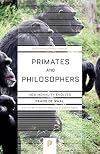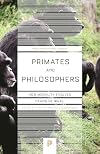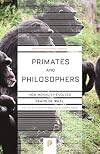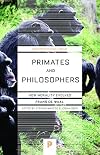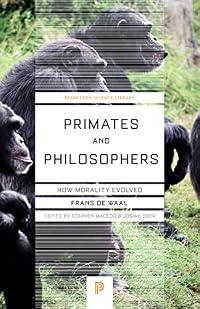
Primates and Philosophers: How Morality Evolved
by Frans de Waal
On This Page
Description
Can virtuous behavior be explained by nature, and not by human rational choice? "It's the animal in us," we often hear when we've been bad. But why not when we're good? Primates and Philosophers tackles this question by exploring the biological foundations of one of humanity's most valued traits: morality. In this provocative book, renowned primatologist Frans de Waal argues that modern-day evolutionary biology takes far too dim a view of the natural world, emphasizing our "selfish" genes show more and reinforcing our habit of labeling ethical behavior as humane and the less civilized as animalistic. Seeking the origin of human morality not in evolution but in human culture, science insists that we are moral by choice, not by nature. Citing remarkable evidence based on his extensive research of primate behavior, de Waal attacks "Veneer Theory," which posits morality as a thin overlay on an otherwise nasty nature. He explains how we evolved from a long line of animals that care for the weak and build cooperation with reciprocal transactions. Drawing on Darwin, recent scientific advances, and his extensive research of primate behavior, de Waal demonstrates a strong continuity between human and animal behavior. He probes issues such as anthropomorphism and human responsibilities toward animals. His compelling account of how human morality evolved out of mammalian society will fascinate anyone who has ever wondered about the origins and reach of human goodness. Based on the Tanner Lectures de Waal delivered at Princeton University's Center for Human Values in 2004, Primates and Philosophers includes responses by the philosophers Peter Singer, Christine M. Korsgaard, and Philip Kitcher and the science writer Robert Wright. They press de Waal to clarify the differences between humans and other animals, yielding a lively debate that will fascinate all those who wonder about the origins and reach of human goodness. show lessTags
Recommendations





















Member Reviews
In this book, Frans de Waal takes on what he calls the "Veneer Theory" of morality. Veneer theory, which de Waal most identifies with T.H. Huxley, treats morality as a separate layer of human behavior and conscious experience that sits over and controls a lower animal layer. After de Waal's argument, several moral philosophers critique de Waal's claims, and de Waal responds in the book's final chapter.
Veneer theory resonates with some traditional theories of morality. Both social contract theory and Kantian morality can be read as suggesting a kind of veneer theory. Social contract theory, at least in its Hobbesian flavors, explicitly treats morality and political order as rational, intentional agreements to counter a state of show more dog-eat-dog nature. Kantian moral theory identifies morality with reason, distinguished from and at least at times opposing "inclination."
I think that, knowing what we know now of animal behavior (partly owing to de Waal), almost no one would deny that animals, especially higher primates, exhibit complex social behavior, or that that social behavior includes actions taken out of concern for others and actions taken to build and maintain group identity and order. Some may deny true altruism, arguing that apparently altruistic actions are either not fully intentional or that they are really disguised pursuits of self-interest (e.g., arrangements in which present assistance is traded for future reciprocation).
And nature isn't quite so dire as a stark veneer theory would have it. It's not "dog eat dog" -- in fact, so far as I know, dogs don't routinely eat other dogs. Animals do behave with regard for the lives of others, and de Waal gives lots of examples from his research with primates. De Waal is right, I think, in so far as he gives us reason to reject veneer theory as a theory that supposes all animal behavior to be base and morality to provide, exclusively for human beings, the ability to rise above and control those base behaviors.
But part of the attraction of veneer theory is that treating morality as separate from our animal natures provides for a struggle between morality and self-interest. Our conscious lives are full of that conflict -- should I tell a white lie to avoid an unpleasant situation or just say "to heck with it" and do whatever I want?
I think that struggle is important to our understanding of human morality. We do struggle to be moral, and part of being moral is succeeding in that struggle. We struggle both to determine what is the right thing to do, and then to do it. In trying to do the right thing, our "better natures" fight to overcome our "baser natures", just as the veneer theorists would have it.
But where they are wrong is in supposing that only one is truly our "nature" while the other isn't. De Waal successfully shows that at least some of the foundations of our better nature are shared with other animals, especially higher primates.
Oddly, it may be that this struggle between morality and self-interest isn't shared with those primates. Nothing, so far as I can see, in the research that de Waal presents here, provides evidence that the same kind of struggle -- struggle either in determining the right thing to do or in overcoming inclinations not to do it -- occurs in the conscious life of apes. Hard to know, certainly, but I'd be interested in knowing what de Waal thinks about that question.
In any case, our closest animal relatives are not mere creatures of self-interest, and our own evolutionary ancestors are accordingly not. There is no absolutely discontinuous evolutionary gap or separation between human morality and the lives of our ancestors. That is the mistaken view that de Waal seems to rightly reject.
None of this, I think, decides the issue of how we should treat apes, something that Peter Singer raises prominently in his critique of de Waal. Singer, a long time advocate for extending our moral "circle" beyond our fellow human beings, is concerned of course about use of chimpanzees and other apes and monkeys in medical experiments and other research. He rightly points out that it matters more simply that apes suffer in such experiments than that they are in some sense on a par with us as moral creatures. I do think however that the more that we perceive them as "like us" the less we are likely to countenance their suffering. show less
Veneer theory resonates with some traditional theories of morality. Both social contract theory and Kantian morality can be read as suggesting a kind of veneer theory. Social contract theory, at least in its Hobbesian flavors, explicitly treats morality and political order as rational, intentional agreements to counter a state of show more dog-eat-dog nature. Kantian moral theory identifies morality with reason, distinguished from and at least at times opposing "inclination."
I think that, knowing what we know now of animal behavior (partly owing to de Waal), almost no one would deny that animals, especially higher primates, exhibit complex social behavior, or that that social behavior includes actions taken out of concern for others and actions taken to build and maintain group identity and order. Some may deny true altruism, arguing that apparently altruistic actions are either not fully intentional or that they are really disguised pursuits of self-interest (e.g., arrangements in which present assistance is traded for future reciprocation).
And nature isn't quite so dire as a stark veneer theory would have it. It's not "dog eat dog" -- in fact, so far as I know, dogs don't routinely eat other dogs. Animals do behave with regard for the lives of others, and de Waal gives lots of examples from his research with primates. De Waal is right, I think, in so far as he gives us reason to reject veneer theory as a theory that supposes all animal behavior to be base and morality to provide, exclusively for human beings, the ability to rise above and control those base behaviors.
But part of the attraction of veneer theory is that treating morality as separate from our animal natures provides for a struggle between morality and self-interest. Our conscious lives are full of that conflict -- should I tell a white lie to avoid an unpleasant situation or just say "to heck with it" and do whatever I want?
I think that struggle is important to our understanding of human morality. We do struggle to be moral, and part of being moral is succeeding in that struggle. We struggle both to determine what is the right thing to do, and then to do it. In trying to do the right thing, our "better natures" fight to overcome our "baser natures", just as the veneer theorists would have it.
But where they are wrong is in supposing that only one is truly our "nature" while the other isn't. De Waal successfully shows that at least some of the foundations of our better nature are shared with other animals, especially higher primates.
Oddly, it may be that this struggle between morality and self-interest isn't shared with those primates. Nothing, so far as I can see, in the research that de Waal presents here, provides evidence that the same kind of struggle -- struggle either in determining the right thing to do or in overcoming inclinations not to do it -- occurs in the conscious life of apes. Hard to know, certainly, but I'd be interested in knowing what de Waal thinks about that question.
In any case, our closest animal relatives are not mere creatures of self-interest, and our own evolutionary ancestors are accordingly not. There is no absolutely discontinuous evolutionary gap or separation between human morality and the lives of our ancestors. That is the mistaken view that de Waal seems to rightly reject.
None of this, I think, decides the issue of how we should treat apes, something that Peter Singer raises prominently in his critique of de Waal. Singer, a long time advocate for extending our moral "circle" beyond our fellow human beings, is concerned of course about use of chimpanzees and other apes and monkeys in medical experiments and other research. He rightly points out that it matters more simply that apes suffer in such experiments than that they are in some sense on a par with us as moral creatures. I do think however that the more that we perceive them as "like us" the less we are likely to countenance their suffering. show less
An interesting and important topic, poorly handled. The scientists and philosophers who contribute to this discussion write as if they are arguing against each other's conclusions, but the truth is that they not only have not defined the terms of the debate, they have not defined the question to be debated.
Also, de Waal listed each reference in text. That is to say, instead of using end- or foot-notes, the reader is constantly bumping into such as (Williams 1988:438) and being jarred out of the development of understanding of the sentence that note interrupts.
Moreover, there are no notes about the other contributors, Singer et al. What is a lay reader like me supposed to think of them? Why should I give any weight to their show more contributions? None wrote clearly enough to illuminate the debate, and apparently none have done actual research, so I don't feel guilty for not being able to understand every intricacy of their essays.
What is perhaps most interesting is that the straw man concept most thoroughly discussed (VT) is that which says that humans are completely self-centered and only behave as if moral and/or altruistic for Machiavellian reasons. This implies that we're polite only as a social 'grease.' And then the reader is cued to wonder why the authors so often refer to 'my respected colleague' and 'the minor flaw in an intelligent theory' etc.... Do they really respect one another, or do they type those words while gritting their teeth?
Some studies reported, some ancient philosophies compared, some animal anecdotes shared... adds up to a book that could be provocative. But I'm waiting for another one - one based on real science that is, perhaps, inspired by the work of de Waal. show less
Also, de Waal listed each reference in text. That is to say, instead of using end- or foot-notes, the reader is constantly bumping into such as (Williams 1988:438) and being jarred out of the development of understanding of the sentence that note interrupts.
Moreover, there are no notes about the other contributors, Singer et al. What is a lay reader like me supposed to think of them? Why should I give any weight to their show more contributions? None wrote clearly enough to illuminate the debate, and apparently none have done actual research, so I don't feel guilty for not being able to understand every intricacy of their essays.
What is perhaps most interesting is that the straw man concept most thoroughly discussed (VT) is that which says that humans are completely self-centered and only behave as if moral and/or altruistic for Machiavellian reasons. This implies that we're polite only as a social 'grease.' And then the reader is cued to wonder why the authors so often refer to 'my respected colleague' and 'the minor flaw in an intelligent theory' etc.... Do they really respect one another, or do they type those words while gritting their teeth?
Some studies reported, some ancient philosophies compared, some animal anecdotes shared... adds up to a book that could be provocative. But I'm waiting for another one - one based on real science that is, perhaps, inspired by the work of de Waal. show less
A book aimed more at the academic reader than general reader (for which his book Are We Smart Enough to Know How Smart Animals Are? is the better choice), this book deals in more detail about the experiments de Waal will return to in his later books. The big difference in content is a heightened and more restrained writing that's met with contrarian replies at the end - what I thought would be the most enlightening, but in fact turned out to be exactly what you'd think; de Waal is accused of anthropomorphism, of expanding his conclusions beyond the confines of the most minimal interpretations, of confounding problems.
It's not that the criticism is unfair, and it's mostly delivered with good natured respect for de Waals work, it's that show more the minimalist view on animal intelligence and morality is already pretty familiar; it predates science itself as a view on "beasts" as fundamentally separate and unfeeling, a sentiment that's followed through the battles over evolution into the modern era, with scientists arguing that animal testing was ethical because animals simply couldn't experience pain as we could. Thankfully that hardline stance was reappraised and dismissed. Even in de Waals work evolutionary similarity is a key feature of the moral argument for higher functionality, and primates are his main focus here (while later books explore alternative examples from the animal kingdom), but experimentally the problem seems just as dependent on the ability to design problems the target animal can and wants to solve (compare experimental approaches to octopus intelligence, corvid intelligence and primates), with some research showing certain animals are too aloof and uninterested in the type of experiments we design (feline vs canine intelligence experiments for instance) rather than clearly lacking the ability.
The greater point in the premise of the book extends into an argument about the evolutionary development of intelligence, higher reasoning and consequently morality in humans, but the book is far more restrained than his more popular science books, and while more rigorous, also lacking what made those really good. show less
It's not that the criticism is unfair, and it's mostly delivered with good natured respect for de Waals work, it's that show more the minimalist view on animal intelligence and morality is already pretty familiar; it predates science itself as a view on "beasts" as fundamentally separate and unfeeling, a sentiment that's followed through the battles over evolution into the modern era, with scientists arguing that animal testing was ethical because animals simply couldn't experience pain as we could. Thankfully that hardline stance was reappraised and dismissed. Even in de Waals work evolutionary similarity is a key feature of the moral argument for higher functionality, and primates are his main focus here (while later books explore alternative examples from the animal kingdom), but experimentally the problem seems just as dependent on the ability to design problems the target animal can and wants to solve (compare experimental approaches to octopus intelligence, corvid intelligence and primates), with some research showing certain animals are too aloof and uninterested in the type of experiments we design (feline vs canine intelligence experiments for instance) rather than clearly lacking the ability.
The greater point in the premise of the book extends into an argument about the evolutionary development of intelligence, higher reasoning and consequently morality in humans, but the book is far more restrained than his more popular science books, and while more rigorous, also lacking what made those really good. show less
Thought provoker, but then de Waal tends to do that. I finished this a couple of days ago and still don't know if I can do this review justice, but... The basis of this is his criticism (and dismissal) of the Hobbesian view that morality is a layer (a veneer) overlaying the baser, brutish animal that humans really are. This Veneer Theory, as dubbed by de Waal, has advocates and opponents (de Waal being one) and his leading essay here outlined his positions as to why the veneerists are wrong...in his view. No, humans are not moral "by choice" as Hobbes, Huxley and, it seems, Dawkins would have...rather, morality evolved from social constructs evidenced by some of our primate cousins. Four essays respond to his, and then he responds to show more them...an interesting format. A civilized debate; a food network throw down for people who actually think. They want to address "why don’t we think it is good to be bad?" And none of the five feel "that there is any reason to suppose that humans are different in their metaphysical essence from other animals, or at least, none base their arguments on the idea that humans uniquely possess a transcendent soul." See? For people who think.
The editors observe that all five share the understanding that
So, to frame the argument, de Wall says
Journalist (and sociobiologist/evolutionary psychologist) Robert Wright picks at de Waal's use of anthropomorphic language in his writings and arguments. He says
Philosopher Christine Korsgaard sides with de Waal in arguing against Veneer Theory in her essay:
Peter Singer, philosopher, in his response essay "Morality, Reason, and the Rights of Animals" points out
Okay, I veneered the second half of the book (first half, too, really, but...) I need to read more de Waal, but my confirmation bias thinks he's right, whether he uses the appropriate descriptive language or attributions. show less
The editors observe that all five share the understanding that
moral goodness is something real, about which it is possible to make truth claims. Goodness requires, at a minimum, taking proper account of others. Badness, by the same token, includes the sort of selfishness that leads us to treat others improperly by ignoring their interests or treating them as mere instruments. The two basic premises of evolutionary science and moral reality establish the boundaries of the debate over the origins of goodness as it is set forth in this book. This means that those religious believers who are committed to the idea that humans have been uniquely endowed with special attributes (including a moral sense) by divine grace alone are not participants in the discussion as it is presented here.Emphasis mine. Some of the counterarguments call out de Wall for anthropomorphizing his studies (more on that), but he has long observed enough behavior that he justifies well his "scientific anthropomorphism" (as distinguished from the Peter Rabbit-ish writings.)
The point is that de Waal’s evidence, quantitative and anecdotal, for primate emotional response is based entirely on observations of actual behavior. De Waal must base his account of primate morality on how primates do in fact act because he has no access to their “ought” stories about what moral reason might ideally demand of them, or to how they suppose they ought to act in a hypothetical situation.So there seems to be a risk of comparing apples and oranges: contrasting primate behavior (based on quantitative and anecdotal observation) with human normative ideals.(their emphasis) Important distinction. There is no anthropomorphism in that. Humans want to project "ought" and it is the duty of the impartial scientific observer to maintain a distance.
So, to frame the argument, de Wall says
Hobbes and Rawls create the illusion of human society as a voluntary arrangement with self-imposed rules assented to by free and equal agents. Yet, there never was a point at which we became social: descended from highly social ancestors—a long line of monkeys and apes—we have been group-living forever. Free and equal people never existed. Humans started out—if a starting point is discernible at all—as interdependent, bonded, and unequal.Our evolution didn't spontaneously pop out a "moral" product.
For a human characteristic, such as empathy, that is so pervasive , develops so early in life, and shows such important neural and physiological correlates as well as a genetic substrate, it would be strange indeed if no evolutionary continuity existed with other mammals. The possibility of empathy and sympathy in other animals has been largely ignored, however.I don't know how anyone can deny that some animals have empathy and either it developed independently (which has happened for multiple many features) or has passed down from some earlier species. de Wall argues that Veneer Theory "lacks any sort of explanation of how we moved from being amoral animals to moral beings. The theory is at odds with the evidence for emotional processing as driving force behind moral judgment." de Waal:
If human morality could truly be reduced to calculations and reasoning, we would come close to being psychopaths, who indeed do not mean to be kind when they act kindly.Extreme? perhaps, but it bears thought. He notes this on morality:
It should further be noted that the evolutionary pressures responsible for our moral tendencies may not all have been nice and positive. After all, morality is very much an in-group phenomenon. Universally, humans treat outsiders far worse than members of their own community: in fact, moral rules hardly seem to apply to the outside.This is lost on so many people! Racism, xenomisia, nationalism...hello!
Morality likely evolved as a within-group phenomenon in conjunction with other typical within-group capacities, such as conflict resolution, cooperation, and sharing.This makes sense, no? de Waal:
The first loyalty of every individual is not to the group, however, but to itself and its kin. With increasing social integration and reliance on cooperation, shared interests must have risen to the surface so that the community as a whole became an issue.
Obviously, the most potent force to bring out a sense of community is enmity toward outsiders. It forces unity among elements that are normally at odds. This may not be visible at the zoo, but it is definitely a factor for chimpanzees in the wild, which show lethal intercommunity violence. In our own species, nothing is more obvious than that we band together against adversaries. In the course of human evolution, out-group hostility enhanced in-group solidarity to the point that morality emerged. Instead of merely ameliorating relations around us, as apes do, we have explicit teachings about the value of the community and the precedence it takes, or ought to take, over individual interests. Humans go much further in all of this than the apes, which is why we have moral systems and apes do not.Still. the fringe elements supported and promoted by the current US administration seem to have a closer connection to the cousins...
Journalist (and sociobiologist/evolutionary psychologist) Robert Wright picks at de Waal's use of anthropomorphic language in his writings and arguments. He says
There are two broad categories of anthropomorphic language. First, there is emotional language: We can say that chimpanzees feel compassionate, outraged, aggrieved, insecure, et cetera. Second, there is cognitive language, language that attributes conscious knowledge and/or reasoning to animals: We can say that chimpanzees remember, anticipate, plan, strategize, et cetera.His beef with de Waal seems to be that "It isn’t always clear from the behavioral evidence alone which kind of anthropomorphic language is in order." and that de Waal seems to prefer cognitive anthropomorphism. de Waal does tend to impart a more human reasoning to explain some of his (many) observations of simian behavior, the cognitive anthropomorphism, but then he does have decades of behaviors observed!
Philosopher Christine Korsgaard sides with de Waal in arguing against Veneer Theory in her essay:
There are a number of problems with Veneer Theory. In the first place, despite its popularity in the social sciences, the credentials of the principle of pursuing your own best interests as a principle of practical reason have never been established. [...]She then looks at de Waal's consideration of intent as he establishes the primacy of the bases for the evolution of our morality.
In the second place, it is not even clear that the idea of self-interest is a well-formed concept when applied to an animal as richly social as a human being.[...]
So the idea that we can clearly identify our own interests as something set apart from or over against the interests of others is strained to say the least.
And yet even this is not the deepest thing wrong with Veneer Theory. Morality is not just a set of obstructions to the pursuit of our interests. Moral standards define ways of relating to people that most of us, most of the time, find natural and welcome.[...]
It is absurd to suggest that this is what most human beings are like, or long to be like, beneath a thin veneer of restraint.
But it is also absurd to think that nonhuman animals are motivated by self-interest. The concept of what is in your own best interests, if it makes any sense at all, requires a kind of grip on the future and an ability to calculate that do not seem available to a nonhuman animal.
The question of intention is a question about how an episode in which an animal does something looks from the acting animal’s own point of view, whether it is plausible to think that the animal acts with a certain kind of purpose in mind. I think there is a temptation to think that the question whether we can see the origins of morality in animal behavior depends on how exactly we interpret their intentions, whether their intentions are “good” or not. I think that, at least taken in the most obvious way, this is a mistake.She has a point - interpretation is necessary, as we cannot (yet) know what animals are thinking, so care must be taken to normalize that interpretation.
Peter Singer, philosopher, in his response essay "Morality, Reason, and the Rights of Animals" points out
Once we recognize that nonhuman animals have complex emotional and social needs, we begin to see animal abuse where others might not see it [...]I didn't pull much from his counter, but I thought that worth sharing. In de Waal's response to the responses, he asks
So, we need to distinguish intentional selfishness and intentional altruism from mere functional equivalents of such behavior. Biologists use the two almost interchangeably, but Philip Kitcher and Christine Korsgaard are correct to stress the importance of knowing the motives behind behavior. Do animals ever intentionally help each other? Do humans?I submit that Daniel Kahneman answers that. Our emotional brain reacts first, much as we rational beings hate to admit it, and that emotional brain developed much earlier than the human primate overlay.
I add the second question even if most people blindly assume a affirmative answer. We show a host of behavior, though, for which we develop justifications after the fact.
Okay, I veneered the second half of the book (first half, too, really, but...) I need to read more de Waal, but my confirmation bias thinks he's right, whether he uses the appropriate descriptive language or attributions. show less
Primates and Philosophers, or how you should think of morality on the 21st century. This could as well be the title of this book. For, as de Waal states in the conclusion of this work "The debate with my colleagues made me think of Wilson’s (1975: 562) recommendation three decades ago that 'the time has come for ethics to be removed temporarily from the hands of philosophers and biologicized.'" (2006) So there you have. You can either go by the moralists who believe that morality is only a human affair, or go the biological way and realize that as with everything else, in what concerns morality, we are again the tip of the iceberg in evolutionary terms.
If you are interested in delving deeper into these kind of debates, you'll show more definitely love this book. There's plenty of academic nitty-picking inside, so you have to measure how much committed you are to these issues before opening the book. Again, quoting de Waal, "While making for good academic fights, semantics are mostly a waste of time. Are animals moral? Let us simply conclude that they occupy several floors of the tower of morality. Rejection of even this modest proposal can only result in an impoverished view of the structure as a whole" (2006).
In any case, de Waal's essays are rich and insightful as everything he has written thus far. So you won't waste your time if you just read his contributions to the volume. show less
If you are interested in delving deeper into these kind of debates, you'll show more definitely love this book. There's plenty of academic nitty-picking inside, so you have to measure how much committed you are to these issues before opening the book. Again, quoting de Waal, "While making for good academic fights, semantics are mostly a waste of time. Are animals moral? Let us simply conclude that they occupy several floors of the tower of morality. Rejection of even this modest proposal can only result in an impoverished view of the structure as a whole" (2006).
In any case, de Waal's essays are rich and insightful as everything he has written thus far. So you won't waste your time if you just read his contributions to the volume. show less
Frans de Waal is one of my favorite writers about what makes us human, and in that context I was a bit disappointed in this book. I had expected a bright and breezy de Waal book, like "Our Inner Ape" or "Chimpanzee Politics". Instead, this book consists of a longish academic article by de Waal, preceded by an introduction, and followed by commentary and appendices. There is lots of interesting stuff in the the book; my problem is that it's not nearly as much fun to get at. Worth ready, but also worthy reading.
A discussion of the evolution of morality. The author is a primatologist, and brings his experience to the question by asking whether there is any evidence of consciousness and altruism in our nearest relatives, which would help support the argument for an evolutionary origin of morality. The paper is actually quite short, and there are answers from other writers, mostly philosophers, who disagree with all or part of what de Waal has to say, followed by his response. The questions raised are interesting, the articles are well written, and none of them seem to be disagreeing with the idea of an evolutionary basis for morality; they are mostly quibbling about details.
Members
- Recently Added By
Author Information

30+ Works 6,058 Members
Frans De Waal has been named one of Time magazine's 100 Most Influential People. The author of The Bonobo and the Atheist, among many other works, he is the C. H. Candler Professor in Emory University's Psychology Department and director of the Living Links Center at the Yerkes National Primate Research Center. He lives in Atlanta, Georgia.
All Editions
Series
Belongs to Publisher Series
Common Knowledge
- Canonical title
- Primates and Philosophers: How Morality Evolved
- Original publication date
- 2006
- Epigraph
- We approve and we disapprove because we cannot do otherwise. Can we help feeling pain when the fire burns us? Can we help sympathizing with our friends?
-- Edward Westermarck ([The Origin and Development of the... (show all) Moral Ideas, v.1, 2d ed.])
Why should our nastiness be the baggage of an apish past and our kindness uniquely human? Why should we not seek continuity with other animals for our "noble" traits as well?
-- Stephen Jay Gould (["So Cleverly Kind ... (show all)an Animal," in Ever Since Darwin]) - First words
- In the Tanner Lectures on Human Values that became the lead essay in this book, Frans de Waal brings his decades of work with primates, and his habit of thinking deeply about the meaning of evolution, to bear on a fundamental... (show all) question about human morality. (Introduction)
Homo homini lupus -- "man is wolf to man" -- is an ancient Roman proverb popularized by Thomas Hobbes. - Last words
- (Click to show. Warning: May contain spoilers.)Rejection of even this modest proposal can only result in an impoverished view of the structure as a whole.
- Publisher's editor
- Elworthy, Sam; Beder, Jodi
Classifications
Statistics
- Members
- 402
- Popularity
- 77,014
- Reviews
- 9
- Rating
- (3.50)
- Languages
- 8 — Dutch, English, French, German, Italian, Polish, Portuguese (Portugal), Spanish
- Media
- Paper, Audiobook, Ebook
- ISBNs
- 15
- ASINs
- 4