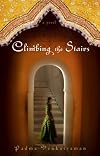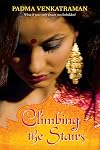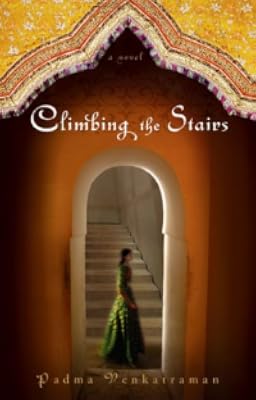
Climbing the Stairs
by Padma Venkatraman
On This Page
Description
In India, in 1941, when her father becomes brain-damaged in a non-violent protest march, fifteen-year-old Vidya and her family are forced to move in with her father's extended family and become accustomed to a totally different way of life.Tags
Recommendations



























Member Recommendations
Member Reviews
August, 1941 in Bombay, India. Vidya is a teenage girl in a Brahman family. Her father is a doctor, volunteering as an Indian freedom fighter, her brother is in college, and her mother really just wants to see Vidya married happily. One day, after they have dropped off Vidya’s uncle at the train station, the family’s life changes drastically.
On their drive home from the train station, Vidya and her father encounter a protest. Vidya wants nothing more than to be able to join them, and so rushes into the crowd. Soon, the British police arrive on the scene and start beating the protesters; in order to protect one woman whom the police are brutally beating, Vidya’s father shields this woman, and ends up getting his head crushed. show more Though not dead, he has massive brain damage and is more of a shell than the person Vidya and her family loved.
As her father can no longer take care of them, Vidya’s family must move to Madras to join her grandfather’s traditional home. Living in the house are a number of Vidya’s aunts and uncles, and the brother-in-law (Raman) of one of Vidya’s aunts. Vidya has a very tough time adjusting – doesn’t make friends at school, is bullied by two of her aunts, and has to deal with the guilt of believing she’s caused her father’s infirmity. The only place where she finds refuge is the forbidden library in her grandfather’s home, and she soon develops a strong friendship with Raman during their time spent in the library.
I have to say that I enjoyed reading this book. It took me less than the span of a weekend to get through the whole thing. The characters were believable, and there was enough depth that I could like certain ones and dislike others completely. It also had some paralleling with Cinderella, though I wouldn’t consider this a retelling of the story at all – just some similar elements like the evil family members who are only sort of related to the main character, that make her do more than her share of housework.
The last chapter… I really wish it wasn’t included in the book. It acted more as an epilogue than anything else, and I have a habit of NOT liking epilogues. I mean, did you read the one in Deathly Hallows? Wasn’t it ghastly? Anyway, the one in this book was written as a letter from Vidya to Raman, but it didn’t carry Vidya’s voice in it; it didn’t mesh with the rest of the book. And I had a minor quibble with the last couple of sentences in the book, as they had the feeling of “Yayz America! Best Country Evar!” in a way that wasn’t like Vidya’s voice previously and quite frankly made me roll my eyes. I realize the book is written by an American author for an American audience, but it felt a little bit too over-the-top for me to find it believable.
Other than that, I thought the book was quite good and enjoyable. It was emotional – made me tear up at least once (but what would you expect from a book that takes place during WWII?) – and transported me fully to WWII-era India. Gave the full picture of what it would’ve been like to actually be there, and it was beautiful. show less
On their drive home from the train station, Vidya and her father encounter a protest. Vidya wants nothing more than to be able to join them, and so rushes into the crowd. Soon, the British police arrive on the scene and start beating the protesters; in order to protect one woman whom the police are brutally beating, Vidya’s father shields this woman, and ends up getting his head crushed. show more Though not dead, he has massive brain damage and is more of a shell than the person Vidya and her family loved.
As her father can no longer take care of them, Vidya’s family must move to Madras to join her grandfather’s traditional home. Living in the house are a number of Vidya’s aunts and uncles, and the brother-in-law (Raman) of one of Vidya’s aunts. Vidya has a very tough time adjusting – doesn’t make friends at school, is bullied by two of her aunts, and has to deal with the guilt of believing she’s caused her father’s infirmity. The only place where she finds refuge is the forbidden library in her grandfather’s home, and she soon develops a strong friendship with Raman during their time spent in the library.
I have to say that I enjoyed reading this book. It took me less than the span of a weekend to get through the whole thing. The characters were believable, and there was enough depth that I could like certain ones and dislike others completely. It also had some paralleling with Cinderella, though I wouldn’t consider this a retelling of the story at all – just some similar elements like the evil family members who are only sort of related to the main character, that make her do more than her share of housework.
The last chapter… I really wish it wasn’t included in the book. It acted more as an epilogue than anything else, and I have a habit of NOT liking epilogues. I mean, did you read the one in Deathly Hallows? Wasn’t it ghastly? Anyway, the one in this book was written as a letter from Vidya to Raman, but it didn’t carry Vidya’s voice in it; it didn’t mesh with the rest of the book. And I had a minor quibble with the last couple of sentences in the book, as they had the feeling of “Yayz America! Best Country Evar!” in a way that wasn’t like Vidya’s voice previously and quite frankly made me roll my eyes. I realize the book is written by an American author for an American audience, but it felt a little bit too over-the-top for me to find it believable.
Other than that, I thought the book was quite good and enjoyable. It was emotional – made me tear up at least once (but what would you expect from a book that takes place during WWII?) – and transported me fully to WWII-era India. Gave the full picture of what it would’ve been like to actually be there, and it was beautiful. show less
Before I start this review, I do have to say that I have met the author, and like her very much, but have tried to make this review fair and unbiased. Climbing the Stairs by Padma Venkatraman is a YA historical fiction about a fifteen-year-old girl named Vidya that takes place in India during the struggle for Indian independence and WWII. Outspoken and willful Vidya is excited about her future, but when her father is injured in a freedom rally, Vidya’s hopes of entering college are shattered when her family is forced to move in with her grandfather and his straight-laced, traditional household. Her only way to escape is to climb the stairs to her grandfather’s library where she is forbidden to go.
Vidya is a delightful protagonist, show more but at first she seems a little naïve and immature for her age. For example, in a strange scene in the first chapter, she is unable to identify a stain on her father’s shirt as blood, despite the fact that she is fifteen years old and the daughter of a physician. However, after witnessing a British officer brutally beat her father, she becomes a much more believable character as she struggles with guilt about her role in her father’s injury and shame about her father’s resulting brain damage. I also thought that a few of the interactions Vidya has with her love interest, Raman, are sometimes very awkward and her uncle’s family comes across as a little too mean to be realistic.
Despite these shortcomings, I would highly recommend this novel to anyone who is interested in in Indian history. The setting and time-period covered by this book are not often covered in American literature and especially not in such a truthful, open way. Sometimes I find that Indian-American authors tend to romanticize India and their novels read as odes to a perfect country where problems such as caste-based discrimination and sexism don’t seem to exist. However, through Vidya’s eyes, the author unflinchingly shows us her view of what it was like to live in a male-dominated society and where oppression was a fact of life. We see shocking events and difficult social problems portrayed honestly, and this important time in India’s history comes to life in a believable and interesting way. show less
Vidya is a delightful protagonist, show more but at first she seems a little naïve and immature for her age. For example, in a strange scene in the first chapter, she is unable to identify a stain on her father’s shirt as blood, despite the fact that she is fifteen years old and the daughter of a physician. However, after witnessing a British officer brutally beat her father, she becomes a much more believable character as she struggles with guilt about her role in her father’s injury and shame about her father’s resulting brain damage. I also thought that a few of the interactions Vidya has with her love interest, Raman, are sometimes very awkward and her uncle’s family comes across as a little too mean to be realistic.
Despite these shortcomings, I would highly recommend this novel to anyone who is interested in in Indian history. The setting and time-period covered by this book are not often covered in American literature and especially not in such a truthful, open way. Sometimes I find that Indian-American authors tend to romanticize India and their novels read as odes to a perfect country where problems such as caste-based discrimination and sexism don’t seem to exist. However, through Vidya’s eyes, the author unflinchingly shows us her view of what it was like to live in a male-dominated society and where oppression was a fact of life. We see shocking events and difficult social problems portrayed honestly, and this important time in India’s history comes to life in a believable and interesting way. show less
Climbing the Stairs is about fifteen year old Vidya, a member of an orthodox Tamil Brahmin family, who does not want to get married, but instead wants to attend college and make something of herself. It is the early 1940s, and India's independence movement is in full swing, even as World War II rages across the world. Vidya has a liberal family, but when tragedy strikes, she has to move to Madras to her grandfather's home, which is a traditional joint family home. (And of course, she meets a boy there that dashes all her dreams of spinsterhood.)
This story resonated with me more than I thought it would because my grandmother was part of a joint family in Madras (albeit not Brahmin.) The relationships between the various family members show more (the grandfather being the supreme authority, the older sister in laws being bossy, the family hierarchy) really seemed to ring true. I don't think my grandmother's family was as strict as this one, but I'm not sure.
Vidya is a likeable protagonist (although it's hard to go wrong with a girl that likes books), she knew what she wanted and tried her best to get it. She didn't complain too much, though, or stoop to the petty level of the other women she was surrounded by. I loved the turn that her relationship with Raman took (to say any more would be a spoiler, but I was glad that she didn't have to be "rescued.") I think that her voice and opinions were also very well portrayed – she was a very believable sheltered fifteen year old girl.
I also liked the setting a lot, despite being a fairly lighthearted and simple book, the various factions in India during this very volatile time period were portrayed pretty well. The non-violent Gandhians that believed in ahimsa, the people that believed that independence required violence, the sycophants to the British. There were British police that wanted to stop protests with violence, but there was also a kindly British man.
Overall, a pretty enjoyable and easy read. show less
This story resonated with me more than I thought it would because my grandmother was part of a joint family in Madras (albeit not Brahmin.) The relationships between the various family members show more (the grandfather being the supreme authority, the older sister in laws being bossy, the family hierarchy) really seemed to ring true. I don't think my grandmother's family was as strict as this one, but I'm not sure.
Vidya is a likeable protagonist (although it's hard to go wrong with a girl that likes books), she knew what she wanted and tried her best to get it. She didn't complain too much, though, or stoop to the petty level of the other women she was surrounded by. I loved the turn that her relationship with Raman took (to say any more would be a spoiler, but I was glad that she didn't have to be "rescued.") I think that her voice and opinions were also very well portrayed – she was a very believable sheltered fifteen year old girl.
I also liked the setting a lot, despite being a fairly lighthearted and simple book, the various factions in India during this very volatile time period were portrayed pretty well. The non-violent Gandhians that believed in ahimsa, the people that believed that independence required violence, the sycophants to the British. There were British police that wanted to stop protests with violence, but there was also a kindly British man.
Overall, a pretty enjoyable and easy read. show less
Fifteen year old Vidya and her family, Amma, Appa, and Kitta, her brother,live in British occupied Bombay, India in 1941. She has led a carefree life unconstrained by the duties or something of young girls of her station as Brahmins. Her father, Appa, is a well-respected doctor who assists the injured in India’s struggle for independence, when he is brutally rendered brain damaged after being beaten by a British soldier at a protest march, Vidya and her family are forced to go live with her father’s family in Madras. Vidya feels responsible for this change in the family’s circumstance, especially since before the beating her father had promised that she could go to college. Her father’s older brother, Periappa, and his wife, show more Periamma, are very different from her parents and run a traditional household where the men are separated from the women and never eat together. They are caricatures of the evil aunt and uncle. Her cousin Malati, who is the same age as Vidya, can’t wait for her arranged marriage. While taking care of her Chinni chithi’s baby as one of her chores, Vidya sneaks up the stairs to the men’s wing and into the library. Vidya’s life revolves around school, her chores, music lessons with her cousin, the library and more chores. While in the library she meets her cousin Raman who treats her as an equal. This stiff coming of age tale in exotic India leaves many questions unanswered. For example, Appa’s character is insufficiently developed to give any indication that he would have such modern views about educating his daughter. The overuse of similes in the first half of the book is distracting. show less
The cover of this book caught my eye and I'm so glad it did. It took me back to the summer I spent in India with a friend's family. Her family was like Amma and Appa and I could relate to Vidya's life in Bombay.
The tragedy that followed and her thrust into traditional life was almost as heartbreaking for me as it was for her. Her strong spirit allowed her to make the best of the situation and she ultimately triumphs in the end. I wondered that her Thatha wasn't paying attenton to what was going on in his own house, but he does answer that in the end.
Her descriptions brought to mind places I'd been, things we'd seen... It was a great trip down memory lane.
The tragedy that followed and her thrust into traditional life was almost as heartbreaking for me as it was for her. Her strong spirit allowed her to make the best of the situation and she ultimately triumphs in the end. I wondered that her Thatha wasn't paying attenton to what was going on in his own house, but he does answer that in the end.
Her descriptions brought to mind places I'd been, things we'd seen... It was a great trip down memory lane.
Growing up in India during WWII, scholarly fifteen-year-old Vidya dreams of going to college one day, but when her supportive father is injured during a passive protest march, Vidya must move in with her conservative relatives and fight to keep her dream of college alive. This historical young-adult novel explores a fascinating setting, with plenty of insights into Indian culture and the Indian perspective of the war. These elements are handled with great care and ring with authenticity. Unfortunately, the story itself is too leisurely paced and the characters too underdeveloped to be truly engaging. While teen girls will certainly root for Vidya, they may ultimately be disappointed by how little she actually does to achieve her dream. show more This title will instead appeal most strongly to readers who wish to immerse themselves in Indian history or culture or who wish to explore a non-Western view of WWII. Recommended for libraries with strong world literature or historical fiction collections. Recommended for readers age 13 to 18. show less
Vidya and her family's life turns upside down after her dad sustains brain injury while caught up in a nonviolent demonstration against British rule in India during WWII. An interesting look at traditional Hindu customs and division of the genders in the Brahmin caste. Vidya is determined to get an education, racked with guilt about her father's injury, struggles to maintain her relationship with her older brother, and manages to fall in love while worrying about being forced into an arranged marriage before finishing her education.
Members
- Recently Added By
Lists

Teen Historical Fiction
29 works; 1 member

A Child's Book Tour of India
71 works; 3 members
Author Information

11+ Works 2,172 Members
Awards and Honors
Awards
Distinctions
Common Knowledge
- Original publication date
- 2008
Classifications
Statistics
- Members
- 604
- Popularity
- 48,619
- Reviews
- 24
- Rating
- (3.87)
- Languages
- English, Korean, Spanish
- Media
- Paper, Ebook
- ISBNs
- 13
- ASINs
- 3