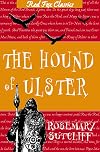
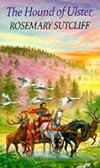
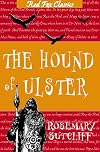
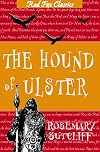
The Hound of Ulster
by Rosemary Sutcliff
On This Page
Description
This saga of the Irish Celts is re-told by Rosemary Sutcliff with a magical weaving together of passion and poetry. The boy who takes up the spear and shield of Manhood on this day will become the most renowned of all the warriors of Ireland, men will follow at his call to the world's end, and his enemies will shudder at the thunder of his chariot wheels. So the prophecy went, and as the boy Cuchulain heard it, he went forward to claim the weapons of his manhood. This is the story of how he show more became the greatest of heroes--the Hound of Ulster. show lessTags
Recommendations





















Member Reviews
Prolific English children's author Rosemary Sutcliff, perhaps best known for her novels set in Roman Britain, here retells the life story of Cú Chulainn, one the greatest figures of Irish myth and folklore. The son of Dectera (Deichtire), here a half fairy woman, the boy Setanta is sent to be raised by his kinsman, Conor Mac Nessa, and gains his true name - Cú Chulainn, the "Hound of Cullan" - through an act of boyhood bravery, in which he slays a fearsome dog. The narrative follows him through his wooing of Emer, his youthful training with the woman warrior Skatha (Scáthach), and his many battles and heroic deeds. The book climaxes with the great war between Ulster and Connacht, in which Cú Chulainn, the champion of Ulster, kills show more his own son, Connla, before realizing who he is. The story concludes with the death of the hero, at the hands of the three Witch Daughters of Calatin...
Although quite familiar with the character of Cú Chulainn, who is the hero of the ancient Irish epic, The Táin Bó Cúailnge ("The Cattle Raid of Cooley"), which has been described as the Irish Iliad, and which chronicles the events of the ancient war between Connacht and Ulster, I had never read anything that took all of the stories about him and tied them together into one narrative of his life. I was therefore pleased when Sutcliff's The Hound of Ulster was assigned as a text in the course I took on the history of children's literature, while getting my masters, particularly as I had already read and greatly enjoyed her historical novel, The Eagle of the Ninth. I found this telling immensely engaging, and was interested to see Sutcliff's take on this famous tale. I do wish that she had discussed her specific sources, in her too-brief foreword, but leaving aside that criticism, this is one I would highly recommend, to any middle-grade reader (or older reader of middle-grade books) who enjoys fantasy and/or mythology. show less
Although quite familiar with the character of Cú Chulainn, who is the hero of the ancient Irish epic, The Táin Bó Cúailnge ("The Cattle Raid of Cooley"), which has been described as the Irish Iliad, and which chronicles the events of the ancient war between Connacht and Ulster, I had never read anything that took all of the stories about him and tied them together into one narrative of his life. I was therefore pleased when Sutcliff's The Hound of Ulster was assigned as a text in the course I took on the history of children's literature, while getting my masters, particularly as I had already read and greatly enjoyed her historical novel, The Eagle of the Ninth. I found this telling immensely engaging, and was interested to see Sutcliff's take on this famous tale. I do wish that she had discussed her specific sources, in her too-brief foreword, but leaving aside that criticism, this is one I would highly recommend, to any middle-grade reader (or older reader of middle-grade books) who enjoys fantasy and/or mythology. show less
I believe I had probably read this book before, when I was very young. However, it's possible that I'd read a different re-telling of these stories.
"The Hound of Ulster" is Cuchulain, the legendary Irish hero, who, when his battle rage was upon him, was undefeatable.
It collects the different tales of Cuchulain, and strings them together into a narrative, much like Howard Pyle's tales of King Arthur.
The language is quite traditional, without using the technique of fleshing out the stories with many completely original details, as is more the mode today. What's here is pretty much just what's in the original tales, but told in an easy-to-follow, enjoyable way.
However, in Sutcliff's introduction, she mentions how one can tell a lot about a show more people and culture from the tales that they tell... and, reading these, I couldn't help but be reminded (again) of Ursula K. LeGuin's "Gifts," and how she showed in that book how small and petty conflicts and rivalries could be magnified to an importance all out of proportion in an isolated, primitive culture. Here, a good deal of Cuchulain's "heroic" exploits have to do with no more than stealing a neighbor's cattle! It's interesting to read these stories in contrast to so much of the extremely 'elevated' fantasy inspired by Celtic myth.
The book also shows, however, some of the interesting aspects of the culture - how a Queen could sometimes be more powerful than her husband, how bearing a child out of wedlock did not have shame attached, and acceptance of infidelity in marriage - things that are there in the original stories, but surprising, I thought, for a book published in 1963 and marketed to an audience including young people. show less
"The Hound of Ulster" is Cuchulain, the legendary Irish hero, who, when his battle rage was upon him, was undefeatable.
It collects the different tales of Cuchulain, and strings them together into a narrative, much like Howard Pyle's tales of King Arthur.
The language is quite traditional, without using the technique of fleshing out the stories with many completely original details, as is more the mode today. What's here is pretty much just what's in the original tales, but told in an easy-to-follow, enjoyable way.
However, in Sutcliff's introduction, she mentions how one can tell a lot about a show more people and culture from the tales that they tell... and, reading these, I couldn't help but be reminded (again) of Ursula K. LeGuin's "Gifts," and how she showed in that book how small and petty conflicts and rivalries could be magnified to an importance all out of proportion in an isolated, primitive culture. Here, a good deal of Cuchulain's "heroic" exploits have to do with no more than stealing a neighbor's cattle! It's interesting to read these stories in contrast to so much of the extremely 'elevated' fantasy inspired by Celtic myth.
The book also shows, however, some of the interesting aspects of the culture - how a Queen could sometimes be more powerful than her husband, how bearing a child out of wedlock did not have shame attached, and acceptance of infidelity in marriage - things that are there in the original stories, but surprising, I thought, for a book published in 1963 and marketed to an audience including young people. show less
Ratings
Members
- Recently Added By
Lists

Myth (Reuse and Retelling)
188 works; 24 members

Books Read in 2015
3,299 works; 129 members

Books With Place Names in the Title
315 works; 12 members
Author Information

83+ Works 22,386 Members
Rosemary Sutcliff was on born December 14, 1920 in East Clandon in Surrey, England. As a child she had Still's Disease, a form of juvenile arthritis. The effect of this led to many stays in hospital for painful remedial operations. She ended her formal education at fourteen, and went to Bideford Art School. She passed the City and Guilds show more examination and worked as a painter of miniatures. She felt cramped by the small canvas of miniature painting and turned to writing. Her first two books, The Chronicles of Robin Hood and The Queen Elizabeth Story, were published in 1950. Her other works included The Eagle of the Ninth, The Silver Branch, Sword Song, and the autobiography Blue Remembered Hills. She won the annual Carnegie Medal from the Library Association for The Lantern Bearers in 1959 and the annual Horn Book Award for Tristan and Iseult in 1971. She won inaugural Phoenix Award in 1985 for The Mark of the Horse Lord and again in 2010 for The Shining Company. In 1975, she was appointed an Officer of the Order of the British Empire for services to children's literature, and was promoted to be a Commander of the Order of the British Empire in 1992. She died on July 23, 1992. (Bowker Author Biography) show less
Some Editions
Awards and Honors
Awards
Series
Belongs to Publisher Series
Work Relationships
Is contained in
Common Knowledge
- Original title
- Hound of Ulster
- Original publication date
- 1963
- People/Characters
- Cuchulain; Conor Mac Nessa; Maeve of Connacht
- Important places
- Ulster, Ireland; Emain Macha, County Armagh, Northern Ireland, UK (a.k.a. Navan Fort); Navan Fort, County Armagh, Northern Ireland, UK (a.k.a. Emain Macha); Ard Cuillen
- First words
- This is the story of Cuchulain, the Champion of Ulster, the greatest of all the Heroes of the Red Branch. Listen, now.
- Last words
- (Click to show. Warning: May contain spoilers.)No more.
- Disambiguation notice
- "Cwchwlin penarwr Iwerddon" is a Welsh translation of "Hound of Ulster" by Rosemary Sutcliff.
Classifications
- Genres
- Fiction and Literature, Children's Books, Kids
- DDC/MDS
- 398.2 — Society, government, & culture Customs, etiquette & folklore Folklore & Folktales Folk literature
- LCC
- PZ8.1 .S95 .H — Language and Literature Fiction and juvenile belles lettres Fiction and juvenile belles lettres Juvenile belles lettres
- BISAC
Statistics
- Members
- 195
- Popularity
- 168,852
- Reviews
- 3
- Rating
- (3.97)
- Languages
- English, Japanese, Welsh
- Media
- Paper, Ebook
- ISBNs
- 10
- ASINs
- 6