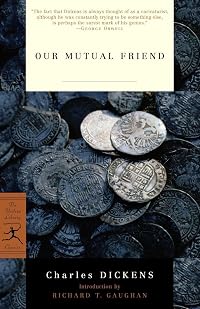
Our Mutual Friend
by Charles Dickens
On This Page
Description
Our Mutual Friend was Charles Dickens' last completed novel, and some believe his most sophisticated. A young man discovers that he must marry a mercenary young woman before he can claim his inheritance. He is on his way to do his father's bidding when a body discovered in the Thames is identified as his, and his inheritance passes instead to Boffins, a working class man. The effects are felt through all levels of society..
Tags
Recommendations







Member Reviews
“Here, conveniently and healthfully elevated above the level of the living, were the dead, and the tombstones; some of the latter droopingly inclined from the perpendicular, as if they were ashamed of the lies they told.” — Charles Dickens, “Our Mutual Friend”
“Our Mutual Friend” is a thick novel about thin lines. Throughout its (in my paperback edition) 800 pages of small print, Charles Dickens ponders those narrow lines that separate the living from the dead and people of different stations and conditions.
His main plot involves the supposed drowning death of John Harmon, a wealthy young man returning home to claim his late father's estate. He was also to claim the hand of the beautiful Bella Wilfer as required by the show more terms of his father's will. Not wanting a bride who might marry him only for his money, Harmon fakes his death and returns as John Rokesmith, becoming secretary to Mr. Boffin, a man of modest means who inherits the house and the fortune in his place and then invites Bella to live with him and his wife.
So already we can what Dickens has on his mind. Harmon is dead, but not really. Will Bella love him and consent to marry him when he is a poor man? Will she be changed by living in that great house and wearing the finest clothes? Will the fortune change the Boffins?
These concerns are echoed in the novel's various subplots and in the lives of its many characters. Other men are dragged from the Thames presumably dead, yet they survive. Other characters seemingly die only to come back to life. There are even dolls treated as living persons and living persons treated as if dolls. References to death and tombstones return again and again in this novel that celebrates life.
Another young couple consists of a man and woman of different social classes, and that difference threatens to keep them apart. Another couple, the opposite of John Harmon, pretends to be wealthy when they are impoverished. One boy, raised in poverty, struggles to rise in the world, yet as he rises his character lowers. Another poor boy finds contentment in his situation and maintains his strong character as that situation improves.
This novel, the last one Dickens would complete (1865), is not a favorite of many readers because of its length, complexity and contrived plot. Yet there is much to admire here and much to think about. It makes a reader realize that those tombstones, even when not lying, do not tell the whole truth about those who lie below. show less
“Our Mutual Friend” is a thick novel about thin lines. Throughout its (in my paperback edition) 800 pages of small print, Charles Dickens ponders those narrow lines that separate the living from the dead and people of different stations and conditions.
His main plot involves the supposed drowning death of John Harmon, a wealthy young man returning home to claim his late father's estate. He was also to claim the hand of the beautiful Bella Wilfer as required by the show more terms of his father's will. Not wanting a bride who might marry him only for his money, Harmon fakes his death and returns as John Rokesmith, becoming secretary to Mr. Boffin, a man of modest means who inherits the house and the fortune in his place and then invites Bella to live with him and his wife.
So already we can what Dickens has on his mind. Harmon is dead, but not really. Will Bella love him and consent to marry him when he is a poor man? Will she be changed by living in that great house and wearing the finest clothes? Will the fortune change the Boffins?
These concerns are echoed in the novel's various subplots and in the lives of its many characters. Other men are dragged from the Thames presumably dead, yet they survive. Other characters seemingly die only to come back to life. There are even dolls treated as living persons and living persons treated as if dolls. References to death and tombstones return again and again in this novel that celebrates life.
Another young couple consists of a man and woman of different social classes, and that difference threatens to keep them apart. Another couple, the opposite of John Harmon, pretends to be wealthy when they are impoverished. One boy, raised in poverty, struggles to rise in the world, yet as he rises his character lowers. Another poor boy finds contentment in his situation and maintains his strong character as that situation improves.
This novel, the last one Dickens would complete (1865), is not a favorite of many readers because of its length, complexity and contrived plot. Yet there is much to admire here and much to think about. It makes a reader realize that those tombstones, even when not lying, do not tell the whole truth about those who lie below. show less
Fear death by water. Madame Sosostris's advice came way too late for the characters in this 1865 satire of upward mobility and the corrupting power of money, through which the River Thames flows in its stately and all-devouring way from Henley to Limehouse and beyond. (It's a fair bet that TS Eliot had Our Mutual Friend in mind when he wrote the line, given that one working title for The Waste Land is said to be He do the policemen in different voices, Betty Higden's account of her supposedly idiotic assistant Sloppy reading her the law reports from the newspaper). As well as those who meet a wet end, and the whole complex narrative opens with a corpse dragged from the murky river, baptism and moral redemption through near-drowning is a show more powerful theme for no fewer than three prominent characters. One of those believes that surviving such an experience renders him immune from drowning. I don't want to spoil things for would-be readers by saying more, except that this is Dickens and as ever the story is shot through with the tropes of myth, fairy-tale and even pantomine. The child is mother to the man, the Jewish moneylender is as kind and generous as his Christian master is grasping and ruthless, and the vacuous social climbers trample all over each other in their rush to get to the top. Sorry, I lied about the last example, that's just like real life in the 20th Century.
It's a rum old thing, is this. It's a somewhat different, somewhat more subdued Dickens than the author of Oliver Twist and David Copperfield. The indignation against social injustice is still there; he revisits his outrage at the treatment of the poor from Oliver Twist, the corrupting power of wealth from Great Expectations, the shortcomings of the education system from Nicholas Nickleby and Hard Times, and yet it's less gripping than any of those. That's not to diminish it; this may not be a book to stay up all night reading, but it's a book to be a companion on a long journey, complex and intricate in its detail and one that refuses to be rushed. It lacks the stature of Bleak House maybe, but that's a very high standard to match.
And so this one-time Dickens-loather takes a further step on her journey to fandom. I do find I prefer the darker, more labyrinthine later Dickens to the earlier and better-known stuff. show less
It's a rum old thing, is this. It's a somewhat different, somewhat more subdued Dickens than the author of Oliver Twist and David Copperfield. The indignation against social injustice is still there; he revisits his outrage at the treatment of the poor from Oliver Twist, the corrupting power of wealth from Great Expectations, the shortcomings of the education system from Nicholas Nickleby and Hard Times, and yet it's less gripping than any of those. That's not to diminish it; this may not be a book to stay up all night reading, but it's a book to be a companion on a long journey, complex and intricate in its detail and one that refuses to be rushed. It lacks the stature of Bleak House maybe, but that's a very high standard to match.
And so this one-time Dickens-loather takes a further step on her journey to fandom. I do find I prefer the darker, more labyrinthine later Dickens to the earlier and better-known stuff. show less
In this novel Dickens appears to tackle virtually everything he ever attacked before: education, law and lawyers, debtor's prison, elections, high society, etc. The reason is that his primary topic this time is money, which touches on and lies behind everything else. Here we see the struggling desperation of the poor, the ridiculous rich with their curious motives, and the challenge of finding anyone with good morals at either end of the scale with all of them so focused upon this one thing, whether by necessity, greed or simple obliviousness to the importance of anything else. Dickens portrays the lengths men must go to for acquiring it or to sustain themselves, dwelling especially on the grim or dirty. He starts this novel with a man show more pursuing what might have been the worst 'job' anyone in London at the time could have. We also see a taxidermist's shop of horrors, dealers in 'dust' (garbage/recycling, I take it?), and other lines of work that expose the 'glory' of what's profitable.
It's not a very fun novel, compared to most Dickens. There are likeable characters here but they are fewer and farther between, the rest being placed under microscope for a study of their faults. We see the grudging of others' good fortune and its close attendance by suspect charities; another association of Judaism with usury (not so bad as Oliver Twist, but not so good either) and its fashioning as a front for a young man on the path to miserliness. We see petty justifications for theft, the underhanded negotiations that take advantage of generous natures, a young lady's determination to marry into wealth, the best healthcare money can buy (as compared with the least or none, a plight of the poor), and how having too much wealth can start to change you for the worse (echoes of Great Expectations here).
In terms of complexity, the plot interweaving is enough to rival Bleak House or anything else Dickens wrote, and he does his usual fine job of balancing his coverage of each element. I'm only sorry there weren't all that many threads I cared returning to, as many of them were quite dark. The characteristic humour is still there, popping up as a welcome and pleasant surprise, but sometimes it has an edge to it. Wegg is a miserable man to read about except when he's being foolish, the high society circle is chock full of snobs with only one sympathetic character in their midst to leaven them, and Eugene troubled me all the way to the end. Lizzie is too much of Dickens' usual pattern for angelic waifs, but Bella is a pleasure to know and I'm sorry she aspires to be a 1950s housewife. Jenny Wren is the most impressive female in the novel; can she really be only twelve?
The ending was mostly a series of disappointments for me:the Boffin betrayal of the reader's confidence is far worse than Martin Chuzzlewit's. Eugene's ending is totally undeserved and unearned, I suppose the moral being you give a scoffing womanizer a strong whack in the head and suddenly he's devoted husband material? And I'm even made to feel bad for Wegg, who only wanted a cut of what he supposed was another miscreant's spoils , but still it's not terrible. I like how all the moving pieces fit together and the strong theme that's as relevant as ever. There's clear potential for a modern adaptation to do this story justice. show less
It's not a very fun novel, compared to most Dickens. There are likeable characters here but they are fewer and farther between, the rest being placed under microscope for a study of their faults. We see the grudging of others' good fortune and its close attendance by suspect charities; another association of Judaism with usury (not so bad as Oliver Twist, but not so good either) and its fashioning as a front for a young man on the path to miserliness. We see petty justifications for theft, the underhanded negotiations that take advantage of generous natures, a young lady's determination to marry into wealth, the best healthcare money can buy (as compared with the least or none, a plight of the poor), and how having too much wealth can start to change you for the worse (echoes of Great Expectations here).
In terms of complexity, the plot interweaving is enough to rival Bleak House or anything else Dickens wrote, and he does his usual fine job of balancing his coverage of each element. I'm only sorry there weren't all that many threads I cared returning to, as many of them were quite dark. The characteristic humour is still there, popping up as a welcome and pleasant surprise, but sometimes it has an edge to it. Wegg is a miserable man to read about except when he's being foolish, the high society circle is chock full of snobs with only one sympathetic character in their midst to leaven them, and Eugene troubled me all the way to the end. Lizzie is too much of Dickens' usual pattern for angelic waifs, but Bella is a pleasure to know and I'm sorry she aspires to be a 1950s housewife. Jenny Wren is the most impressive female in the novel; can she really be only twelve?
The ending was mostly a series of disappointments for me:
Dickens at his most wonderful and at his most dreadful. The good bits of this book are a very strong reminder of why we should read Dickens and keep on re-reading him at every opportunity; the bad bits help to explain why many of us don't do that. We get some of his most vivid, unexpected sketches of characters and settings, especially the famous characterization of the River Thames that gives the book a kind of Wagnerian Leitmotif. In Headstone we have one of the most striking descriptions of hate and obsession anywhere, the hapless Wegg is a brilliant description of small-minded envy, and the sensitive way Dickens treats his "minority" characters (a mentally-handicapped person, one with a physical disability, an alcoholic, and a Jew) show more is completely different from what you expect from the mid-Victorian period. Despite the length of the book, one of its most striking features is the economy with which Dickens handles the scene changes. The Veneerings and their friends, who provide a Greek chorus commenting on the action at critical points, would dominate the story if it had been written by Trollope or Thackeray; Dickens barely pencils them in, but we still feel as though we know them all intimately.
On the other hand, there is one of the silliest and least plausible plot devices in the whole canon of Victorian fiction, we get two "good deaths" so sentimental they will make you feel physically sick, and there are a couple of father-daughter relationships that are almost as bad. Members of the teaching profession might also be forgiven for feeling a bit hard done by: apparently Dickens had not said all the nasty things he wanted to about education in David Copperfield, Oliver Twist, Nicholas Nickleby and Hard Times, so he thought of a few more for this book... show less
On the other hand, there is one of the silliest and least plausible plot devices in the whole canon of Victorian fiction, we get two "good deaths" so sentimental they will make you feel physically sick, and there are a couple of father-daughter relationships that are almost as bad. Members of the teaching profession might also be forgiven for feeling a bit hard done by: apparently Dickens had not said all the nasty things he wanted to about education in David Copperfield, Oliver Twist, Nicholas Nickleby and Hard Times, so he thought of a few more for this book... show less
Meera Syal’s narration of this work, complete with a unique voice for each character, is the best performance I’ve heard on Audible and what a story!
As Dickens writes in an afterword, there are two major plot twists in this novel (John Rockville is the heir John Hanford and the Boffins were in on the secret all along), one of which is deliberately telegraphed to the reader very early on and the other completely disguised until the very end of the novel. The final twist is worthy of the Dallas reunion movie where it turns out that J.R. merely shot the mirror in the original series finale inspired by A Christmas Carol.
And along the way, we see Dickens at his most masterful in creating unforgettable characters and dialogue, skewering show more society, advocating for the poor and writing some of the finest landscape/riverscape descriptions I have ever had the pleasure to read. This is one of those books the reader savors. I found myself worrying that some particularly wonderful passages were not bound to be bound to my memory.
If pressed for what I liked best, I would have to say the characters and the dialogue: Ms. Jenny Wren, the dressmaker of children’s dolls, the Veneerings, Podsnaps and Miss Tiffen, dinner hosts and guests from hell, Betty Hidgins, a poor woman destined to die on the road, Mrs.Wilfer, who wants nothing more than to rise above her station, Mr. Venus the taxidermist and the unparalleled band of villains—Bradley Headstone, the stalking, murderous schoolmaster, the Lammles, the fortune hunters mutually deceived into marriage, Rodger Ridinghood a river rogue, and Fascinating Fledgby, the indolent “gentleman” looking for a scam and hiding his money-lending business behind the kindly Jew, Mr. Riah, and Charley Hexam, a poor boy with brains and ambition.
These characters are all much more interesting with richer lives, stories, dialogue, than the main characters driving the plot. With Dickens, the plot is just the structure around which the best parts of the novel are strung.
This could be the best Dickens I’ve ever read although Great Expectations will always hold a special place for me. I see that it often ranks among Dickens’ most beloved works, the other one that is frequently mentioned being Bleak House. It’s been at least thirty years since I last visited Bleak House and this experience tells me it’s time for a revisit. show less
As Dickens writes in an afterword, there are two major plot twists in this novel (John Rockville is the heir John Hanford and the Boffins were in on the secret all along), one of which is deliberately telegraphed to the reader very early on and the other completely disguised until the very end of the novel. The final twist is worthy of the Dallas reunion movie where it turns out that J.R. merely shot the mirror in the original series finale inspired by A Christmas Carol.
And along the way, we see Dickens at his most masterful in creating unforgettable characters and dialogue, skewering show more society, advocating for the poor and writing some of the finest landscape/riverscape descriptions I have ever had the pleasure to read. This is one of those books the reader savors. I found myself worrying that some particularly wonderful passages were not bound to be bound to my memory.
If pressed for what I liked best, I would have to say the characters and the dialogue: Ms. Jenny Wren, the dressmaker of children’s dolls, the Veneerings, Podsnaps and Miss Tiffen, dinner hosts and guests from hell, Betty Hidgins, a poor woman destined to die on the road, Mrs.Wilfer, who wants nothing more than to rise above her station, Mr. Venus the taxidermist and the unparalleled band of villains—Bradley Headstone, the stalking, murderous schoolmaster, the Lammles, the fortune hunters mutually deceived into marriage, Rodger Ridinghood a river rogue, and Fascinating Fledgby, the indolent “gentleman” looking for a scam and hiding his money-lending business behind the kindly Jew, Mr. Riah, and Charley Hexam, a poor boy with brains and ambition.
These characters are all much more interesting with richer lives, stories, dialogue, than the main characters driving the plot. With Dickens, the plot is just the structure around which the best parts of the novel are strung.
This could be the best Dickens I’ve ever read although Great Expectations will always hold a special place for me. I see that it often ranks among Dickens’ most beloved works, the other one that is frequently mentioned being Bleak House. It’s been at least thirty years since I last visited Bleak House and this experience tells me it’s time for a revisit. show less
I am a little ashamed to say that this was my first experience of reading Dickens properly, though I am obviously very familiar with some of his plots through film and TV adaptations and radio abridgements, not to mention pastiches such as BBC Radio's Bleak Expectations. So many elements felt familiar.
I read it now because I have taken on the task of attempting to revive the dormant Reading the Chunksters group after spotting that it no longer had any moderators, and they chose this as a group read, which will start next week. In some ways it was a good choice as an introduction to Dickens, as I have not seen or heard any adaptations of this one and it is one of his most ambitious novels (and the last completed one).
I made a lot of show more notes while reading (my typed summary runs to 9 pages), but I won't say too much here, as I would rather save them for the discussion - after all Dickens has never been short of reviews and comments. As so often in classic novels the plotting seems outrageously contrived in places, but there is plenty to admire - the scope of Dickens' ambition, his unsparing vision of the city in all its guises, plenty of memorable characters, scenes and set pieces both comic and melodramatic.
I can't resist finishing with a quote from one of the book's lighter moments: “Lady Tippins lives in a chronic state of invitation to dine with the Veneerings, and in a chronic state of inflammation arising from the dinners.” show less
I read it now because I have taken on the task of attempting to revive the dormant Reading the Chunksters group after spotting that it no longer had any moderators, and they chose this as a group read, which will start next week. In some ways it was a good choice as an introduction to Dickens, as I have not seen or heard any adaptations of this one and it is one of his most ambitious novels (and the last completed one).
I made a lot of show more notes while reading (my typed summary runs to 9 pages), but I won't say too much here, as I would rather save them for the discussion - after all Dickens has never been short of reviews and comments. As so often in classic novels the plotting seems outrageously contrived in places, but there is plenty to admire - the scope of Dickens' ambition, his unsparing vision of the city in all its guises, plenty of memorable characters, scenes and set pieces both comic and melodramatic.
I can't resist finishing with a quote from one of the book's lighter moments: “Lady Tippins lives in a chronic state of invitation to dine with the Veneerings, and in a chronic state of inflammation arising from the dinners.” show less
Oh Dickens, I’ve missed you! I used to read one Dickens novel each year, but it’s been four years since I last picked up a new one of his tomes. It took me a minute to get into the novel, but once I got to know the characters I was completely hooked.
Dickens creates stories with a huge cast of supporting characters and half a dozen overlapping plots. His work was originally serialized, so imagine watching a complicated television drama. Each week there’s new twists and turns, but rarely are things resolved or revealed until those final chapters. His work is the same. You spend the first third of the book just trying to keep everyone straight and it was slow-going for a bit.
This novel, more than his others, starts off with an show more incredibly gripping scene. Lizzie and her father are rowing around the River Thames looking for dead bodies. They find a drowned man named John Harmon who is the heir to his grandfather’s fortune. From that moment on things become much more complicated.
There are the Boffins, an older couple that inherits the money when Harmon is declared dead. Then we meet Bella, the young lady who was destined to marry Harmon, even though they had never met. There’s a little crippled woman named Jenny Wren who makes clothes for dolls and a shady man named Silas Wegg with a wooden leg and a pile of schemes to get his hands on the inheritance.
SPOILERS
When John Rokesmith’s true identity was revealed I was so surprised! What an impossible situation to find yourself believed to be dead and then to realize that the woman you were supposed to marry didn't want to marry you. Then to fall in love with her without meaning to, even though you know she won’t love you because you’re “poor” now. If you tell her who you are she’ll marry you, but she won’t love you. Or you can walk away and lose your love forever.
The scene where Mr. Boffin tells him off and humiliates Bella was such a great one. I loved that they fell in love and he knew that she truly loved him and not his money. At the same time, I couldn’t believe he took so long to tell her who he was. I understand that she had seen something nasty in herself that scared her, but at some point you have to be honest with your spouse. I loved watching her transformation. She was such a frivolous creature and she found out what was really important to her when it was almost taken away.
A Few Highlights:
- The friendship between Lizzy and Bella, I love that relationship.
- I was so glad the Boffins were in on it and that he hadn't really turned miserly.
- The sweet scene towards the end with Sloppy and Jenny Wren was just the best.
- How perfect that the novel comes full circle for Lizzie. In the beginning she finds the dead body in the river and at the end she saves Eugene by pulling him from the river. No one does a full circle like Dickens!
- The schoolmaster was such a creepy stalker. That whole love story was sad an twisted. Eugene is so selfish and oblivious, Lizzie so hopeless, and Bradley is just aggressive and awful.
SPOILERS OVER
BOTTOM LINE: In Our Mutual Friend Dickens explores social classes, the dangers of greed, a twisted love triangle, and so much more. It was definitely one of my favorites of his books. This was his final completed novel, but I still have quite a few left to read. I’m sure I’ll pick a new one next year when the weather turns cold. There’s something about the first snow that always makes me want to curl up with his work.
"There's no royal road to learning and what is life but learning." show less
Dickens creates stories with a huge cast of supporting characters and half a dozen overlapping plots. His work was originally serialized, so imagine watching a complicated television drama. Each week there’s new twists and turns, but rarely are things resolved or revealed until those final chapters. His work is the same. You spend the first third of the book just trying to keep everyone straight and it was slow-going for a bit.
This novel, more than his others, starts off with an show more incredibly gripping scene. Lizzie and her father are rowing around the River Thames looking for dead bodies. They find a drowned man named John Harmon who is the heir to his grandfather’s fortune. From that moment on things become much more complicated.
There are the Boffins, an older couple that inherits the money when Harmon is declared dead. Then we meet Bella, the young lady who was destined to marry Harmon, even though they had never met. There’s a little crippled woman named Jenny Wren who makes clothes for dolls and a shady man named Silas Wegg with a wooden leg and a pile of schemes to get his hands on the inheritance.
SPOILERS
When John Rokesmith’s true identity was revealed I was so surprised! What an impossible situation to find yourself believed to be dead and then to realize that the woman you were supposed to marry didn't want to marry you. Then to fall in love with her without meaning to, even though you know she won’t love you because you’re “poor” now. If you tell her who you are she’ll marry you, but she won’t love you. Or you can walk away and lose your love forever.
The scene where Mr. Boffin tells him off and humiliates Bella was such a great one. I loved that they fell in love and he knew that she truly loved him and not his money. At the same time, I couldn’t believe he took so long to tell her who he was. I understand that she had seen something nasty in herself that scared her, but at some point you have to be honest with your spouse. I loved watching her transformation. She was such a frivolous creature and she found out what was really important to her when it was almost taken away.
A Few Highlights:
- The friendship between Lizzy and Bella, I love that relationship.
- I was so glad the Boffins were in on it and that he hadn't really turned miserly.
- The sweet scene towards the end with Sloppy and Jenny Wren was just the best.
- How perfect that the novel comes full circle for Lizzie. In the beginning she finds the dead body in the river and at the end she saves Eugene by pulling him from the river. No one does a full circle like Dickens!
- The schoolmaster was such a creepy stalker. That whole love story was sad an twisted. Eugene is so selfish and oblivious, Lizzie so hopeless, and Bradley is just aggressive and awful.
SPOILERS OVER
BOTTOM LINE: In Our Mutual Friend Dickens explores social classes, the dangers of greed, a twisted love triangle, and so much more. It was definitely one of my favorites of his books. This was his final completed novel, but I still have quite a few left to read. I’m sure I’ll pick a new one next year when the weather turns cold. There’s something about the first snow that always makes me want to curl up with his work.
"There's no royal road to learning and what is life but learning." show less
Members
- Recently Added By
Lists

1001 Books You Must Read Before You Die
1,448 works; 1,134 members
501 Must-Read Books
529 works; 72 members

Favorite Dickens novels?
16 works; 27 members

Favorite Long Books
330 works; 42 members

Favourite 19th century fiction
257 works; 62 members

Unread books
1,063 works; 83 members

Favourite Books
1,819 works; 316 members

The Top Ten: Writers Pick Their Favorite Books
240 works; 31 members
Literature About Social Class
134 works; 19 members

Best Books Set in London
157 works; 42 members

Top Five Books of 2013
1,562 works; 721 members
Books I've Read More Than Once
602 works; 49 members
BBC's 100 Novels That Shaped Our World
100 works; 22 members
Folio Society
831 works; 53 members
Harold Bloom - The Western Canon: C. The Democratic Age
336 works; 15 members

Books Featured on Gilmore Girls
307 works; 21 members

Western World's Greatest Books - Project Gutenberg
295 works; 15 members

Bibliography for Among Others
159 works; 15 members

Victorian Period
113 works; 10 members
A Novel Cure
742 works; 23 members
Good, Smart, Clean Fiction
46 works; 4 members
Books mentioned in The Diary of a Provincial Lady
59 works; 4 members

Books Read in 2017
4,249 works; 130 members

CCE 1000 Good Books List
1,033 works; 12 members

covers with paintings / paintings as covers .
37 works; 1 member

SHOULD Read Books!
354 works; 9 members
KayStJ's to-read list
1,616 works; 11 members

Greatest Books, allegedly
484 works; 9 members

Franklit
95 works; 1 member

New Lifetime Reading Plan by Fadiman and Major
225 works; 5 members

DigitalDreamDoor top 300
300 works; 4 members
The Complete Rory Gilmore Reading List
506 works; 5 members

Books read in 2025
49 works; 1 member

Charles Dickens books
17 works; 1 member
Talk Discussions
Past Discussions
Our Mutual Friend by Charles Dickens - LizzieD and lyzard get their thoughts in order in 75 Books Challenge for 2012 (December 2024)
Our Mutual Friend in What the Dickens...? (September 2013)
Author Information

2,578+ Works 313,139 Members
Charles Dickens, perhaps the best British novelist of the Victorian era, was born in Portsmouth, Hampshire, England on February 7, 1812. His happy early childhood was interrupted when his father was sent to debtors' prison, and young Dickens had to go to work in a factory at age twelve. Later, he took jobs as an office boy and journalist before show more publishing essays and stories in the 1830s. His first novel, The Pickwick Papers, made him a famous and popular author at the age of twenty-five. Subsequent works were published serially in periodicals and cemented his reputation as a master of colorful characterization, and as a harsh critic of social evils and corrupt institutions. His many books include Oliver Twist, David Copperfield, Bleak House, Great Expectations, Little Dorrit, A Christmas Carol, and A Tale of Two Cities. Dickens married Catherine Hogarth in 1836, and the couple had nine children before separating in 1858 when he began a long affair with Ellen Ternan, a young actress. Despite the scandal, Dickens remained a public figure, appearing often to read his fiction. He died in 1870, leaving his final novel, The Mystery of Edwin Drood, unfinished. (Bowker Author Biography) show less
Some Editions
Awards and Honors
Notable Lists
Series
Belongs to Publisher Series
Fireside Dickens (20)
New Century Library Works of Charles Dickens (Volume 15)
Project Gutenberg EBook (883)
Penguin English Library, 2012 series (2012-09)
Modern Library (308)
Everyman's Library (294)
Work Relationships
Is contained in
Contains
Has the adaptation
Is abridged in
Has as a reference guide/companion
Has as a study
Common Knowledge
- Canonical title
- Our Mutual Friend
- Original title
- Our Mutual Friend
- Original publication date
- 1865
- People/Characters
- John Harmon; John Rokesmith; Bella Wilfer; Eugene Wrayburn; Lizzie Hexam; Jesse "Gaffer" Hexam (show all 25); Charley Hexam; Mortimer Lightwood; Nicodemus "Noddy" Boffin; Henrietta Boffin; Silas Wegg; Bradley Headstone; Jenny Wren; Mr Riah; Roger "Rogue" Riderhood; Pleasant Riderhood; Mr Twemlow; Mr Podsnap; Georgiana Podsnap; Alfred Lammle; Sophronia Lammle; Mr Veneering; Mrs Veneering; Reginald Wilfer; Mrs Wilfer
- Important places
- London, England, UK; United Kingdom
- Related movies
- Our Mutual Friend (1998 | IMDb); Our Mutual Friend (1976 | IMDb); Our Mutual Friend (1958 | IMDb)
- Dedication
- This book is inscribed by its author to Sir James Emerson Tennent as a memorial of friendship
- First words
- In these times of ours, though concerning the exact year there is no need to be precise, a boat of dirty and disreputable appearance, with two figures in it, floated on the Thames, between Southwark bridge which is of iron, a... (show all)nd London Bridge which is of stone, as an autumn evening was closing in.
- Quotations
- "Why not possible, deary, when so many things are possible?" ~Mrs. Boffin
"You could draw me to fire. You could draw me to water. You could draw me to the gallows. You could draw me to any death." ~Bradley Headstone - Last words
- (Click to show. Warning: May contain spoilers.)When the company disperse—by which time Mr and Mrs Veneering have had quite as much as they want of the honour, and the guests have had quite as much as THEY want of the other honour—Mortimer sees Twemlow home, shakes hands with him cordially at parting, and fares to the Temple, gaily.
- Original language
- English
- Canonical DDC/MDS
- 823.8
Classifications
Statistics
- Members
- 6,595
- Popularity
- 1,833
- Reviews
- 110
- Rating
- (4.16)
- Languages
- 14 — Czech, Danish, Dutch, English, French, German, Italian, Norwegian (Bokmål), Norwegian, Polish, Portuguese, Spanish, Swedish, Turkish
- Media
- Paper, Audiobook, Ebook
- ISBNs
- 259
- UPCs
- 1
- ASINs
- 203