Fallen Dragon
by Peter F. Hamilton
On This Page
Description
In the distant future, corporations have become sustainable communities with their own militaries, and corporate goals have essentially replaced political ideology. On a youthful, rebellious impulse, Lawrence joined the military of a corporation that he now recognizes to be ruthless and exploitative. His only hope for escape is to earn enough money to buy his place in a better corporation. When his platoon is sent to a distant colony to quell a local resistance effort, it seems like a stroke show more of amazing fortune, and Lawrence plans to rob the colony of their fabled gemstone, the Fallen Dragon, to get the money he needs. However, he soon discovers that the Fallen Dragon is not a gemstone at all, but an alien life form that the local colonists have been protecting since it crashed in their area. Now, Lawrence has to decide if he will steal the alien to exploit the use of its inherent biotechnical processes -- which far exceed anything humans are capable of -- or if he will help the Resistance get the alien home. show lessTags
Recommendations




Member Reviews
This was a weird one. 80% of the novel is spent on a conflict between a pirate corporation and the revolutionary groups who try to stop the company from pilfering their planets resources. But the last 20% reveals what was truly at stake and the tone completely shifts. I liked the revolutionary characters the most, and really wanted them to wipe out the main character, who was a space marine who joined a space-faring corporation to explore the stars, but ended up enforcing the corporation's policy of forced resource accumulation on colonized planets, i.e. piracy, because this was the only way that space colonization was profitable. I did not identify with his character, but he was obviously written to be the protagonist, even though his show more ultimate character arc came so close to maturation and growth, he ended up chasing his past and his ending was just..uncomfortable. There were many interesting ideas here and the author tried as hard as possible to be even-handed about the philosophies that were being argued. I liked the themes and ultimate philosophy of the book but did not enjoy the military aspects of it. Probably won't read it again, but it was worth reading once. show less
Peter F. Hamilton’s Fallen Dragon blends a coming-of-age story with a military adventure set in a future where the dream of terraforming worlds has been corrupted by corporate greed. Along the way, Hamilton invents some tough armor and discusses the ethics of colonization. At one point, our protagonist, Lawrence Newton, who grew up on a colony world, is revolted by the idea of eating food that has not been artificially produced.
As usual, Hamilton’s world-building is inventive, and his plotting is discursive. Usually, the inventiveness is enough to make the meander worth the effort. This time it wasn’t quite.
As usual, Hamilton’s world-building is inventive, and his plotting is discursive. Usually, the inventiveness is enough to make the meander worth the effort. This time it wasn’t quite.
Of the Peter F. Hamilton novels I've read (which is a large majority of them), this is my favourite. It avoids most of the problems I have come to associate with him and has one great merit absent from them: it is about something! As usual it is a fast-paced thriller but it stands alone, not linked to any other works in a series and the main protagonists total only two, rather than the dozen or more appearing in the bloated sagas Hamilton is renowned for. This allows one to actually start to care what happens to them without always distractingly wondering what is going on elsewhere.... The discussion of the purpose and merits or otherwise of interstellar colonisation is interesting and unexpected from a writer more associated with pure show more space-opera and who-dunnits. It reminded me of the last volume of the Hyperion Cantos by Dan Simmons which has a similar theme and conclusion. show less
As the novel states at the beginning, the fault of most things in the universe is money
.
And money is the problem with space exploration in the mid-24th century. Space exploration and colonization just isn't paying for itself. Colonies take centuries to repay investors. To make matters worse, some declare themselves independent of their corporate founders on Earth. The solution? The "asset-recovery mission", legalized piracy where corporate armies swoop down on colonies to plunder them.
Lawrence Newton is a sergeant in such an army, and, when he gets word of an impending mission to the planet Thallspring, he starts to plan a little private asset realization of his own. On Thallspring, we get the story of a mission frustrated by local show more resistance headed up by Denise Ebourn who is much more than the simple storyteller and schoolteacher she appears to be.
Alternating with this plot is the story of how Newton, son of corporate elite on the colony Amethi, fled his home after a bitter betrayal. Spurred on by a beloved science fiction "i-drama", he dreams of becoming a starship explorer. Twenty years later, this exiled corporate prince is a corporate mercenary and still dreaming. Counterpointed to Newton's adventures are Ebourn's tales, for her students, of Prince Mozark of the long dead Ring Empire and the civilizations he finds in his quest for life's purpose and what course his people should adopt.
Thus the novel not only turns out to be filled with Hamilton's typically clear and exciting combat sequences and technological skullduggery but is also a look at the economic constraints on space travel and colonization, the spreading of corporate uniculture on Earth and on man's colonies, the purpose humans should find in their lives as technology advances, and the influence of science fiction's romances on our future.
This novel doesn't immerse you in a world as thoroughly as Hamilton's Night's Dawn series did simply because it has fewer pages, but Hamilton pays careful attention to his technology and economics.
And the last hundred pages of this novel will change your whole perception of what has gone before. show less
.
And money is the problem with space exploration in the mid-24th century. Space exploration and colonization just isn't paying for itself. Colonies take centuries to repay investors. To make matters worse, some declare themselves independent of their corporate founders on Earth. The solution? The "asset-recovery mission", legalized piracy where corporate armies swoop down on colonies to plunder them.
Lawrence Newton is a sergeant in such an army, and, when he gets word of an impending mission to the planet Thallspring, he starts to plan a little private asset realization of his own. On Thallspring, we get the story of a mission frustrated by local show more resistance headed up by Denise Ebourn who is much more than the simple storyteller and schoolteacher she appears to be.
Alternating with this plot is the story of how Newton, son of corporate elite on the colony Amethi, fled his home after a bitter betrayal. Spurred on by a beloved science fiction "i-drama", he dreams of becoming a starship explorer. Twenty years later, this exiled corporate prince is a corporate mercenary and still dreaming. Counterpointed to Newton's adventures are Ebourn's tales, for her students, of Prince Mozark of the long dead Ring Empire and the civilizations he finds in his quest for life's purpose and what course his people should adopt.
Thus the novel not only turns out to be filled with Hamilton's typically clear and exciting combat sequences and technological skullduggery but is also a look at the economic constraints on space travel and colonization, the spreading of corporate uniculture on Earth and on man's colonies, the purpose humans should find in their lives as technology advances, and the influence of science fiction's romances on our future.
This novel doesn't immerse you in a world as thoroughly as Hamilton's Night's Dawn series did simply because it has fewer pages, but Hamilton pays careful attention to his technology and economics.
And the last hundred pages of this novel will change your whole perception of what has gone before. show less
Basically the same as all his other books; trashy and fun with insane action scenes and unbelievable tension, creepy approach to sex and vague misogyny, with women treated either as the enemy encroaching into the sacred world of men, or the prostitute tolerated for her ability to give pleasure. If you can ignore all the weirdness that the author is obsessed with (threesomes, always fucking threesomes, good lord) you will enjoy this very much.
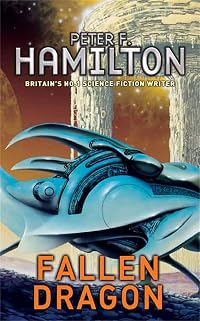
I still have no idea what that thing is on the cover. Another case of an artist not paying attention to the book they're supposed to be illustrating.
I still have no idea what that thing is on the cover. Another case of an artist not paying attention to the book they're supposed to be illustrating.
"Fallen Dragon" had been called a synthesis of the ideas of the Night Dawn trilogy. In a way it can be looked at this way - but only on the surface. And then you can call that every novel that Hamilton wrote. But each of the novels and worlds is different from the previous ones - and this one is not an exception.
Lawrence Newton is born in the ruling elite of his planet (or better to say to the rulling board - as the planet is owned by a corporation, as is any other planet in the sky) and seemingly has everything - including a woman that he loves and believes to love him. But he dreams of the stars - interstellar ships and new worlds - and this is not what seems to be available in his world. So he leaves the world that grew up on, a show more world that is turning into a paradise slowly for the big corporations on Earth that still send people to the stars. Of course, it comes after he is betrayed by the people he loves the most.
20 years later he is a mercenary - because the trip to the stars is to collect the bounty from the worlds that the corporation owns. People on these worlds are not very happy about it of course - thus the need for the mercenaries. And now, when he lands on Thallspring, he has another plan - because he had been here before and something made him think that there is something really valuable hidden in the jungle.
But the invasion comes down to the matched mental powers of Simon Roderick (who is a lot more than he looks and is leading the fleet) and Denise Ebourn - a school teacher on the planet that is a lot more than that. What is expected to be an easy job starts getting complicated and turns into a nightmare. And in the jungle, something is waiting for all of them.
Hamilton builds his universe slowly, with a lot of details that make it alive and believable. The aliens, when they show up, are so different from humanity - and when the main characters expect them to believe as people, they get a nasty surprise.
If I had one problem with the book, it was Lawrence's change of reasoning - it comes way too... abrupt. Even the powers of the aliens do not explain that. But despite it, it is a great novel - worth the read. Too bad that Hamilton decided that he wants to write a short novel and stopped after about 800 pages. show less
Lawrence Newton is born in the ruling elite of his planet (or better to say to the rulling board - as the planet is owned by a corporation, as is any other planet in the sky) and seemingly has everything - including a woman that he loves and believes to love him. But he dreams of the stars - interstellar ships and new worlds - and this is not what seems to be available in his world. So he leaves the world that grew up on, a show more world that is turning into a paradise slowly for the big corporations on Earth that still send people to the stars. Of course, it comes after he is betrayed by the people he loves the most.
20 years later he is a mercenary - because the trip to the stars is to collect the bounty from the worlds that the corporation owns. People on these worlds are not very happy about it of course - thus the need for the mercenaries. And now, when he lands on Thallspring, he has another plan - because he had been here before and something made him think that there is something really valuable hidden in the jungle.
But the invasion comes down to the matched mental powers of Simon Roderick (who is a lot more than he looks and is leading the fleet) and Denise Ebourn - a school teacher on the planet that is a lot more than that. What is expected to be an easy job starts getting complicated and turns into a nightmare. And in the jungle, something is waiting for all of them.
Hamilton builds his universe slowly, with a lot of details that make it alive and believable. The aliens, when they show up, are so different from humanity - and when the main characters expect them to believe as people, they get a nasty surprise.
If I had one problem with the book, it was Lawrence's change of reasoning - it comes way too... abrupt. Even the powers of the aliens do not explain that. But despite it, it is a great novel - worth the read. Too bad that Hamilton decided that he wants to write a short novel and stopped after about 800 pages. show less
I was confused and uninterested in this book until I was like 95% through it, but it was fantastic from there so I’m a little conflicted. My dad loves Peter F. Hamilton, specifically Fallen Dragon, and recommended it to me (see also: he was begging me to read it until I finally gave in). 800 pages of a book you never really wanted to read in the first place is a big commitment but I guess I love him. I am glad I read this in the end, but whether it’s because of the relief I feel from it being over with or the genius ending of the book I have no idea.
PS— please never tell my mom about this book my family has in common now because it was so full of sex. She would be appalled at this entire situation
PS— please never tell my mom about this book my family has in common now because it was so full of sex. She would be appalled at this entire situation
Members
- Recently Added By
Lists

Space Colonization
100 works; 25 members

Arthur C. Clarke Award Winners and Shortlisted Books
219 works; 14 members

Top Five Books of 2016
795 works; 229 members

Best Books With Aliens
67 works; 10 members

Top Five Books of 2017
757 works; 231 members
Author Information

126+ Works 42,732 Members
Peter F. Hamilton was born in Rutland, England on March 2, 1960. He started writing in 1987 and sold his first short story to Fear magazine in 1988. His first novel, Mindstar Rising, was published in 1993. His other works include the Night's Dawn series; Fallen Dragon; and the Void series. (Bowker Author Biography)
Some Editions
Awards and Honors
Work Relationships
Common Knowledge
- Canonical title
- Fallen Dragon
- Original title
- Fallen Dragon
- Original publication date
- 2001
- People/Characters
- Lawrence Newton; Roselyn; Denise Ebourn
- Important places
- Amethi
- Dedication
- For Kate who said yes
- First words
- Time was when the bar would have welcomed a man from Zantiu-Braun's Strategic Security Division, given him his first beer on the house and listened with keen admiration to his stories of life as it was lived oh so differently... (show all) out among the new colony planets.
- Last words
- (Click to show. Warning: May contain spoilers.)Poor, dear old Lawrence. I wonder if he could resist the temptation?
Classifications
Statistics
- Members
- 2,242
- Popularity
- 8,989
- Reviews
- 33
- Rating
- (3.84)
- Languages
- 6 — English, French, German, Hungarian, Polish, Spanish
- Media
- Paper, Audiobook, Ebook
- ISBNs
- 28
- ASINs
- 18