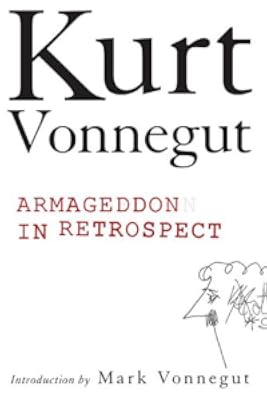
Armageddon in Retrospect
by Kurt Vonnegut
On This Page
Description
Twelve previously unpublished writings on war and peace include such pieces as an essay on the destruction of Dresden, a story about the first-meal fantasies of three soldiers, and a meditation on the impossibility of shielding children from the temptations of violence.Tags
Recommendations





Member Recommendations
Member Reviews
I don’t know if it was the subject of war, which I have to be in the mood for, or just the fact the cover was green (I’m not generally a fan of green - it’s a dirty yellow (my fave)) but Armageddon in Retrospect took some motivation to start. All this despite the fact that Vonnegut is one of my favourite authors and I should never have doubted that this fact would mean I was in good hands. Yes these are stories of war, loss, misery and hopelessness but Vonnegut somehow, relentlessly hits the mark, illuminating all that’s wrong with the world in his lackadaisical, irreverent, quirky way so as to uncover the light - make you feel that it might be ok, that there are others who are keeping up the good fight. I always think a sign of show more a great short story collection is being able to remember the stories afterwards and this (I read it quite a while ago and got pushed down the review pile due to a lack of picture) comes up trumps. Be it the passive aggressive resistance of a carpenter, soldiers creating journals with shared culinary delights, a mind-boggling new war weapon of the 21st century or the account of Dresden after the horrific bombing - the stories stay with you. 5/5 One caveat (and to borrow a quote from a fellow Goodreads reviewer) ‘Never trust my rating on a Vonnegut. I love this man.’ show less
Armageddon in Retrospect could be seen as a shout from the grave, a humanist’s last call from the afterlife, if Vonnegut hadn’t already played out that trope in God Bless You, Dr. Kevorkian by doing interviews with the dead for his local NPR station. Instead, it is merely another installment in his long line of story collections. And from Welcome to the Monkey House and Wampeters, Foma and Granfalloons through the recently-collected magazine stories in Bagombo Snuffbox, Vonnegut’s short work has been consistent in its quality.
Unlike all of Vonnegut’s prior collections, though, these stories have never been published before. As noted above, they all exhibit Vonnegut’s careful high polish, so perhaps their common theme is what show more kept them in his desk drawer.
As the title suggests, these pieces are all about the end of the world. For Vonnegut, this was World War II, in which he fought, and during which he survived the Allied fire-bombing of Dresden. He struggled with what he saw for years, until finally decanting it as Slaughterhouse-5, but we never really saw this struggle in print until now.
The pieces in Armageddon are undated, except for Vonnegut’s letter home from a Red Cross camp once the war ended and the speech he was preparing when he died, so we can’t attribute them to a particular period in his career. “Guns before Butter” and The Commandant’s Desk”, however, stand up well with the best of his previously published short pieces-- this is not simply mining the files of a dead icon for easy money, but a unified collection of highly personal material. And as his son Mark says in the introduction, “(e)ven if the content of any given piece isn’t interesting to you, look at the structure and rhythm and choices of words. If you can’t learn about reading and writing from Kurt, maybe you should be doing something else.”
As an added bonus, the book is illustrated with prints from Vonnegut’s post-novelist career as a graphic artist. show less
Unlike all of Vonnegut’s prior collections, though, these stories have never been published before. As noted above, they all exhibit Vonnegut’s careful high polish, so perhaps their common theme is what show more kept them in his desk drawer.
As the title suggests, these pieces are all about the end of the world. For Vonnegut, this was World War II, in which he fought, and during which he survived the Allied fire-bombing of Dresden. He struggled with what he saw for years, until finally decanting it as Slaughterhouse-5, but we never really saw this struggle in print until now.
The pieces in Armageddon are undated, except for Vonnegut’s letter home from a Red Cross camp once the war ended and the speech he was preparing when he died, so we can’t attribute them to a particular period in his career. “Guns before Butter” and The Commandant’s Desk”, however, stand up well with the best of his previously published short pieces-- this is not simply mining the files of a dead icon for easy money, but a unified collection of highly personal material. And as his son Mark says in the introduction, “(e)ven if the content of any given piece isn’t interesting to you, look at the structure and rhythm and choices of words. If you can’t learn about reading and writing from Kurt, maybe you should be doing something else.”
As an added bonus, the book is illustrated with prints from Vonnegut’s post-novelist career as a graphic artist. show less
Unlike some of the other posthumous publications, this one doesn't feel like a pile of scraps cobbled together for a buck. United by the theme of war, and featuring some of Vonnegut's most human and least jokey (while still having plenty of that), these stories make a good companion piece to Mother Night.
It's hard to write an objective review of this collection -- presumably, Vonnegut's final publication, a mélange of heretofore unpublished works -- since I've been anticipating this for many months and managed to read it in just a few hours after its official release.
The truth is that this book, while not as strong as Vonnegut's previous works or even his other collection of "unpublished" pieces, Bagombo Snuff Box, still contains moments of brilliance, pathos, and humor, the things we've come to expect from Vonnegut.
Mark Vonnegut's introduction, written in a faux-Kurt style, is an appropriately unassuming opening, save for the insistent revelation that Kurt worked painfully hard to get his casual, off-the-cuff style just right, and it show more is armed with this knowledge that we approach perhaps the weakest piece in the collection, his final written (but never performed) speech. He rehashes some jokes, and speaks about war with an anger that's missing in much of his previous work, but the speech's uncomfortable mix of humor and horror sets the stage for the stories to follow.
There's not nearly enough room to explore all of them, but there are very few if any that can be characterized as unmemorable, and at least half are astonishing in their own ways. Whether it's the helplessness of the final scene in "Happy Birthday, 1951," the blisteringly funny satire of "Armageddon in Retrospect," or the last-second twists that give radical new meaning to "Great Day" and "The Commandant's Desk," each work manages to encapsulate some small part of the familiarity of Vonnegut's voice, so that even if the individual stories aren't the strongest, they operate within the work as a whole to create a stunning reminder of Vonnegut's gifts.
If nothing else, this posthumous collection feels like a long-lost note from an old friend, a comforting voice telling a few good stories, a nostalgic look back over the career of one of the most unassuming voices in American letters. It will warm your heart, then break it in two. show less
The truth is that this book, while not as strong as Vonnegut's previous works or even his other collection of "unpublished" pieces, Bagombo Snuff Box, still contains moments of brilliance, pathos, and humor, the things we've come to expect from Vonnegut.
Mark Vonnegut's introduction, written in a faux-Kurt style, is an appropriately unassuming opening, save for the insistent revelation that Kurt worked painfully hard to get his casual, off-the-cuff style just right, and it show more is armed with this knowledge that we approach perhaps the weakest piece in the collection, his final written (but never performed) speech. He rehashes some jokes, and speaks about war with an anger that's missing in much of his previous work, but the speech's uncomfortable mix of humor and horror sets the stage for the stories to follow.
There's not nearly enough room to explore all of them, but there are very few if any that can be characterized as unmemorable, and at least half are astonishing in their own ways. Whether it's the helplessness of the final scene in "Happy Birthday, 1951," the blisteringly funny satire of "Armageddon in Retrospect," or the last-second twists that give radical new meaning to "Great Day" and "The Commandant's Desk," each work manages to encapsulate some small part of the familiarity of Vonnegut's voice, so that even if the individual stories aren't the strongest, they operate within the work as a whole to create a stunning reminder of Vonnegut's gifts.
If nothing else, this posthumous collection feels like a long-lost note from an old friend, a comforting voice telling a few good stories, a nostalgic look back over the career of one of the most unassuming voices in American letters. It will warm your heart, then break it in two. show less
I have a problem with the way Kurt Vonnegut collections seem to be coming out more quickly now than when he was alive. There is often a reason why the author had a collection of “previously unpublished” works.
Hence, I approached this latest with some trepidation.
My fear was unfounded. No, this is not a collection of the world’s greatest. Yes, there are a few clunkers. But, overall, it is a nicely rounded collection that shows the development of the writer. And, the most surprising (pleasantly surprising) aspect was that, in spite of being called “writings on war and peace”, it was primarily fiction. Yes, a copy of his last speech (that was actually made by his son) is included. Yes, there is a copy of the letter he sent his show more parents upon return from the war. But it is really a collection of stories.
And it becomes quickly evident that Vonnegut, even when not at his best, ain’t half bad. So, the recommendation for this comes with a caveat. If you are new to Vonnegut, find other places to spend your time. However, if you already know most of the works, then this is an opportunity for an additional, pleasant visit with a friend who is no longer with us. show less
Hence, I approached this latest with some trepidation.
My fear was unfounded. No, this is not a collection of the world’s greatest. Yes, there are a few clunkers. But, overall, it is a nicely rounded collection that shows the development of the writer. And, the most surprising (pleasantly surprising) aspect was that, in spite of being called “writings on war and peace”, it was primarily fiction. Yes, a copy of his last speech (that was actually made by his son) is included. Yes, there is a copy of the letter he sent his show more parents upon return from the war. But it is really a collection of stories.
And it becomes quickly evident that Vonnegut, even when not at his best, ain’t half bad. So, the recommendation for this comes with a caveat. If you are new to Vonnegut, find other places to spend your time. However, if you already know most of the works, then this is an opportunity for an additional, pleasant visit with a friend who is no longer with us. show less
This was a solid assembly of short works by Kurt Vonnegut. Some of them are really good and others fall by the wayside. Nevertheless, it is an important collection and, for those who enjoy the man's works, it should be read. The introduction is also highly illuminating, written by his son, about the famed writer.
4 stars.
4 stars.
Members
- Recently Added By
Lists

Books Read in 2014
2,343 works; 86 members
Author Information

291+ Works 201,129 Members
The appeal of Kurt Vonnegut, especially to bright younger readers of the past few decades, may be attributed partly to the fact that he is one of the few writers who have successfully straddled the imaginary line between science-fiction/fantasy and "real literature." He was born in Indianapolis and attended Cornell University, but his college show more education was interrupted by World War II. Captured during the Battle of the Bulge and imprisoned in Dresden, he received a Purple Heart for what he calls a "ludicrously negligible wound." After the war he returned to Cornell and then earned his M.A. at the University of Chicago.He worked as a police reporter and in public relations before placing several short stories in the popular magazines and beginning his career as a novelist. His first novel, Player Piano (1952), is a highly credible account of a future mechanistic society in which people count for little and machines for much. The Sirens of Titan (1959), is the story of a playboy whisked off to Mars and outer space in order to learn some humbling lessons about Earth's modest function in the total scheme of things. Mother Night (1962) satirizes the Nazi mentality in its narrative about an American writer who broadcasts propaganda in Germany during the war as an Allied agent. Cat's Cradle (1963) makes use of some of Vonnegut's experiences in General Electric laboratories in its story about the discovery of a special kind of ice that destroys the world. God Bless You, Mr. Rosewater (1965) satirizes a benevolent foundation set up to foster the salvation of the world through love, an endeavor with, of course, disastrous results. Slaughterhouse-Five; or The Children's Crusade (1969) is the book that marked a turning point in Vonnegut's career. Based on his experiences in Dresden, it is the story of another Vonnegut surrogate named Billy Pilgrim who travels back and forth in time and becomes a kind of modern-day Everyman. The novel was something of a cult book during the Vietnam era for its antiwar sentiments. Breakfast of Champions (1973), the story of a Pontiac dealer who goes crazy after reading a science fiction novel by "Kilgore Trout," received generally unfavorable reviews but was a commercial success. Slapstick (1976), dedicated to the memory of Laurel and Hardy, is the somewhat wacky memoir of a 100-year-old ex-president who thinks he can solve society's problems by giving everyone a new middle name. In addition to his fiction, Vonnegut has published nonfiction on social problems and other topics, some of which is collected in Wampeters, Foma and Granfalloons (1974). He died from head injuries sustained in a fall on April 11, 2007. (Bowker Author Biography) show less
Some Editions
Awards and Honors
Awards
Distinctions
Notable Lists
Series
Belongs to Publisher Series
Common Knowledge
- Original title
- Armageddon in Retrospect
- Original publication date
- 2008-04-01
- Important events
- Bombing of Dresden
- Original language
- English
Classifications
Statistics
- Members
- 2,213
- Popularity
- 9,125
- Reviews
- 35
- Rating
- (3.83)
- Languages
- 8 — Czech, Dutch, English, Estonian, Hungarian, Italian, Polish, Portuguese
- Media
- Paper, Audiobook, Ebook
- ISBNs
- 30
- ASINs
- 15