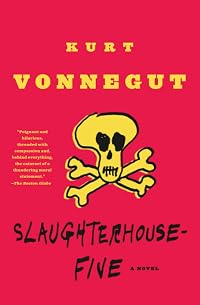
Slaughterhouse-Five
by Kurt Vonnegut
On This Page
Description
Billy Pilgrim returns home from the Second World War only to be kidnapped by aliens from the planet Tralfamadore, who teach him that time is an eternal present.Tags
Recommendations







Member Recommendations
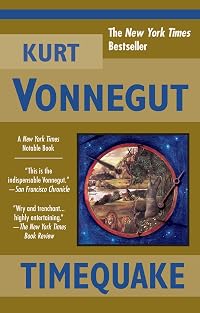
esswedl Both of these Vonnegut novels involve the question of free will (and both are great).
80


anonymous user Slightly absurdist satire that includes an anti-war message
andomck Both books, besides having science fiction/magical realism elements, discuss bloody episodes of WWII from the point of view of everyday people.
43
PghDragonMan War is not glorious and even survivors are not unscathed.
11


1968 by Joe Haldeman
by snat

by hvg
anonymous user Elliot Rosewater, the main character of God Bless You, Mr Rosewater, appears in Slaughterhouse-Five. Also, they both feature books from fictional author Kilgore Trout.

Member Reviews
»Another book, another June
Another sunny afternoon
Another season, another reason
For breakin’ with classics!«
(Based on “Makin’ Whoopee”, by Gus Kahn)
So, 1969 is still too old for me or maybe it’s just that this rambling, repetitive, dated-feeling, non-linear novel is a true classic in the worst sense of the word!
Supposedly, it focuses on the firebombing of Dresden during World War II but in fact, it’s more of an episodic play on war. The protagonist, Billy Pilgrim, is a prisoner of war, an optometrist and a time-traveller (since he suffered a brain trauma and had a major surgery done…) who experiences his life in a non-linear way and tells us about it.
Actually, I’m tempted to say he threatens us, because he’s become show more convinced he’ll live forever, thus troubling us with his terrible anecdotes.
Let’s get the most minor annoyance out of the way first: »So it goes.« - that phrase comes up exactly 106 times in a novel of barely 200 pages (yes, every time some kind of death occurs, I know, doesn’t make it any better). And it actually felt like a billion times.
Several times I fantasised about shooting a bullet at Vonnegut while screaming “So it goes” at the top of my lungs!
Also annoying: Billy Pilgrim’s brain-surgery induced belief he had been abducted by aliens from the planet »Tralfamadore«. There they put him under a glass dome, abduct a beautiful young actress for him whom he proceeds to impregnate and he lives the life…
Yes, I get he tries to rationalise his sense of powerlessness and isolation in a hostile world but I still hated it.
»There could be babies without men over sixty-five. There couldn’t be babies without other babies who had lived an hour or less after birth. And so on.
It was gibberish to Billy.«
(As was the novel to me!)
Moreover, the novel is also factually wrong in many aspects: Dresden has a long military history dating back to the 16th century, when it became the capital of Saxony and a major political and cultural centre. It was also a fortress city with strong fortifications and a large garrison. During World War 2, Dresden was a military centre for the Nazi regime, hosting several military factories, barracks, headquarters and transportation hubs.
For a novel that’s supposed to centre on Dresden, arriving at it after almost 75% of the novel has gone is also somewhat strange.
Also wrong: »It was the next night that about one hundred and thirty thousand people in Dresden would die. So it goes.«
Actually, there were 22.700 to 25.000 victims who died due to those bombings. Why does this matter? Because it’s still part of the narrative of the neo-Nazi plague that still infests (primarily) the eastern parts of Germany: While only about 20% of Germany’s population lives there, almost half the rightwing-extremist crimes were committed there…
»They were literary critics, and they thought Billy was one, too. They were going to discuss whether the novel was dead or not. So it goes.«
So, no, the novel itself isn’t dead. Just this kind of novel thankfully is. So it goes.
One out of five stars.
Blog | Facebook | Twitter | Mastodon | Instagram | Pinterest | Medium | Matrix | Tumblr
Ceterum censeo Putin esse delendam show less
Another sunny afternoon
Another season, another reason
For breakin’ with classics!«
(Based on “Makin’ Whoopee”, by Gus Kahn)
So, 1969 is still too old for me or maybe it’s just that this rambling, repetitive, dated-feeling, non-linear novel is a true classic in the worst sense of the word!
Supposedly, it focuses on the firebombing of Dresden during World War II but in fact, it’s more of an episodic play on war. The protagonist, Billy Pilgrim, is a prisoner of war, an optometrist and a time-traveller (since he suffered a brain trauma and had a major surgery done…) who experiences his life in a non-linear way and tells us about it.
Actually, I’m tempted to say he threatens us, because he’s become show more convinced he’ll live forever, thus troubling us with his terrible anecdotes.
Let’s get the most minor annoyance out of the way first: »So it goes.« - that phrase comes up exactly 106 times in a novel of barely 200 pages (yes, every time some kind of death occurs, I know, doesn’t make it any better). And it actually felt like a billion times.
Several times I fantasised about shooting a bullet at Vonnegut while screaming “So it goes” at the top of my lungs!
Also annoying: Billy Pilgrim’s brain-surgery induced belief he had been abducted by aliens from the planet »Tralfamadore«. There they put him under a glass dome, abduct a beautiful young actress for him whom he proceeds to impregnate and he lives the life…
Yes, I get he tries to rationalise his sense of powerlessness and isolation in a hostile world but I still hated it.
»There could be babies without men over sixty-five. There couldn’t be babies without other babies who had lived an hour or less after birth. And so on.
It was gibberish to Billy.«
(As was the novel to me!)
Moreover, the novel is also factually wrong in many aspects: Dresden has a long military history dating back to the 16th century, when it became the capital of Saxony and a major political and cultural centre. It was also a fortress city with strong fortifications and a large garrison. During World War 2, Dresden was a military centre for the Nazi regime, hosting several military factories, barracks, headquarters and transportation hubs.
For a novel that’s supposed to centre on Dresden, arriving at it after almost 75% of the novel has gone is also somewhat strange.
Also wrong: »It was the next night that about one hundred and thirty thousand people in Dresden would die. So it goes.«
Actually, there were 22.700 to 25.000 victims who died due to those bombings. Why does this matter? Because it’s still part of the narrative of the neo-Nazi plague that still infests (primarily) the eastern parts of Germany: While only about 20% of Germany’s population lives there, almost half the rightwing-extremist crimes were committed there…
»They were literary critics, and they thought Billy was one, too. They were going to discuss whether the novel was dead or not. So it goes.«
So, no, the novel itself isn’t dead. Just this kind of novel thankfully is. So it goes.
One out of five stars.
Blog | Facebook | Twitter | Mastodon | Instagram | Pinterest | Medium | Matrix | Tumblr
Ceterum censeo Putin esse delendam show less
I have a lot of classics on my shelves that I've never gotten around to reading. They hadn't been assigned when I was in school and I had so many other things I wanted to read once I was out of school. So I decided to work my way through some of them and started with Slaughterhouse-Five, Vonnegut's anti-war masterpiece.
The story revolves around the Allied bombing of Dresden near the end of World War II, bookended with Vonnegut's own experiences in Dresden during the war and after. The prose is simple and felt dated, but it was still powerful in its ordinariness. The horrors of war are here, as Billy Pilgrim, our hero and Vonngeut's stand-in, goes to war as a chaplain's assistant, gets taken prisoner by the Germans, ends up in Dresden in show more time for the bombing, then goes home to get married and become an optometrist. He also gets unstuck from time, traveling up and down his timeline, and gets taken prisoner by aliens who put him on display in a zoo, along with a fellow abductee, a former porn actress. Did he really get abducted by aliens? Is he really traveling through time? Or did he wartime experiences leave him with PTSD and a need to make some sort of sense of his life? There is something so mundane in how Vonnegut describes the horrors of war, giving it the same tone and weight as everything else that happened in Billy's life that makes the war scenes worse somehow.
And the repetitive phrase "And so it goes" that punctuates nearly all the paragraphs in the book, a precursor, perhaps, for the more contemporary "It is what it is." There are things that can't be changed, so they can either be accepted or not. To not is to drive yourself crazy. To accept is to, perhaps, stay sane. But war isn't sane, and maybe a sane response isn't appropriate. Maybe I'm reading too much into this, but the story is the sort that inspires introspection. I'm glad I finally read this. show less
The story revolves around the Allied bombing of Dresden near the end of World War II, bookended with Vonnegut's own experiences in Dresden during the war and after. The prose is simple and felt dated, but it was still powerful in its ordinariness. The horrors of war are here, as Billy Pilgrim, our hero and Vonngeut's stand-in, goes to war as a chaplain's assistant, gets taken prisoner by the Germans, ends up in Dresden in show more time for the bombing, then goes home to get married and become an optometrist. He also gets unstuck from time, traveling up and down his timeline, and gets taken prisoner by aliens who put him on display in a zoo, along with a fellow abductee, a former porn actress. Did he really get abducted by aliens? Is he really traveling through time? Or did he wartime experiences leave him with PTSD and a need to make some sort of sense of his life? There is something so mundane in how Vonnegut describes the horrors of war, giving it the same tone and weight as everything else that happened in Billy's life that makes the war scenes worse somehow.
And the repetitive phrase "And so it goes" that punctuates nearly all the paragraphs in the book, a precursor, perhaps, for the more contemporary "It is what it is." There are things that can't be changed, so they can either be accepted or not. To not is to drive yourself crazy. To accept is to, perhaps, stay sane. But war isn't sane, and maybe a sane response isn't appropriate. Maybe I'm reading too much into this, but the story is the sort that inspires introspection. I'm glad I finally read this. show less
Slaughterhouse 5 is really good but five thousand people have reviewed it already and what more is there to say? A discussion then. There’s always more to say.
This is a pacifist piece, written by someone who has grown up being conditioned that pacifism is something to be ashamed of (phrases of opposition include: lily-liver, conscientious objectors, conchies, chicken, draft-dodgers, fifth columnists, cowards, white feather, traitors) and therefore the writer’s feelings are not spelled out in unambiguous ink, instead the author provides just enough observation to let the reader come to their own conclusion. That’s literature. Each time someone expires, sadly and pointlessly, their epithet is “and so it goes”. When you’ve read show more enough if the book, you become aware of the great count of times this line has been used and that gives a woeful sense of the cumulative procession to the unthinking grave, the complete lack of alternatives to donating more and more lives to the pit until the other side eventually runs out of people first and, if this is only one soldier’s experience, we sense how many millions of lives are being pinched out as he writes, across the broad theatre of this conflict. If you take the politics of this particular case out, wars at this scale are a disaster.
The character based on the author has gone off to fight because this is what a proper man of the time was expected to do (phrases of reinforcement include: Red blooded, hero, true, duty, onward Christian soldiers) and he’s performed a role even though his objective critical faculties whisper to him there’s something not quite right about encouraging all of this. Top Gun, for example, says war is brilliant, join up! This book says think twice.
The thing is, war is necessary in certain extreme circumstances (e.g. your own group’s survival). It is totally absurd and often makes the problem bigger and last longer rather than concluding it, but even so it’s hard to find a principled alternative process to settle a dispute when then only thing the ideological lunatic on the other side of the table will settle for is your death. Using the logic of proportionate reaction to an opponent you cannot survive in parallel with, engineering death to people you have never met sounds reasonable. ABSURD, but reasonable. Alternatives to fighting might include vacating your country and living on the Moon (unpractical) or simply waiting for the opposition leader or ideology to collapse and normalise (and sit idly by while they do their worst to innocent civilians?).
From the perspective of the allied forces (anti-fascist), from which this is composed, humanity was drawn into WWII sensibly, reasonably, no choice, with all its intellect in full working order because that’s what you had to do against this level of evil aggression. Was everyone unified in this opinion though? A footnote of absurdity floats up when you realise this author (a member of the US Army) had Germanic heritage and, in 1939-41, there were congressmen petitioning for America to come into the war on Germany’s side. Luckily, the president didn’t entertain this lobbying but, specifically, this book is by a soldier being asked to fight his own distant relations and accepting being put in that position without complaint. Would you feel conflicted? In any country’s forces you will find a complexity of allegiances based on things like ‘the old country’ your parents were from, which side your employer supports, favouritism, distrust from a previous injury, love & marriage or religious alignment (God’s law above Man’s law). What you don’t see in the movies is there’s a full range of commitment in any group, including reluctance. There was a fascinating example from an American Civil War battlefield, where archaeologists recovered a musket that had been muzzle-loaded 24 times and not fired. Picture that soldier thinking ‘thou shalt not kill’, ahead of him seeing brothers, countrymen, his ethics telling him not to shoot but all the time someone behind him yelling “Re-load. Ready. Aim.” and then he mimed firing. Connected research in the same article suggested that in any platoon of 30, there are perhaps two doing the majority of the killing and the rest are ‘also there’, similar to the committee decision system where group responsibility protects the individual’s personal decision.
How wide do you cast your own feeling of group identity? In any movement, e.g. an army, a health service or a religion, individual people will have a different diameter of circle they’d draw around the concept of ‘us’. It might be small, e.g. genetic family or close colleagues, or is might be their professional designation, brigade, nation or even encompass an ideological expanse (republicans, monarchists). In the south-west of the UK, some people see themselves as Cornish and that’s where it ends, not identifying with the English or British. To bring this interesting dilemma up to date with an hypothetical situation, I wonder what would happen today if the institution of the EU (different from the population) called up British people en-masse to go to war under their flag. Come and work for the success of your abductor. What proportion would refuse? What share would actively identify their own force as hostile to themselves, antagonistic to their ‘us’? If you think I’m kidding, the Eurofighter aeroplane was re-named Typhoon in the UK because focus groups consistently interpreted the nomenclature to mean it was an enemy aircraft. If a circle is drawn too wide it becomes artificial and will be wrong most of the time, so people will desert it. In the UK’s case, members of Parliament draw their circle of ‘us’ so amazingly wide that it includes the enemy. The resilience of small circles is the reason why the soldier is encouraged to fight for his mates and doesn’t want to let the people he knows personally down – not for concepts or figureheads. I know it’s hard to talk to a squaddie for long without getting bored (try big drinks and loud places) but you might learn something.
In Let the People Think, Bertrand Russell wrote that he believed the most pro-war section of society were elderly women as (during WWI) they were the ones who felt the most bitter, walking down trains, pinning white feathers on males not in uniform. He also recounted a conversation between three of them as their carriage passed Plymouth docks, when the elderly women were saddened that they could see three naval destroyers idle in dock, much preferring the idea that their sailors should be killing and being killed without stopping. I think that’s more about cossetted individuals who have never experienced horror believing a romanticism that has somehow become attached to the act, to make to more palatable for recruitment. The first war did its best to dispel that illusion but does endure, through each new generation.
Yes, it was a catastrophic time “and so it goes.” There were difficult decisions taken, ones people had to live with for the rest of their lives. The elephantine one in this book, the culmination of the story, is the bombing of Dresden which killed more people than either the Hiroshima or Nagasaki atomic blasts. The exact number (80,000?) is unclear but, wow, imagine a teeming city that’s gone in the morning. It was a city made of wood, so Bomber Command logically selected incendiaries, firebombs. There were a lot of civilians but Germany had destroyed civilian Coventry, so this wasn’t a defence. It also seems the allies had dropped on all the military sites so were searching around for somewhere new to try – not an immediate threat. Then again, Dresden had supplied people to the German forces.
Almost everyone who took part of either side of this famous conflict is now dead. A lot of resentment continues but mainly these events are recounted as object lessons of what right and wrong look like, hopefully making it less likely this sort of wasteful mess will happen again. People are predators, it’s in our evolutionary design, but large population groups don’t have to be. Collective reason can over-rule primeval instinct, those grannies on a train. Dresden, or a catastrophic event like it, was the almost inevitable result of the decision to start a war between industrialised nations. You shouldn’t complain you have to pay a ransom to escape your prison – the error was at the beginning when you began a course of action that put you in a situation which you have to pay a ransom to undo.
The self-propelled field gun fires at a tank in the winter and misses, a long mark of burned powder scoring a dark line across the snow. The tank’s turret turns and fires much more effectively back; and so it goes. Stupid at one level, tragic at another, inevitable in the grand design. The message is to find a different answer. No one can afford to go through all of this again, economically or psychologically, so we all finish the book agreeing with the author. Black and white, doves and hawks, absolute right and wrong are all badly fitting generalisations but it’s easy for the winner to adjust the emphasis of history to fit their moral lesson.
We are all used to rationalising through perspective changes. For example, it is true to say that humans are the only species on planet Earth which subsists on the baby food of another species, comprising a hormonal soup tailored specifically for their species, not ours (suggesting we should not eat cheese, butter, milk and egg yolk). Change the context and you can say there are a million species on the planet who subsist on the meat and blood of other species, so using another species as a food source is normal. You choose a side to be on and then conveniently only remember one of the two justifications. Context becomes important.
I can see that death can be memorable but this book teaches me to conclude the romantic attribute is added later, by someone who wasn’t there. Dilating something horrible with the charms of fancy isn’t a matter for law but the embellisher is guilty of poor taste.
Like everyone else, I can make a convincing case for global peace forever at the conceptual level and believe it can work, on paper. To live in peace should be a human right. I’m on the side of the doves and the ethics committees, the defenceless righteous who stand up against self-interest in the individual and the nation. However, this is an ignus fatuus because when faced with the brutal reality of in-your-face evil (in this book, the most unpleasant opponent in the history of our species; Cassandra prophesied evils that would come to greet you at your hearth and board) and a side that absolutely must not be allowed to continue, it’s amazing how fast reasonable people elbow their ethics into storage and carry out the previously unthinkable. Dresden, Hiroshima. Everyone should read this once, reflect on it and ask themselves the pertinent questions because Slaughterhouse 5 is a great anti-war novel showing us the reality of how bad it gets, the pointlessness too, and we agree with its powerful peaceful sentiment in theory but, even with hindsight, in the context of what we could expect to happen to ‘us’ if Hitler and his supporters had won, I doubt we would really do anything different… “and so it goes.” show less
This is a pacifist piece, written by someone who has grown up being conditioned that pacifism is something to be ashamed of (phrases of opposition include: lily-liver, conscientious objectors, conchies, chicken, draft-dodgers, fifth columnists, cowards, white feather, traitors) and therefore the writer’s feelings are not spelled out in unambiguous ink, instead the author provides just enough observation to let the reader come to their own conclusion. That’s literature. Each time someone expires, sadly and pointlessly, their epithet is “and so it goes”. When you’ve read show more enough if the book, you become aware of the great count of times this line has been used and that gives a woeful sense of the cumulative procession to the unthinking grave, the complete lack of alternatives to donating more and more lives to the pit until the other side eventually runs out of people first and, if this is only one soldier’s experience, we sense how many millions of lives are being pinched out as he writes, across the broad theatre of this conflict. If you take the politics of this particular case out, wars at this scale are a disaster.
The character based on the author has gone off to fight because this is what a proper man of the time was expected to do (phrases of reinforcement include: Red blooded, hero, true, duty, onward Christian soldiers) and he’s performed a role even though his objective critical faculties whisper to him there’s something not quite right about encouraging all of this. Top Gun, for example, says war is brilliant, join up! This book says think twice.
The thing is, war is necessary in certain extreme circumstances (e.g. your own group’s survival). It is totally absurd and often makes the problem bigger and last longer rather than concluding it, but even so it’s hard to find a principled alternative process to settle a dispute when then only thing the ideological lunatic on the other side of the table will settle for is your death. Using the logic of proportionate reaction to an opponent you cannot survive in parallel with, engineering death to people you have never met sounds reasonable. ABSURD, but reasonable. Alternatives to fighting might include vacating your country and living on the Moon (unpractical) or simply waiting for the opposition leader or ideology to collapse and normalise (and sit idly by while they do their worst to innocent civilians?).
From the perspective of the allied forces (anti-fascist), from which this is composed, humanity was drawn into WWII sensibly, reasonably, no choice, with all its intellect in full working order because that’s what you had to do against this level of evil aggression. Was everyone unified in this opinion though? A footnote of absurdity floats up when you realise this author (a member of the US Army) had Germanic heritage and, in 1939-41, there were congressmen petitioning for America to come into the war on Germany’s side. Luckily, the president didn’t entertain this lobbying but, specifically, this book is by a soldier being asked to fight his own distant relations and accepting being put in that position without complaint. Would you feel conflicted? In any country’s forces you will find a complexity of allegiances based on things like ‘the old country’ your parents were from, which side your employer supports, favouritism, distrust from a previous injury, love & marriage or religious alignment (God’s law above Man’s law). What you don’t see in the movies is there’s a full range of commitment in any group, including reluctance. There was a fascinating example from an American Civil War battlefield, where archaeologists recovered a musket that had been muzzle-loaded 24 times and not fired. Picture that soldier thinking ‘thou shalt not kill’, ahead of him seeing brothers, countrymen, his ethics telling him not to shoot but all the time someone behind him yelling “Re-load. Ready. Aim.” and then he mimed firing. Connected research in the same article suggested that in any platoon of 30, there are perhaps two doing the majority of the killing and the rest are ‘also there’, similar to the committee decision system where group responsibility protects the individual’s personal decision.
How wide do you cast your own feeling of group identity? In any movement, e.g. an army, a health service or a religion, individual people will have a different diameter of circle they’d draw around the concept of ‘us’. It might be small, e.g. genetic family or close colleagues, or is might be their professional designation, brigade, nation or even encompass an ideological expanse (republicans, monarchists). In the south-west of the UK, some people see themselves as Cornish and that’s where it ends, not identifying with the English or British. To bring this interesting dilemma up to date with an hypothetical situation, I wonder what would happen today if the institution of the EU (different from the population) called up British people en-masse to go to war under their flag. Come and work for the success of your abductor. What proportion would refuse? What share would actively identify their own force as hostile to themselves, antagonistic to their ‘us’? If you think I’m kidding, the Eurofighter aeroplane was re-named Typhoon in the UK because focus groups consistently interpreted the nomenclature to mean it was an enemy aircraft. If a circle is drawn too wide it becomes artificial and will be wrong most of the time, so people will desert it. In the UK’s case, members of Parliament draw their circle of ‘us’ so amazingly wide that it includes the enemy. The resilience of small circles is the reason why the soldier is encouraged to fight for his mates and doesn’t want to let the people he knows personally down – not for concepts or figureheads. I know it’s hard to talk to a squaddie for long without getting bored (try big drinks and loud places) but you might learn something.
In Let the People Think, Bertrand Russell wrote that he believed the most pro-war section of society were elderly women as (during WWI) they were the ones who felt the most bitter, walking down trains, pinning white feathers on males not in uniform. He also recounted a conversation between three of them as their carriage passed Plymouth docks, when the elderly women were saddened that they could see three naval destroyers idle in dock, much preferring the idea that their sailors should be killing and being killed without stopping. I think that’s more about cossetted individuals who have never experienced horror believing a romanticism that has somehow become attached to the act, to make to more palatable for recruitment. The first war did its best to dispel that illusion but does endure, through each new generation.
Yes, it was a catastrophic time “and so it goes.” There were difficult decisions taken, ones people had to live with for the rest of their lives. The elephantine one in this book, the culmination of the story, is the bombing of Dresden which killed more people than either the Hiroshima or Nagasaki atomic blasts. The exact number (80,000?) is unclear but, wow, imagine a teeming city that’s gone in the morning. It was a city made of wood, so Bomber Command logically selected incendiaries, firebombs. There were a lot of civilians but Germany had destroyed civilian Coventry, so this wasn’t a defence. It also seems the allies had dropped on all the military sites so were searching around for somewhere new to try – not an immediate threat. Then again, Dresden had supplied people to the German forces.
Almost everyone who took part of either side of this famous conflict is now dead. A lot of resentment continues but mainly these events are recounted as object lessons of what right and wrong look like, hopefully making it less likely this sort of wasteful mess will happen again. People are predators, it’s in our evolutionary design, but large population groups don’t have to be. Collective reason can over-rule primeval instinct, those grannies on a train. Dresden, or a catastrophic event like it, was the almost inevitable result of the decision to start a war between industrialised nations. You shouldn’t complain you have to pay a ransom to escape your prison – the error was at the beginning when you began a course of action that put you in a situation which you have to pay a ransom to undo.
The self-propelled field gun fires at a tank in the winter and misses, a long mark of burned powder scoring a dark line across the snow. The tank’s turret turns and fires much more effectively back; and so it goes. Stupid at one level, tragic at another, inevitable in the grand design. The message is to find a different answer. No one can afford to go through all of this again, economically or psychologically, so we all finish the book agreeing with the author. Black and white, doves and hawks, absolute right and wrong are all badly fitting generalisations but it’s easy for the winner to adjust the emphasis of history to fit their moral lesson.
We are all used to rationalising through perspective changes. For example, it is true to say that humans are the only species on planet Earth which subsists on the baby food of another species, comprising a hormonal soup tailored specifically for their species, not ours (suggesting we should not eat cheese, butter, milk and egg yolk). Change the context and you can say there are a million species on the planet who subsist on the meat and blood of other species, so using another species as a food source is normal. You choose a side to be on and then conveniently only remember one of the two justifications. Context becomes important.
I can see that death can be memorable but this book teaches me to conclude the romantic attribute is added later, by someone who wasn’t there. Dilating something horrible with the charms of fancy isn’t a matter for law but the embellisher is guilty of poor taste.
Like everyone else, I can make a convincing case for global peace forever at the conceptual level and believe it can work, on paper. To live in peace should be a human right. I’m on the side of the doves and the ethics committees, the defenceless righteous who stand up against self-interest in the individual and the nation. However, this is an ignus fatuus because when faced with the brutal reality of in-your-face evil (in this book, the most unpleasant opponent in the history of our species; Cassandra prophesied evils that would come to greet you at your hearth and board) and a side that absolutely must not be allowed to continue, it’s amazing how fast reasonable people elbow their ethics into storage and carry out the previously unthinkable. Dresden, Hiroshima. Everyone should read this once, reflect on it and ask themselves the pertinent questions because Slaughterhouse 5 is a great anti-war novel showing us the reality of how bad it gets, the pointlessness too, and we agree with its powerful peaceful sentiment in theory but, even with hindsight, in the context of what we could expect to happen to ‘us’ if Hitler and his supporters had won, I doubt we would really do anything different… “and so it goes.” show less
For too long I’ve been away from my much loved books as life snuck up and carried me away in other directions. Anxious to get back to reading again I decided the first book to tackle would have to be from the 1001 Books to Reads Before you Die list and who could be better than Vonnegut to ease me back into literature.
In this slim volume he has managed to convey the horrors of war and the lasting damage to those affected by it. With an economy of words and his trademark blend of science fiction and black humor we are introduced to Billy Pilgrim, a tall skinny optometrist as he recalls his war time experiences as a prisoner of war during the firebombing of Dresden. Through his time travel, made possible by his abduction by the aliens show more from the planet Tralfamadore, we make multiple jumps from the present, back to the war, to his childhood, early adulthood, then back to the present again. Without any preaching we are shown how unnecessary and horrible war is for everyone except certain elites who gain financially or politically from the misery of the soldiers who have to fight in one and the civilians who are helplessly caught up in the death and destruction brought to them.
Billy’s non-linear narration makes for loosely connected events that are discomforting and confusing at times and by all rights shouldn’t work, but it does, and it works well! Once started I couldn’t put it down until the last word on the last page was finished. Excellent read that I happily recommend! show less
In this slim volume he has managed to convey the horrors of war and the lasting damage to those affected by it. With an economy of words and his trademark blend of science fiction and black humor we are introduced to Billy Pilgrim, a tall skinny optometrist as he recalls his war time experiences as a prisoner of war during the firebombing of Dresden. Through his time travel, made possible by his abduction by the aliens show more from the planet Tralfamadore, we make multiple jumps from the present, back to the war, to his childhood, early adulthood, then back to the present again. Without any preaching we are shown how unnecessary and horrible war is for everyone except certain elites who gain financially or politically from the misery of the soldiers who have to fight in one and the civilians who are helplessly caught up in the death and destruction brought to them.
Billy’s non-linear narration makes for loosely connected events that are discomforting and confusing at times and by all rights shouldn’t work, but it does, and it works well! Once started I couldn’t put it down until the last word on the last page was finished. Excellent read that I happily recommend! show less
The Everyday Frauds of War and Peace
The life of Billy Pilgrim, an American soldier during World War II, who is captured by the German army and taken to Dresden, where he witnesses the Allies' bombing in February 1945, and is later abducted by aliens who see all of time simultaneously and take him to their home planet to be put on display in a human zoo.
A central point to the novel which contemporary reviewers often misconstrue is it's not, as is so often claimed, a depiction of post-traumatic stress disorder. Author Kurt Vonnegut was himself a World War II veteran and POW witness, and both he and his war buddy Bernard V. O'Hare are background characters in this, his best known and most lauded novel. The first sentence is, "All this show more happened, more or less." This could certainly refer solely to the historically documented bombing and Vonnegut's first-hand experiences. That reading is substantiated both by the next sentence, "The war parts, anyway, are pretty much true," and by how often Billy's unsticking in time happens around markers which might trigger flashbacks: The orange and black stripes decorating his daughter Barbara's wedding tent resemble the same-colored stripes on the POW transport trains to protect them from Allied bombings. Or his wife Valencia asking about Edgar Derby, an American who was killed by an American firing squad after the POW camp's post-bombing liberation for stealing a teapot, transports him back to the camp where he slept next to Derby. Valencia and other characters eat Three Musketeers bars, which is reminiscent of the boyish hero fantasies of Roland Weary, a brutish antitank gunner Billy encounters shortly after his regiment in Luxembourg is destroyed. And so on.
But that reading is undermined by two more sentences in the novel, roughly two-thirds of the way through:
This is but one piece of evidence which suggests Billy's time-viewing experiences are meant to be read as actual, rather than as a PTSD-induced hallucination. The appearance of characters from Vonnegut's earlier novels - including Winston Niles Rumfoord of the fantastical The Sirens of Titan (1959), and Howard W. Campbell, Jr. and Eliot Rosewater, protagonists of the more realistic Mother Night (1961) and God Bless You, Mr. Rosewater (1965), respectively - grounds this firmly in the "Vonnegut-verse," as it were. To be sure, it's a fictional universe subject to the whims of its creator. The time-traveling aliens who abduct Billy, the Tralfamadorians, also appear in earlier Vonnegut novels, but those depictions are very different from the passive observers they are here. In The Sirens of Titan, they are intelligent machines who take an active role in Earth's history for their own petty purpose. In God Bless You, Mr. Rosewater, the planet Trafalmadore is a fictional world imagined by author Kilgore Trout, another character from this novel who makes frequent appearances throughout Vonnegut's canon and whose biographical details and physical descriptions vary across the oeuvre.
What remains more or less consistent of the Trafalmadorians and Trout in all appearances is their philosophical and intellectual detachment from the crudities and banality of traditional desires for higher social status or material wealth or even vengeance. In every novel, they have what could be called, for lack of a better term, a "higher understanding." In this case, both of them can see in the fourth dimension of time, whether always, as in the case of the Trafalmadorians, or only occasionally, as with Trout. As a result, the literal reality of, say, a history book is a separate reality from the reality of carefully crafted fiction. Trout calls attention to this fuzzy line between truth and fiction when he has a conversation with an optometrist's wife at a party, after he has told her an utterly fabricated, outrageous story of a funeral for a celebrity chef:
In the plot of the novel, this conversation comes shortly after the second of two incidents of a particularly insidious form of advertising, i.e.: wartime propaganda, in this case, the lies of Howard W. Campbell, Jr., an American who has become a propagandist for Nazi Germany, where he spreads Nazi lies of Allied weakness and white supremacy. (In his own novel, Campbell is a double agent, posing as a Nazi to gather intelligence for the Americans, thereby making him a fraud of a fraud. Billy is unaware of this, and Vonnegut never mentions it here, so it's unclear but irrelevant if it's "true" in this novel's half-independent, half-shared reality.) Campbell mixes his outright lies with just enough truth as to confuse the question of what is true and what is not. It is very hard to present a counter-argument when he says, for instance:
Similarly, when Campbell describes the symbolism of the colors of the American flag, in a reverse game of Two Truths and a Lie, he says:
[Note: Red is the true one.]
Conversely, when Edgar Derby challenges Campbell in what Vonnegut calls one of the few moments where the story has a character, as Derby argues for freedom and justice, he says there isn't "a man there who wouldn't gladly die for those ideals," although he knows this to be untrue, or anyway, he ought to know it to be. The Chicagolander small-time crook and sadistic malcontent Paul Lazzaro has already said, or at least made clear, he doesn't care about any ideals or allegiances, and he exacts vengeance only in exchange for his own personal petty grudges and grievances. Or perhaps Derby isn't lying, because perhaps he doesn't believe Lazzaro could possibly be sincere in this pure expression of id, a concept beyond Derby the Indianapolis English teacher's ken in its sheer vulgar simplicity. To the extent Derby is a fraud, he is defrauding himself as much as he is defrauding anyone else, because he can't see what is in front of him.
Seeing is a motif throughout the novel. The Trafalmadorians compare human understanding of time to looking at the Rocky Mountains and seeing just a tiny detail rather than the mountain range as a whole. During the war, when Billy and his fellow captured Allied prisoners, mostly from the Battle of the Bulge, are being marched to a railroad yard to be transported to their camps, they pass a German film crew there to record German victories for a propaganda film, but the camera is not running, because they are out of film, and so they can only watch the battle from a distance as gray clouds on the horizon. Before the war, when Billy and his parents go to Carlsbad Caverns, and the ranger shuts off the lights, Billy is plunged into complete darkness until he sees the "ghostly" radium face of a timepiece, his father's watch. After the war, Billy becomes an optometrist, an occupation which is not only a nod to the Great American Novel The Great Gatsby (1925) by F. Scott Fitzgerald, but one which involves him helping people to see, but that's not how Billy makes the bulk of his fortune. As Vonnegut says, "Frames are where the money is." In other words, Billy's eyeglasses are more prized by their wearers not for their ability to improve or protect vision, but in how they appear to others and indicate status and fashion. They are like the exiled children of Israel whom the prophet Jeremiah calls in the Nevi'im "foolish people, and without understanding; which have eyes, and see not." (5:21).
Billy sees, although his seeing is limited. As Vonnegut sometimes reminds us, there are parts of the story which Billy never knows, such as that he and his Dresden guard Werner Gluck are distant cousins. There may also be a hidden play on the names. Billy's surname "Pilgrim" is no doubt an illusion to the classic 1678 allegorical novel The Pilgrim's Progress by John Bunyan, in which the protagonist travels from Earth and specifically his hometown (called the "City of Destruction") through Hell, and at last into Heaven. Along the way, he is only ever an observer, not a participant, and he is powerless to change or affect any of it, much as Billy is powerless to change his circumstances. On his optometry office wall, Billy has a framed copy of the Serenity Prayer, which begins, "God grant me the serenity to accept the things I cannot change," to which Vonnegut adds, "Among the things Billy Pilgrim could not change were the past, the present, and the future." The name "Billy" is likely inspired by the legendary Western outlaw William Henry McCarty Jr., aka Billy the Kid, who died at age 21, which recalls the subtitle of the novel, The Children's Crusade, a peace offering to his war buddy O'Hare's wife Mary, who objects to the idea of the novel by saying of her husband and Vonnegut, "You were just babies then!" If Gluck's name is similarly referential, the surname "Gluck" translates to "[good] luck" or "happiness," while the name "Werner" could very well be after St. Werner of Oberwesel, a 16-year-old Rheinlander boy in the 13th century whose mysterious death was blamed on the local Jewish populace, resulting in numerous pogroms in the following decades.
It is within the scaffolding of what is seen, then, whether directly through Billy's eyes or from the eyes of Vonnegut the omniscient narrator, that the novel is often mistaken for an anti-war novel, or a war novel at all. Even the back cover of this edition says it's "one of the world's great antiwar books." It may have been conceived as such, but once fully realized, it is not. The first chapter outlines the history of Vonnegut's writing what he initially assumed to be, in his words, "a book about Dresden." Over the course of nearly a quarter-century, as he struggles with how to convey an ever-fading memory, it transforms. When he conceived it, he could no more see what it would be than it is clear to Valencia, on the night she and Billy conceive their son Robert, her body is assembling a future high school troublemaker-cum-Green Beret Vietnam War veteran. Billy sees this future, of course, having already seen/soon to be seeing the vast expanse of universal time, but as with everything else, he is helpless to change it if he were to want to, which he doesn't. The same can be said of Vonnegut and his novel. The turning point seems to come from an oft-cited conversation between Vonnegut and his friend, the Hollywood film producer Harrison Starr:
Slaughterhouse-Five is not about war, nor is it about glaciers. It is about "plain old death." The famous recurring refrain, "So it goes," is used not after every anecdote or insightful comment, nor is it intended to be profound. It is used whenever someone or something dies or is said to have died. It is the same whether the person dies in a war or in an accident, violently or from old age. The simplicity of the epitaph is a rejection of the profundity typically afforded death in novels and poetry, a deference to its ultimate inexorability, which inevitably comes as readily to a glass of water or lice in clothing as to Jews in death camps or POWs who contract gangrene. Yet the repetition of the phrase simultaneously belittles death, reduces it signficance to that of a punctuation mark. Just as the story continues after each comma, in fact after every period, so it continues after each, "So it goes," until the final punctuation mark, which in this novel is a question mark followed by closing quotation marks. In that sense, then, the novel is about life just as much - if not all the more so - as it is about death. The only lesson the Tralfamadorians ever attempt to impart upon Billy is:
More than a few contemporary readers note the retrospective irony of Harrison Starr's analogy. More than a half-century later, the glaciers have been stopped and made to recede. The forces which have caused this dramatic shift have been manmade, but not any one man's, and eventually all mankind is nearly impotent at reversing the consequences of decades to centuries of its own actions. At several points in the wartime chronicles, hundreds or thousands of people at once are merged into a unified, hapless mass, which Vonnegut sometimes describes as flowing liquid, sometimes as stacks like firewood. The same kind be said of 21st-century humans, who watch as the factories formerly manufacturing the machinery of war, the vehicles formerly transporting casualties and fresh recruits, food and ammunition, have set off a chain reaction which cannot be entirely halted in any of our lifetimes, one which causes the formerly unstoppable glaciers to disappear, perhaps forever, or at least longer than any of us will be alive to notice.
So it goes. show less
The life of Billy Pilgrim, an American soldier during World War II, who is captured by the German army and taken to Dresden, where he witnesses the Allies' bombing in February 1945, and is later abducted by aliens who see all of time simultaneously and take him to their home planet to be put on display in a human zoo.
A central point to the novel which contemporary reviewers often misconstrue is it's not, as is so often claimed, a depiction of post-traumatic stress disorder. Author Kurt Vonnegut was himself a World War II veteran and POW witness, and both he and his war buddy Bernard V. O'Hare are background characters in this, his best known and most lauded novel. The first sentence is, "All this show more happened, more or less." This could certainly refer solely to the historically documented bombing and Vonnegut's first-hand experiences. That reading is substantiated both by the next sentence, "The war parts, anyway, are pretty much true," and by how often Billy's unsticking in time happens around markers which might trigger flashbacks: The orange and black stripes decorating his daughter Barbara's wedding tent resemble the same-colored stripes on the POW transport trains to protect them from Allied bombings. Or his wife Valencia asking about Edgar Derby, an American who was killed by an American firing squad after the POW camp's post-bombing liberation for stealing a teapot, transports him back to the camp where he slept next to Derby. Valencia and other characters eat Three Musketeers bars, which is reminiscent of the boyish hero fantasies of Roland Weary, a brutish antitank gunner Billy encounters shortly after his regiment in Luxembourg is destroyed. And so on.
But that reading is undermined by two more sentences in the novel, roughly two-thirds of the way through:
Billy was unconscious for two days after that, and he dreamed millions of things, some of them true. The true things were time-travel. [emphasis added]
This is but one piece of evidence which suggests Billy's time-viewing experiences are meant to be read as actual, rather than as a PTSD-induced hallucination. The appearance of characters from Vonnegut's earlier novels - including Winston Niles Rumfoord of the fantastical The Sirens of Titan (1959), and Howard W. Campbell, Jr. and Eliot Rosewater, protagonists of the more realistic Mother Night (1961) and God Bless You, Mr. Rosewater (1965), respectively - grounds this firmly in the "Vonnegut-verse," as it were. To be sure, it's a fictional universe subject to the whims of its creator. The time-traveling aliens who abduct Billy, the Tralfamadorians, also appear in earlier Vonnegut novels, but those depictions are very different from the passive observers they are here. In The Sirens of Titan, they are intelligent machines who take an active role in Earth's history for their own petty purpose. In God Bless You, Mr. Rosewater, the planet Trafalmadore is a fictional world imagined by author Kilgore Trout, another character from this novel who makes frequent appearances throughout Vonnegut's canon and whose biographical details and physical descriptions vary across the oeuvre.
What remains more or less consistent of the Trafalmadorians and Trout in all appearances is their philosophical and intellectual detachment from the crudities and banality of traditional desires for higher social status or material wealth or even vengeance. In every novel, they have what could be called, for lack of a better term, a "higher understanding." In this case, both of them can see in the fourth dimension of time, whether always, as in the case of the Trafalmadorians, or only occasionally, as with Trout. As a result, the literal reality of, say, a history book is a separate reality from the reality of carefully crafted fiction. Trout calls attention to this fuzzy line between truth and fiction when he has a conversation with an optometrist's wife at a party, after he has told her an utterly fabricated, outrageous story of a funeral for a celebrity chef:
"Did that really happen?" said Maggie White. ...
"Of course it happened," Trout told her. "If I wrote something that hadn't really happened, and I tried to sell it, I could go to jail. That's fraud."
Maggie believed him. ... "It's like advertising. You have to tell the truth in advertising, or you get in trouble."
"Exactly. The same body of law applies."
In the plot of the novel, this conversation comes shortly after the second of two incidents of a particularly insidious form of advertising, i.e.: wartime propaganda, in this case, the lies of Howard W. Campbell, Jr., an American who has become a propagandist for Nazi Germany, where he spreads Nazi lies of Allied weakness and white supremacy. (In his own novel, Campbell is a double agent, posing as a Nazi to gather intelligence for the Americans, thereby making him a fraud of a fraud. Billy is unaware of this, and Vonnegut never mentions it here, so it's unclear but irrelevant if it's "true" in this novel's half-independent, half-shared reality.) Campbell mixes his outright lies with just enough truth as to confuse the question of what is true and what is not. It is very hard to present a counter-argument when he says, for instance:
America is the wealthiest nation on Earth, but its people are mainly poor, and poor Americans are urged to hate themselves. ... The meanest eating or drinking establishment, owned by a man who is himself poor, is very likely to have a sign on its wall asking this cruel question: "If you're so smart, why ain't you rich?" There will also be an American flag no larger than a child's hand‒glued to a lollipop stick and flying from the cash register.
Similarly, when Campbell describes the symbolism of the colors of the American flag, in a reverse game of Two Truths and a Lie, he says:
Blue is for the American sky. ... White is for the race that pioneered the continent, drained the swamps and cleared the forests and built the roads and bridges. Red is for the blood of American patriots which was shed so gladly in years gone by.
[Note: Red is the true one.]
Conversely, when Edgar Derby challenges Campbell in what Vonnegut calls one of the few moments where the story has a character, as Derby argues for freedom and justice, he says there isn't "a man there who wouldn't gladly die for those ideals," although he knows this to be untrue, or anyway, he ought to know it to be. The Chicagolander small-time crook and sadistic malcontent Paul Lazzaro has already said, or at least made clear, he doesn't care about any ideals or allegiances, and he exacts vengeance only in exchange for his own personal petty grudges and grievances. Or perhaps Derby isn't lying, because perhaps he doesn't believe Lazzaro could possibly be sincere in this pure expression of id, a concept beyond Derby the Indianapolis English teacher's ken in its sheer vulgar simplicity. To the extent Derby is a fraud, he is defrauding himself as much as he is defrauding anyone else, because he can't see what is in front of him.
Seeing is a motif throughout the novel. The Trafalmadorians compare human understanding of time to looking at the Rocky Mountains and seeing just a tiny detail rather than the mountain range as a whole. During the war, when Billy and his fellow captured Allied prisoners, mostly from the Battle of the Bulge, are being marched to a railroad yard to be transported to their camps, they pass a German film crew there to record German victories for a propaganda film, but the camera is not running, because they are out of film, and so they can only watch the battle from a distance as gray clouds on the horizon. Before the war, when Billy and his parents go to Carlsbad Caverns, and the ranger shuts off the lights, Billy is plunged into complete darkness until he sees the "ghostly" radium face of a timepiece, his father's watch. After the war, Billy becomes an optometrist, an occupation which is not only a nod to the Great American Novel The Great Gatsby (1925) by F. Scott Fitzgerald, but one which involves him helping people to see, but that's not how Billy makes the bulk of his fortune. As Vonnegut says, "Frames are where the money is." In other words, Billy's eyeglasses are more prized by their wearers not for their ability to improve or protect vision, but in how they appear to others and indicate status and fashion. They are like the exiled children of Israel whom the prophet Jeremiah calls in the Nevi'im "foolish people, and without understanding; which have eyes, and see not." (5:21).
Billy sees, although his seeing is limited. As Vonnegut sometimes reminds us, there are parts of the story which Billy never knows, such as that he and his Dresden guard Werner Gluck are distant cousins. There may also be a hidden play on the names. Billy's surname "Pilgrim" is no doubt an illusion to the classic 1678 allegorical novel The Pilgrim's Progress by John Bunyan, in which the protagonist travels from Earth and specifically his hometown (called the "City of Destruction") through Hell, and at last into Heaven. Along the way, he is only ever an observer, not a participant, and he is powerless to change or affect any of it, much as Billy is powerless to change his circumstances. On his optometry office wall, Billy has a framed copy of the Serenity Prayer, which begins, "God grant me the serenity to accept the things I cannot change," to which Vonnegut adds, "Among the things Billy Pilgrim could not change were the past, the present, and the future." The name "Billy" is likely inspired by the legendary Western outlaw William Henry McCarty Jr., aka Billy the Kid, who died at age 21, which recalls the subtitle of the novel, The Children's Crusade, a peace offering to his war buddy O'Hare's wife Mary, who objects to the idea of the novel by saying of her husband and Vonnegut, "You were just babies then!" If Gluck's name is similarly referential, the surname "Gluck" translates to "[good] luck" or "happiness," while the name "Werner" could very well be after St. Werner of Oberwesel, a 16-year-old Rheinlander boy in the 13th century whose mysterious death was blamed on the local Jewish populace, resulting in numerous pogroms in the following decades.
It is within the scaffolding of what is seen, then, whether directly through Billy's eyes or from the eyes of Vonnegut the omniscient narrator, that the novel is often mistaken for an anti-war novel, or a war novel at all. Even the back cover of this edition says it's "one of the world's great antiwar books." It may have been conceived as such, but once fully realized, it is not. The first chapter outlines the history of Vonnegut's writing what he initially assumed to be, in his words, "a book about Dresden." Over the course of nearly a quarter-century, as he struggles with how to convey an ever-fading memory, it transforms. When he conceived it, he could no more see what it would be than it is clear to Valencia, on the night she and Billy conceive their son Robert, her body is assembling a future high school troublemaker-cum-Green Beret Vietnam War veteran. Billy sees this future, of course, having already seen/soon to be seeing the vast expanse of universal time, but as with everything else, he is helpless to change it if he were to want to, which he doesn't. The same can be said of Vonnegut and his novel. The turning point seems to come from an oft-cited conversation between Vonnegut and his friend, the Hollywood film producer Harrison Starr:
He raised his eyebrows and inquired, "Is it an anti-war book?"
"Yes," I said. "I guess."
"You know what I say to people when I hear they're writing anti-war books? ... I say, 'Why don't you write an anti-glacier book, instead?'"
What he meant, of course, was that there would always be wars, that they were as easy to stop as glaciers. I believe that, too.
And even if wars didn't keep coming like glaciers, there would still be plain old death.
Slaughterhouse-Five is not about war, nor is it about glaciers. It is about "plain old death." The famous recurring refrain, "So it goes," is used not after every anecdote or insightful comment, nor is it intended to be profound. It is used whenever someone or something dies or is said to have died. It is the same whether the person dies in a war or in an accident, violently or from old age. The simplicity of the epitaph is a rejection of the profundity typically afforded death in novels and poetry, a deference to its ultimate inexorability, which inevitably comes as readily to a glass of water or lice in clothing as to Jews in death camps or POWs who contract gangrene. Yet the repetition of the phrase simultaneously belittles death, reduces it signficance to that of a punctuation mark. Just as the story continues after each comma, in fact after every period, so it continues after each, "So it goes," until the final punctuation mark, which in this novel is a question mark followed by closing quotation marks. In that sense, then, the novel is about life just as much - if not all the more so - as it is about death. The only lesson the Tralfamadorians ever attempt to impart upon Billy is:
That's one things Earthlings might learn to do, if they tried hard enough: Ignore the awful times, and concentrate on the good ones.
More than a few contemporary readers note the retrospective irony of Harrison Starr's analogy. More than a half-century later, the glaciers have been stopped and made to recede. The forces which have caused this dramatic shift have been manmade, but not any one man's, and eventually all mankind is nearly impotent at reversing the consequences of decades to centuries of its own actions. At several points in the wartime chronicles, hundreds or thousands of people at once are merged into a unified, hapless mass, which Vonnegut sometimes describes as flowing liquid, sometimes as stacks like firewood. The same kind be said of 21st-century humans, who watch as the factories formerly manufacturing the machinery of war, the vehicles formerly transporting casualties and fresh recruits, food and ammunition, have set off a chain reaction which cannot be entirely halted in any of our lifetimes, one which causes the formerly unstoppable glaciers to disappear, perhaps forever, or at least longer than any of us will be alive to notice.
So it goes. show less
Slaughterhouse-Five presents Vonnegut in a more serious mode than most of his other work. Sure, there's still a prevalence of his darkly ironic and silly humor, but it plays second fiddle to grappling with the bombing of Dresden, something he lived through during WWII. As such, Slaughterhouse-Five is partially autobiographical, along with perfectly balancing the line between genre and literary fiction.
Billy Pilgrim isn't especially good at anything, at least as it pertains to the traits that the U.S. Army values. A shame, since he gets drafted late during WWII to serve as a member of the clergy. Carrying no gun and with seemingly no ill-will towards anybody, he is immediately captured by the Germans and taken in as POW. It is within show more these war experiences that Billy begins to travel in time, surveying the events of his life from beginning to end out of sequence with one another. Despite its grim content, the novel itself reads really light and breezy like most of Vonnegut's works, and though it plays out non-chronologically, in my opinion it's one of his more coherent works as well.
This time travel element is such a neat way of presenting and discussing PTSD. Nearly all of the sequences of time travel are nucleated by Billy seeing/doing/hearing something that directly correlates with something that happened during the war. Billy is a deeply troubled person who struggles to come to terms with everything he witnessed. During the war, he travels in time to escape the horrors of his current reality, and afterwards he does so as a way of processing his feelings. Billy more-or-less comes to some sense of resigned acceptance about the circumstances of his life, somewhat similar to George Orr's expression of Daoism in Le Guin's The Lathe of Heaven. He does so by imagining all of the events of his life playing out simultaneously, forever. He's able to cope with the many tragedies and deaths he has experienced by imagining that the positive moments and the lives of loved ones are still actively taking place, no matter where he currently finds himself. The alien species that Billy is eventually kidnapped by, the Tralfamadorians, have a certain brand of this fatalism that views all events as predetermined and unchangeable, and idea that echos from his much earlier work The Sirens of Titan.
As I've worked my way through Vonnegut's works as an adult, I've come to appreciate the connections between his novels. Though it's a stretch to imagine that there's a cohesive universe between his works, the same characters, locations, and ideas crop up again and again in a pleasing way.
This is one of those 'classics' where I feel like there's nothing I could possibly add to the discussion on. It's taught in schools for a reason; it's an inspiring work that makes you want to write, and it presents plenty of layers for rich discussions. Vonnegut remains one of the only writers whose humor I really appreciate and connect with. I think I've said this before about him in other reviews, but regardless of whether Vonnegut's distinct flavor agrees with you, I think it's hard to deny that his creativity and writing flair make Vonnegut unique amongst his peers. I highly recommend Slaughterhouse-Five, whether you're reading it for the first time or returning to it again after primary education. show less
Billy Pilgrim isn't especially good at anything, at least as it pertains to the traits that the U.S. Army values. A shame, since he gets drafted late during WWII to serve as a member of the clergy. Carrying no gun and with seemingly no ill-will towards anybody, he is immediately captured by the Germans and taken in as POW. It is within show more these war experiences that Billy begins to travel in time, surveying the events of his life from beginning to end out of sequence with one another. Despite its grim content, the novel itself reads really light and breezy like most of Vonnegut's works, and though it plays out non-chronologically, in my opinion it's one of his more coherent works as well.
This time travel element is such a neat way of presenting and discussing PTSD. Nearly all of the sequences of time travel are nucleated by Billy seeing/doing/hearing something that directly correlates with something that happened during the war. Billy is a deeply troubled person who struggles to come to terms with everything he witnessed. During the war, he travels in time to escape the horrors of his current reality, and afterwards he does so as a way of processing his feelings. Billy more-or-less comes to some sense of resigned acceptance about the circumstances of his life, somewhat similar to George Orr's expression of Daoism in Le Guin's The Lathe of Heaven. He does so by imagining all of the events of his life playing out simultaneously, forever. He's able to cope with the many tragedies and deaths he has experienced by imagining that the positive moments and the lives of loved ones are still actively taking place, no matter where he currently finds himself. The alien species that Billy is eventually kidnapped by, the Tralfamadorians, have a certain brand of this fatalism that views all events as predetermined and unchangeable, and idea that echos from his much earlier work The Sirens of Titan.
As I've worked my way through Vonnegut's works as an adult, I've come to appreciate the connections between his novels. Though it's a stretch to imagine that there's a cohesive universe between his works, the same characters, locations, and ideas crop up again and again in a pleasing way.
This is one of those 'classics' where I feel like there's nothing I could possibly add to the discussion on. It's taught in schools for a reason; it's an inspiring work that makes you want to write, and it presents plenty of layers for rich discussions. Vonnegut remains one of the only writers whose humor I really appreciate and connect with. I think I've said this before about him in other reviews, but regardless of whether Vonnegut's distinct flavor agrees with you, I think it's hard to deny that his creativity and writing flair make Vonnegut unique amongst his peers. I highly recommend Slaughterhouse-Five, whether you're reading it for the first time or returning to it again after primary education. show less
I'm rereading a lot of Vonnegut, whom I read many years ago, in college. My memory is that Slaughterhouse Five was his masterpiece, and I do like it more than the others I've reread. The book follows the life of the fictional Billy Pilgrim, who is a POW in WW II in Dresden during the firebombing of that city, a hideous war crime by the Allied forces in 1945 as the war was winding down. The book moves back and forth through time, which for Billy is normal because he was kidnapped by the alien Trafalmadorians and spent years in a zoo on their planet, and learned to see time the way they do, which is not linear. Billy keeps jumping in time, from the war, to his childhood, to his marriage, to his injury in a plane crash in which he was the show more only survivor, and to his own death. And the author breaks the fourth wall a few times, in describing the war, stating that he was also there. The book also includes references to Kilgore Trout, Vonnegut's alter ego (I think), an unsuccessful science fiction writer who makes it into other books too.
As with most Vonnegut books, the tone is weird- funny, but in a profoundly heartbreaking way. The writing can be beautiful, and then crass all in the same sentence. He notes horrible deaths or tragedies, and the next sentence is often "So it goes".
I like this book more because, though it's weird and the plot is wandering, it comes across as the author trying to write about Dresden, an unspeakable moment in time, to deal with his own trauma. I appreciate that he lets the reader in to his broken mind here, a brave thing to do. Vonnegut's combination of humor and tragedy is spot on for this story, and his voice really is unique in this way- nobody else writes like this. show less
As with most Vonnegut books, the tone is weird- funny, but in a profoundly heartbreaking way. The writing can be beautiful, and then crass all in the same sentence. He notes horrible deaths or tragedies, and the next sentence is often "So it goes".
I like this book more because, though it's weird and the plot is wandering, it comes across as the author trying to write about Dresden, an unspeakable moment in time, to deal with his own trauma. I appreciate that he lets the reader in to his broken mind here, a brave thing to do. Vonnegut's combination of humor and tragedy is spot on for this story, and his voice really is unique in this way- nobody else writes like this. show less
Members
- Recently Added By
Lists

The Guardian's 1000 Novels Everyone Must Read
1,005 works; 548 members

1001 Books You Must Read Before You Die
1,448 works; 1,133 members

Best Science Fiction Novels
816 works; 426 members

Classics you know you should have read but probably haven't
421 works; 409 members
Survey of Classic Science Fiction
171 works; 48 members
501 Must-Read Books
529 works; 72 members

Radcliffe's 100 Best Novel of the 20th Century
100 works; 32 members

Newsweek's Top 100 Books: The Meta-List
100 works; 18 members

Best Contemporary Literary Fiction (Around the Last 30 Years)
388 works; 123 members

Read the book and saw the movie
1,170 works; 195 members

Best Time Travel Novels
165 works; 125 members

Great American Novels
158 works; 40 members
NPRs your picks: top 100 Sci-Fi/Fantasy books
297 works; 80 members
Novels from The Guardian's Great American Novelist Tournament
148 works; 24 members
20th Century Literature
1,161 works; 55 members
Favourite Books
1,819 works; 309 members

The Top Ten: Writers Pick Their Favorite Books
240 works; 31 members

Magic Realism
371 works; 52 members

Top Five Books of 2013
1,562 works; 715 members
Best Satire
188 works; 29 members

Recommend the 20 best books you've read in the last five years
2,168 works; 606 members

Philosophical Fiction
97 works; 27 members
Folio Society
831 works; 53 members
Larry McCaffery's 20th Century Greatest Hits: 100 English-Language Books
103 works; 12 members

100 books to read in a lifetime
102 works; 37 members
Banned Books Week 2014
268 works; 63 members
Historical Fiction
889 works; 91 members
Time Magazine's "All-Time 100"
113 works; 15 members

Best War Stories
87 works; 16 members

Best First Contact Stories
33 works; 16 members
1960s, Best books published therein
254 works; 22 members
Books About World War II
102 works; 29 members

Stories of War and Revolution
143 works; 54 members

Survey of Science Fiction and Fantasy
101 works; 13 members
National Book Award Finalists - Fiction
377 works; 12 members

Significant works of postmodern fiction
86 works; 25 members

Speculative Fiction: Slipstream Literature
166 works; 16 members

Slipstream or Interstitial Fiction
160 works; 19 members
Unreliable Narrators
170 works; 43 members
Books That Changed Me
158 works; 47 members
War Literature
101 works; 19 members
Books Set in Germany
74 works; 12 members

Amazon's 100 Science Fiction & Fantasy Books to Read in a Lifetime
87 works; 23 members

Experimental Literature
141 works; 19 members

Weird and Weirder Fiction
270 works; 35 members
LibraryThingers' 1001 Books You Must Read Before You Die
442 works; 30 members
Banned or Challenged Books
400 works; 41 members

Canon de la narrativa universal del siglo XX
254 works; 6 members
Time's All-Time 100 Novels
100 works; 27 members

100 Most Recommended Works
100 works; 11 members

Books Featured on Gilmore Girls
307 works; 21 members

Top Five Books of 2022
736 works; 272 members
1,001 BYMRBYD Concensus
723 works; 27 members
Stream of Consciousness
87 works; 8 members
Science Fiction
42 works; 7 members
Blue Pyramid 1,276 Best Books of All Time
1,248 works; 32 members

Books about World War II
241 works; 22 members

Best First Lines
133 works; 8 members
The American Experience
173 works; 18 members

Top Five Books of 2014
1,064 works; 398 members

1960s
281 works; 16 members
Mind Expanding Books by hackerkid
581 works; 8 members

Books tagged favorites
390 works; 30 members
Best War Fiction Books
41 works; 4 members
Best of American Literature
146 works; 9 members

Best Historical Fiction
620 works; 257 members

New wave science fiction
23 works; 2 members

Books With Numbers in the Title
308 works; 13 members
Unbound Worlds 100 Best SF Books
100 works; 8 members

Reiny
17 works; 2 members
The Modern Library's 100 Best Novels: The Board's List
85 works; 6 members
The Greatest Books
99 works; 5 members
The College Board: 101 Great Books Recommended for College-Bound Readers
111 works; 7 members

Rory Gilmore Book Club
193 works; 5 members

Books Read in 2023
5,617 works; 145 members
Amanda's Guaranteed Books
110 works; 5 members

Which Books Made You Laugh Out Loud (Literally)
23 works; 2 members

Books Featured on Readers' Review of the Diane Rehm Show
161 works; 8 members

Speculative Fiction to Read
706 works; 31 members

Dystopian Novels you should read
25 works; 2 members
Existentialism
90 works; 11 members

What are your favourite books?
121 works; 10 members

Recommended Philosophic Novels
26 works; 1 member
Overdue Podcast
806 works; 9 members

Europe
205 works; 6 members

Huxley's reading log 2016
84 works; 3 members
Books I've Read
40 works; 2 members

Books Read in 2016
4,666 works; 197 members
The Guardian's best novels in English: Readers' alternative list
15 works; 2 members
Best Books of the 20th Century
193 works; 5 members

Favourite Books by Male Authors
29 works; 2 members
My Favourite Books
86 works; 5 members
Books Read in 2015
3,299 works; 126 members
E's Reader
30 works; 1 member

Best Books With Aliens
67 works; 10 members

Books Read in 2008
335 works; 8 members

Books Read in 2022
5,218 works; 112 members
Literature which inspired Pop songs
85 works; 9 members

Plan to Read Books
75 works; 1 member

Midwest
16 works; 2 members
http://thegreatestbooks.org's Greatest Fiction Books
59 works; 1 member
American Lit for Eng 11 Research Project
368 works; 6 members
World War II Novels
28 works; 4 members
Our Favorite Banned Books
138 works; 122 members

science fiction
17 works; 1 member
The Complete Rory Gilmore Reading List
506 works; 5 members

DigitalDreamDoor top 300
300 works; 4 members
Classic Sci-Fi
27 works; 1 member
history
12 works; 1 member

Books That Changed Our Perspective
423 works; 168 members
recommended
8 works; 1 member
autobiographies, biographies & memoirs
56 works; 1 member
Retrospective of 20th- and 21st-century literature
154 works; 1 member

Reading Glasses Podcast
410 works; 3 members

Recommended Reading : 600 Classics Reviewed, Editors of Salem Press, 2015
634 works; 6 members

Books Read in 2025
4,092 works; 98 members
Canon de la narrativa universal del s. XX (cicutadry)
499 works; 3 members

The 150 Greatest Novels of All Time
150 works; 6 members
Read
28 works; 1 member
School Made Us Read It
380 works; 196 members

.
194 works; 2 members

The Five Books That Represent Us
391 works; 148 members
Authors' Favourites
18 works; 5 members

Books We Resisted Reading
178 works; 110 members

Books in the Bibliography of The Cold War by John Lewis Gaddis
192 works; 1 member

bound
100 works; 1 member
Literary SF/F
19 works; 1 member
Favorite Science Fiction
456 works; 218 members
The "A" List
67 works; 8 members
Modern Library's 100 Best Novels
100 works; 2 members
Vlogbrothers Book Recommendations
307 works; 4 members
.
396 works; 1 member
GREAT 1960s BOOKS
37 works; 1 member
el
1,139 works; 1 member

Check Library
177 works; 1 member
NPR Books You Love: Books That Shaped You in High School
26 works; 1 member
BitLife
212 works; 4 members
Books We Couldn't Put Down
443 works; 197 members
Books We Love to Reread
688 works; 296 members

LT picks: Blue Books
197 works; 44 members

Books Read in 2024
4,712 works; 128 members

Books
85 works; 1 member

READ IN 2020
172 works; 1 member
SF - To Read
17 works; 2 members
Tagged 20th Century
33 works; 4 members

Books Read in 2019
4,052 works; 110 members
BingoDOG - Genre Benders
74 works; 14 members

Read
293 works; 4 members

The Books I Read in 2016
54 works; 1 member

Books Read in 2013
1,630 works; 51 members
Speculative Fiction
40 works; 2 members

Política - Clásicos
164 works; 2 members
Books Read in 2018
4,360 works; 110 members

Global Reads: Books Set in Western Europe
186 works; 10 members

Time is out of joint
19 works; 3 members
Penguin Random House
458 works; 4 members

Books Read in 2021
5,361 works; 114 members

Tonikat reading completed on Librarything journals
329 works; 2 members
The Atlantic's The Great American Novel
136 works; 12 members

Best books I read in 2013
152 works; 3 members
BBC World Book Club
265 works; 5 members
Five Star Novels
20 works; 2 members
THE WAR ROOM
813 works; 24 members

Great Films Based on Books
319 works; 140 members

Time Travel Stories
64 works; 6 members

Books With the Most Memorable Titles
478 works; 158 members
Books With Our Favorite First Lines
168 works; 104 members

Mustich's 1000 Books to Read Before You Die: A Life Changing List
1,001 works; 19 members

Books Read in College
80 works; 5 members
Classics
7 works; 2 members
Humorous Science Fiction and Fantasy
28 works; 6 members

Florida's Book Bans and Challenges
311 works; 4 members
Fate vs. Free Will
63 works; 8 members
The Art of Manliness' 100+ Books Every Man Should Read
108 works; 2 members

World Book Club (BBC World Service)
212 works; 1 member
Five star books
1,767 works; 110 members

Unread books
1,063 works; 85 members
Talk Discussions
Past Discussions
Slaughterhouse-Five by Kurt Vonnegut [Hamilton Press 2001] in Fine Press Forum (October 2022)
1001 Group Read-December, 2012: Slaughterhouse Five in 1001 Books to read before you die (January 2013)
Author Information

291+ Works 201,432 Members
The appeal of Kurt Vonnegut, especially to bright younger readers of the past few decades, may be attributed partly to the fact that he is one of the few writers who have successfully straddled the imaginary line between science-fiction/fantasy and "real literature." He was born in Indianapolis and attended Cornell University, but his college show more education was interrupted by World War II. Captured during the Battle of the Bulge and imprisoned in Dresden, he received a Purple Heart for what he calls a "ludicrously negligible wound." After the war he returned to Cornell and then earned his M.A. at the University of Chicago.He worked as a police reporter and in public relations before placing several short stories in the popular magazines and beginning his career as a novelist. His first novel, Player Piano (1952), is a highly credible account of a future mechanistic society in which people count for little and machines for much. The Sirens of Titan (1959), is the story of a playboy whisked off to Mars and outer space in order to learn some humbling lessons about Earth's modest function in the total scheme of things. Mother Night (1962) satirizes the Nazi mentality in its narrative about an American writer who broadcasts propaganda in Germany during the war as an Allied agent. Cat's Cradle (1963) makes use of some of Vonnegut's experiences in General Electric laboratories in its story about the discovery of a special kind of ice that destroys the world. God Bless You, Mr. Rosewater (1965) satirizes a benevolent foundation set up to foster the salvation of the world through love, an endeavor with, of course, disastrous results. Slaughterhouse-Five; or The Children's Crusade (1969) is the book that marked a turning point in Vonnegut's career. Based on his experiences in Dresden, it is the story of another Vonnegut surrogate named Billy Pilgrim who travels back and forth in time and becomes a kind of modern-day Everyman. The novel was something of a cult book during the Vietnam era for its antiwar sentiments. Breakfast of Champions (1973), the story of a Pontiac dealer who goes crazy after reading a science fiction novel by "Kilgore Trout," received generally unfavorable reviews but was a commercial success. Slapstick (1976), dedicated to the memory of Laurel and Hardy, is the somewhat wacky memoir of a 100-year-old ex-president who thinks he can solve society's problems by giving everyone a new middle name. In addition to his fiction, Vonnegut has published nonfiction on social problems and other topics, some of which is collected in Wampeters, Foma and Granfalloons (1974). He died from head injuries sustained in a fall on April 11, 2007. (Bowker Author Biography) show less
Some Editions
Awards and Honors
Series
Belongs to Publisher Series
Work Relationships
Is contained in
The Sirens of Titan • Mother Night • Cat's Cradle • God Bless You, Mr. Rosewater • Slaughterhouse-Five by Kurt Vonnegut
Novels & Stories, 1963-1973: Cat's Cradle / God Bless You, Mr. Rosewater / Slaughterhouse-Five / Breakfast of Champions / Stories by Kurt Vonnegut
Slaughterhouse-Five • The Sirens of Titan • Player Piano • Cat's Cradle • Breakfast of Champions • Mother Night by Kurt Vonnegut
Cat's Cradle • The Sirens of Titan • God Bless You, Mr. Rosewater • Welcome to the Monkey House • Slaughterhouse Five by Kurt Vonnegut
Has the adaptation
Is abridged in
Has as a study
Has as a commentary on the text
Has as a student's study guide
Common Knowledge
- Canonical title*
- Mattatoio n. 5
- Original title
- Slaughterhouse-Five
- Alternate titles
- Slaughterhouse-Five: Or, The Children’s Crusade, a Duty-Dance with Death
- Original publication date
- 1969-03-31
- People/Characters
- Billy Pilgrim; Montana Wildhack; Eliot Rosewater; Howard W. Campbell, Jr.; Kilgore Trout; Kurt Vonnegut (show all 26); Roland Weary; Paul Lazzaro; Tralfamadorians; Edgar Derby; Valencia Pilgrim (née Merble); Robert Pilgrim; Barbara Pilgrim; Colonel Wild Bob; Bertram Copeland Rumfoord; Lionel Merble; Bernard V. O'Hare; Gerhard Muller; Mary O'Hare; The Hobo; Lance Rumfoord; Cynthia Rumfoord; Werner Gluck; Blue Fairy Godmother; Maggie White; Lily Rumfoord
- Important places
- Dresden, Saxony, Germany; Schenectady, New York, USA; Tralfamadore (Planet); Ilium, New York, USA; Chicago, Illinois, USA; Boston, Massachusetts, USA (show all 14); Vermont, USA; New York, New York, USA; South Carolina, USA; Bright Angel Trail, Arizona, USA; Carlsbad Caverns, New Mexico, USA; Cape Ann, Massachusetts, USA; France; Luxembourg
- Important events
- World War II (1939 | 1945); Bombing of Dresden; Battle of the Bulge (1944-12-16 | 1945-01-25)
- Related movies
- Slaughterhouse-Five (1972 | IMDb)
- Epigraph
- The cattle are lowing,
The Baby awakes.
But the little Lord Jesus
No crying He makes. - Dedication
- For Mary O'Hare
and Gerhard Müller - First words
- All this happened, more or less.
- Quotations
- Like so many Americans, she was trying to construct a life that made sense from things she found in gift shops.
There was a a soft drink bottle on the windowsill. Its label boasted that it contained no nourishment whatsoever.
I have told my sons that they are not under any circumstances to take part in massacres, and that the news of massacres of enemies is not to fill them with satisfaction or glee.
So it goes.
Listen:
Billy Pilgrim has come unstuck in time.
You know — we've had to imagine the war here, and we have imagined that it was being fought by aging men like ourselves. We had forgotten that wars were fought by babies. When I saw those freshly shaved faces, it was a shoc... (show all)k. "'My God, my God — ' I said to myself, 'It's the Children's Crusade.'"
All time is all time. It does not change. It does not lend itself to warnings or explanations. It simply is. Take it moment by moment, and you will find that we are all, as I've said before, bugs in amber.
'We don't ever have to talk about it,' said Billy. 'I just want you to know: I was there.'
How nice--to feel nothing, and still get full credit for being alive.
The nicest veterans in Schenectady, I thought, the kindest and funniest ones, the ones who hated war the most, were the ones who'd really fought.
Billy covered his head with his blanket again. He always covered his head when his mother came to see him in the mental ward — always got much sicker until she went away. It wasn't that she was ugly, or had bad breath or a ... (show all)bad personality. She was a perfectly nice, standard-issue, brown-haired, white woman with a high-school education.
She upset Billy simply by being his mother. She made him feel embarrassed and ungrateful and weak because she had gone to so much trouble to give him life, and to keep that life going, and Billy didn't really like life at all.
There are almost no characters in this story, and almost no dramatic confrontations, because most of the people in it are so sick and so much the listless playthings of enormous forces. One of the main effects of war, after a... (show all)ll, is that people are discouraged from being characters.
There isn't any particular relationship between all the messages, except that the author has chosen them carefully, so that, when seen all at once, they produce an image of life that is beautiful and surprising and deep. Ther... (show all)e is no beginning, no middle, no end, no suspense, no moral, no causes, no effects. What we love in our books are the depths of the many marvelous moments seen all at once time.
The master of ceremonies asked people to say what they thought the function of the novel might be in modern society, and one critic said, "To provide touches of color in rooms with all-white walls." Another one said, "To desc... (show all)ribe blow-jobs artistically."
Trout, incidentally, had written a book about a money tree. It had twenty-dollar bills for leaves. Its flowers were government bonds. Its fruit was diamonds. It attracted human beings who killed each other around the roots an... (show all)d made very good fertilizer.
So it goes.
There was a big number over the door of the building. The number was five. Before the Americans could go inside, their only English-speaking guard told them to memorize their simple address, in case they got lost in th... (show all)e big city. Their address was this: 'Schlachthof-funf'. Schlachthof meant Slaughterhouse. Funf was good old five.
The most important thing i learned on Tralfamadore that when a person dies he [sic] only appears to die. He is still very much alive in the past, so it is very silly of people to cry at his funeral.
The gun made a ripping sound like the opening of the zipper on the fly of God Almighty - Last words
- (Click to show. Warning: May contain spoilers.)One bird said to Billy Pilgrim, "Poo-tee-weet?"
- Blurbers
- Heller, Joseph; Greene, Graham; Lessing, Doris
- Original language
- English
- Canonical DDC/MDS
- 813.087621
- Canonical LCC
- PS3572.O5
*Some information comes from Common Knowledge in other languages. Click "Edit" for more information.
Classifications
- Genres
- Science Fiction, Fiction and Literature, General Fiction, Historical Fiction
- DDC/MDS
- 813.087621 — Literature & rhetoric American literature in English American fiction in English By type Genre fiction Adventure fiction Speculative fiction Science fiction Time travel
- LCC
- PS3572 .O5 — Language and Literature American literature American literature Individual authors 1961-
- BISAC
Statistics
- Members
- 49,282
- Popularity
- 42
- Reviews
- 779
- Rating
- (4.10)
- Languages
- 34 — Albanian, Bulgarian, Catalan, Chinese, Czech, Danish, Dutch, English, Estonian, Finnish, French, German, Greek, Hebrew, Hungarian, Italian, Japanese, Lithuanian, Norwegian (Bokmål), Norwegian, Farsi/Persian, Polish, Romanian, Russian, Serbian, Croatian, Slovak, Slovenian, Spanish, Swedish, Turkish, Ukrainian, Vietnamese, Portuguese (Brazil)
- Media
- Paper, Audiobook, Ebook
- ISBNs
- 220
- UPCs
- 2
- ASINs
- 186