
Mark Vonnegut
Author of The Eden Express: A Memoir of Insanity
About the Author
Image credit: Photo credit: Barb Vonnegut
Works by Mark Vonnegut
Associated Works
Tagged
Common Knowledge
- Birthdate
- 1947-05-11
- Gender
- male
- Education
- Swarthmore College
Harvard University (MD) - Occupations
- pediatrician
memoirist - Relationships
- Vonnegut, Kurt (father)
- Nationality
- USA
- Places of residence
- Quincy, Massachusetts, USA
- Associated Place (for map)
- Massachusetts, USA
Members
Reviews

Around 1970 soon after finishing college, Mark Vonnegut and assorted college friends left the East for British Columbia to fulfill a dream of living off the land, the classic hippie fantasy. They find a beautiful isolated (12 mile boat ride) farm for sale cheap near Powell River and set up camp, working like demons repairing the house, clearing and planting a garden, getting goats.... All seems to be going brilliantly, when Mark succumbs to a full blown psychotic episode. I vaguely remember show more hearing about The Eden Express years ago; it would come up sometimes when discussing people who never fully recovered from tripping - people who, I see now, had a vulnerability and might well have with other stresses succumbed to an episode without any drugs. His friends tried their best to cope, the ethic of the day obliged them to, but at last he was committed in Vancouver. Back then Mark was diagnosed as schizophrenic, now he has been diagnosed as bipoloar and while neither is desirable, the latter is a preferable diagnosis, as the long-term prognosis is better. Among the many strengths of the memoir, Mark's 'voice' and his uncompromising description of what he can recall of what was going on in his head that year, as he first moved to B.C., and slowly but steadily went downhill under the pressure of 'doing it right', from what is recognizable now as a steady manic high that was sustaining him at first to a dissociative state in which he would be sure those he loved were dead, the world was coming to an end....(culminating in 'blanks' of which he remembers nothing). It is clear that a good deal of the time Mark had a strong awareness of what was happening and some realization that he needed help. He is wonderfully candid and sometimes very funny about his own weaknesses. Another strength and a hugely important one is Mark's articulation of the absolute sincerity of those who made the effort he and his friends did to become self-sufficient, to stop harming others and the earth, to find a new way to live, and that many, like him, who threw themselves entirely into this effort emerged wiser, yes, but also scarred. **** show less
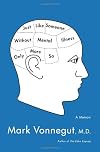
Just Like Someone Without Mental Illness Only More So is Mark Vonnegut’s follow-up to The Eden Express, his 1975 memoir of a series of psychotic breakdowns in his early 20s.
This is memoir also, of perseverance, told through a collection of thoughts, vignettes, and longer pieces. Vonnegut writes about attending Harvard Medical School (of twenty programs he applied to, his only acceptance); a passage describing his first patient death, alongside a staff nurse, reminded me how often nurses show more guide doctors-to-be through that experience. He writes about his career as a pediatrician, including criticism of contemporary health care and the health-insurance industry. He includes passages about his own childhood -- his weirdly prescient (and mentally ill) mother; his plainly weird (and genius) father (before he was successful and famous); his orphaned cousins his parents took in and raised as his siblings. He describes a medical mission to Honduras. He examines marriage, fatherhood, being alcoholic … and a fourth psychotic episode, wherein he takes us inside his mind as it breaks down.
Each chapter opens with a personal photo or sample of his own artwork, and he includes bits of advice about sanity and sobriety throughout, for example: “It’s possible within any given moment of any given day to choose between self and sickness. Rarely are there big heroic choices that will settle matters once and for all. The smallest positive step is probably the right one.”
Vonnegut is curious, optimistic, fun, philosophical ... and this gentle memoir is highly recommended. show less
This is memoir also, of perseverance, told through a collection of thoughts, vignettes, and longer pieces. Vonnegut writes about attending Harvard Medical School (of twenty programs he applied to, his only acceptance); a passage describing his first patient death, alongside a staff nurse, reminded me how often nurses show more guide doctors-to-be through that experience. He writes about his career as a pediatrician, including criticism of contemporary health care and the health-insurance industry. He includes passages about his own childhood -- his weirdly prescient (and mentally ill) mother; his plainly weird (and genius) father (before he was successful and famous); his orphaned cousins his parents took in and raised as his siblings. He describes a medical mission to Honduras. He examines marriage, fatherhood, being alcoholic … and a fourth psychotic episode, wherein he takes us inside his mind as it breaks down.
Each chapter opens with a personal photo or sample of his own artwork, and he includes bits of advice about sanity and sobriety throughout, for example: “It’s possible within any given moment of any given day to choose between self and sickness. Rarely are there big heroic choices that will settle matters once and for all. The smallest positive step is probably the right one.”
Vonnegut is curious, optimistic, fun, philosophical ... and this gentle memoir is highly recommended. show less
 This review was written for LibraryThing Early Reviewers.
This book will make you smile, smirk, chuckle and laugh out loud. It will also make you wince, perhaps in recognition, but certainly in sympathy. Because Mark Vonnegut's road to finding some measure of peace in his sixty-three years of life has been filled with bumps, collisions and countless stretches of "under construction." One would think that being the son of a famous author like Kurt Vonnegut would have made for an easy and charmed life. Nope. As it turns out mental illness ran in show more Vonnegut's family on both sides probably back three or four generations. With a family history like that, it's not surprising that Mark Vonnegut cracked up in his early twenties, the first of at least four major episodes in his life which each time left him hospitalized and scrambling to find purchase on a sudden downward slide. The last time it happened, Vonnegut had reconstructed his life well enough to have gotten into Harvard Med School and had successfully completed an internship and residency and was already well established as one of the top pediatricians in the Boston area. Alcohol and prescription drugs (Xanax) played a part, and denial played perhaps an even bigger role.
Mark Vonnegut has written only one other book, a memoir 35 years ago. The Eden Express, an insider's tale of mental illness, was a smashing success, enough to finance the author's med school and buy him a house. I must have read the book, probably soon after it came out, because my brother said I lent it to him years ago. But I can't remember it at all, so I'll have to find a copy and read it again. Since I'm a few years older than Mark Vonnegut, I guess I'll just chalk my forgetfulness up to age. Because I love this new book. While mental illness is not exactly a happy subject, Vonnegut's wit, wisdom and wry and dry slightly off-center sense of humor make the journey an extremely entertaining one. I found myself nodding in agreement to many of the things he had to say, smiling and chuckling at much of it. A confirmed introvert myself, I had to laugh at what he had to say about people like me and also about extroverts -
"Introverts almost never cause me trouble and are usually much better at what they do than extroverts. Extroverts are too busy slapping one another on the back, team building, and making fun of introverts to get much done ... I can pass for normal most of the time, but I understand perfectly why some of my autistic patients scream and flap their arms - it's to frighten off extroverts."
There's more, but you get the idea. This perhaps gene-propagated Vonnegut sense of humor is very much in evidence throughout the book. Here's another sample from pediatrician/would-be handyman Vonnegut - "Since I took up carpentry I measure children much more carefully, sometimes to 1/32 of an inch." Hmm ... I wonder if, like most good carpenters, he measures twice, so he'll only have to cut once.
Vonnegut has many points he wants to make and is pretty successful in making all of them I think. He is quite disenchanted, for example, with insurance and pharmaceutical companies and the general state of the health care business today, and pretty much everything he has to say on these things rings true and makes sense. He has numerous comments to make about his famous father, usually making allowances for his crankiness and ungraciousness, calling him "more like an unpredictable younger brother than a father ... [who] fiercely defended and exercised his right to be a pain in the ass on a regular basis." But he obviously loved Kurt, as evidenced in the chapter entitled, "There Is Nothing Quite as Final as a Dead Father," when he comments sadly, "I was no longer on deck."
The final chapter in this slim volume is called "Mushrooms," and is quite hilarious as he describes his late-in-life discovery and fascination with finding various fungi and cooking and eating them, which leads to what he calls the UNFORTUNATE INCIDENT. In a book describing a life filled with UNFORTUNATE INCIDENTs, Vonnegut somehow manages to end his story on a upbeat note, with "a wish to move forward. I love finding out what happens next."
I sincerely hope this guy is not finished telling his story, because he is an extremely talented and engaging writer. This apple didn't fall far. I want to know what happens next too. Take notes, Dr. Vonnegut, and please write it all down. Your daddy would be proud, but then again ... Well, he SHOULD be proud.
- Tim Bazzett, author of the memoir, BOOKLOVER show less
Mark Vonnegut has written only one other book, a memoir 35 years ago. The Eden Express, an insider's tale of mental illness, was a smashing success, enough to finance the author's med school and buy him a house. I must have read the book, probably soon after it came out, because my brother said I lent it to him years ago. But I can't remember it at all, so I'll have to find a copy and read it again. Since I'm a few years older than Mark Vonnegut, I guess I'll just chalk my forgetfulness up to age. Because I love this new book. While mental illness is not exactly a happy subject, Vonnegut's wit, wisdom and wry and dry slightly off-center sense of humor make the journey an extremely entertaining one. I found myself nodding in agreement to many of the things he had to say, smiling and chuckling at much of it. A confirmed introvert myself, I had to laugh at what he had to say about people like me and also about extroverts -
"Introverts almost never cause me trouble and are usually much better at what they do than extroverts. Extroverts are too busy slapping one another on the back, team building, and making fun of introverts to get much done ... I can pass for normal most of the time, but I understand perfectly why some of my autistic patients scream and flap their arms - it's to frighten off extroverts."
There's more, but you get the idea. This perhaps gene-propagated Vonnegut sense of humor is very much in evidence throughout the book. Here's another sample from pediatrician/would-be handyman Vonnegut - "Since I took up carpentry I measure children much more carefully, sometimes to 1/32 of an inch." Hmm ... I wonder if, like most good carpenters, he measures twice, so he'll only have to cut once.
Vonnegut has many points he wants to make and is pretty successful in making all of them I think. He is quite disenchanted, for example, with insurance and pharmaceutical companies and the general state of the health care business today, and pretty much everything he has to say on these things rings true and makes sense. He has numerous comments to make about his famous father, usually making allowances for his crankiness and ungraciousness, calling him "more like an unpredictable younger brother than a father ... [who] fiercely defended and exercised his right to be a pain in the ass on a regular basis." But he obviously loved Kurt, as evidenced in the chapter entitled, "There Is Nothing Quite as Final as a Dead Father," when he comments sadly, "I was no longer on deck."
The final chapter in this slim volume is called "Mushrooms," and is quite hilarious as he describes his late-in-life discovery and fascination with finding various fungi and cooking and eating them, which leads to what he calls the UNFORTUNATE INCIDENT. In a book describing a life filled with UNFORTUNATE INCIDENTs, Vonnegut somehow manages to end his story on a upbeat note, with "a wish to move forward. I love finding out what happens next."
I sincerely hope this guy is not finished telling his story, because he is an extremely talented and engaging writer. This apple didn't fall far. I want to know what happens next too. Take notes, Dr. Vonnegut, and please write it all down. Your daddy would be proud, but then again ... Well, he SHOULD be proud.
- Tim Bazzett, author of the memoir, BOOKLOVER show less
This review was written for LibraryThing Early Reviewers.Part memoir of growing up with an unconventional family, part criticism of the modern healthcare industry, part insight into living with mental illness, Mark Vonnegut's Just Like Someone Without Mental Illness Only More So is a fascinating read. The narrative reads like a bipolar brain might think - disjointed, non-linear, without transitions. The result is a quick, bumpy, jaunt through Dr. Vonnegut's life. What's most striking is that other than his polymathic tendencies, his famous family, show more and his psychotic breaks, Mark is pretty much a regular guy with the problems and issues many of us face. And, really, I think that's the take home message. show less
Lists
Awards


You May Also Like


Statistics
- Works
- 3
- Also by
- 1
- Members
- 1,188
- Popularity
- #21,642
- Rating
- 3.8
- Reviews
- 43
- ISBNs
- 27
- Languages
- 5
- Favorited
- 1
