
Kurt Vonnegut (1922–2007)
Author of Slaughterhouse-Five
About the Author
The appeal of Kurt Vonnegut, especially to bright younger readers of the past few decades, may be attributed partly to the fact that he is one of the few writers who have successfully straddled the imaginary line between science-fiction/fantasy and "real literature." He was born in Indianapolis and show more attended Cornell University, but his college education was interrupted by World War II. Captured during the Battle of the Bulge and imprisoned in Dresden, he received a Purple Heart for what he calls a "ludicrously negligible wound." After the war he returned to Cornell and then earned his M.A. at the University of Chicago.He worked as a police reporter and in public relations before placing several short stories in the popular magazines and beginning his career as a novelist. His first novel, Player Piano (1952), is a highly credible account of a future mechanistic society in which people count for little and machines for much. The Sirens of Titan (1959), is the story of a playboy whisked off to Mars and outer space in order to learn some humbling lessons about Earth's modest function in the total scheme of things. Mother Night (1962) satirizes the Nazi mentality in its narrative about an American writer who broadcasts propaganda in Germany during the war as an Allied agent. Cat's Cradle (1963) makes use of some of Vonnegut's experiences in General Electric laboratories in its story about the discovery of a special kind of ice that destroys the world. God Bless You, Mr. Rosewater (1965) satirizes a benevolent foundation set up to foster the salvation of the world through love, an endeavor with, of course, disastrous results. Slaughterhouse-Five; or The Children's Crusade (1969) is the book that marked a turning point in Vonnegut's career. Based on his experiences in Dresden, it is the story of another Vonnegut surrogate named Billy Pilgrim who travels back and forth in time and becomes a kind of modern-day Everyman. The novel was something of a cult book during the Vietnam era for its antiwar sentiments. Breakfast of Champions (1973), the story of a Pontiac dealer who goes crazy after reading a science fiction novel by "Kilgore Trout," received generally unfavorable reviews but was a commercial success. Slapstick (1976), dedicated to the memory of Laurel and Hardy, is the somewhat wacky memoir of a 100-year-old ex-president who thinks he can solve society's problems by giving everyone a new middle name. In addition to his fiction, Vonnegut has published nonfiction on social problems and other topics, some of which is collected in Wampeters, Foma and Granfalloons (1974). He died from head injuries sustained in a fall on April 11, 2007. (Bowker Author Biography) show less
Disambiguation Notice:
Kilgore Trout, the name of a character in several of Kurt Vonnegut's books, was later used as a pseudonym by Philip José Farmer. Vonnegut himself never wrote under or went by the name Kilgore Trout.
Image credit: Kurt Vonnegut, 2001.
Works by Kurt Vonnegut
Novels & Stories, 1963-1973: Cat's Cradle / God Bless You, Mr. Rosewater / Slaughterhouse-Five / Breakfast of Champions / Stories (2011) 499 copies, 8 reviews
Novels & Stories 1950-1962: Player Piano / The Sirens of Titan / Mother Night / Stories (2012) 305 copies, 4 reviews
Slaughterhouse-Five • The Sirens of Titan • Player Piano • Cat's Cradle • Breakfast of Champions • Mother Night (1980) 190 copies, 1 review
Kurt Vonnegut: The Last Interview: And Other Conversations (The Last Interview Series) (2011) 128 copies, 1 review
If this isn't nice what is?, (much) expanded second edition: the graduation speeches and other words to live by (2014) 125 copies, 2 reviews
If This Isn't Nice, What Is? (Even More) Expanded Third Edition: The Graduation Speeches and Other Words to Live By (2020) 84 copies, 3 reviews
Kurt Vonnegut, Jr. Reads Welcome to the Monkey House, New Dictionary, and Harrison Bergeron 19 copies, 2 reviews
The Sirens of Titan • Mother Night • Cat's Cradle • God Bless You, Mr. Rosewater • Slaughterhouse-Five (1988) 18 copies
Cat's Cradle • The Sirens of Titan • God Bless You, Mr. Rosewater • Welcome to the Monkey House • Slaughterhouse Five (1973) 16 copies
The Vonnegut Quartet: Breakfast of Champions / Mother Night / Player Piano / Wampeters, Foma & Granfalloons (1976) 9 copies
Kurt Vonnegut 6 copies
Thanasphere 6 copies
galaxy 14 Auswahl der besten Stories aus dem Science Fiction Magazine Galaxy (1970) — Contributor — 5 copies
The Big Space Fuck [short story] 4 copies
Masters of Science Fiction, Vol 1 4 copies
Utopia 14 - 1º volume 4 copies
Utopia 14 - 2º Volume 4 copies
Long Walk to Forever [short story] 4 copies
Hall of Mirrors 3 copies
The Souvenir 3 copies
Happy Birthday, Kurt Vonnegut: A Festschrift for Kurt Vonnegut on his Sixtieth Birthday (1982) 3 copies
Kurt Vonnegut PALM SUNDAY An Autobiographical Collage 1981 Delacorte Press, NY [Hardcover] unknown (1981) 3 copies
Short Science Fiction Collection 005 3 copies
Short Science Fiction Collection 007 3 copies
Kirjailijan työ : Saul Bellow, William Faulkner, Ernest Hemingway, Boris Pasternak, Kurt Vonnegut (1985) 3 copies
Works of K. Vonnegut: Slaughterhouse Five, Breakfast of Champions, The Sirens of Titan — Author — 2 copies
Short Science Fiction Collection 056 2 copies
Short Science Fiction Collection 067 2 copies
Short Science Fiction Collection 020 2 copies
The Cruise Of The Jolly Roger 2 copies
utopia 14 - 2 2 copies
Short Science Fiction Collection 075 2 copies
Short Science Fiction Collection 076 2 copies
Runaways 2 copies
Short Science Fiction Collection 051 2 copies
Cold Turkey 2 copies
The Ides of March 2 copies
Колыбель для кошки 1 copy
Колыбель для кошки Бойня номер пять, или Крестовый поход детей; Сирены Титана : Романы : [Пер. с… (1999) 1 copy
Slaugherhouse 5 1 copy
Sirens of Triton 1 copy
Slaughterhouse 5, or The Children's Crusade - A Duty-dance with Death by Kurt Vonnegut (1991-03-21) 1 copy
Lot 3 books by Kurt Vonnegut,Jr., Galapagos a novel, Slaughter-House Five, Player Piano, (1974) 1 copy
0083- Selected stories 1 copy
مهد القطة 1 copy
epicac 1 copy
Śniadanie mistrzów 1 copy
Бойня номер пять, или Крестовый поход детей ; Балаган, или Конец одиночеству : [романы] (2009) 1 copy
עריסת חתול 1 copy
هارسِن بيرجيرون 1 copy
MËNGJES KAMPIONËSH 1 copy
المسلخ رقم 05 1 copy
Gempa Waktu 1 copy
Cat’s Cradle 1 copy
Hello, Red (Stories) 1 copy
The Good Explainer (Stories) 1 copy
דיק הצלף 1 copy
Bard books 1 copy
Fortitude [short story] 1 copy
Notes on Armagedon 1 copy
Here is a Lesson in Creative Writing (in The Best American Nonrequired Reading 2006 - EGGERS) 1 copy
The Drone King 1 copy
Any Reasonable Offer 1 copy
The Package 1 copy
Poor Little Rich Town 1 copy
Custom-made Bride 1 copy
Ambitious Sophomore 1 copy
A Present For Big Saint Nick 1 copy
Unpaid Consultant 1 copy
The Boy Who Hated Girls 1 copy
This Son Of Mine 1 copy
A Night For Love 1 copy
Find Me A Dream 1 copy
Lovers Anonymous 1 copy
Hal Irwin’s Magic Lamp 1 copy
Requiem for Zeitgeist 1 copy
Elle est pas belle, la vie ? 1 copy
Gdy Śmiertelnicy Śpią 1 copy
Fates Worth Than Death 1 copy
Untitled 1 copy
The World Without Us 1 copy
Lige i j̜et 1 copy
Slaugtherhouse-Five 1 copy
Mnemonics 1 copy
Bode Vermelho 1 copy
Un avanzo di galera 1 copy
Sláturhús fimm 1 copy
The Lost Board Game: GMQ 1 copy
Часотрус 1 copy
Associated Works
The Story and Its Writer: An Introduction to Short Fiction (1976) — Contributor — 1,216 copies, 3 reviews
The Big Book of Science Fiction: The Ultimate Collection (2016) — Contributor — 522 copies, 8 reviews
Writers on Writing: Collected Essays from the New York Times (2001) — Contributor — 482 copies, 5 reviews
For the Love of Books: 115 Celebrated Writers on the Books They Love Most (1999) — Contributor — 479 copies, 4 reviews
The Man with the Golden Arm: 50th Anniversary Critical Edition (1999) — Contributor — 464 copies, 8 reviews
The Moral Life: An Introductory Reader in Ethics and Literature (1999) — Contributor — 205 copies, 2 reviews
First Fiction: An Anthology of the First Published Stories by Famous Writers (1994) — Contributor — 197 copies, 1 review
The Rolling Stone Book of the Beats: The Beat Generation and American Culture (1999) — Contributor — 180 copies, 2 reviews
The Mark Twain Anthology: Great Writers on His Life and Work (2010) — Contributor — 160 copies, 1 review
The Very Best of Fantasy & Science Fiction: Sixtieth Anniversary Anthology (2009) — Contributor — 151 copies, 6 reviews
War No More: Three Centuries of American Antiwar and Peace Writing (2016) — Contributor — 111 copies, 2 reviews
Write If You Get Work : The Best of Bob and Ray (1975) — Foreword, some editions — 107 copies, 3 reviews
The Prentice Hall Anthology of Science Fiction and Fantasy (2000) — Contributor — 100 copies, 2 reviews
The Best Fantasy Stories from the Magazine of Fantasy & Science Fiction (1985) — Contributor — 77 copies, 2 reviews
Cape Cod Stories: Tales from Cape Cod, Nantucket, and Martha's Vineyard (1996) — Contributor — 59 copies, 5 reviews
Grave Predictions: Tales of Mankind’s Post-Apocalyptic, Dystopian and Disastrous Destiny (2016) 35 copies, 7 reviews
The Magazine of Fantasy and Science Fiction October 1961, Vol. 21, No. 4 (1961) — Contributor — 21 copies, 1 review
Democracy in Print: The best of the Progressive Magazine, 1909-2009 (2009) — Contributor — 15 copies
MHQ: The Quarterly Journal of Military History — Winter 1994 (1993) — Author "So it goes." — 10 copies
Tider skal komme : 15 langtidsvarsler : en science fiction-antologi — Contributor — 5 copies
10 Lost Vintage Sci-Fi Masterpieces for Hardcore Fans Only! (2009) — Contributor — 4 copies, 1 review
Ki ょ う も 気 God prepared a short masterpiece SF election (Kadokawa library) (2010) — Contributor — 2 copies
Short Science Fiction Collection 047 — Contributor — 2 copies
Short Science Fiction Collection 045 2 copies
RDCBLP Saint Paul | Apostle to All Men | Horowitz and Mrs. Washington | The Foster Portfolio | Bel Ria (1980) 1 copy
The Most Dangerous Game and Other Stories of Menace and Adventure (2013) — Contributor — 1 copy, 1 review
S-Fマガジン 2007年 09月号 [雑誌] 1 copy
Tagged
Common Knowledge
- Legal name
- Vonnegut, Kurt, Jr.
- Birthdate
- 1922-11-11
- Date of death
- 2007-04-11
- Gender
- male
- Education
- University of Chicago
Cornell University
Carnegie Institute of Technology
University of Tennessee - Occupations
- journalist
novelist
essayist
playwright
screenwriter - Organizations
- American Humanist Association
U.S. Army (WWII|POW)
Iowa Writers' Workshop - Awards and honors
- State Author of New York/Edith Wharton Citation of Merit (2001-03)
American Academy of Arts and Letters Academy Award [1970]
Humanist of the Year [1992]
Asteroid Namesake [2539]
Purple Heart
Prisoner of War Medal (show all 8)
Science Fiction and Fantasy Hall of Fame (2015)
Carl Sandburg Literary Award (2001) - Relationships
- Vonnegut, Mark (son)
Vonnegut, Edith (daughter)
Krementz, Jill (spouse) - Cause of death
- a fall (brain injuries incurred several weeks prior from a fall at his New York brownstone home)
- Nationality
- USA
- Birthplace
- Indianapolis, Indiana, USA
- Places of residence
- New York, New York, USA
Indianapolis, Indiana, USA
Barnstable, Massachusetts, USA - Place of death
- New York, New York, USA
- Map Location
- Indiana, USA
- Disambiguation notice
- Kilgore Trout, the name of a character in several of Kurt Vonnegut's books, was later used as a pseudonym by Philip José Farmer. Vonnegut himself never wrote under or went by the name Kilgore Trout.
Members
Discussions
Slaughterhouse-Five by Kurt Vonnegut [Hamilton Press 2001] in Fine Press Forum (October 2022)
Sci-Fi Story, People Live Forever in Name that Book (August 2017)
November 2013: Kurt Vonnegut in Monthly Author Reads (November 2014)
1001 Group Read-December, 2012: Slaughterhouse Five in 1001 Books to read before you die (January 2013)
Reviews

»Another book, another June
Another sunny afternoon
Another season, another reason
For breakin’ with classics!«
(Based on “Makin’ Whoopee”, by Gus Kahn)
So, 1969 is still too old for me or maybe it’s just that this rambling, repetitive, dated-feeling, non-linear novel is a true classic in the worst sense of the word!
Supposedly, it focuses on the firebombing of Dresden during World War II but in fact, it’s more of an episodic play on war. The protagonist, Billy Pilgrim, is a prisoner show more of war, an optometrist and a time-traveller (since he suffered a brain trauma and had a major surgery done…) who experiences his life in a non-linear way and tells us about it.
Actually, I’m tempted to say he threatens us, because he’s become convinced he’ll live forever, thus troubling us with his terrible anecdotes.
Let’s get the most minor annoyance out of the way first: »So it goes.« - that phrase comes up exactly 106 times in a novel of barely 200 pages (yes, every time some kind of death occurs, I know, doesn’t make it any better). And it actually felt like a billion times.
Several times I fantasised about shooting a bullet at Vonnegut while screaming “So it goes” at the top of my lungs!
Also annoying: Billy Pilgrim’s brain-surgery induced belief he had been abducted by aliens from the planet »Tralfamadore«. There they put him under a glass dome, abduct a beautiful young actress for him whom he proceeds to impregnate and he lives the life…
Yes, I get he tries to rationalise his sense of powerlessness and isolation in a hostile world but I still hated it.
»There could be babies without men over sixty-five. There couldn’t be babies without other babies who had lived an hour or less after birth. And so on.
It was gibberish to Billy.«
(As was the novel to me!)
Moreover, the novel is also factually wrong in many aspects: Dresden has a long military history dating back to the 16th century, when it became the capital of Saxony and a major political and cultural centre. It was also a fortress city with strong fortifications and a large garrison. During World War 2, Dresden was a military centre for the Nazi regime, hosting several military factories, barracks, headquarters and transportation hubs.
For a novel that’s supposed to centre on Dresden, arriving at it after almost 75% of the novel has gone is also somewhat strange.
Also wrong: »It was the next night that about one hundred and thirty thousand people in Dresden would die. So it goes.«
Actually, there were 22.700 to 25.000 victims who died due to those bombings. Why does this matter? Because it’s still part of the narrative of the neo-Nazi plague that still infests (primarily) the eastern parts of Germany: While only about 20% of Germany’s population lives there, almost half the rightwing-extremist crimes were committed there…
»They were literary critics, and they thought Billy was one, too. They were going to discuss whether the novel was dead or not. So it goes.«
So, no, the novel itself isn’t dead. Just this kind of novel thankfully is. So it goes.
One out of five stars.
Blog | Facebook | Twitter | Mastodon | Instagram | Pinterest | Medium | Matrix | Tumblr
Ceterum censeo Putin esse delendam show less
Another sunny afternoon
Another season, another reason
For breakin’ with classics!«
(Based on “Makin’ Whoopee”, by Gus Kahn)
So, 1969 is still too old for me or maybe it’s just that this rambling, repetitive, dated-feeling, non-linear novel is a true classic in the worst sense of the word!
Supposedly, it focuses on the firebombing of Dresden during World War II but in fact, it’s more of an episodic play on war. The protagonist, Billy Pilgrim, is a prisoner show more of war, an optometrist and a time-traveller (since he suffered a brain trauma and had a major surgery done…) who experiences his life in a non-linear way and tells us about it.
Actually, I’m tempted to say he threatens us, because he’s become convinced he’ll live forever, thus troubling us with his terrible anecdotes.
Let’s get the most minor annoyance out of the way first: »So it goes.« - that phrase comes up exactly 106 times in a novel of barely 200 pages (yes, every time some kind of death occurs, I know, doesn’t make it any better). And it actually felt like a billion times.
Several times I fantasised about shooting a bullet at Vonnegut while screaming “So it goes” at the top of my lungs!
Also annoying: Billy Pilgrim’s brain-surgery induced belief he had been abducted by aliens from the planet »Tralfamadore«. There they put him under a glass dome, abduct a beautiful young actress for him whom he proceeds to impregnate and he lives the life…
Yes, I get he tries to rationalise his sense of powerlessness and isolation in a hostile world but I still hated it.
»There could be babies without men over sixty-five. There couldn’t be babies without other babies who had lived an hour or less after birth. And so on.
It was gibberish to Billy.«
(As was the novel to me!)
Moreover, the novel is also factually wrong in many aspects: Dresden has a long military history dating back to the 16th century, when it became the capital of Saxony and a major political and cultural centre. It was also a fortress city with strong fortifications and a large garrison. During World War 2, Dresden was a military centre for the Nazi regime, hosting several military factories, barracks, headquarters and transportation hubs.
For a novel that’s supposed to centre on Dresden, arriving at it after almost 75% of the novel has gone is also somewhat strange.
Also wrong: »It was the next night that about one hundred and thirty thousand people in Dresden would die. So it goes.«
Actually, there were 22.700 to 25.000 victims who died due to those bombings. Why does this matter? Because it’s still part of the narrative of the neo-Nazi plague that still infests (primarily) the eastern parts of Germany: While only about 20% of Germany’s population lives there, almost half the rightwing-extremist crimes were committed there…
»They were literary critics, and they thought Billy was one, too. They were going to discuss whether the novel was dead or not. So it goes.«
So, no, the novel itself isn’t dead. Just this kind of novel thankfully is. So it goes.
One out of five stars.
Blog | Facebook | Twitter | Mastodon | Instagram | Pinterest | Medium | Matrix | Tumblr
Ceterum censeo Putin esse delendam show less

Spoilers
This is one that will stay with me for a while. I loved the detail in the creation of Rufoord's new religion. I almost wondered at times if I was instead reading "The Winston Niles Rumfoord Pocket HIstory of Mars". But it wasn't until I reached the end, until the reveal of the Tralfamadorian influence on Earth, that I realized the full impact of the story. For me, it changed the whole perspective of the narrative, and wonderfully so. Throughout the book, Vonnegut in his show more matter-of-fact tone simultaneously challenges and embraces the ideas of free will, fate, and purpose. I think if there is a moral to the story, it would be what Constant said of Beatrice at the very end- "It took us that long to realize that a purpose of human life, no matter who is controlling it, is to love whoever is around to be loved." And I'll be comforted in the future by the thought that I am a victim of a series of accidents, as are we all. show less
This is one that will stay with me for a while. I loved the detail in the creation of Rufoord's new religion. I almost wondered at times if I was instead reading "The Winston Niles Rumfoord Pocket HIstory of Mars". But it wasn't until I reached the end, until the reveal of the Tralfamadorian influence on Earth, that I realized the full impact of the story. For me, it changed the whole perspective of the narrative, and wonderfully so. Throughout the book, Vonnegut in his show more matter-of-fact tone simultaneously challenges and embraces the ideas of free will, fate, and purpose. I think if there is a moral to the story, it would be what Constant said of Beatrice at the very end- "It took us that long to realize that a purpose of human life, no matter who is controlling it, is to love whoever is around to be loved." And I'll be comforted in the future by the thought that I am a victim of a series of accidents, as are we all. show less
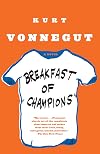
Kilgore Trout, an obscure science fiction writer, is invited to an Arts Festival in a Midwest city where Dwayne Hoover, a successful business man and owner of many local institutions, is having a mental breakdown.
This book is very quintessential Vonnegut, with tons of absurd, dark humor and pessimistic views of the world around him (and rightly so in many cases). He even populates it with characters from his other books, such as the aforementioned Kilgore Trout as well as Eliot Rosewater. show more
Despite being published in 1973 and in some places showing its age (e.g., certain language used), this books feels surprisingly and perhaps disappointingly fresh as Vonnegut addresses the very same social and environmental issues that we are still grappling with today, from racism to pollution to gender identity to the way American history is taught and more. It's definitely a thought-provoking book. As the plot progresses, tension builds as Vonnegut clues you in to what will happen when Dwayne and Kilgore meet.
Unfortunately, towards the end of the book, Vonnegut goes from an omniscient narrator to actually inserting himself as a flesh-and-blood person in the book, walking around with his characters while acknowledging that they are fictional. I felt that the book lost some steam for me there. The big climactic scenes were a bit less climactic than they could have been, and the meta-ness was maybe a little too much. So, I was not thrilled with the ending and found it a little flat, although I thought the beginning and middle parts of the book were compelling.
Overall, I still recommend this book for raising lots of serious issues but in a way that is very readable with its biting satire. It's a classic for a reason and fans of Vonnegut will not be disappointed to come back to the world of characters he created. This book also includes some drawings from the author, which add to the story and its dark humor. show less
This book is very quintessential Vonnegut, with tons of absurd, dark humor and pessimistic views of the world around him (and rightly so in many cases). He even populates it with characters from his other books, such as the aforementioned Kilgore Trout as well as Eliot Rosewater. show more
Despite being published in 1973 and in some places showing its age (e.g., certain language used), this books feels surprisingly and perhaps disappointingly fresh as Vonnegut addresses the very same social and environmental issues that we are still grappling with today, from racism to pollution to gender identity to the way American history is taught and more. It's definitely a thought-provoking book. As the plot progresses, tension builds as Vonnegut clues you in to what will happen when Dwayne and Kilgore meet.
Unfortunately, towards the end of the book, Vonnegut goes from an omniscient narrator to actually inserting himself as a flesh-and-blood person in the book, walking around with his characters while acknowledging that they are fictional. I felt that the book lost some steam for me there. The big climactic scenes were a bit less climactic than they could have been, and the meta-ness was maybe a little too much. So, I was not thrilled with the ending and found it a little flat, although I thought the beginning and middle parts of the book were compelling.
Overall, I still recommend this book for raising lots of serious issues but in a way that is very readable with its biting satire. It's a classic for a reason and fans of Vonnegut will not be disappointed to come back to the world of characters he created. This book also includes some drawings from the author, which add to the story and its dark humor. show less

Se há livros que quebram certezas e perturbam convicções, este é um deles.
Qual a relação entre um químico, um dos pais da bomba atómica, uma religião inventada, uma ilha pobre no meio das caraíbas, a destruição do mundo e uma cama de gato? Vê a cama? Vê o gato? pergunta um anão, filho do químico. Eu não vi cama, nem gato. Mas estou confusa, parece que a cama e o gato estão mesmo lá.
- Diga-me o senhor, como morre um homem quando privado do consolo da literatura?
- De uma de show more duas maneiras - disse ele - putrefação do coração ou atrofia do sistema nervoso.
- Nenhuma delas muito agradável, imagino eu. - sugeri.
- Não - disse Castle mais velho. - Por amor de Deus, vocês os dois, por favor, continuem a escrever!
- «Muitas mãos tornam o trabalho bem mais leve.» É um provérbio chinês antigo.
- Eram espertos em muitas coisas, esses chineses, lá isso eram.
- Sim, devemos manter viva a sua memória.
- Agora gostava de ter lido mais sobre eles.
- Bem, era difícil, mesmo em condições ideais.
- Agora gostava de ter lido mais sobre tudo.
- Todos nós temos os nossos arrependimentos, mamã.
- Não vale a pena chorar sobre o leite derramado.
- Tal como disse o poeta, mamã: «De todas as palavras de ratos e homens, as mais tristes são: "Podia ter sido."»
- Isso é muito bonito, e bem verdade. show less
Qual a relação entre um químico, um dos pais da bomba atómica, uma religião inventada, uma ilha pobre no meio das caraíbas, a destruição do mundo e uma cama de gato? Vê a cama? Vê o gato? pergunta um anão, filho do químico. Eu não vi cama, nem gato. Mas estou confusa, parece que a cama e o gato estão mesmo lá.
- Diga-me o senhor, como morre um homem quando privado do consolo da literatura?
- De uma de show more duas maneiras - disse ele - putrefação do coração ou atrofia do sistema nervoso.
- Nenhuma delas muito agradável, imagino eu. - sugeri.
- Não - disse Castle mais velho. - Por amor de Deus, vocês os dois, por favor, continuem a escrever!
- «Muitas mãos tornam o trabalho bem mais leve.» É um provérbio chinês antigo.
- Eram espertos em muitas coisas, esses chineses, lá isso eram.
- Sim, devemos manter viva a sua memória.
- Agora gostava de ter lido mais sobre eles.
- Bem, era difícil, mesmo em condições ideais.
- Agora gostava de ter lido mais sobre tudo.
- Todos nós temos os nossos arrependimentos, mamã.
- Não vale a pena chorar sobre o leite derramado.
- Tal como disse o poeta, mamã: «De todas as palavras de ratos e homens, as mais tristes são: "Podia ter sido."»
- Isso é muito bonito, e bem verdade. show less
Lists
Unread books (13)
Five Star Novels (1)
On the pile (1)
bound (1)
Literary SF/F (1)
Banned Books (1)
A Novel Cure (1)
Short and Sweet (1)
Cult Classics (1)
scav (1)
Classic Sci-Fi (1)
Classics (1)
. (1)
Check Library (1)
Europe (1)
Read (1)
E's Reader (1)
Dead narrators (1)
recommended (1)
Magic Realism (1)
2015 UpROOTed (1)
SF - To Read (1)
Non-Fiction (1)
The "A" List (1)
READ IN 2020 (1)
SF Masterworks (1)
Existentialism (1)
um actually (1)
Read (12)
Metafiction (2)
Best Dystopias (3)
THE WAR ROOM (2)
Five star books (2)
Read This Next (2)
Best Satire (5)
el (3)
1980s (3)
Favourite Books (3)
Overdue Podcast (3)
1950s (2)
Reading LIst (1)
Best First Lines (1)
Midwest (1)
Science Fiction (1)
Best War Stories (1)
Read in 2014 (1)
science fiction (1)
Reiny (1)
. (1)
On Books (1)
BitLife (1)
Books (1)
Folio Society (1)
1970s (2)
War Literature (2)
SF Masterworks (2)
Nifty Fifties (2)
1960s (2)
history (1)
Books I've Read (1)
Awards


You May Also Like


Associated Authors
Statistics
- Works
- 296
- Also by
- 92
- Members
- 201,541
- Popularity
- #20
- Rating
- 4.0
- Reviews
- 2,636
- ISBNs
- 1,695
- Languages
- 40
- Favorited
- 1,411


