
Norah Vincent (1968–2022)
Author of Self-Made Man: One Woman's Journey into Manhood and Back Again
About the Author
Image credit: Michele Asselin/Corbis
Works by Norah Vincent
Associated Works
Tagged
Common Knowledge
- Canonical name
- Vincent, Norah
- Legal name
- Vincent, Norah Mary
- Birthdate
- 1968-09-20
- Date of death
- 2022-07-06
- Gender
- female
- Education
- Williams College (BA|1990 ∙ Philosophy)
American School, London, England, UK - Occupations
- journalist
columnist
editor - Organizations
- The Village Voice
Los Angeles Times
Free Press - Agent
- Eric Simonoff
- Cause of death
- medically assisted death
- Nationality
- USA
- Birthplace
- Detroit, Michigan, USA
- Places of residence
- New York, New York, USA
England, UK - Place of death
- Basel, Switzerland
- Map Location
- USA
Members
Reviews
Voluntary Madness: My Year Lost and Found in the Loony Bin [VOLUNTARY MADNESS] [Hardcover] by Norah Vincent

This book turned out to be entirely different from my expectations. I was expecting a rather light, humorous kind of book and instead found one that was profoundly enlightening and moving. The author, Norah Vincent, herself a sufferer of depression, decided she would spend a year "undercover" in 3 different mental health facilities in the United States. She found the type of care and degree of empathy on the part of the staff varied tremendously depending on whether the facility was public show more or private and the economic position of the patients.
Also, as a mental health consumer myself and being well aware of the stigma that is attached to mental illness, I found Vincent put into words feelings and thoughts that I have experienced often but did not know how to express. What it boils down to is all human beings want to be treated with respect. A great book! show less
Also, as a mental health consumer myself and being well aware of the stigma that is attached to mental illness, I found Vincent put into words feelings and thoughts that I have experienced often but did not know how to express. What it boils down to is all human beings want to be treated with respect. A great book! show less
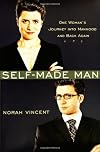
I strolled past Self-Made Man on the bargain table at Border's for more than a month, wondering whether it would be intriguing or simply the vitriol of an angry woman. I am glad -- no, grateful -- that I finally picked it up. Norah Vincent, who is neither a transvestite nor transgendered, wants to know what's like to be man. With the help of a voice coach, a make-up artist, and a muscle-building work-out routine, she spends 18 months living as her alter-ego Ned. The results of her experience show more are a far better guide to the opposite sex than trite drivel like Men Are from Mars, Women Are from Venus.
Each chapter explores a facet of her male life: joining a men's bowling league, working, strip clubs, dating, living in a monastery and joining a men's support group. She enters each of these venues expecting to find a privileged world where men wield power, ridicule homosexuals and make racist jokes. Instead, the truth turns out to be much more complex. Of her dating experience, she writes:
"Women were very hard to please. They wanted me to be in control, big and strong both in spirit and in body, but also tender and vulnerable at the same time, subservient to their whims and bunny-soft...As much as these women wanted an in-control man, they wanted a man who was vulnerable to them, a man who would...open his doors, someone expressive, intuitive, attuned. This I was in spades, and I always got points for it, but feeling the pressure to be that other world-bestriding colossus at the same time made me feel very sympathetic toward heterosexual men...A man is expected to be modern, to treat women as equals in every respect, [but] he is often still expected to be traditional at the same time, to treat a lady like a lady, to lead the way and pick up the check."
Perhaps these things are common sense, but it was the first time I heard them articulated in such a clear-headed way. Part of what makes the book so fascinating is that the writer is a lesbian who is often called "butch" or "masculine." But, as a man, she is often perceived as "fag" by both male and female audiences. This is probably why she excels at considering each chapter from both a male and female perspective, and although some chapters are less insightful than others, the book made me reflect carefully on what I expect from the men in my life. I recommend this book to people of both sexes, both single and in relationships. Everyone could learn something from it. show less
Each chapter explores a facet of her male life: joining a men's bowling league, working, strip clubs, dating, living in a monastery and joining a men's support group. She enters each of these venues expecting to find a privileged world where men wield power, ridicule homosexuals and make racist jokes. Instead, the truth turns out to be much more complex. Of her dating experience, she writes:
"Women were very hard to please. They wanted me to be in control, big and strong both in spirit and in body, but also tender and vulnerable at the same time, subservient to their whims and bunny-soft...As much as these women wanted an in-control man, they wanted a man who was vulnerable to them, a man who would...open his doors, someone expressive, intuitive, attuned. This I was in spades, and I always got points for it, but feeling the pressure to be that other world-bestriding colossus at the same time made me feel very sympathetic toward heterosexual men...A man is expected to be modern, to treat women as equals in every respect, [but] he is often still expected to be traditional at the same time, to treat a lady like a lady, to lead the way and pick up the check."
Perhaps these things are common sense, but it was the first time I heard them articulated in such a clear-headed way. Part of what makes the book so fascinating is that the writer is a lesbian who is often called "butch" or "masculine." But, as a man, she is often perceived as "fag" by both male and female audiences. This is probably why she excels at considering each chapter from both a male and female perspective, and although some chapters are less insightful than others, the book made me reflect carefully on what I expect from the men in my life. I recommend this book to people of both sexes, both single and in relationships. Everyone could learn something from it. show less

Like many of the other reviewers, I found this very shallow. I have read similar books in which a man tried to live as a woman, and was curious as to whether the other direction works better. It doesn't. At least not in this case.
I came to even question the author's basic social competency. For example, how much insight should it take to get that if a group of women are sitting in a bar interacting with each other that a stranger butting in and trying to flirt with one of them is going to show more get rejected? She reports that it took a long time for any of them to show more than a profile. This is body language 101. They were there as a group to enjoy their group, not to get hitched up to a guy. But she interprets it as personal rejection. The whole dating chapter showed mostly that she doesn't have any experience of male-female relationships from either side.
The different venues she chose for exploring masculine life were generally not everyday life for the men involved. A few hours once a week doesn't do it. Especially not if there are class differences as well as the gender one to be overcome. Spending time in a monastary was just a very peculiar idea. show less
I came to even question the author's basic social competency. For example, how much insight should it take to get that if a group of women are sitting in a bar interacting with each other that a stranger butting in and trying to flirt with one of them is going to show more get rejected? She reports that it took a long time for any of them to show more than a profile. This is body language 101. They were there as a group to enjoy their group, not to get hitched up to a guy. But she interprets it as personal rejection. The whole dating chapter showed mostly that she doesn't have any experience of male-female relationships from either side.
The different venues she chose for exploring masculine life were generally not everyday life for the men involved. A few hours once a week doesn't do it. Especially not if there are class differences as well as the gender one to be overcome. Spending time in a monastary was just a very peculiar idea. show less
Fascinating study of men's lives by a woman pretending to be a man. We probably all wonder what the opposite sex really thinks, what they talk about when they are alone together, but never have a chance to find out. Norah Vincent actually finds out.
She makes it clear that this is just one woman's observations, and only of particular groups of men, but it's fascinating and eye-opening, scary and depressing at times, but also saddening for the unreported restrictions society imposes on men and show more men impose on each other. I'm a feminist and I know plenty about the injustices on women's lives, but this has given me more sympathy for the different difficulties in men's lives.
"I passed in a man’s world not because my mask was so real, but because the world of men was a masked ball." show less
She makes it clear that this is just one woman's observations, and only of particular groups of men, but it's fascinating and eye-opening, scary and depressing at times, but also saddening for the unreported restrictions society imposes on men and show more men impose on each other. I'm a feminist and I know plenty about the injustices on women's lives, but this has given me more sympathy for the different difficulties in men's lives.
"I passed in a man’s world not because my mask was so real, but because the world of men was a masked ball." show less
Lists
Awards


You May Also Like


Associated Authors
Statistics
- Works
- 5
- Also by
- 1
- Members
- 2,353
- Popularity
- #10,899
- Rating
- 3.4
- Reviews
- 99
- ISBNs
- 58
- Languages
- 8