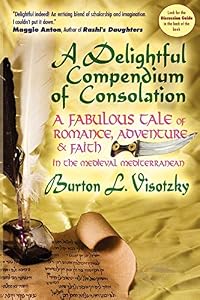
A Delightful Compendium of Consolation
by Burton L. Visotzky
On This Page
Description
The year is 1031. Karimah, a charming, headstrong Jewish nineteen-year-old has followed her heart on an adventure that will take her far from home. The story is revealed in her letters to the family she left behind in Egypt, their letters to her, and their correspondence with others as they seek to make sense of the disorder that Karimah has brought to their lives. Details of everday life from a millennium ago are now familiar to scholars through the discovery of the Cairo Geniza, a show more synagogue storeroom full of several centuries' worth of religious manuscripts, receipts, and business correspondence. The author creates an impassioned portrayal of a time when Jews and Muslims lived together in reasonable harmony. show lessTags
Recommendations









Member Reviews
A novel in letters of 11th century Judaism in North Africa, Visotzky put a lot of work into making this as factual as possible. He writes in the Postscript "This is a work of fiction. It is an historical novel, if that is not too much of an oxymoron. Yet it is precisely the blurred line between fact and fiction that I wished to explore here." I would argue the stress is on the fact. As a novel, it's OK, but as a window into in the time period and the culture it's wonderful.
The set up are the real documents found in the Cairo Geniza, a collection of Hebrew script that was preserved in an old temple. Some of the documents may date back to the 9th century, and quite a few of them are letters. Visotzky took historical documents, characters show more and rabbinical stories from that period and then fleshed out this story. Even his fictional games have non-fictional counterparts. One character apparently lives through several tales straight out of Arabian Nights.
What makes this so fascinating is what we learn. The letters have the language quirks and formality of that time. And through them we learn about the nature of the trading, financing, communication, the mixed cultures and politics of that time. And we learn it from a Jewish perspective, lived, as it was, in a perpetual state of uncertainty. Jews of the time also apparently lived in dedication to the study of Torah, Talmud etc., for we learn quite a bit about the variety of Jewish sects of the time and their arguments and literature. The arguments, stories and poetry presented are largely real, as are many of the Jewish characters.
For me personally, this was precious little window into a time and place I know very little about; and that happens to be my own heritage. show less
The set up are the real documents found in the Cairo Geniza, a collection of Hebrew script that was preserved in an old temple. Some of the documents may date back to the 9th century, and quite a few of them are letters. Visotzky took historical documents, characters show more and rabbinical stories from that period and then fleshed out this story. Even his fictional games have non-fictional counterparts. One character apparently lives through several tales straight out of Arabian Nights.
What makes this so fascinating is what we learn. The letters have the language quirks and formality of that time. And through them we learn about the nature of the trading, financing, communication, the mixed cultures and politics of that time. And we learn it from a Jewish perspective, lived, as it was, in a perpetual state of uncertainty. Jews of the time also apparently lived in dedication to the study of Torah, Talmud etc., for we learn quite a bit about the variety of Jewish sects of the time and their arguments and literature. The arguments, stories and poetry presented are largely real, as are many of the Jewish characters.
For me personally, this was precious little window into a time and place I know very little about; and that happens to be my own heritage. show less
 This review was written for LibraryThing Early Reviewers.
[LT early reviewer - These comments apply to the advance reading edition (ARC)]
First, let me say that I cannot think of anything that I would change about this book. "A Delightful Compendium" is historical fiction in the form of letters imagined as part of the Cairo Geniza manuscripts. At first, I thought that using nothing but letters and journal entries to tell the story (stories) would wear thin and become a bit tedious after awhile. However, once adjusted to the absence of a narrator, I realized that I had begun to ‘open’ each letter with anticipation. I have read stories and novels written in this way before, and found the form limiting and somewhat frustrating. I do not know what magic Visotzky uses here, but I found myself show more fully engaged within the first 60 or 70 pages, and from then on, never felt a lull in the telling of the tale.
"A Delightful Compendium" contains the story of the al-Tustaris, a Jewish merchant family living in Cairo under Muslim rule in the 11th century. Central to the story is Karimah, the daughter who has left home with a boyfriend; Dunash, her father, who now considers Karimah dead and maintains regular correspondence with Nissim, a friend, teacher, and trading partner in north-west Africa; and Karimah’s brother, Iskander, to whom Karimah writes letters in confidence. Woven together in the resulting bundle of letters are stories of Karimah’s adventures, Talmudic stories and Torah wisdom from the sages, and the story of how the al-Tustari family copes with Karimah’s departure and the difficulties of trade in a dangerous time and place. All of this is cast with the Muslim majority culture in the background, which quite naturally becomes crucial to the al-Tustari family story. Though I was concerned when I started this novel (especially given the academic credentials of the author), I found that not being of either the Jewish nor Muslim cultures which are central to this story was not a handicap at all. The storytelling is plain spoken and clear, and Visotzky provides a helpful glossary and source notes which are clearly intended to help the ‘gentile’ reader (not too surprising given Visotsky's work in Jewish/Christian/Muslim relations).
I have to say that I was somewhat frustrated by Iskander’s silence in the first part of this book, as he only appears as the silent recipient of letters from Karimah or as the voice of his father in correspondence with Nissim. However, when Iskander does appear personally in letters to Karimah and Nissim later in the book, the impact of his letters is magnified by the early silence. I found myself responding emotionally to Iskander’s first few personal letters, and he quickly becomes, in my mind, the sympathetic protagonist of the story. That being said, all of the letter writers are fully human - faults, blind-spots, and all. Including these blemishes along with the characters’ determination to stay in community with each other and their dedication to their faith help create fully 3-dimensional persons despite the limitations of the letter/journal format.
In short, an easily accessible peek into 11th century Jewish culture in North Africa in the form of an engaging story of family and community.
Os. show less
First, let me say that I cannot think of anything that I would change about this book. "A Delightful Compendium" is historical fiction in the form of letters imagined as part of the Cairo Geniza manuscripts. At first, I thought that using nothing but letters and journal entries to tell the story (stories) would wear thin and become a bit tedious after awhile. However, once adjusted to the absence of a narrator, I realized that I had begun to ‘open’ each letter with anticipation. I have read stories and novels written in this way before, and found the form limiting and somewhat frustrating. I do not know what magic Visotzky uses here, but I found myself show more fully engaged within the first 60 or 70 pages, and from then on, never felt a lull in the telling of the tale.
"A Delightful Compendium" contains the story of the al-Tustaris, a Jewish merchant family living in Cairo under Muslim rule in the 11th century. Central to the story is Karimah, the daughter who has left home with a boyfriend; Dunash, her father, who now considers Karimah dead and maintains regular correspondence with Nissim, a friend, teacher, and trading partner in north-west Africa; and Karimah’s brother, Iskander, to whom Karimah writes letters in confidence. Woven together in the resulting bundle of letters are stories of Karimah’s adventures, Talmudic stories and Torah wisdom from the sages, and the story of how the al-Tustari family copes with Karimah’s departure and the difficulties of trade in a dangerous time and place. All of this is cast with the Muslim majority culture in the background, which quite naturally becomes crucial to the al-Tustari family story. Though I was concerned when I started this novel (especially given the academic credentials of the author), I found that not being of either the Jewish nor Muslim cultures which are central to this story was not a handicap at all. The storytelling is plain spoken and clear, and Visotzky provides a helpful glossary and source notes which are clearly intended to help the ‘gentile’ reader (not too surprising given Visotsky's work in Jewish/Christian/Muslim relations).
I have to say that I was somewhat frustrated by Iskander’s silence in the first part of this book, as he only appears as the silent recipient of letters from Karimah or as the voice of his father in correspondence with Nissim. However, when Iskander does appear personally in letters to Karimah and Nissim later in the book, the impact of his letters is magnified by the early silence. I found myself responding emotionally to Iskander’s first few personal letters, and he quickly becomes, in my mind, the sympathetic protagonist of the story. That being said, all of the letter writers are fully human - faults, blind-spots, and all. Including these blemishes along with the characters’ determination to stay in community with each other and their dedication to their faith help create fully 3-dimensional persons despite the limitations of the letter/journal format.
In short, an easily accessible peek into 11th century Jewish culture in North Africa in the form of an engaging story of family and community.
Os. show less
This review was written for LibraryThing Early Reviewers.What a great read! Set in early medieval northern Africa, the book evokes an exotic atmosphere with caravans, rabbinic tales, a rebellious daughter, an outraged father, pirates, Bedouins and more. Burton Visotzky has crafted a novel that consists primarily of letters sent to and from the principal characters in the novel. Despite the letter format, the characters became people that I cared about. The author has also created a great sense of place either through the descriptions one character gives to another of a place he is visiting, or by being dropped in casually in Karima's complaint about the heat in Kairawan (Tunisia) when she was pregnant.
The novel centers on the relationship between the rebellious Karima who runs away from home show more and her younger brother, Iskander, who is left to help his father with the family business. Other principal characters are Karima and Iskander's father and a close friend and business associate, Rabbi Nissim. Additional characters are deftly woven in and out of the letters as the scenes and events change.
The rabbinic tales that Rabbi Nissim sends to Dunash (Karima's father) to console him as he mourns the loss of his daughter add an additional dimension to the novel. The stories enhance the narrative and may provide comfort to readers who are experiencing losses of their own. The reader is kept on the edge of his seat, rapidly flipping pages to see what happens to Karima and her family next. I highly recommend this 'delightful' book, even if you're not a medievalist. show less
The novel centers on the relationship between the rebellious Karima who runs away from home show more and her younger brother, Iskander, who is left to help his father with the family business. Other principal characters are Karima and Iskander's father and a close friend and business associate, Rabbi Nissim. Additional characters are deftly woven in and out of the letters as the scenes and events change.
The rabbinic tales that Rabbi Nissim sends to Dunash (Karima's father) to console him as he mourns the loss of his daughter add an additional dimension to the novel. The stories enhance the narrative and may provide comfort to readers who are experiencing losses of their own. The reader is kept on the edge of his seat, rapidly flipping pages to see what happens to Karima and her family next. I highly recommend this 'delightful' book, even if you're not a medievalist. show less
This review was written for LibraryThing Early Reviewers.Please note that there will be spoilers in the review below.
Burton Visotzky's A Delightful Compendium of Consolation first attracted me with its whimsical title, and I was thrilled when I received the book as part of LibraryThing's Early Reviewers program. The year is 1031, and Karimah, the 19-year-old daughter of a Jewish merchant, has run away from home with the son of her father's Muslim business partner. This begins a series of letters back and forth between Karimah and her brother al-Iskander and between her father Dunash and his rabbi friend Nissim. Dunash is mourning for Karimah as though she were dead, and Nissim sends him many letters that contain stories in the rabbinic tradition, to comfort him for his loss.
As a modern-day show more reader, I found that the closest thing to these rabbinic story-lessons I had encountered were Christ's parables in the Gospels. It was interesting to see that that teaching method was part of a larger tradition of using story as a means to convey truth; the Gospel parables were not told in a vacuum. The stories Nissim tells in his letters range from humorous to sad, and the characters in these tales are quite human. Often these stories center on the figure of a wise and respected rabbi, who answers his opponents cleverly or advises a ruler without appearing forward. Like Dunash, I began to look forward to when Nissim's letters would segue from a personal section to a story, always tying it back to the situation at hand. Also interspersed throughout the narrative are references to The Arabian Nights, which is fitting, given the tales — sometimes true, sometimes fabricated — that Karimah writes back to her brother.
Karimah is a wonderful narrator and I enjoyed her letters to her brother and nurse. One of the more interesting things about the epistolary style of this book was how different events were presented by each character. We get a few extracts from Nissim's journal, which show a side of him that he carefully hides in his letters to others. We see Dunash's letters to Nissim mentioning his emotional and financial distress, and suddenly Dunash's letters stop due to illness and his son al-Iskander takes over writing to Nissim. Life is not easy for any of the characters, and it's interesting to read between the lines and see what they are really saying.
I also liked learning about the different sects of Judaism and the traditions that varied between the Karaite and rabbinic Jewish communities. It was intriguing to note that though the different groups would firmly defend the superiority of their specific traditions, members of each group extended financial generosity to Jews of all persuasions. Under the differences there was a unity that expressed itself in a very tangible way.
My qualms about this story are few. Karimah's character seemed so flippant about losing her virginity. I found it hard to believe that a carefully raised Jewish girl would feel no guilt over giving up what her culture prized as her most valuable attribute — and it seemed almost too easy that she would be able to leave that past behind her so neatly and marry a well-respected man like Nissim. I also thought it unlikely that there would be such an abundance of letters flowing back and forth between the correspondents. Karimah's ability to read and write was explained by Dunash having taught her and allowed her to help with the accounts for his business. There were also several unlikely coincidences (Karimah's Badawi lover showing up at least twice unlooked-for comes to mind). Still, these are minor quibbles in light of the whole.
Visotzky has managed to make an immense amount of scholarship seem effortless, and the result is quite readable. Like the best historical fiction, the history in this tale never took the spotlight off the characters as they dealt with the uncertainty of the political situation as it related directly to their lives. I learned a lot about life in the medieval Mediterranean, but I think of it in terms of the characters who came to life for me in this book. I thoroughly enjoyed this story, and I'd be interested in reading more works from this author. Overall, this is an enjoyable novel set in a fascinating historical period. Recommended!
Thank you to Ben Yehuda Press for the opportunity to review this book as part of the Early Reviewer program! show less
Burton Visotzky's A Delightful Compendium of Consolation first attracted me with its whimsical title, and I was thrilled when I received the book as part of LibraryThing's Early Reviewers program. The year is 1031, and Karimah, the 19-year-old daughter of a Jewish merchant, has run away from home with the son of her father's Muslim business partner. This begins a series of letters back and forth between Karimah and her brother al-Iskander and between her father Dunash and his rabbi friend Nissim. Dunash is mourning for Karimah as though she were dead, and Nissim sends him many letters that contain stories in the rabbinic tradition, to comfort him for his loss.
As a modern-day show more reader, I found that the closest thing to these rabbinic story-lessons I had encountered were Christ's parables in the Gospels. It was interesting to see that that teaching method was part of a larger tradition of using story as a means to convey truth; the Gospel parables were not told in a vacuum. The stories Nissim tells in his letters range from humorous to sad, and the characters in these tales are quite human. Often these stories center on the figure of a wise and respected rabbi, who answers his opponents cleverly or advises a ruler without appearing forward. Like Dunash, I began to look forward to when Nissim's letters would segue from a personal section to a story, always tying it back to the situation at hand. Also interspersed throughout the narrative are references to The Arabian Nights, which is fitting, given the tales — sometimes true, sometimes fabricated — that Karimah writes back to her brother.
Karimah is a wonderful narrator and I enjoyed her letters to her brother and nurse. One of the more interesting things about the epistolary style of this book was how different events were presented by each character. We get a few extracts from Nissim's journal, which show a side of him that he carefully hides in his letters to others. We see Dunash's letters to Nissim mentioning his emotional and financial distress, and suddenly Dunash's letters stop due to illness and his son al-Iskander takes over writing to Nissim. Life is not easy for any of the characters, and it's interesting to read between the lines and see what they are really saying.
I also liked learning about the different sects of Judaism and the traditions that varied between the Karaite and rabbinic Jewish communities. It was intriguing to note that though the different groups would firmly defend the superiority of their specific traditions, members of each group extended financial generosity to Jews of all persuasions. Under the differences there was a unity that expressed itself in a very tangible way.
My qualms about this story are few. Karimah's character seemed so flippant about losing her virginity. I found it hard to believe that a carefully raised Jewish girl would feel no guilt over giving up what her culture prized as her most valuable attribute — and it seemed almost too easy that she would be able to leave that past behind her so neatly and marry a well-respected man like Nissim. I also thought it unlikely that there would be such an abundance of letters flowing back and forth between the correspondents. Karimah's ability to read and write was explained by Dunash having taught her and allowed her to help with the accounts for his business. There were also several unlikely coincidences (Karimah's Badawi lover showing up at least twice unlooked-for comes to mind). Still, these are minor quibbles in light of the whole.
Visotzky has managed to make an immense amount of scholarship seem effortless, and the result is quite readable. Like the best historical fiction, the history in this tale never took the spotlight off the characters as they dealt with the uncertainty of the political situation as it related directly to their lives. I learned a lot about life in the medieval Mediterranean, but I think of it in terms of the characters who came to life for me in this book. I thoroughly enjoyed this story, and I'd be interested in reading more works from this author. Overall, this is an enjoyable novel set in a fascinating historical period. Recommended!
Thank you to Ben Yehuda Press for the opportunity to review this book as part of the Early Reviewer program! show less
This review was written for LibraryThing Early Reviewers.I thoroughly enjoyed A DELIGHTFUL COMPENDIUM though I'm not sure it's a very good novel. By drawing on the literary treasures of the 11th century diasporic Jewish community in Northern Africa, the author gives his readers an invaluable window into the times and the cultures, not only of the Jewish rabbinic and Kuarite (which I had never heard of before) traditions, but also of the Fatimid Islamic caliphate and Coptic Christianity. Our educational system with its Eurocentric focus rarely examines the Middle Ages as it played out in Northern Africa. I found the history fascinating.
The epistolary construction of the novel works best in the first part of the book which covers a period of a little over two years with the letter writers, show more Karimah, her father Dunash, and his spiritual mentor, Nissim, chronicling their lives on a fairly extensive basis. As the time stretches out in the second and third parts of the book, events are sketched in much less detail over fewer letters, and the personalities of the characters seem to pale.
The major theme of the book is stated at the center of the book in Chapter 8: "Although it is not a text of the law our rabbis long ago reckoned that stories draw the hearts of men." As much as anything, this is a novel about storytelling -- the storytelling of the Midrash, of the 1001 Arabian Nights, of the stories that family members tell to each other, and of the stories that we all must tell to affirm our human connections, both within, and even more importantly outside of our local communities. show less
The epistolary construction of the novel works best in the first part of the book which covers a period of a little over two years with the letter writers, show more Karimah, her father Dunash, and his spiritual mentor, Nissim, chronicling their lives on a fairly extensive basis. As the time stretches out in the second and third parts of the book, events are sketched in much less detail over fewer letters, and the personalities of the characters seem to pale.
The major theme of the book is stated at the center of the book in Chapter 8: "Although it is not a text of the law our rabbis long ago reckoned that stories draw the hearts of men." As much as anything, this is a novel about storytelling -- the storytelling of the Midrash, of the 1001 Arabian Nights, of the stories that family members tell to each other, and of the stories that we all must tell to affirm our human connections, both within, and even more importantly outside of our local communities. show less
This review was written for LibraryThing Early Reviewers.When I first opened the package containing A Delightful Compendium of Consolation: A Fabulous Tale of Romance, Adventure and Faith in the Medieval Mediterranean, my initial fear was that I had just committed myself to a vanity press publication, whose content would be as wordy as the title suggested. After a solid read, I am pleased to say that Visotzky not only lives up to his title, in many ways, he exceeded it. As a fiction read, or as a historical perspective work, the book truly offers delights!
The interweaving of large-scale historical drama in the context of Judeo-Christian-Muslim relations in the time and place of the story, combined with the author's choice in narrative technique (series of letters passed between the show more protagonists) provides a rich set of materials with which to weave a tale. Visotzky's interesting framing for the work (part true, part false), complete with archaeological excerpt, leaves the reader wondering just how much is history, and how much is fiction. At times, the limitations imposed by the choice in exposition vehicle is restricting to the reader's immersion in the action, this is often offset by, what I assume to be the intention of the author, who is trying to place the reader in the seat of the reader of the letter. This forces the reader to shift between what they know (or think they know) about protagonists, while, at the same time, allows for stylistic integrity in regards to the "voices" of the letters.
Bypassing any spoiling details in the plot, one of the central pillars of the book which affected me most profoundly was the observations on the cyclical nature of and questions about the three religious groups which call their first roost the middle east. The plausibility of letters over a millennia old detailing the splits between the Sunni and the Shiite, or the Rabbinic or Kariaite Jews offers insight into divisions well beyond anything often discussed in a modern context. Pepper in a fledgling Christianity, which both co-opted and ruled over (in places) aspects of both these faiths, and you have a vibrant mélange of examinations of religious thought, often professed through the experience of the protagonists (who all share a Jewish perspective, but from very different vantage points).
The letters, travels, and tribulations faced by the protagonists are offset by the exemplary capturing of a rich Rabbinic tradition - the sharing of proverbs as a form of teaching, consolation, enrichment, and entertainment. These tidbits are truly where the book shines brightest, and links back most deeply to its title. If you are a fan of medieval history, particularly based in the middle east, a fan of theological history, or a fan of narrative tales told through letters, you will be hard-pressed to go wrong with this book. show less
The interweaving of large-scale historical drama in the context of Judeo-Christian-Muslim relations in the time and place of the story, combined with the author's choice in narrative technique (series of letters passed between the show more protagonists) provides a rich set of materials with which to weave a tale. Visotzky's interesting framing for the work (part true, part false), complete with archaeological excerpt, leaves the reader wondering just how much is history, and how much is fiction. At times, the limitations imposed by the choice in exposition vehicle is restricting to the reader's immersion in the action, this is often offset by, what I assume to be the intention of the author, who is trying to place the reader in the seat of the reader of the letter. This forces the reader to shift between what they know (or think they know) about protagonists, while, at the same time, allows for stylistic integrity in regards to the "voices" of the letters.
Bypassing any spoiling details in the plot, one of the central pillars of the book which affected me most profoundly was the observations on the cyclical nature of and questions about the three religious groups which call their first roost the middle east. The plausibility of letters over a millennia old detailing the splits between the Sunni and the Shiite, or the Rabbinic or Kariaite Jews offers insight into divisions well beyond anything often discussed in a modern context. Pepper in a fledgling Christianity, which both co-opted and ruled over (in places) aspects of both these faiths, and you have a vibrant mélange of examinations of religious thought, often professed through the experience of the protagonists (who all share a Jewish perspective, but from very different vantage points).
The letters, travels, and tribulations faced by the protagonists are offset by the exemplary capturing of a rich Rabbinic tradition - the sharing of proverbs as a form of teaching, consolation, enrichment, and entertainment. These tidbits are truly where the book shines brightest, and links back most deeply to its title. If you are a fan of medieval history, particularly based in the middle east, a fan of theological history, or a fan of narrative tales told through letters, you will be hard-pressed to go wrong with this book. show less
This review was written for LibraryThing Early Reviewers.With such an extravagant title, this book promises much. And the idea is unique. The book consists of letters written by all the characters in the novel. An incident in 1031 A.D. Cairo, leads Dunash HaCohen al-Tustari to write to Rabbi Nissim in Kairawan ( present day Tunisia ) for consolation. His daughter is dead to him and he is grief stricken. As well, he writes about trading and business matters. The next letter reveals that the daughter, Karimah has run away with the son of her father’s Muslim partner. The letters reveal Karimah's adventures and her travels over the Mediterranean. They read like the stories of the Arabian Nights.She travels in disguise, joins pirates and is able to fight with a sword. Rabbi Nissim’s letters show more are full of stories from rabbinic literature. They serve to illustrate truths and beliefs of the time. The letters are rich with poetry, which is authentic. In fact some of the characters are based on real people and real events . Much of the source material was found in manuscripts from the Cairo Geniza( a synagogue storeroom filled with letters and documents discovered about 1896. ) Visotzsky blends the story with the history of Jews, Muslims and Christians during the 10th century. The stories within stories are fascinating. All the characters in this novel eventually end up discovering secrets about their families. I found that the voice of the men , Rabbi Nissim,, Dunash and Karimah’s brother al-Iskander to be fully realized . Karimah is believable in the early parts of the book but I think that her voice as a mature woman leaves a lot to be desired in plot and character development. However, the book is a delight to read as you find out more about trading in the Mediterranean, caravans, feuds between ruling leaders, tales of the early rabbis and much more. I applaud the author on his first novel as he takes his scholarship and creates a new world in fiction. show less
This review was written for LibraryThing Early Reviewers.Members
- Recently Added By
Lists

Favourite Books
1,817 works; 316 members
Author Information
13+ Works 579 Members
Burton L. Visotzky holds the Nathan and Janet Appleman Chair of Midrash and Interreligious Studies at the Jewish Theological Seminary of America. He lives in New York City
Common Knowledge
- Canonical title
- A Delightful Compendium of Consolation
- Original publication date
- 2007
- People/Characters
- Karimah bint Dunash; al-Iskandar; Rabbenu Nissim; Abu Sin; Dunash HaCohen al-Tustari
- Important places
- Rum (Rome | more commonly, Europe); Misr (Egypt or Cairo); Egypt; Cairo, Egypt; Jerusalem; Fustat (Old Cairo) (show all 11); Kairawan; Amalfi, Campania, Italy; Phaselis; Jordan (as Trans-Jordan); Europe
Classifications
Statistics
- Members
- 44
- Popularity
- 672,102
- Reviews
- 19
- Rating
- (3.33)
- Languages
- English
- Media
- Paper
- ISBNs
- 1