There is 1 current discussion about this work.
On This Page
Description
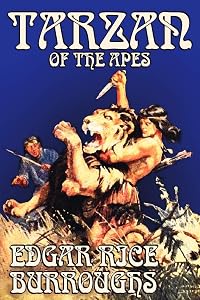
Tarzan of the Apes is Edgar Rice Burroughs' first novel in the series starring the man raised by apes. John Clayton is born in the coastal jungles of equatorial Africa to a marooned couple from England, John and Alice Clayton, the Lord and Lady of Greystoke. But after his parents die, the infant Clayton is adopted by she-ape Kala. Raised without awareness of his human heritage, he is named Tarzan, meaning "White Skin" in the language of the apes. Tarzan proved to be so popular that Burroughs show more continued to write his tales into the 1940s, clocking up two dozen sequels.. show less
Tags
Recommendations
















Member Recommendations


Member Reviews
While on a mission for the British government John Clayton Lord of Greystoke and his young wife are marooned on the west Africa coast. Lady Alice Clayton gives birth to a baby boy and lives for a year before passing away of an unspecified illness. John Clayton is killed soon after by a band of marauding apes. A she-ape by the name of Kala takes the young Lord Greystoke as a replacement for an infant she's recently lost.[return][return]The young Englishman is raised by the apes as one of their own and given the name Tarzan. Tarzan is at a loss in terms of size and stength when compared to his ape playmates, but he makes use of his intelligence and agility to survive and gain status in the group. [return][return]One day Tarzan discovers show more the cabin his father built and where he had lived with his parents. Unaware that the skeletons in the cabin are those of his parents, Tarzan explores and becomes interested in the books within the cabin. Somehow (rather dubiously) he teaches himself to both read and write English fluently with the help of the books in the cabin.[return][return]Tarzan becomes a hero to the apes by killing some of their enemies such as lions and gorillas, he also has the members of a local village of cannibal natives thinking he is a forest god. Eventually Tarzan becomes the leader of the tribe, after defeating the previous leader in single combat, he leaves the tribe following the death of Kala at the hands of the cannibal tribe.[return][return]Not long after this Tarzan sees some newcomers to the west African coast; treasure hunters. Amongst this group are the eccentric American scientist; Professor Archimedes Q. Porter, his associate and friend Samuel Philander, the British Lord (and coincidentally Tarzan's cousin) William Cecil Clayton, the negro maid Esmeralda and Professor Porter's beautiful and spirited daughter Jane.[return][return]Tarzan becomes entranced by the beautiful white woman and largely because of this he assists the party and eventually rescues Jane when she is abducted by one of the apes. Jane is with Tarzan, falling in love with him, when a French ship comes to the aid of the small group and one of their party is captured by the cannibals. After depositing Jane back on the beach Tarzan goes back into the jungle and rescues the French officer; Paul D'Arnot.[return][return]D'Arnot contracts a fever, which Tarzan nurses him through and upon discovering that the wild man can read and write English, but not speak it, teaches him French. By the time D'Arnot and Tarzan arrive back at the beach, their ship has sailed.[return][return]Determining that Tarzan wishes to learn to live as a man, mainly for the purpose of pursuing Jane and winning her love, D'Arnot takes the jungle raised man to a colonial outpost. Tarzan becomes civilized and goes to the United States to be with Jane. Unfortunately, believing that they could never be together, Jane has accepted a proposal of marriage from another. Tarzan and Jane coming together is the subject of a sequel.[return][return]Burrows' treatment of the black natives gives a lot to be desired (when looking back at it from our late 20th century eyes), but I found him to be less offensive than Defoe in "Robinson Crusoe". Crusoe considered Man Friday to have no redeeming features (he's black so he's sub human) even though without Friday, Crusoe would have died - being white and "civilised" gave him no skills to live in the real world. Burrows treats the African natives differently - ok, they're black, they live in the jungle, but they have a very evolved social structure, are efficient and awe-some warriors and can work their environment to their advantage.[return][return]Burrows also has an interesting (dare I say homo-erotic) way of describing Tarzan especially when he is in his element of travellng through the jungle or fighting. Unfortunately he tends to repeat this multiple times in later books so the novelty of his prose does soon wane. show less
(Reprinted from the Chicago Center for Literature and Photography [cclapcenter.com]. I am the original author of this essay, as well as the owner of CCLaP; it is not being reprinted here illegally.)
The CCLaP 100: In which I read for the first time a hundred so-called "classic" books, then write essays on whether or not they still deserve the label
Book #25: Tarzan of the Apes, by Edgar Rice Burroughs (1914)
The story in a nutshell:
Set in the last great days of the British Empire (i.e. the first decades of the 20th Century), Tarzan of the Apes is the story of one John Clayton, Viscount of Greystoke, actually born in the jungle on the western coast of Africa after his parents were marooned there by a mutinous ship crew, while they were show more passengers and bystanders on a long sea voyage. Ah, but it turns out that his parents both die while he's still a newborn, prompting a hasty "adoption" by a local ape named Kala and a childhood raised not as a human, but rather as the palest, weakest, least hairy ape of the entire region. The first half of this book, then, is an examination of tribal life itself, as "Tarzan" (his ape name) navigates the tricky politics and graphic violence of the animal society he finds himself in, even while slowly coming to realize during his puberty just how different he actually is. (See, he ends up stumbling across his parents' old jungle homestead while a teen, a surprisingly domestic setup because of the mutineers letting the Claytons unload all their worldly possessions before being abandoned; and thus does Tarzan end up just naturally learning how to read and write on his own, how to use a weapon and more, eventually using these things to bloodily conquer all his foes and become the famed "King of the Apes" we know today.)
The plot's pace picks up again in the second half, though, after yet another wreck by a ship full of lily-white Europeans; and who should this party include but none other than the evil William Clayton, Tarzan's cousin, who's been using the usurped Greystoke fortune to bully into marriage our adventurous heroine Jane Porter, a Victorian with a wild streak who ends up enjoying their impromptu African adventure much more than the nerdy French scientists also along for the ride. Needless to say, Tarzan ends up saving their lives numerous times; has a chick-lit-esque wordless romantic night of vine-swinging with the clearly "Jungle Fever" infected Jane; and of course somehow manages to be the catalyst behind not only William's fall from grace but a surprise financial windfall for the Porter family, thus erasing the debt that was forcing Jane into a marriage of convenience with William to begin with. And thus does our "origin tale" end in the rural farmlands of Wisconsin (the rural farmlands of Wisconsin?), with the baddies punished and the goodies rewarded and with a now-civilized Tarzan ready for the two dozen official sequels that would soon follow.
The argument for it being a classic:
Even this book's fans admit that it's not the quality of the prose itself that makes this a classic, but rather its place in artistic history; for as most people know by now, Tarzan turned out to be an insanely loved character by the public at large, prompting one of the first-ever "character franchises" in the history of the entertainment industry. (In fact, Burroughs himself started one of the first artist-owned production companies in history as well, the still-existing "Edgar Rice Burroughs Inc.," which has overseen each and every one of the thousands of Tarzan books, movies, TV episodes, comics and more that has ever been made.) And besides, its fans say, even the writing itself isn't as bad as some make it out to be; sure, some of the later sequels get awfully cheesy and formulaic, but this first novel is surprisingly sophisticated for its time, deliberately avoiding many of the lazy racial stereotypes that defined this age and even offering up a refreshingly independent female lead too. Add up all of these things, its fans argue, along with the fantastic snapshot of its times that it provides (a look at an overextended British Empire first seriously questioning the ethics of colonization), and you have yourself a book that still easily deserves to be revisited by a whole new generation of readers.
The argument against:
Oh, and did I mention the CRAPPY, CRAPPY WRITING on display in Tarzan? Because that's certainly the first thing this book's critics will bring up, many of whom openly laugh at the entire concept of this being considered a "literary classic." That's like giving a Best Picture Oscar to a Will Smith movie, they argue, merely for it being the biggest moneymaker that year; just because Tarzan himself has become entwined into our entire popular culture, they say, doesn't make any of the actual projects better in quality than they were when they first came out, i.e. not very good at all. In fact, it could be argued that today's title perfectly illustrates the challenges inherent in defining what exactly the word "classic" even means, the issue that inspired this "CCLaP 100" essay series to begin with; that although this title is certainly historically important, it might be better at this point to actually study the "Tarzan Phenomenon" and its impact on culture than to read the literal books themselves. It's something that can be said these days of more and more popular old genre novels from the Victorian and Edwardian ages, and Tarzan they'd say is no exception.
My verdict:
So first, let's quickly admit that this book's critics are right about its quality, and that Burroughs' own attitude about his ouevre while alive profoundly supports this: turns out that the Chicago-born author never cared much about being a "good" writer at all, and only stumbled into the profession in the first place after a failed career in the US Cavalry (weak heart) and a decade of demeaning odd jobs in the Manifest-Destiny-era western territories. It was while mired in such circumstances that he was first introduced through a friend to the adventure serials of the pulp industry, at which point the non-writing Burroughs famously declared that if this was the kind of crap that sold pulps, he could do such stuff in his sleep and never have to be a day-laborer again; and that's exactly what he did, forging a 75-book "literary career" that for him was much more about simply paying the bills than about any artistic considerations. So is its overwhelming commercial success enough, then, to declare the book a "classic?" Certainly, for example, it almost single-handedly set the tone for the way Hollywood still works even to this day, not just from a "franchise-building" aspect but even in the way this genre-actioner's plotline is set up: there is the main "A" story of the title (Tarzan's struggles both in the wild and among "civilized society"); then a "B" romantic story featuring two good-looking airheads (in this case, Jane and the suave French sailor Paul D'Arnot -- note that the infamous "Me Tarzan, you Jane" love affair isn't explored in the original books until much later in the series); and then a humorous "C" story featuring a pair of bumbling nerds, existing for almost no other reason than to provide comic relief. This has been the basic framework of nearly every Hollywood action movie since, so much so that most of us take these tropes for granted by now; and we have the original Tarzan to thank for this, because of it just happening to be a runaway bestseller at the same exact moment in history that the nascent Hollywood was first starting to write the formulas and rules of its industry, the story conventions that thousands of lazy hacks have leaned on ever since.
So what I'm arguing today, then (and it's rare that I argue this, so enjoy it), is that maybe this is enough to label Tarzan of the Apes a classic, and to encourage people to keep reading it to this day; not for the quality of the writing itself, but rather the overwhelmingly important role it played in the history of both the film industry and popular culture in general. The "summer blockbuster" wouldn't be nearly the thing it currently is if not for Tarzan; and given how important in our modern times the summer blockbuster is to the overall history of the American arts, this alone I feel makes the original slim novel still worth reading. And besides, what its fans say about the book's quality is true too, that ultimately it's not much worse than most of the other serialized genre-actioners that were churned out at the end of the Victorian Era (yes, Jules Verne, I'm looking at you), and in some ways is actually much better than typical; just to cite one excellent example, as mentioned Burroughs goes out of his way to avoid metaphorical comparisons between black people and the ape society on display here (a major point of many of the other eugenics-obsessed genre-actioners of the period), instead deliberately showing through the characters' actions that the shipwrecked white people and local black villagers possess exactly the same amount of intelligence, in both cases way above what even the smartest ape is capable of.
Certainly no one is going to mistake this book for the Early Modernist masterpieces that were coming out at the same time; but maybe a book doesn't always have to be such a thing to be considered a classic, or to argue that people should still continue to read it to this day. Maybe sometimes it's simple competence combined with extraordinary historical significance that justifies such a label; like I said, it's not an argument I make often, but in the case of Tarzan of the Apes is one where I will. Although caution is advised, it's ultimately a title I recommend everyone checking out.
Is it a classic? Yes show less
The CCLaP 100: In which I read for the first time a hundred so-called "classic" books, then write essays on whether or not they still deserve the label
Book #25: Tarzan of the Apes, by Edgar Rice Burroughs (1914)
The story in a nutshell:
Set in the last great days of the British Empire (i.e. the first decades of the 20th Century), Tarzan of the Apes is the story of one John Clayton, Viscount of Greystoke, actually born in the jungle on the western coast of Africa after his parents were marooned there by a mutinous ship crew, while they were show more passengers and bystanders on a long sea voyage. Ah, but it turns out that his parents both die while he's still a newborn, prompting a hasty "adoption" by a local ape named Kala and a childhood raised not as a human, but rather as the palest, weakest, least hairy ape of the entire region. The first half of this book, then, is an examination of tribal life itself, as "Tarzan" (his ape name) navigates the tricky politics and graphic violence of the animal society he finds himself in, even while slowly coming to realize during his puberty just how different he actually is. (See, he ends up stumbling across his parents' old jungle homestead while a teen, a surprisingly domestic setup because of the mutineers letting the Claytons unload all their worldly possessions before being abandoned; and thus does Tarzan end up just naturally learning how to read and write on his own, how to use a weapon and more, eventually using these things to bloodily conquer all his foes and become the famed "King of the Apes" we know today.)
The plot's pace picks up again in the second half, though, after yet another wreck by a ship full of lily-white Europeans; and who should this party include but none other than the evil William Clayton, Tarzan's cousin, who's been using the usurped Greystoke fortune to bully into marriage our adventurous heroine Jane Porter, a Victorian with a wild streak who ends up enjoying their impromptu African adventure much more than the nerdy French scientists also along for the ride. Needless to say, Tarzan ends up saving their lives numerous times; has a chick-lit-esque wordless romantic night of vine-swinging with the clearly "Jungle Fever" infected Jane; and of course somehow manages to be the catalyst behind not only William's fall from grace but a surprise financial windfall for the Porter family, thus erasing the debt that was forcing Jane into a marriage of convenience with William to begin with. And thus does our "origin tale" end in the rural farmlands of Wisconsin (the rural farmlands of Wisconsin?), with the baddies punished and the goodies rewarded and with a now-civilized Tarzan ready for the two dozen official sequels that would soon follow.
The argument for it being a classic:
Even this book's fans admit that it's not the quality of the prose itself that makes this a classic, but rather its place in artistic history; for as most people know by now, Tarzan turned out to be an insanely loved character by the public at large, prompting one of the first-ever "character franchises" in the history of the entertainment industry. (In fact, Burroughs himself started one of the first artist-owned production companies in history as well, the still-existing "Edgar Rice Burroughs Inc.," which has overseen each and every one of the thousands of Tarzan books, movies, TV episodes, comics and more that has ever been made.) And besides, its fans say, even the writing itself isn't as bad as some make it out to be; sure, some of the later sequels get awfully cheesy and formulaic, but this first novel is surprisingly sophisticated for its time, deliberately avoiding many of the lazy racial stereotypes that defined this age and even offering up a refreshingly independent female lead too. Add up all of these things, its fans argue, along with the fantastic snapshot of its times that it provides (a look at an overextended British Empire first seriously questioning the ethics of colonization), and you have yourself a book that still easily deserves to be revisited by a whole new generation of readers.
The argument against:
Oh, and did I mention the CRAPPY, CRAPPY WRITING on display in Tarzan? Because that's certainly the first thing this book's critics will bring up, many of whom openly laugh at the entire concept of this being considered a "literary classic." That's like giving a Best Picture Oscar to a Will Smith movie, they argue, merely for it being the biggest moneymaker that year; just because Tarzan himself has become entwined into our entire popular culture, they say, doesn't make any of the actual projects better in quality than they were when they first came out, i.e. not very good at all. In fact, it could be argued that today's title perfectly illustrates the challenges inherent in defining what exactly the word "classic" even means, the issue that inspired this "CCLaP 100" essay series to begin with; that although this title is certainly historically important, it might be better at this point to actually study the "Tarzan Phenomenon" and its impact on culture than to read the literal books themselves. It's something that can be said these days of more and more popular old genre novels from the Victorian and Edwardian ages, and Tarzan they'd say is no exception.
My verdict:
So first, let's quickly admit that this book's critics are right about its quality, and that Burroughs' own attitude about his ouevre while alive profoundly supports this: turns out that the Chicago-born author never cared much about being a "good" writer at all, and only stumbled into the profession in the first place after a failed career in the US Cavalry (weak heart) and a decade of demeaning odd jobs in the Manifest-Destiny-era western territories. It was while mired in such circumstances that he was first introduced through a friend to the adventure serials of the pulp industry, at which point the non-writing Burroughs famously declared that if this was the kind of crap that sold pulps, he could do such stuff in his sleep and never have to be a day-laborer again; and that's exactly what he did, forging a 75-book "literary career" that for him was much more about simply paying the bills than about any artistic considerations. So is its overwhelming commercial success enough, then, to declare the book a "classic?" Certainly, for example, it almost single-handedly set the tone for the way Hollywood still works even to this day, not just from a "franchise-building" aspect but even in the way this genre-actioner's plotline is set up: there is the main "A" story of the title (Tarzan's struggles both in the wild and among "civilized society"); then a "B" romantic story featuring two good-looking airheads (in this case, Jane and the suave French sailor Paul D'Arnot -- note that the infamous "Me Tarzan, you Jane" love affair isn't explored in the original books until much later in the series); and then a humorous "C" story featuring a pair of bumbling nerds, existing for almost no other reason than to provide comic relief. This has been the basic framework of nearly every Hollywood action movie since, so much so that most of us take these tropes for granted by now; and we have the original Tarzan to thank for this, because of it just happening to be a runaway bestseller at the same exact moment in history that the nascent Hollywood was first starting to write the formulas and rules of its industry, the story conventions that thousands of lazy hacks have leaned on ever since.
So what I'm arguing today, then (and it's rare that I argue this, so enjoy it), is that maybe this is enough to label Tarzan of the Apes a classic, and to encourage people to keep reading it to this day; not for the quality of the writing itself, but rather the overwhelmingly important role it played in the history of both the film industry and popular culture in general. The "summer blockbuster" wouldn't be nearly the thing it currently is if not for Tarzan; and given how important in our modern times the summer blockbuster is to the overall history of the American arts, this alone I feel makes the original slim novel still worth reading. And besides, what its fans say about the book's quality is true too, that ultimately it's not much worse than most of the other serialized genre-actioners that were churned out at the end of the Victorian Era (yes, Jules Verne, I'm looking at you), and in some ways is actually much better than typical; just to cite one excellent example, as mentioned Burroughs goes out of his way to avoid metaphorical comparisons between black people and the ape society on display here (a major point of many of the other eugenics-obsessed genre-actioners of the period), instead deliberately showing through the characters' actions that the shipwrecked white people and local black villagers possess exactly the same amount of intelligence, in both cases way above what even the smartest ape is capable of.
Certainly no one is going to mistake this book for the Early Modernist masterpieces that were coming out at the same time; but maybe a book doesn't always have to be such a thing to be considered a classic, or to argue that people should still continue to read it to this day. Maybe sometimes it's simple competence combined with extraordinary historical significance that justifies such a label; like I said, it's not an argument I make often, but in the case of Tarzan of the Apes is one where I will. Although caution is advised, it's ultimately a title I recommend everyone checking out.
Is it a classic? Yes show less
Tarzan of the Apes for the most part is a riveting tale. Burroughs can make you turn one page after another. He keeps moving the plot along effortlessly. However, it is not flawless. The book can roughly be divided into two parts: the jungle adventures of Tarzan, and Tarzan’s interaction with the mariners who happen upon the island with the beginning first chapters being a sort of prologue.
The former is where the book shines. Tarzan grows up in an hostile environment where most denizens far surpass him in all kinds of physical prowess. He instead has to use his humanity: his wit, his cleverness, his ingenuity to outsmart and outperform his enemies. This not only results in some great episodes of adventure, but also becomes show more philosophical about the difference between man and beast.
But Burroughs replaces this theme with another in the second part. It’s now the primeval man Tarzan encountering the civilized men who have come to Africa. While this could have been another entertaining investigation, he employs romance to do this. One of the sailors who land on the coast is a young girl whom Tarzan cannot help but feel smitten towards. And while I am not saying that romance is not a worthy enough subject (as love is as old as time and even older than it), the introduction of romance turns this tale of survival and adventure into a kind of victorian melodrama. And this persists until the final page (albeit there are some lingering vestiges of the first part present in the second). This saps the tale of the powerful and primal energy that was driving the story up to this point. And even Tarzan starts changing himself as he learns more about and from these men, so it is not like Burroughs was unaware about what he was trying to accomplish. But turning a tale of adventure into a Jane Austen-esque drama is a drastic step, and in my opinion, a faulty one.
But Tarzan of the Apes is nonetheless a great tale. In its around three hundred pages, it will provide you with a narrative much more sumptuous than what any modern bulky tome would have, and for sure with their many sins against Burroughs’ one.
I do think that if Burroughs should have kept in mind what R. L. Stevenson’s stepson Lloyd had told him while chartering the evergreen story of Treasure Island, Tarzan would have been even more magnificent:
No women in the story, Lloyd’s orders; and who so blithe to obey? show less
The former is where the book shines. Tarzan grows up in an hostile environment where most denizens far surpass him in all kinds of physical prowess. He instead has to use his humanity: his wit, his cleverness, his ingenuity to outsmart and outperform his enemies. This not only results in some great episodes of adventure, but also becomes show more philosophical about the difference between man and beast.
But Burroughs replaces this theme with another in the second part. It’s now the primeval man Tarzan encountering the civilized men who have come to Africa. While this could have been another entertaining investigation, he employs romance to do this. One of the sailors who land on the coast is a young girl whom Tarzan cannot help but feel smitten towards. And while I am not saying that romance is not a worthy enough subject (as love is as old as time and even older than it), the introduction of romance turns this tale of survival and adventure into a kind of victorian melodrama. And this persists until the final page (albeit there are some lingering vestiges of the first part present in the second). This saps the tale of the powerful and primal energy that was driving the story up to this point. And even Tarzan starts changing himself as he learns more about and from these men, so it is not like Burroughs was unaware about what he was trying to accomplish. But turning a tale of adventure into a Jane Austen-esque drama is a drastic step, and in my opinion, a faulty one.
But Tarzan of the Apes is nonetheless a great tale. In its around three hundred pages, it will provide you with a narrative much more sumptuous than what any modern bulky tome would have, and for sure with their many sins against Burroughs’ one.
I do think that if Burroughs should have kept in mind what R. L. Stevenson’s stepson Lloyd had told him while chartering the evergreen story of Treasure Island, Tarzan would have been even more magnificent:
No women in the story, Lloyd’s orders; and who so blithe to obey? show less
So I read this book, knowing it was a classic, but expecting that I'd like it and wouldn't absolutely love it, but I got really absorbed into the story.
It's a classic adventure story -- and the pace never really slowed down once it picked up. Of course, you should know that Edgar Rice Burroughs is racist to his core, and the 'African savages' presented in this novel are cringe-worthy and the way he writes them makes my skin crawl. Skip them, if you like, as I did, because they add very little most of the time.
I'm sick of people saying 'he was a man of his time' as if to excuse it? He was a man of his time, yes, and a racist one. (His writing of women is also problematic but I will get into that some other time - I will have to read show more another of his books and pick out examples because they can be quite subtle and subversive.)
One thing I will say is that Edgar Rice Burroughs had never actually been to Africa and imagined it very differently to how it truly was, and so you can rest-assured that the Africa he speaks of is one that does not exist.
... all of that aside, though. This was a really exciting story! It moved well, it read well, I remember quite a few of the lines, and I read it quite easily. The language was easy enough to follow, but it's not a children's story (unlike the Disney film).
I adored this story, but I'll have to give it three stars. show less
It's a classic adventure story -- and the pace never really slowed down once it picked up. Of course, you should know that Edgar Rice Burroughs is racist to his core, and the 'African savages' presented in this novel are cringe-worthy and the way he writes them makes my skin crawl. Skip them, if you like, as I did, because they add very little most of the time.
I'm sick of people saying 'he was a man of his time' as if to excuse it? He was a man of his time, yes, and a racist one. (His writing of women is also problematic but I will get into that some other time - I will have to read show more another of his books and pick out examples because they can be quite subtle and subversive.)
One thing I will say is that Edgar Rice Burroughs had never actually been to Africa and imagined it very differently to how it truly was, and so you can rest-assured that the Africa he speaks of is one that does not exist.
... all of that aside, though. This was a really exciting story! It moved well, it read well, I remember quite a few of the lines, and I read it quite easily. The language was easy enough to follow, but it's not a children's story (unlike the Disney film).
I adored this story, but I'll have to give it three stars. show less
This was surprisingly entertaining, despite the less than politically correct portions. I might even read the next in the series because the cliff hanger was too good. Also, as a Disney-raised child, the difference between the current pop culture image of Tarzan and the original text shouldn't have been surprising, but I wasn't quite prepared for how Disney-ified our perception truly is.
BookRiot Read Harder Challenge | Task 18: Read a book that was adapted into a movie, then watch the movie. Debate which is better. (Basically I wanted an excuse to see Alexander Skarsgård as Tarzan).
BookRiot Read Harder Challenge | Task 18: Read a book that was adapted into a movie, then watch the movie. Debate which is better. (Basically I wanted an excuse to see Alexander Skarsgård as Tarzan).
" Jane her lithe, young form flattened against the trunk of a great tree, her hands tight pressed against her rising and falling bosom, and her eyes wide with mingles horror, fascination, fear, and admiration - watched the primordial ape battle with the primeval man for possession of a woman - for her.
As the great muscles of the man's back and shoulders knotted beneath the tension of his efforts, and the huge biceps and forearm held at bay those mighty tusks, the veil of centuries of civilization and culture was swept from the blurred vision of the Baltimore girl."
Edgar Rice Burroughs knew how to tell a good story; his prose carries the reader along effortlessly page after page. Pulp fiction it may be, but it is so well written and at show more times so convincing that he makes his fantastical stories seam real. I used to gobble these books up as a teenager, and re-reading Tarzan today I was soon under it's spell and could hardly put the book down. Burroughs was in love with his male characters especially his hero Tarzan and if his descriptions of that perfect body are going to put you off then perhaps it's not for you:
She watched him from beneath half-closed lids, Tarzan crossed the little circular clearing toward the trees upon the further side. She noted the graceful majesty of his carriage, the perfect symmetry of his magnificent figure and the poise of his well-shaped head upon his broad shoulders. What a perfect creature! There could be naught of cruelty or baseness beneath that godlike exterior. Never, she thought had such a man strode the earth since God created the first man in his own image."
Burroughs Tarzan is a savage creature, but he is also a noble savage and this is the hook that makes him so attractive. Episodes of the Tarzan story first appeared in 1912 and it was published in book form in 1914 and while the story is very much of it's time as regards attitudes to women and black people, I did not find it overtly racist or sexist; a black maid is singled out as a figure of fun, but then so are two English academics. The black natives are savage and cruel, but Burroughs points out that this is the result of even crueller barbarities practiced on them by white officers of Leopold II's of Belgium regime.
Tarzan is still a rip roaring adventure yarn with a super hero who one could almost believe in and one you might want to believe in. If ever I am in a reading slump I shall just pick up one of these stories, hell I might pick one up if I am not in a slump especially as the Tarzan and Jane story in this first of the series ends in a cliff hanger. Great fun and a four star read. show less
As the great muscles of the man's back and shoulders knotted beneath the tension of his efforts, and the huge biceps and forearm held at bay those mighty tusks, the veil of centuries of civilization and culture was swept from the blurred vision of the Baltimore girl."
Edgar Rice Burroughs knew how to tell a good story; his prose carries the reader along effortlessly page after page. Pulp fiction it may be, but it is so well written and at show more times so convincing that he makes his fantastical stories seam real. I used to gobble these books up as a teenager, and re-reading Tarzan today I was soon under it's spell and could hardly put the book down. Burroughs was in love with his male characters especially his hero Tarzan and if his descriptions of that perfect body are going to put you off then perhaps it's not for you:
She watched him from beneath half-closed lids, Tarzan crossed the little circular clearing toward the trees upon the further side. She noted the graceful majesty of his carriage, the perfect symmetry of his magnificent figure and the poise of his well-shaped head upon his broad shoulders. What a perfect creature! There could be naught of cruelty or baseness beneath that godlike exterior. Never, she thought had such a man strode the earth since God created the first man in his own image."
Burroughs Tarzan is a savage creature, but he is also a noble savage and this is the hook that makes him so attractive. Episodes of the Tarzan story first appeared in 1912 and it was published in book form in 1914 and while the story is very much of it's time as regards attitudes to women and black people, I did not find it overtly racist or sexist; a black maid is singled out as a figure of fun, but then so are two English academics. The black natives are savage and cruel, but Burroughs points out that this is the result of even crueller barbarities practiced on them by white officers of Leopold II's of Belgium regime.
Tarzan is still a rip roaring adventure yarn with a super hero who one could almost believe in and one you might want to believe in. If ever I am in a reading slump I shall just pick up one of these stories, hell I might pick one up if I am not in a slump especially as the Tarzan and Jane story in this first of the series ends in a cliff hanger. Great fun and a four star read. show less
The story of Tarzan is a twist on the noble savage theme, except with a white man as the "other" (ironically among other whites). The book is full of embarrassing artifacts ca. 1912 such as racial stereotypes, social Darwinism, superiority of white culture. A few scenes involving the affair with Jane and Tarzan are well done. Given its influence on popular culture it's still a worthwhile read, only just.
I have a theory about Tarzan. When superheroes arose in the late 19th and early 20th century in pulp fiction and dime store novels, it was in response to a changing world for white males. Colonialism was being questioned, female suffrage was at its height, the western frontier was closed - the white male was suffering a crisis of show more identity. The superhero offered a new found outlet to express a sense of superiority. By identifying with superheroes, he could live out his traditional mandate of conquest and patriarchy, which the real world was increasingly making impossible. Thus we don't find many black superheroes, even to this day. This historical insight makes me a little wary of the whole superhero enterprise and perhaps helps explain what made Tarzan so popular on a certain level.
--Review by Stephen Balbach, via CoolReading (c) 2011 cc-by-nd show less
I have a theory about Tarzan. When superheroes arose in the late 19th and early 20th century in pulp fiction and dime store novels, it was in response to a changing world for white males. Colonialism was being questioned, female suffrage was at its height, the western frontier was closed - the white male was suffering a crisis of show more identity. The superhero offered a new found outlet to express a sense of superiority. By identifying with superheroes, he could live out his traditional mandate of conquest and patriarchy, which the real world was increasingly making impossible. Thus we don't find many black superheroes, even to this day. This historical insight makes me a little wary of the whole superhero enterprise and perhaps helps explain what made Tarzan so popular on a certain level.
--Review by Stephen Balbach, via CoolReading (c) 2011 cc-by-nd show less
Members
- Recently Added By
Lists

1001 Books You Must Read Before You Die
1,448 works; 1,133 members

Favorite Childhood Books
1,646 works; 518 members

Best Adventure Stories
66 works; 15 members

New York Public Library's Books of the Century
120 works; 20 members

Read the book and saw the movie
1,170 works; 195 members

Cawthorn and Moorcock's Fantasy: The 100 Best Books
110 works; 7 members

Watched the Movie, Probably Won't Read the Book
185 works; 34 members

Blue Pyramid 1,276 Best Books of All Time
1,248 works; 32 members

Best First Lines
133 works; 8 members

Childhood Favorites
427 works; 24 members

Fantasy: The 100 Best Books
11 works; 3 members
1,001 BYMRBYD Concensus
723 works; 27 members
Works That Inspired Disney Movies
119 works; 13 members
1920s
141 works; 6 members

2011 Favorite Books Read
6 works; 1 member

Speculative Fiction to Read
706 works; 32 members

Overdue Podcast
806 works; 9 members

Books Set In Africa
81 works; 4 members

BingoDOG - Animals in Adult Fiction
78 works; 20 members

Race and Racism in America
23 works; 1 member

Books With the Most Memorable Titles
478 works; 158 members

Books We Loved As Children
603 works; 252 members

Stories set on African soil
183 works; 2 members

Easton Press Masterpieces of Science Fiction
30 works; 2 members
The Art of Manliness' 100+ Books Every Man Should Read
108 works; 2 members

My TBR
371 works; 3 members

Luetut kirjat
74 works; 1 member

.
396 works; 1 member
Talk Discussions
Current Discussions
1914: Edgar Rice Burroughs - Tarzan of the Apes in Literary Centennials (September 2025)
Author Information

768+ Works 65,233 Members
Edgar Rice Burroughs was born on September 1, 1875, in Chicago. His father, George Tyler was a distiller and a battery manufacturer. Early in life Burroughs attempted to support his family in a variety of occupations, including railroad policeman, business partner, and miner. None of these proved successful. However, Burroughs had always enjoyed show more reading adventure fiction and decided to try his hand at writing. His first attempt, written under the pseudonym Normal Bean, sold very quickly and Burroughs' career took off. Although critics and educators have not always been supportive of Burroughs' writing, the characters in his stories have entertained readers for many years. Tarzan was the most popular, earning Burroughs enough money to start his own publishing house and a motion picture company. Another character, John Carter, is the hero of Burroughs' Mars adventure series. The continuing popularity of these characters has led some critics to reconsider the value of Burroughs' writing and to acknowledge significant themes in his stories. Burroughs died on March 19, 1950. (Bowker Author Biography) show less
Some Editions
Awards and Honors
Awards
Notable Lists
Series

Belongs to Publisher Series
Work Relationships
Is contained in
Is retold in
Has the adaptation
Is parodied in
Common Knowledge
- Canonical title
- Tarzan of the Apes
- Original title
- Tarzan of the Apes
- Alternate titles*
- Dziecko dżungli; Tarzan król małp
- Original publication date
- 1914-06
- People/Characters
- Tarzan; Jane Porter; Kala [from Tarzan]; Paul d'Arnot (Lieutenant); Archimedes Q. Porter (Professor); Samuel T. Philander (show all 15); William Cecil Clayton; John Clayton, Lord Greystoke; Alice Clayton-Rutherford, Lady Greystoke; Esmeralda; Kerchak; Tublat; Black Michael; Sabor; Kulonga
- Important places
- West Africa; Paris, France; Baltimore, Maryland, USA; Maryland, USA
- Related movies
- Tarzan of the Apes (1918 | IMDb); Tarzan the Ape Man (1932 | IMDb); Tarzan TV Series (1966 | IMDb); Tarzan the Ape Man (1981 | IMDb); Greystoke: The Legend of Tarzan (1984 | IMDb); Tarzan: The Epic Adventure (1996 | IMDb) (show all 12); Tarzan of the Apes - Enchanted Tales (1999 | IMDb); Tarzan (1999 | IMDb); Tarzan TV Series (2003 | IMDb); The Romance of Tarzan (1918 | IMDb); Tarzan (2013 | IMDb); The Legend of Tarzan (2016 | IMDb)
- First words
- I had this story from one who had no business to tell it to me, or to any other.
- Quotations
- Tarzan's grief and anger were unbounded. He roared out his hideous challenge time and again. He beat upon his great chest with his clenched fists, and then he fell upon the body of Kala and sobbed out the pitiful sorrowing of... (show all) his lonely heart. To lose the only creature in all one's world who ever had manifested love and affection for one, is a great bereavement indeed.
What though Kala was a fierce and hideous ape! To Tarzan she had been kind, she had been beautiful. - Last words
- (Click to show. Warning: May contain spoilers.)"I was born there," said Tarzan, quietly. "My mother was an Ape, and of course she couldn't tell me much about it. I never knew who my father was."
- Publisher's editor*
- Círculo de Lectores
- Original language
- English
*Some information comes from Common Knowledge in other languages. Click "Edit" for more information.
Classifications
Statistics
- Members
- 5,532
- Popularity
- 2,406
- Reviews
- 129
- Rating
- (3.74)
- Languages
- 21 — Afrikaans, Amharic, Armenian, Czech, Danish, Dutch, English, Estonian, Finnish, French, German, Hungarian, Italian, Norwegian (Bokmål), Polish, Russian, Slovak, Slovenian, Spanish, Swedish, Portuguese (Portugal)
- Media
- Paper, Audiobook, Ebook
- ISBNs
- 369
- UPCs
- 2
- ASINs
- 143