The Einstein Intersection
by Samuel R. Delany
On This Page
Description
A nonhuman race reimagines human mythology.Tags
Recommendations

















Member Recommendations


Member Reviews
A Fabulous, Formless Darkness
I first encountered Samuel Delaney's books in 1975 - my third year of college - when my roommate handed me a copy of [b:Dhalgren|40963358|Dhalgren|Samuel R. Delany|https://i.gr-assets.com/images/S/compressed.photo.goodreads.com/books/1532735651l/40963358._SY75_.jpg|873021]. At that time in my life, and at that stage in our country's history, it was about the coolest, hippest thing around as far as I was concerned, except maybe for Thomas Pynchon's [b:Gravity's Rainbow|415|Gravity's Rainbow|Thomas Pynchon|https://i.gr-assets.com/images/S/compressed.photo.goodreads.com/books/1414969925l/415._SY75_.jpg|866393], which I had earlier obtained from the same source. Thank you, Greg!
The Einstein Intersection reads as show more a young, gifted writer's first book - a journey of the young man toward his place in the world. But it also prefigures a lot of what science fiction would become in later decades, moving away from the "old school" of Asimov, Heinlein, Bradbury toward today's diverse writers who comment more on the evolution of society than on advancement in scientific marvels.
The novel (whose working title was "A Fabulous, Formless Darkness") concerns an alien race that has occupied earth long after humanity has departed as a result of some sort of environmental catastrophe. The alien race not only takes up residence, it adopts the biological form and cultural background of humanity, apparently in an effort to adapt to the new landscape. This adoption of new forms includes taking on human mythic stereotypes (taken from 1960s - era pop culture). The aliens repurposing humanity's skin are not a perfect fit, however: they don't easily adopt a two-gender body, for example. Importantly, the result is a new culture on earth whose members don't quite feel that they "belong" here. In this way, the novel is about what it means to fit in, and what it means to be "different."
Very lyrical and engaging, it's still a good read today. As an interesting contrast, take a look at [b:The Broken Earth Trilogy: The Fifth Season, The Obelisk Gate, The Stone Sky|38496769|The Broken Earth Trilogy The Fifth Season, The Obelisk Gate, The Stone Sky|N.K. Jemisin|https://i.gr-assets.com/images/S/compressed.photo.goodreads.com/books/1530531199l/38496769._SX50_.jpg|60137524] for insight on where The Einstein Intersection?> took the world. show less
I first encountered Samuel Delaney's books in 1975 - my third year of college - when my roommate handed me a copy of [b:Dhalgren|40963358|Dhalgren|Samuel R. Delany|https://i.gr-assets.com/images/S/compressed.photo.goodreads.com/books/1532735651l/40963358._SY75_.jpg|873021]. At that time in my life, and at that stage in our country's history, it was about the coolest, hippest thing around as far as I was concerned, except maybe for Thomas Pynchon's [b:Gravity's Rainbow|415|Gravity's Rainbow|Thomas Pynchon|https://i.gr-assets.com/images/S/compressed.photo.goodreads.com/books/1414969925l/415._SY75_.jpg|866393], which I had earlier obtained from the same source. Thank you, Greg!
The Einstein Intersection reads as show more a young, gifted writer's first book - a journey of the young man toward his place in the world. But it also prefigures a lot of what science fiction would become in later decades, moving away from the "old school" of Asimov, Heinlein, Bradbury toward today's diverse writers who comment more on the evolution of society than on advancement in scientific marvels.
The novel (whose working title was "A Fabulous, Formless Darkness") concerns an alien race that has occupied earth long after humanity has departed as a result of some sort of environmental catastrophe. The alien race not only takes up residence, it adopts the biological form and cultural background of humanity, apparently in an effort to adapt to the new landscape. This adoption of new forms includes taking on human mythic stereotypes (taken from 1960s - era pop culture). The aliens repurposing humanity's skin are not a perfect fit, however: they don't easily adopt a two-gender body, for example. Importantly, the result is a new culture on earth whose members don't quite feel that they "belong" here. In this way, the novel is about what it means to fit in, and what it means to be "different."
Very lyrical and engaging, it's still a good read today. As an interesting contrast, take a look at [b:The Broken Earth Trilogy: The Fifth Season, The Obelisk Gate, The Stone Sky|38496769|The Broken Earth Trilogy The Fifth Season, The Obelisk Gate, The Stone Sky|N.K. Jemisin|https://i.gr-assets.com/images/S/compressed.photo.goodreads.com/books/1530531199l/38496769._SX50_.jpg|60137524] for insight on where The Einstein Intersection?> took the world. show less
Getting the story out of this book is like prying the meat out of a crab claw. Once you get eatin' though, the story is fairly out there. I love it's ambiguous ending.
When I read something like Micheal Swanwick's "Stations of the Tide" I can't help but feeling that it was influenced by this book.
Not for non-fans of 70s "New Wave" SF. Put it down and read something else.
When I read something like Micheal Swanwick's "Stations of the Tide" I can't help but feeling that it was influenced by this book.
Not for non-fans of 70s "New Wave" SF. Put it down and read something else.
Delany, Samuel R. Einstein Intersection. 1967. Introduction by Neil Gaiman. Wesleyan University Press, 1998.
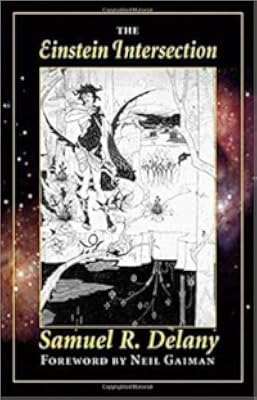
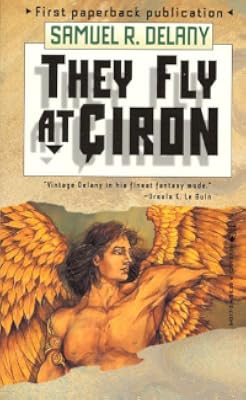
Reviewers have never known quite what to do with Delany’s early novels, and I am no exception. In the late 1960s, everyone knew that Delany was an original talent who was taking science fiction in a new literary direction. He was the newest of the New Wave. His gender-bent combination of myth, poetry, pop culture, and science fiction tropes sent the literary taxonomists to their aspirin bottles. There are epigraphs from Delany’s own journals, Bob Dylan, and John Ruskin. Was anyone but Delany reading Ruskin then? Cover artists pictured protagonist Lobey encountering a Minotaur. But reading the novel it is hard to picture Lobey show more as the clean-cut blond Tab Hunter lookalike we see on the cover. (The cover of the Wesleyan edition is an exception.) Lobey is part of a community of mutant kids scaring each other with campfire stories, many of which are true. How far each of them depart from human norm is never clear. In the end, though, as in all Delany’s early novels, the hero is an artist seeking self-knowledge. All the novels are portraits of the artist as a young man, with an asterisk. 4 stars. show less
Reviewers have never known quite what to do with Delany’s early novels, and I am no exception. In the late 1960s, everyone knew that Delany was an original talent who was taking science fiction in a new literary direction. He was the newest of the New Wave. His gender-bent combination of myth, poetry, pop culture, and science fiction tropes sent the literary taxonomists to their aspirin bottles. There are epigraphs from Delany’s own journals, Bob Dylan, and John Ruskin. Was anyone but Delany reading Ruskin then? Cover artists pictured protagonist Lobey encountering a Minotaur. But reading the novel it is hard to picture Lobey show more as the clean-cut blond Tab Hunter lookalike we see on the cover. (The cover of the Wesleyan edition is an exception.) Lobey is part of a community of mutant kids scaring each other with campfire stories, many of which are true. How far each of them depart from human norm is never clear. In the end, though, as in all Delany’s early novels, the hero is an artist seeking self-knowledge. All the novels are portraits of the artist as a young man, with an asterisk. 4 stars. show less
This book has won both Hugo and Nebula Awards for best novel. It has a distinctly 60s feel, balancing on the edge of psychedelia, an early example of New Wave in SFF, where ‘hard’(-ish) SF of the 50s was replaced by more psychologic and philosophic texts.
The author decides not to start with an infodump on what is the world-setting we appear into. Instead we follow the personal narrative of Lobey, who initially appears like a boy-mutant in a post-apoc Earth (in the beginning, we find out that his feet are almost as dexterous as his hands and he can bite his toenails), living with other mutants (?) in a village. As story progresses we can see that it is deeper than just another post-apoc.
My edition has a foreword by Neil Gaiman, who show more writes that he read it several times as he aged and each time saw a completely new facet. While this is my first read, I see what he means – the story can be read and entertain a 10 year old as well as a 50 year old. At the same time, unlike some other books, at least for me it doesn’t call for any re-read in the near future.
There are some references to both 60s pop-culture as well as to ancient myths, which I had to google to comprehend. How hard it was to read such text before one could search for a name as s/he reads…
Another [avant-garde] point of the text are multiple quotes at the start of each chapter, including pieces from the author’s diary regarding ‘fleshing out’ book’s characters, so that reality is interwoven with fiction.
3* read, which gets another star for the fact that it can be an interesting yarn for very different ages. show less
The author decides not to start with an infodump on what is the world-setting we appear into. Instead we follow the personal narrative of Lobey, who initially appears like a boy-mutant in a post-apoc Earth (in the beginning, we find out that his feet are almost as dexterous as his hands and he can bite his toenails), living with other mutants (?) in a village. As story progresses we can see that it is deeper than just another post-apoc.
My edition has a foreword by Neil Gaiman, who show more writes that he read it several times as he aged and each time saw a completely new facet. While this is my first read, I see what he means – the story can be read and entertain a 10 year old as well as a 50 year old. At the same time, unlike some other books, at least for me it doesn’t call for any re-read in the near future.
There are some references to both 60s pop-culture as well as to ancient myths, which I had to google to comprehend. How hard it was to read such text before one could search for a name as s/he reads…
Another [avant-garde] point of the text are multiple quotes at the start of each chapter, including pieces from the author’s diary regarding ‘fleshing out’ book’s characters, so that reality is interwoven with fiction.
3* read, which gets another star for the fact that it can be an interesting yarn for very different ages. show less
I like stories that use or retell myths. Some chapters start with the author's journal; I found his notes helpful in explaining connections that I did not see on my own.
SOME QUOTES:
about myths, modern and ancient and their basis in fact and how they evolve:
".... You remember the legend of the Beatles? You remember the Beatle Ringo left his love even though she treated him tender. He was the one Beatle who did not sing, so the earliest forms of the legend go. After a hard day's night he and the rest of the Beatles were torn apart by screaming girls, and he and the other Beatles returned, finally at one, with the great rock and the great roll... Well, that myth is a version of a much older story that is not so well known. There are no show more 45's or 33's from the time of this older story. There are only a few written versions, and reading is rapidly losing its interest for the young. In the older story Ringo was called Orpheus. He too was torn apart by screaming girls. But the details are different. He lost his love---in this version Eurydice---and she went straight to the great rock and the great roll., where Orpheus had to to to get her back. He went singing, for in this version Orpheus was the greatest singer, instead of the silent one. In myths things always turn into their opposites as one version supersedes the next." [pp. 17-18]
a typical poetic description, which had immediate resonance when the book was written and people still burned their leaves, but not so much now, showing that even stories about the far future can become dated:
I passed some leaves, blown here by what wind, that his hooves had ignited. They writhed with worms of fire, glowing about my toes. And for a moment the darkness was filled with autumn. [p. 32]
an explanation of the title of the book and why most people still don't seem to know about Goedel and his proof that we can never know everything:
"... Einstein defined the extent of the rational. Goedel stuck a pin into the irrational and fixed it to the wall of the universe so that it held still long enough for people to know it was there.... The visible effects of Einstein's theory leaped up on a convex curve, its production huge in the first century after its discovery, then leveling off. The production of Goedel's law crept up on a concave curve, microscopic at first, then leaping to equal the Einsteinian curve, cross it, outstrip it...." [p. 128]
why it's OK to say "huh?" when finishing a story:
Endings to be useful must be inconclusive.
Author's Journal/Istanbul, March 1966 show less
SOME QUOTES:
about myths, modern and ancient and their basis in fact and how they evolve:
".... You remember the legend of the Beatles? You remember the Beatle Ringo left his love even though she treated him tender. He was the one Beatle who did not sing, so the earliest forms of the legend go. After a hard day's night he and the rest of the Beatles were torn apart by screaming girls, and he and the other Beatles returned, finally at one, with the great rock and the great roll... Well, that myth is a version of a much older story that is not so well known. There are no show more 45's or 33's from the time of this older story. There are only a few written versions, and reading is rapidly losing its interest for the young. In the older story Ringo was called Orpheus. He too was torn apart by screaming girls. But the details are different. He lost his love---in this version Eurydice---and she went straight to the great rock and the great roll., where Orpheus had to to to get her back. He went singing, for in this version Orpheus was the greatest singer, instead of the silent one. In myths things always turn into their opposites as one version supersedes the next." [pp. 17-18]
a typical poetic description, which had immediate resonance when the book was written and people still burned their leaves, but not so much now, showing that even stories about the far future can become dated:
I passed some leaves, blown here by what wind, that his hooves had ignited. They writhed with worms of fire, glowing about my toes. And for a moment the darkness was filled with autumn. [p. 32]
an explanation of the title of the book and why most people still don't seem to know about Goedel and his proof that we can never know everything:
"... Einstein defined the extent of the rational. Goedel stuck a pin into the irrational and fixed it to the wall of the universe so that it held still long enough for people to know it was there.... The visible effects of Einstein's theory leaped up on a convex curve, its production huge in the first century after its discovery, then leveling off. The production of Goedel's law crept up on a concave curve, microscopic at first, then leaping to equal the Einsteinian curve, cross it, outstrip it...." [p. 128]
why it's OK to say "huh?" when finishing a story:
Endings to be useful must be inconclusive.
Author's Journal/Istanbul, March 1966 show less
This reads more like an epic poem than a novel. It's very odd, but its treatment of the ideas of gender and "the other" were really interesting.
Lobey, a musician from a small, agrarian village of non-human, intelligent anthropoids who have inherited the Earth thousands of years after humans have gone extinct. When his love, Friza, dies under mysterious circumstances, he sets out on a quest to find her, paralleling the myth of Orpheus and Eurydice.
Lobey pursues his nemesis, Kid Death, a dangerous, red-haired psychic child who embodies death and is inspired by the outlaw figure Billy the Kid. He journeys through a strange, mutated landscape, battling dangers: carnivorous plants, navigating the Source Caves, and herding local dragons. While doing so, he meets companions like Spider and the mythological archetype figure Dove.
Lobey pursues his nemesis, Kid Death, a dangerous, red-haired psychic child who embodies death and is inspired by the outlaw figure Billy the Kid. He journeys through a strange, mutated landscape, battling dangers: carnivorous plants, navigating the Source Caves, and herding local dragons. While doing so, he meets companions like Spider and the mythological archetype figure Dove.
Members
- Recently Added By
Lists

The Guardian's 1000 Novels Everyone Must Read
1,005 works; 549 members

Best Science Fiction Novels
816 works; 430 members

Bibliography for Among Others
159 works; 15 members

infjsarah's wishlist
408 works; 2 members

Nebula Award
111 works; 14 members

Biggest Disappointments
606 works; 168 members

Books Read in 2022
5,226 works; 115 members
Author Information

195+ Works 28,997 Members
Samuel R. Delany Jr. was born in Harlem, New York on April 1, 1942. He is a science fiction and short story writer. His first novel, The Jewels of Aptor, was published in 1962. He has written more than 20 novels and collections of short stories, memoirs, and critical essays. He has received numerous awards including the Nebula Award for best novel show more for Babel-17 in 1966 and The Einstein Intersection in 1967, the Nebula Award for best short story for Aye, and Gomorrah and Time Considered as a Helix of Semi-Precious Stones, the Hugo Award for best short story for Time Considered as a Helix of Semi-Precious Stones in 1970 and for his non-fiction book, The Motion of Light in Water, and the Bill Whitehead Award for Lifetime Achievement in Gay Literature in 1993. He is as a professor in the department of English at the University at Buffalo, Buffalo, New York. (Bowker Author Biography) Samuel R. Delany is a professor of English & Creative Writing at Temple University in Philadelphia. (Publisher Provided) show less
Some Editions
Awards and Honors
Awards
Series
Belongs to Publisher Series
Nova Pocket (30)
ハヤカワ文庫 SF (1148)
Work Relationships
Is contained in
Common Knowledge
- Canonical title
- The Einstein Intersection
- Original title
- The Einstein Intersection
- Alternate titles
- A Fabulous, Formless Darkness
- Original publication date
- 1967
- People/Characters
- Lo Lobey; Kid Death
- Epigraph
- It darkles, (tinct, tint) all this our funanimal world. James Joyce/Finnegans Wake
I do not say, however, that every delusion or wandering of the mind should be called madness. Erasmus of Rotterdam/In Praise of Folly - Dedication
- for DON WOLLHEIM
a responsible man
in all meanings
to and for what is
within and
JACK GUAGHAN
for what is
without - First words
- In meiner Machete läuft ein hohler, mit Löchern durchsetzter Zylinder vom Heft bis zur Spitze.
There is a hollow, holey cylinder running from hilt to point in my machete. When I blow across the mouthpiece in the handle, I make music with my blade. - Last words
- (Click to show. Warning: May contain spoilers.)Ich wndte mich und folgte ihr.
(Click to show. Warning: May contain spoilers.)As morning branded the sea, darkness fell away at the far side of the beach. I turned to follow it. - Blurbers
- Merril, Judith
- Original language
- English
Classifications
Statistics
- Members
- 1,753
- Popularity
- 12,636
- Reviews
- 41
- Rating
- (3.32)
- Languages
- 10 — Danish, English, French, German, Italian, Japanese, Polish, Spanish, Swedish, Turkish
- Media
- Paper, Audiobook, Ebook
- ISBNs
- 34
- ASINs
- 41