
George Zebrowski (1945–2024)
Author of A Fury Scorned
About the Author
Series
Works by George Zebrowski
Three in Time: Classic Novels of Time Travel (White Wolf Rediscovery Trio, Vol. 1) (1997) — Editor — 53 copies, 2 reviews
Nebula Awards 22: Sfwa's Choices for the Best Science Fiction and Fantasy 1986 (Nebula Awards Showcase) (1988) — Editor — 53 copies, 1 review
Nebula Awards 21: Sfwa's Choices for the Best Science Fiction and Fantasy, 1985 (Nebula Awards Showcase) (1986) — Editor — 44 copies, 2 reviews
Nebula Awards 20: SFWA's Choices for the Best Science Fiction and Fantasy 1984 (1985) — Editor; Contributor — 28 copies
Wound the Wind 5 copies
The Water Sculptor of Station 233 5 copies
This Life and Later Ones 3 copies
Behind the Stars 3 copies
The Eichmann Variations 3 copies
Stranger Suns 2 copies
Once Upon a Future — Contributor — 2 copies
The Word Sweep 1 copy
Oh, Miranda! {short story} 1 copy
Settlements 1 copy
Nebula Awards 20 1 copy
Nebula Awards 21 1 copy
Foundation’s Conscience 1 copy
Takes You Back 1 copy
Passing Nights 1 copy
Jumper 1 copy
Between the Winds 1 copy
Sacred Fire 1 copy
Shrinkers and Movers 1 copy
Perfecting Visions, Slaying Cynics: The Life and Works of George Zebrowski (Borgo bioviews) (1997) 1 copy
Behind the Night 1 copy
Cliometricon {short story} 1 copy
Moving Mars 1 copy
Bridge of Silence 1 copy
Augie 1 copy
Stooges 1 copy
Starcrossed {short story} 1 copy
Le città che ci aspettano 1 copy
Godel's Doom [short fiction] 1 copy
Macro Life 1 copy
Le piège à idées 1 copy
Associated Works
What Might Have Been, Volumes 1 & 2: Alternate Empires, Alternate Heroes (1990) — Contributor — 185 copies, 2 reviews
Here Comes Civilization: The Complete Science Fiction of William Tenn, Volume 2 (2001) — Afterword — 159 copies
Alternate Americas (What Might Have Been, Vol. 4) (1992) — Contributor, some editions — 101 copies, 1 review
Science Fiction Today and Tomorrow: A Discursive Symposium (1974) — Contributor — 101 copies, 2 reviews
Nebula Awards 27: SFWA's Choices for the Best Science Fiction and Fantasy of the Year (1993) — Contributor — 61 copies, 1 review
Nebula Awards 26: SFWA's Choices for the Best Science Fiction and Fantasy of the Year (1992) — Contributor — 52 copies, 1 review
Solaris Rising 3: The New Solaris Book of Science Fiction (2014) — Contributor — 48 copies, 6 reviews
Light Years and Dark: Science Fiction and Fantasy of and for Our Time (1984) — Contributor — 37 copies
A Cross of Centuries: Twenty-five Imaginative Tales About the Christ (2007) — Contributor — 32 copies, 2 reviews
The War of the Worlds: Fresh Perspectives on the H. G. Wells Classic (2005) — Contributor — 19 copies
The Magazine of Fantasy and Science Fiction July 1974, Vol. 47, No. 1 (1974) — Book Reviewer — 16 copies
The Magazine of Fantasy and Science Fiction March 1986, Vol. 70, No. 3 (1986) — Contributor — 13 copies
The Magazine of Fantasy and Science Fiction April 1981, Vol. 60, No. 4 (1981) — Book reviewer — 10 copies
Once Upon a Future: The Third Borgo Press Book of Science Fiction Stories (2011) — Contributor — 2 copies, 1 review
Tagged
Common Knowledge
- Legal name
- Zebrowski, George Thaddeus
- Other names
- ZEBROWSKI, Jerzy Tadeus (birth name)
- Birthdate
- 1945-12-28
- Date of death
- 2024-12-20
- Gender
- male
- Occupations
- author
editor - Organizations
- Science Fiction and Fantasy Writers of America
- Relationships
- Sargent, Pamela (partner)
- Nationality
- Austria (birth)
USA - Birthplace
- Villach, Carinthia, Austria
- Associated Place (for map)
- Carinthia, Austria
Members
Reviews

I started this book with low expectations thinking it would be just another rip-roaring space adventure and I must say I was pleasantly surprised. It IS an adventure (a tragic adventure) for sure, but it is also a fantastical lecture on physics and biology, a theological discourse, and an interesting debate on life, the universe, and everything else. Add a bit of dark satire plus a few cheeky cameos from the likes of Isaac Asimov, Arthur C. Clarke, and Jesus and his friend Buddha (sort of) show more and you have a pretty cool novel that kept me up way past my bedtime. show less
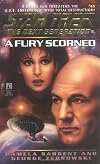
Every fan of Star Trek knows that the books set in each universe of the franchise are often problematic. Sometimes the story is ho-hum, other times the writing isn’t that good, occasionally, especially with books written early in the show’s run, the writer seems to have no grasp of the characters, and they don’t conform to the crew as we came to know them through television. For these reasons, perhaps 2/3 of the books aren’t as good as we’d like them to be. I’d been lucky with a show more few in the past, but also obtained some that sounded good, and ended up not being so — which I didn’t review. When I had a chance to pick up several at one go recently, I spent a great deal of time researching them, and haven’t come across a dud yet among the several I acquired in both the Voyager and Next Generation universes.
A Fury Scorned in the Next Generation universe had some mixed reviews, but I read enough about it to take a chance on it, and threw this one in at the last second. I’m very glad I did! Pamela Sargent and George Zebrowski have written an excellent book for Next Generation fans, that is no ordinary entry. There’s a real story here, and it’s big. A world is created, and it’s done slowly through the inhabitants so that by the end, we feel for what happens to them. Red Shirts — Star Trek fans will know the term well — are not just there to be extinguished. Some in fact, survive, and when one does go down, we’ve been made through the dense and involving narrative to like the individual Star Fleet officer so much that we’re uttering unpleasant things under our breath when it happens.
The characters we grew so fond of in the show seem very much themselves for the vast majority of A Fury Scorned. There is much less light-hearted banter here than in some books, because this is a more serious “episode” in the Next Generation universe. This doesn’t detract from enjoying the story, however, as the writers deftly draw us into the mood and ambiance of this particular story. With characters so familiar, and perimeters so pre-outlined, it’s difficult to do what Sargent and Zebrowski have done here, which is to write a human-driven science fiction story about a world in need of a miracle, then drop the Next Generation characters and Federation into the mix as the element responsible for the miracle — which comes at a great price.
There is in fact, probably more story here than a lot of fans are used to in the books. It’s layered, it’s involving, and it adds to what happens rather than detract from it. The characters on the world of Epictetus III are shaded in gray, becoming distinct; ranging from selfish to noble, brave to misguided, as their world is bathed in hopelessness. And even once Data comes up with a plan, it’s so out there, and dangerous for both the planet and the Enterprise itself, even Data isn’t positive it will work. With 20 million lives at stake, Picard must weight the danger for not only his own crew, but the lives that might be saved if Data’s extremely risky plan works. And the latter he must way against the handful that they can definitely save and keep the Enterprise safe, against the millions who will die on the planet when the sun goes Nova if he does.
Where many have a problem is Star Fleet ordering Picard to keep from the inhabitants Data’s plan, leaving them so hopeless that some on the planet are committing suicide, preferring to die in a less horrific manner than they are certain to within days. It’s a moral dilemma Picard has on his hands, one he shares with his crew, who all feel the weight of their actions, whatever they decide. It truly is a no-win situation, and there’s no way to cheat it as Kirk did. While on the surface the reasoning of Star Fleet to forbid Picard from giving what may turn out to be false hope to the inhabitants of Epictetus III seems lame, even flimsy, it is exactly like all organizations and entities in any government react — protecting their own backs and own reputation when push comes to shove. Once you realize that, you just get on with the story.
The story gradually morphs from a cerebral study of the morality of choices, to an exciting action story as Data’s plan is put into motion, and not everything goes to plan. There are consequences in this one, lives lost, but a world — for the most part — saved, if still devastated. The ending is exciting, the enterprise crew themselves touched by a deep loss, but there is also hope. It’s pretty terrific in a quiet, almost subdued way, but is somewhat different from most entries in the book arm of the universe. It is only in the last conversation between Picard and Data that I felt the intrusion of the writers’ thoughts and feelings, as it seemed a tick off for the characters, but it’s a minor quibble. Mostly Sargent and Zebrowski stay out of the way of this involving story. They give us real and clearly defined characters, a terrific story, and the crew seem to be the crew we know for the vast majority of this one. This one doesn’t have much light-heartedness, none of the feel-good or humorous moments that might mark it as a favorite, but in this universe I think it ranks among the best as per writing and story and execution. Great stuff, just maybe a bit more story than a lot of readers expect when they pick up a Star Trek book. Recommended. show less
A Fury Scorned in the Next Generation universe had some mixed reviews, but I read enough about it to take a chance on it, and threw this one in at the last second. I’m very glad I did! Pamela Sargent and George Zebrowski have written an excellent book for Next Generation fans, that is no ordinary entry. There’s a real story here, and it’s big. A world is created, and it’s done slowly through the inhabitants so that by the end, we feel for what happens to them. Red Shirts — Star Trek fans will know the term well — are not just there to be extinguished. Some in fact, survive, and when one does go down, we’ve been made through the dense and involving narrative to like the individual Star Fleet officer so much that we’re uttering unpleasant things under our breath when it happens.
The characters we grew so fond of in the show seem very much themselves for the vast majority of A Fury Scorned. There is much less light-hearted banter here than in some books, because this is a more serious “episode” in the Next Generation universe. This doesn’t detract from enjoying the story, however, as the writers deftly draw us into the mood and ambiance of this particular story. With characters so familiar, and perimeters so pre-outlined, it’s difficult to do what Sargent and Zebrowski have done here, which is to write a human-driven science fiction story about a world in need of a miracle, then drop the Next Generation characters and Federation into the mix as the element responsible for the miracle — which comes at a great price.
There is in fact, probably more story here than a lot of fans are used to in the books. It’s layered, it’s involving, and it adds to what happens rather than detract from it. The characters on the world of Epictetus III are shaded in gray, becoming distinct; ranging from selfish to noble, brave to misguided, as their world is bathed in hopelessness. And even once Data comes up with a plan, it’s so out there, and dangerous for both the planet and the Enterprise itself, even Data isn’t positive it will work. With 20 million lives at stake, Picard must weight the danger for not only his own crew, but the lives that might be saved if Data’s extremely risky plan works. And the latter he must way against the handful that they can definitely save and keep the Enterprise safe, against the millions who will die on the planet when the sun goes Nova if he does.
Where many have a problem is Star Fleet ordering Picard to keep from the inhabitants Data’s plan, leaving them so hopeless that some on the planet are committing suicide, preferring to die in a less horrific manner than they are certain to within days. It’s a moral dilemma Picard has on his hands, one he shares with his crew, who all feel the weight of their actions, whatever they decide. It truly is a no-win situation, and there’s no way to cheat it as Kirk did. While on the surface the reasoning of Star Fleet to forbid Picard from giving what may turn out to be false hope to the inhabitants of Epictetus III seems lame, even flimsy, it is exactly like all organizations and entities in any government react — protecting their own backs and own reputation when push comes to shove. Once you realize that, you just get on with the story.
The story gradually morphs from a cerebral study of the morality of choices, to an exciting action story as Data’s plan is put into motion, and not everything goes to plan. There are consequences in this one, lives lost, but a world — for the most part — saved, if still devastated. The ending is exciting, the enterprise crew themselves touched by a deep loss, but there is also hope. It’s pretty terrific in a quiet, almost subdued way, but is somewhat different from most entries in the book arm of the universe. It is only in the last conversation between Picard and Data that I felt the intrusion of the writers’ thoughts and feelings, as it seemed a tick off for the characters, but it’s a minor quibble. Mostly Sargent and Zebrowski stay out of the way of this involving story. They give us real and clearly defined characters, a terrific story, and the crew seem to be the crew we know for the vast majority of this one. This one doesn’t have much light-heartedness, none of the feel-good or humorous moments that might mark it as a favorite, but in this universe I think it ranks among the best as per writing and story and execution. Great stuff, just maybe a bit more story than a lot of readers expect when they pick up a Star Trek book. Recommended. show less

Zebrowski, George. The Omega Point Trilogy. Omega Point Trilogy Nos. 1-3. Ace, 1983.
Let me say at the outset that the best way to read the Omega Point series is in this one-volume edition. None of the three novellas that make up the trilogy really make good sense by themselves. One reason is the curious way in which the trilogy was developed—the second volume written first, then the first, then the third over more than a decade. The story as it develops is part revenge narrative, part show more family saga, and mostly mysticism on a cosmic deep-future scale. It is the kind of novel that Roger Zelazny could tell so well at about the same time. Unfortunately, Zebrowski does not have the stylistic panache to carry it off. It is a work that puts ideas ahead of story, so your reaction to the story will largely depend on how open you are to the ideas. Its title gives you the key to its main source, the works of French Jesuit Catholic priest Pierre Teilhard de Chardin, a paleontologist who coined the term omega point and who wanted to reconcile evolution and twentieth-century cosmology with his brand Christian teleology. His notion that the universe is headed toward a big crunch that would pull us and everyone else into the mind of God was radical enough that the church exiled him to China and did not publish his work until after his death in the mid-1950s. Oddly enough, Pope Benedict XVI was a fan. Like Teilhard, Zebrowski intended his work to be based on hard science, but two things have sabotaged his effort. First, he wrote a few years before the theory got some support from a like-minded physicist, Frank J. Tipler, and then recent measurements have upset the premise that the universe is heading toward a big crunch. Zebrowski wrote better later in his career, and you can see science and theology played with in science fiction a lot more successfully than this book does. So, unless you are interested in Teilhard, you might want to give this book a pass. show less
Let me say at the outset that the best way to read the Omega Point series is in this one-volume edition. None of the three novellas that make up the trilogy really make good sense by themselves. One reason is the curious way in which the trilogy was developed—the second volume written first, then the first, then the third over more than a decade. The story as it develops is part revenge narrative, part show more family saga, and mostly mysticism on a cosmic deep-future scale. It is the kind of novel that Roger Zelazny could tell so well at about the same time. Unfortunately, Zebrowski does not have the stylistic panache to carry it off. It is a work that puts ideas ahead of story, so your reaction to the story will largely depend on how open you are to the ideas. Its title gives you the key to its main source, the works of French Jesuit Catholic priest Pierre Teilhard de Chardin, a paleontologist who coined the term omega point and who wanted to reconcile evolution and twentieth-century cosmology with his brand Christian teleology. His notion that the universe is headed toward a big crunch that would pull us and everyone else into the mind of God was radical enough that the church exiled him to China and did not publish his work until after his death in the mid-1950s. Oddly enough, Pope Benedict XVI was a fan. Like Teilhard, Zebrowski intended his work to be based on hard science, but two things have sabotaged his effort. First, he wrote a few years before the theory got some support from a like-minded physicist, Frank J. Tipler, and then recent measurements have upset the premise that the universe is heading toward a big crunch. Zebrowski wrote better later in his career, and you can see science and theology played with in science fiction a lot more successfully than this book does. So, unless you are interested in Teilhard, you might want to give this book a pass. show less

This is an excellent novel. I can easily understand why it was included in the Masterpieces of Science Fiction series from Easton Press. As others have noted in their reviews, Zebrowski considers both the philosophy and consequences of long term incarceration from an extrapolation of the prison industry in 20th (now 21st) century America using an ingenious thought experiment of placing the unwanted, the unrepentant, and those unable to be rehabilitated in hollowed out long term (decades show more long) orbits. There are a couple of descriptions of sexual violence which are difficult to read and in today’s age makes me question why those details were necessary. On the one hand they allow the reader to enter the mind of the incarcerated. On the other, I am not sure I need those images to be with me. So as good as this book is, it does haunt the reader. So why did I like it? The descriptions of the prison, the reasons for building the brute orbits, the consideration of the consequences of life imprisonment on both the guilty (mostly) and innocent (sometimes) are thought-provoking. Is it possible to punish without creating a new crime in doing so? Is rehabilitation of the violent always possible? Is life imprisonment without possible parole... ever... better than death? These are the questions that Zebrowski asks the reader of Brute Orbits. show less
Lists
Awards


You May Also Like


Associated Authors
Statistics
- Works
- 88
- Also by
- 76
- Members
- 3,627
- Popularity
- #6,980
- Rating
- 3.8
- Reviews
- 54
- ISBNs
- 127
- Languages
- 6
- Favorited
- 2