
On This Page
Description
Earth, 2031: Alien contact. Signals are received: a crude depiction of creatures pantomiming the cataclysmic destruction of the universe. Soon after, scientists note unusual radiation emanating from an abandoned Earth-orbital observatory. When a group of scientists and astronauts board the observatory to investigate, they are taken prisoner. An unsuspecting Earth has just become part of a vast interstellar war. For the human prisoners, this minor skirmish in a vast war becomes a fantastic show more adventure. The hunters become the hunted, the prey the predators, and nothing is as it seems. The only sure thing is that the winners will rule eternity at..."The Other End of Time." show lessTags
Recommendations






























Member Reviews
During his long career, Frederik Pohl held most of the jobs in the science fiction world: author, editor, publisher, big-time fan, and literary agent. Nobody knew the requirements of the genre better than he did, so we should not be surprised that The Other End of Time (1997) has most of the elements that attract science fiction readers. It gives us speculative hard science and technology: matter transmission, tachyons, and time dilation. Pohl also raises ethical issues about using a matter transmitter to create several copies of the same individual, devaluing the original person.
Some of the ideas, of course, are now dated: have you played chess by fax lately?
You can also count on Pohl for social commentary that edges on dystopian show more satire. Here is a deft piece of world-building that tells you all you need to know about a possible future of American politics: “Major General Martin Delasquez had just been given his second star by the high governor of the sovereign state of Florida.” And this was before the hanging-chad election of 2000.
Pohl knows a story needs a hook. Here, aliens have visited a derelict space station and left some technology that sends greedy governments scrambling for their piece of the action. His lead character, Dan Dannerman, is a covert government agent who majored in English and was attracted to the stage. So, he's not your usual science nerd, but he can ask the nerds the plausible questions readers want answered and has enough action-hero cred to get by.
The Other End of Time is a better book than its current user-ratings suggest. It was not nominated for a Hugo in 1997. That year's winner was Kim Stanley Robinson’s Blue Mars, followed closely by Lois McMaster Bujold’s Memory in the Vorkosigan series. Pohl’s work clearly falls short of these, but it could have held its own against other nominees that year, like Robert Sawyer’s Starplex. show less
Some of the ideas, of course, are now dated: have you played chess by fax lately?
You can also count on Pohl for social commentary that edges on dystopian show more satire. Here is a deft piece of world-building that tells you all you need to know about a possible future of American politics: “Major General Martin Delasquez had just been given his second star by the high governor of the sovereign state of Florida.” And this was before the hanging-chad election of 2000.
Pohl knows a story needs a hook. Here, aliens have visited a derelict space station and left some technology that sends greedy governments scrambling for their piece of the action. His lead character, Dan Dannerman, is a covert government agent who majored in English and was attracted to the stage. So, he's not your usual science nerd, but he can ask the nerds the plausible questions readers want answered and has enough action-hero cred to get by.
The Other End of Time is a better book than its current user-ratings suggest. It was not nominated for a Hugo in 1997. That year's winner was Kim Stanley Robinson’s Blue Mars, followed closely by Lois McMaster Bujold’s Memory in the Vorkosigan series. Pohl’s work clearly falls short of these, but it could have held its own against other nominees that year, like Robert Sawyer’s Starplex. show less
review of
Frederik Pohl's The Other End of Time
by tENTATIVELY, a cONVENIENCE - July 12, 2015
Ok, I cd spend the rest of my life (assuming I die by the average age for a man on this planet: 65) reading & reviewing Frederik Pohl bks. That's how good he is, that's how prolific he is. I've read at least 15 of them so far, there're something like 79 more for me to read. But, of course, no matter how much I enjoy them I have better things to do. I'm only writing this review right now b/c I just finished reading the bk & I've got a long wait for some movie files to download. SO, why not review this & listen to Beethoven's "Fidelio"? That's less intimidating than making the French Foreign Legion costume I'm procrastinating on starting on. show more
Right. As is so often the case I'm going to avoid spoilers by paying attn to what might seem like quasi-ephemeral details that catch my attn (let go!). EG: In the "Before" chapter, the somewhat dubious hero has infiltrated "the terrorist Free Bavaria Bund, more commonly referred to as the Mad King Ludwigs." (p 7) I like that. I read a bio of Ludwig & was thinking of making a movie vaguely referencing his life. That didn't happen. The details are in the pudding - or something like that.
& then, a mere few paragraphs later, the reader is treated to a SETI reference (Search for Extraterrestrial Intelligence): "It was a major historical event. It was definitely the very first time that the patient astronomers who tended the SETI telescopes, or for that matter anybody else, had received an authentic, guaranteed alien message from an extraterrestrial source." (p 8)
Now, imagine: it's centuries in the future &, alas, copies of The Other End of Time are nowhere to be found but my review is everywhere. Just try reconstructing its plot from the fragments I'm putting out here:
"["]I'm gonna get rid of this crappy little peashooter I been carrying and get me a real gun. An then I'm gonna take that gun and—"
"Dannerman stopped listening before she got to the ways in which she was going to take the city's police system on single-handed." - p 15
I earmarked that passage b/c it's a woman who's having the violent gun-toting fantasy but it's really peripheral to the story & to this review. But, as I wasn't exactly saying, the proof is in the devil - or something like that - by wch I mean that this next part really got me: ""I don't know about hiring you, though, Dan. It says here you got your doctorate at Harvard and your dissertation was called 'Between Two Worlds: Freud and Marx in the Plays of Elmer Rice.' Who the hell was he?"" (p 26) Elmer Rice just happens to be the author of Judgment Day (1934) about the burning of the Reichstag. To quote from my review of that:
"This particular play is important as a commentary on the political machinations invoking "patriotism" for the destruction of civil liberties. Given that it's inspired by the nazi rise to power thru civil-liberties-curtailing after the burning of the Reichstag (German Parliament) bldg in Germany in the early 1930s & that it was written when that subject was topical, it's educational to compare it to the parallel curtailing of civil liberties in the USA after the mayhem of September 11, 2001." - http://www.goodreads.com/book/show/2532924.Judgment_Day
The devil, too, is in the pudding. Let's hope Pohl's passing reference will get more people to read more by Rice. I intend to. The proof that's in the details is the state of inflation in Pohl's near future (2031 - 16 yrs after the writing of this review): "At the end of working hours, when all the employees were lining up at Janice DuPage's desk to collect their day's pay before inflation kocked another two or three per cent off it" (p 49) How many people really pay attn to inflation?
I've had a particular job since 1996. I started at something like $9.49 an hr (I was told I was hired at $10 an hr but that didn't happen) w/ a vague promise of a 3% 'cost-of-living' raise per annum. Let's say I started at the wage promised of $10 hrly, w/ the promised annual raises, I wd've made:
1997: $10.30
1998: $10.60.9
1999: $10.92.7
2000: $11.25.4
2001: $11.59.1
2002: $11.93.8
2003: $12.26.6
2004: $12.63.3
2005: $13.01.1
2006: $13.40.1
2007: $13.80.1
2008: $14.21.5
2009: $14.64.1
2010: $15.08
2011: $15.53.2
2012: $15.99.7
2013: $16.47.6
2014: $16.97
2015: $17.47.9
NOW, $10, in 1996, has now been inflated by 52.97%, that's an annual inflation of 2.26%, making it so that what I cd buy in 1996 for $10 wd now cost me $15.29. ( http://www.dollartimes.com/inflation/inflation.php?amount=10&year=1996 ). That means that I wd be slightly ahead of my 1996 wages by 2015, after 19 yrs of working at the un-named job. However, since my actual wage at this job as of 2015 is $14.07 hrly due to the initial wage lie & the subsequent unreliability of the not-really-annual cost-of-living raise, I'm actually making less than I was when I started 19 yrs before! How many other people are in a similar position?! Think about this:
"Especially in an economic crisis or a war, the pressure to inflate becomes overwhelming." [The US has been continuously at war for my entire lifetime] "Any alternative may seem politically disastrous. Whether it be the Roman emperors repeatedly debasing their coinage, the French revolutionary government printing a flood of assignats, John Law flooding France with debased money, or the Continental Congress issuing money until it was literally "not worth a Continental," the story is similar. A government in financial straits finds its easiest recourse is to issue more and more money until the money loses its value. The entire process is accompanied by a barrage of explanations, propaganda and new regulations which hide the true situation from the eyes of most people until they have lost all their savings. In World War I, Germany -- like other governments -- borrowed heavily to pay its war costs. This led to inflation, but not much more than in the U.S. during the same period. After the war there was a period of stability, but then the inflation resumed. By 1923, the wildest inflation in history was raging. Often prices doubled in a few hours. A wild stampede developed to buy goods and get rid of money. By late 1923 it took 200 billion marks buy a loaf of bread." - http://www.usagold.com/germannightmare.html
Thus, according to the above-quoted source, what one cd buy w/ 1 German mark in July, 1914 required 726,000,000,000 marks by November, 1923!!!!! German artists used the paper money as collage material. The USA GOLD site goes on to claim that:
"The many parallels between 1924 Germany and present-day United States are cause for concern. Though the U.S. has not yet reached the depths to which Germany descended in that era, few can look at the constant depreciation of the dollar since the early 1970's and fail to be alarmed. It seems contemporary America differs from 1924 Germany only in the duration between cause and effect. While the German experience was compressed over a few short years, the effects of the American inflation have been more drawn out." They substantiate this claim w/ these statistics: "The largest annual contribution to the outstanding public debt during the Nixon years was $30.9 billion; Ford - $87.2 billion; Carter - $81.2 billion; Reagan - $302 billion; Bush(Sr.) - $432 billion; Clinton - $347 billion; GW Bush - $1,017 billion; Obama - $1,885 billion."
Now, USA GOLD is a business. They sell coins & bullion. Therefore, they have an obvious motive for this alarmism: they stand to make a profit from people believing their position. Nonetheless, they state their case well & German history provides a precedent for both their future & Pohl's.
The dubious hero, Dan, works for the NBI (National Bureau of Investigation) & his boss has blackmail material that she wants him to use for manipulating the people under his scrutiny. One of Pohl's touches is to have some of the blackmail material not be enuf: "Chesweiler, identified as a former member of the Man-Boy Love Association" can't be successfully blackmailed on that basis. Pohl's future is astonishingly different from now in that respect!
Another such touch is one re national formations: "the embassy of the United Koreas across the street. But then Florida was stretching a point to have an "embassy" at all, since it wasn't really an independent nation. At least not in name." (p 76) Can you imagine a future w/ North & South Korea reunited as one country? Can you imagine Florida as seceding from the USA? Maybe w/ Jeb Bush as president?
""So how do you like micrograv?" he asked amiably; then, glancing at Artzybachova and lowering his voice: "Tell you one thing, if my great-great had ever gone into orbit he would've had to write three or four new books. You don't know what screwing is until you try it weightless."" - p 111
I'm reminded of the AAA (The Asssociation of Autonomous Astronauts) from the 1990s. founded, in fact, before this bk was published. Of the 3 web-links I have handy for them, only the Oceania AAA one seems to work anymore: http://www.deepdisc.com/aaa/ . At any rate, their space program definitely involved sex in microgravity. One of my own modest contributions to the AAA can be read about in the September 4, 1998 entry, "Air Drop #2: Code Name: Alpha Alpha Alpha", here: http://idioideo.pleintekst.nl/MereOutline1998.html .
Most of my favorite SF writers are prescient in their ability to imagine an accurate vision of the future from the hints of their time-of-writing. "Oh, it was interesting enough, as a souvenir of the days when wars were actually fought between nations, instead of between legions of police on one side, and on the horde of criminals and a few squads of slippery terrorists." (p 112) The Other End of Time was published in 1996. Wars were already like that by then - but the post-9/11 wars have been framed even more so like that.
Of course, the problem is that the 'peacekeepers' are often the criminals & terrorists - so the sides aren't so clearly drawn. Look at the example of the 'peace keeper' sex slavers of 1999 Bosnia. Check out the film entitled The Whistleblower "inspired by the story of Kathryn Bolkovac, a Nebraska police officer who was recruited as a United Nations peacekeeper for DynCorp International in post-war Bosnia and Herzegovina in 1999. While there, she discovered a sex trafficking ring serving (and facilitated by) DynCorp employees, with the UN's SFOR peacekeeping force turning a blind eye." - https://en.wikipedia.org/wiki/The_Whistleblower
Do you ever get annoyed w/ the way people use words w/o an etymological clue? EG: people write "perks" b/c it's phonetically more common than the actual abbreviation "perqs" but also b/c they don't know what "perks" is a shortening of. As anyone reading my reviews knows, I'm all in favor of what I call "abbrevispeak" but I'm not in favor of ignorance. "She was also used to all the perquisites that went with being more or less rich." (p 137)
I falsely remember 1st reading about tachyons in Madeleine L'Engle's A Wrinkle in Time (1962) wch I wd've read around when it was published. So much for my memory. According to Wikipedia:
"A tachyon /ˈtæki.ɒn/ or tachyonic particle is a hypothetical particle that always moves faster than light. The word comes from the Greek: ταχύ pronounced tachy /ˈtɑːxi/, meaning rapid. It was coined in 1967 by Gerald Feinberg. The complementary particle types are called luxon (always moving at the speed of light) and bradyon (always moving slower than light), which both exist. The possibility of particles moving faster than light was first proposed by Bilaniuk, Deshpande, and George Sudarshan in 1962, although the term they used for it was "meta-particle"." - https://en.wikipedia.org/wiki/Tachyon
I still have an edition of A Wrinkle in Time. Looking thru it again to see whether there was anything resembling tachyons in it I now realize that I was confusing "tachyons" w/ "tesseract", a very different ball of 8-cell 4 cube wax.
""Hold it!" Pat commanded. "What do you mean, 'transmitted'? Not even photons can exceed light speed."
"Dopey said patiently, "I did not use the word 'photons.' The transmissions are carried by a different particle, the name of which—" He hesitated, while his fingers moved rapidly in the muff. "—is 'tachyons' in your language."
""Oh, my God," Pat breathed, remembering her days in graduate school. "Tachyons! Yes, I've heard of tachyons. They were, what's his name, Gerald Feinberg's theory, right? Particles for which the speed of light was a limiting veolcity, yes, but a lower limiting velocity, so that they could travel only faster than light."" - p 169
"I don't personally make up much" [science] "in my writing. I do, however, quite often make use of scientific ideas that have been put forth by some actual scientist but fall a long way short of being consensual. For example, I did not make up the faster-than-light "tachyons" I have used in this sotry (and in others) in order to provide a mechanism for getting my characters around this very large universe in reasonable travel times. They were originally proposed by Dr. Gerry Feinberg and others thirty or more years ago. Tachyons may or may not exist." - p 347
In defense of my faulty tachyon memory I will say that the way tesseracts are used in A Wrinkle in Time was basically also to "provide a mechanism for getting" [the] "characters around this very large universe in reasonable travel times." I quote: ""Well, the fifth dimension's a tesseract. You add that to the other four dimensions, and you can travel through space without having to go the long way around. In other words, to put it in Euclid, or old-fashioned plane geometry, a straight line is not the shortest distance between two points."" (p 78, A Wrinkle in Time)
I've noticed Pohl's penchant for using older forms of words before in my review of his Beyond the Blue Event Horizon ( https://www.goodreads.com/book/show/1416732.Beyond_the_Blue_Event_Horizon ):
"Then, on p 129 it's printed: "But the relationship had been of suppliant and monarch" in wch "suppliant" was presumably meant to read "supplicant". But was it? After all, a "suppliant" is "a person making a humble plea to someone in power or authority" & a "supplicant" is "a person who asks for something in a respectful way from a powerful person or God". SO, what's the difference? According to http://dictionary.reference.com/browse/suppliant, the etymology for "suppliant" is "1400-50; late Middle English can be confused w/ "supplicant". The same source, http://dictionary.reference.com/browse/supplicant, provides an etymology for "supplicant" as: "1590-1600;
SO, when I read: "the U.S. Calvary would come charging over the hill with bugles blowing and pennons flying" (p 231, The Other End of Time) I check my assumption "pennons" 'shd be' "pennants" & look up the word:
"A pennon was one of the principal three varieties of flags carried during the Middle Ages (the other two were the banner and the standard). Pennoncells and streamers or pendants are minor varieties of this style of flag. The pennon is a flag resembling the guidon in shape, but only half the size. It does not contain any coat of arms, but only crests, mottos and heraldic and ornamental devices." - https://en.wikipedia.org/wiki/Pennon
Although, I have to say that mixing a Middle Ages term w/ a 19th century American reference is almost like a tesserwaxian mixing of devil's pudding. Some people might even complain that it's a whipped metaphor.
Funny you shd mention L'Engle. She & C. S. Lewis were 2 Christian fantasy writers whose work I enjoyed as a pre-atheist child.
""So you killed them all?" Pat asked in horror.
"Dopey said earnestly, "It was not an evil act! Do you not understand? In effect, we merely transported them all, instantly, to their immortality at the eschaton."" - p 273
In other words, to heaven. Since it's against most religions to commit suicide, I've always wondered why Christians & Moslems don't do each other a favor & kill each other off? That way that can both go straight to Paradise in defense of their respective religions w/o braking their own rules other than petty little things like "Thou shalt not kill." Oops! That's right, that's what they're already doing! Why aren't they grateful to each other?
The idea of the eschaton as heavenly immortality is another of those scientific ideas that "fall a long way short of being consensual." That's fine w/ me. The only thing I prefer to be consensual is socio-political relations - wch includes sex, of course. The man who proposed the eschaton is:
"["]Frank Tipler. Tulane University. He wrote a book. I also remember that old what's-his-face told us it was a lot of crap, since the Hubble Constant showed that the universe wasn't ever going to collapse again anyway."" - p 336
"Tipler has authored books and papers on the Omega Point based on Pierre Teilhard de Chardin's religious ideas, which he claims is a mechanism for the resurrection of the dead."
[..]
"The Omega Point is a term Tipler uses to describe a cosmological state in the distant proper-time future of the universe that he maintains is required by the known physical laws. According to this cosmology, it is required for the known laws of physics to be mutually consistent that intelligent life take over all matter in the universe and eventually force its collapse. During that collapse, the computational capacity of the universe diverges to infinity and environments emulated with that computational capacity last for an infinite duration as the universe attains a solitary-point cosmological singularity. This singularity is Tipler's Omega Point.[6] With computational resources diverging to infinity, Tipler states that a society far in the future would be able to resurrect the dead by emulating all alternative universes of our universe from its start at the Big Bang.[7] Tipler identifies the Omega Point with God, since, in his view, the Omega Point has all the properties claimed for gods by most of the traditional religions." - https://en.wikipedia.org/wiki/Frank_J._Tipler
"The stimulus which led to the present story came from a paper by Dr. Frank Tipler, sent to me some years ago by Dr. Hans Moravec of the Robotics Institute at Carnegie-Mellon University. Tipler's paper, originally published in a journal devoted to religious questions, was quite tentative in tone. However, it appears that, having started thinking on the subject, Tipler began to feel that he was onto something really important. So in 1994 he published a book, The Physics of Immortality". - p 348, The Other End of Time
Now, I'm back 'full-circle' to my beloved Pittsburgh & the often excellent CMU that I live so near to & have occasionally guest-lectured at. Thank you, Mr. Pohl, for having written yet-another bk to get those tesserwax juices flowing in my devil's pudding. show less
Frederik Pohl's The Other End of Time
by tENTATIVELY, a cONVENIENCE - July 12, 2015
Ok, I cd spend the rest of my life (assuming I die by the average age for a man on this planet: 65) reading & reviewing Frederik Pohl bks. That's how good he is, that's how prolific he is. I've read at least 15 of them so far, there're something like 79 more for me to read. But, of course, no matter how much I enjoy them I have better things to do. I'm only writing this review right now b/c I just finished reading the bk & I've got a long wait for some movie files to download. SO, why not review this & listen to Beethoven's "Fidelio"? That's less intimidating than making the French Foreign Legion costume I'm procrastinating on starting on. show more
Right. As is so often the case I'm going to avoid spoilers by paying attn to what might seem like quasi-ephemeral details that catch my attn (let go!). EG: In the "Before" chapter, the somewhat dubious hero has infiltrated "the terrorist Free Bavaria Bund, more commonly referred to as the Mad King Ludwigs." (p 7) I like that. I read a bio of Ludwig & was thinking of making a movie vaguely referencing his life. That didn't happen. The details are in the pudding - or something like that.
& then, a mere few paragraphs later, the reader is treated to a SETI reference (Search for Extraterrestrial Intelligence): "It was a major historical event. It was definitely the very first time that the patient astronomers who tended the SETI telescopes, or for that matter anybody else, had received an authentic, guaranteed alien message from an extraterrestrial source." (p 8)
Now, imagine: it's centuries in the future &, alas, copies of The Other End of Time are nowhere to be found but my review is everywhere. Just try reconstructing its plot from the fragments I'm putting out here:
"["]I'm gonna get rid of this crappy little peashooter I been carrying and get me a real gun. An then I'm gonna take that gun and—"
"Dannerman stopped listening before she got to the ways in which she was going to take the city's police system on single-handed." - p 15
I earmarked that passage b/c it's a woman who's having the violent gun-toting fantasy but it's really peripheral to the story & to this review. But, as I wasn't exactly saying, the proof is in the devil - or something like that - by wch I mean that this next part really got me: ""I don't know about hiring you, though, Dan. It says here you got your doctorate at Harvard and your dissertation was called 'Between Two Worlds: Freud and Marx in the Plays of Elmer Rice.' Who the hell was he?"" (p 26) Elmer Rice just happens to be the author of Judgment Day (1934) about the burning of the Reichstag. To quote from my review of that:
"This particular play is important as a commentary on the political machinations invoking "patriotism" for the destruction of civil liberties. Given that it's inspired by the nazi rise to power thru civil-liberties-curtailing after the burning of the Reichstag (German Parliament) bldg in Germany in the early 1930s & that it was written when that subject was topical, it's educational to compare it to the parallel curtailing of civil liberties in the USA after the mayhem of September 11, 2001." - http://www.goodreads.com/book/show/2532924.Judgment_Day
The devil, too, is in the pudding. Let's hope Pohl's passing reference will get more people to read more by Rice. I intend to. The proof that's in the details is the state of inflation in Pohl's near future (2031 - 16 yrs after the writing of this review): "At the end of working hours, when all the employees were lining up at Janice DuPage's desk to collect their day's pay before inflation kocked another two or three per cent off it" (p 49) How many people really pay attn to inflation?
I've had a particular job since 1996. I started at something like $9.49 an hr (I was told I was hired at $10 an hr but that didn't happen) w/ a vague promise of a 3% 'cost-of-living' raise per annum. Let's say I started at the wage promised of $10 hrly, w/ the promised annual raises, I wd've made:
1997: $10.30
1998: $10.60.9
1999: $10.92.7
2000: $11.25.4
2001: $11.59.1
2002: $11.93.8
2003: $12.26.6
2004: $12.63.3
2005: $13.01.1
2006: $13.40.1
2007: $13.80.1
2008: $14.21.5
2009: $14.64.1
2010: $15.08
2011: $15.53.2
2012: $15.99.7
2013: $16.47.6
2014: $16.97
2015: $17.47.9
NOW, $10, in 1996, has now been inflated by 52.97%, that's an annual inflation of 2.26%, making it so that what I cd buy in 1996 for $10 wd now cost me $15.29. ( http://www.dollartimes.com/inflation/inflation.php?amount=10&year=1996 ). That means that I wd be slightly ahead of my 1996 wages by 2015, after 19 yrs of working at the un-named job. However, since my actual wage at this job as of 2015 is $14.07 hrly due to the initial wage lie & the subsequent unreliability of the not-really-annual cost-of-living raise, I'm actually making less than I was when I started 19 yrs before! How many other people are in a similar position?! Think about this:
"Especially in an economic crisis or a war, the pressure to inflate becomes overwhelming." [The US has been continuously at war for my entire lifetime] "Any alternative may seem politically disastrous. Whether it be the Roman emperors repeatedly debasing their coinage, the French revolutionary government printing a flood of assignats, John Law flooding France with debased money, or the Continental Congress issuing money until it was literally "not worth a Continental," the story is similar. A government in financial straits finds its easiest recourse is to issue more and more money until the money loses its value. The entire process is accompanied by a barrage of explanations, propaganda and new regulations which hide the true situation from the eyes of most people until they have lost all their savings. In World War I, Germany -- like other governments -- borrowed heavily to pay its war costs. This led to inflation, but not much more than in the U.S. during the same period. After the war there was a period of stability, but then the inflation resumed. By 1923, the wildest inflation in history was raging. Often prices doubled in a few hours. A wild stampede developed to buy goods and get rid of money. By late 1923 it took 200 billion marks buy a loaf of bread." - http://www.usagold.com/germannightmare.html
Thus, according to the above-quoted source, what one cd buy w/ 1 German mark in July, 1914 required 726,000,000,000 marks by November, 1923!!!!! German artists used the paper money as collage material. The USA GOLD site goes on to claim that:
"The many parallels between 1924 Germany and present-day United States are cause for concern. Though the U.S. has not yet reached the depths to which Germany descended in that era, few can look at the constant depreciation of the dollar since the early 1970's and fail to be alarmed. It seems contemporary America differs from 1924 Germany only in the duration between cause and effect. While the German experience was compressed over a few short years, the effects of the American inflation have been more drawn out." They substantiate this claim w/ these statistics: "The largest annual contribution to the outstanding public debt during the Nixon years was $30.9 billion; Ford - $87.2 billion; Carter - $81.2 billion; Reagan - $302 billion; Bush(Sr.) - $432 billion; Clinton - $347 billion; GW Bush - $1,017 billion; Obama - $1,885 billion."
Now, USA GOLD is a business. They sell coins & bullion. Therefore, they have an obvious motive for this alarmism: they stand to make a profit from people believing their position. Nonetheless, they state their case well & German history provides a precedent for both their future & Pohl's.
The dubious hero, Dan, works for the NBI (National Bureau of Investigation) & his boss has blackmail material that she wants him to use for manipulating the people under his scrutiny. One of Pohl's touches is to have some of the blackmail material not be enuf: "Chesweiler, identified as a former member of the Man-Boy Love Association" can't be successfully blackmailed on that basis. Pohl's future is astonishingly different from now in that respect!
Another such touch is one re national formations: "the embassy of the United Koreas across the street. But then Florida was stretching a point to have an "embassy" at all, since it wasn't really an independent nation. At least not in name." (p 76) Can you imagine a future w/ North & South Korea reunited as one country? Can you imagine Florida as seceding from the USA? Maybe w/ Jeb Bush as president?
""So how do you like micrograv?" he asked amiably; then, glancing at Artzybachova and lowering his voice: "Tell you one thing, if my great-great had ever gone into orbit he would've had to write three or four new books. You don't know what screwing is until you try it weightless."" - p 111
I'm reminded of the AAA (The Asssociation of Autonomous Astronauts) from the 1990s. founded, in fact, before this bk was published. Of the 3 web-links I have handy for them, only the Oceania AAA one seems to work anymore: http://www.deepdisc.com/aaa/ . At any rate, their space program definitely involved sex in microgravity. One of my own modest contributions to the AAA can be read about in the September 4, 1998 entry, "Air Drop #2: Code Name: Alpha Alpha Alpha", here: http://idioideo.pleintekst.nl/MereOutline1998.html .
Most of my favorite SF writers are prescient in their ability to imagine an accurate vision of the future from the hints of their time-of-writing. "Oh, it was interesting enough, as a souvenir of the days when wars were actually fought between nations, instead of between legions of police on one side, and on the horde of criminals and a few squads of slippery terrorists." (p 112) The Other End of Time was published in 1996. Wars were already like that by then - but the post-9/11 wars have been framed even more so like that.
Of course, the problem is that the 'peacekeepers' are often the criminals & terrorists - so the sides aren't so clearly drawn. Look at the example of the 'peace keeper' sex slavers of 1999 Bosnia. Check out the film entitled The Whistleblower "inspired by the story of Kathryn Bolkovac, a Nebraska police officer who was recruited as a United Nations peacekeeper for DynCorp International in post-war Bosnia and Herzegovina in 1999. While there, she discovered a sex trafficking ring serving (and facilitated by) DynCorp employees, with the UN's SFOR peacekeeping force turning a blind eye." - https://en.wikipedia.org/wiki/The_Whistleblower
Do you ever get annoyed w/ the way people use words w/o an etymological clue? EG: people write "perks" b/c it's phonetically more common than the actual abbreviation "perqs" but also b/c they don't know what "perks" is a shortening of. As anyone reading my reviews knows, I'm all in favor of what I call "abbrevispeak" but I'm not in favor of ignorance. "She was also used to all the perquisites that went with being more or less rich." (p 137)
I falsely remember 1st reading about tachyons in Madeleine L'Engle's A Wrinkle in Time (1962) wch I wd've read around when it was published. So much for my memory. According to Wikipedia:
"A tachyon /ˈtæki.ɒn/ or tachyonic particle is a hypothetical particle that always moves faster than light. The word comes from the Greek: ταχύ pronounced tachy /ˈtɑːxi/, meaning rapid. It was coined in 1967 by Gerald Feinberg. The complementary particle types are called luxon (always moving at the speed of light) and bradyon (always moving slower than light), which both exist. The possibility of particles moving faster than light was first proposed by Bilaniuk, Deshpande, and George Sudarshan in 1962, although the term they used for it was "meta-particle"." - https://en.wikipedia.org/wiki/Tachyon
I still have an edition of A Wrinkle in Time. Looking thru it again to see whether there was anything resembling tachyons in it I now realize that I was confusing "tachyons" w/ "tesseract", a very different ball of 8-cell 4 cube wax.
""Hold it!" Pat commanded. "What do you mean, 'transmitted'? Not even photons can exceed light speed."
"Dopey said patiently, "I did not use the word 'photons.' The transmissions are carried by a different particle, the name of which—" He hesitated, while his fingers moved rapidly in the muff. "—is 'tachyons' in your language."
""Oh, my God," Pat breathed, remembering her days in graduate school. "Tachyons! Yes, I've heard of tachyons. They were, what's his name, Gerald Feinberg's theory, right? Particles for which the speed of light was a limiting veolcity, yes, but a lower limiting velocity, so that they could travel only faster than light."" - p 169
"I don't personally make up much" [science] "in my writing. I do, however, quite often make use of scientific ideas that have been put forth by some actual scientist but fall a long way short of being consensual. For example, I did not make up the faster-than-light "tachyons" I have used in this sotry (and in others) in order to provide a mechanism for getting my characters around this very large universe in reasonable travel times. They were originally proposed by Dr. Gerry Feinberg and others thirty or more years ago. Tachyons may or may not exist." - p 347
In defense of my faulty tachyon memory I will say that the way tesseracts are used in A Wrinkle in Time was basically also to "provide a mechanism for getting" [the] "characters around this very large universe in reasonable travel times." I quote: ""Well, the fifth dimension's a tesseract. You add that to the other four dimensions, and you can travel through space without having to go the long way around. In other words, to put it in Euclid, or old-fashioned plane geometry, a straight line is not the shortest distance between two points."" (p 78, A Wrinkle in Time)
I've noticed Pohl's penchant for using older forms of words before in my review of his Beyond the Blue Event Horizon ( https://www.goodreads.com/book/show/1416732.Beyond_the_Blue_Event_Horizon ):
"Then, on p 129 it's printed: "But the relationship had been of suppliant and monarch" in wch "suppliant" was presumably meant to read "supplicant". But was it? After all, a "suppliant" is "a person making a humble plea to someone in power or authority" & a "supplicant" is "a person who asks for something in a respectful way from a powerful person or God". SO, what's the difference? According to http://dictionary.reference.com/browse/suppliant, the etymology for "suppliant" is "1400-50; late Middle English can be confused w/ "supplicant". The same source, http://dictionary.reference.com/browse/supplicant, provides an etymology for "supplicant" as: "1590-1600;
SO, when I read: "the U.S. Calvary would come charging over the hill with bugles blowing and pennons flying" (p 231, The Other End of Time) I check my assumption "pennons" 'shd be' "pennants" & look up the word:
"A pennon was one of the principal three varieties of flags carried during the Middle Ages (the other two were the banner and the standard). Pennoncells and streamers or pendants are minor varieties of this style of flag. The pennon is a flag resembling the guidon in shape, but only half the size. It does not contain any coat of arms, but only crests, mottos and heraldic and ornamental devices." - https://en.wikipedia.org/wiki/Pennon
Although, I have to say that mixing a Middle Ages term w/ a 19th century American reference is almost like a tesserwaxian mixing of devil's pudding. Some people might even complain that it's a whipped metaphor.
Funny you shd mention L'Engle. She & C. S. Lewis were 2 Christian fantasy writers whose work I enjoyed as a pre-atheist child.
""So you killed them all?" Pat asked in horror.
"Dopey said earnestly, "It was not an evil act! Do you not understand? In effect, we merely transported them all, instantly, to their immortality at the eschaton."" - p 273
In other words, to heaven. Since it's against most religions to commit suicide, I've always wondered why Christians & Moslems don't do each other a favor & kill each other off? That way that can both go straight to Paradise in defense of their respective religions w/o braking their own rules other than petty little things like "Thou shalt not kill." Oops! That's right, that's what they're already doing! Why aren't they grateful to each other?
The idea of the eschaton as heavenly immortality is another of those scientific ideas that "fall a long way short of being consensual." That's fine w/ me. The only thing I prefer to be consensual is socio-political relations - wch includes sex, of course. The man who proposed the eschaton is:
"["]Frank Tipler. Tulane University. He wrote a book. I also remember that old what's-his-face told us it was a lot of crap, since the Hubble Constant showed that the universe wasn't ever going to collapse again anyway."" - p 336
"Tipler has authored books and papers on the Omega Point based on Pierre Teilhard de Chardin's religious ideas, which he claims is a mechanism for the resurrection of the dead."
[..]
"The Omega Point is a term Tipler uses to describe a cosmological state in the distant proper-time future of the universe that he maintains is required by the known physical laws. According to this cosmology, it is required for the known laws of physics to be mutually consistent that intelligent life take over all matter in the universe and eventually force its collapse. During that collapse, the computational capacity of the universe diverges to infinity and environments emulated with that computational capacity last for an infinite duration as the universe attains a solitary-point cosmological singularity. This singularity is Tipler's Omega Point.[6] With computational resources diverging to infinity, Tipler states that a society far in the future would be able to resurrect the dead by emulating all alternative universes of our universe from its start at the Big Bang.[7] Tipler identifies the Omega Point with God, since, in his view, the Omega Point has all the properties claimed for gods by most of the traditional religions." - https://en.wikipedia.org/wiki/Frank_J._Tipler
"The stimulus which led to the present story came from a paper by Dr. Frank Tipler, sent to me some years ago by Dr. Hans Moravec of the Robotics Institute at Carnegie-Mellon University. Tipler's paper, originally published in a journal devoted to religious questions, was quite tentative in tone. However, it appears that, having started thinking on the subject, Tipler began to feel that he was onto something really important. So in 1994 he published a book, The Physics of Immortality". - p 348, The Other End of Time
Now, I'm back 'full-circle' to my beloved Pittsburgh & the often excellent CMU that I live so near to & have occasionally guest-lectured at. Thank you, Mr. Pohl, for having written yet-another bk to get those tesserwax juices flowing in my devil's pudding. show less
A great book, and not a fluffy piece like I thought the title might suggest. Definitely an action story, but with some intellectual time (problem solving), and a little bit of look-see adventure.
This is one I can re-read
This is one I can re-read
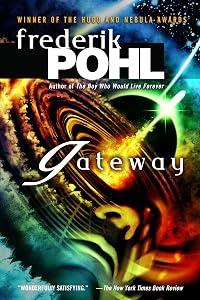
Pohl will always be one of my favorite Classic SF writers. His best work is still "Gateway" but he has many other fine books to his credit.
This was a later work but still enjoyable. Yes, there are aliens. Yes, they have unusual ideas about what to do with humans.
This was a later work but still enjoyable. Yes, there are aliens. Yes, they have unusual ideas about what to do with humans.
Ratings
Members
- Recently Added By
Lists

Best First Contact Stories
33 works; 16 members
Author Information

641+ Works 42,910 Members
Frederik Pohl was born in New York City on November 26, 1919. More interested in writing than in school, he dropped out of high school in his senior year and took a job with a publishing company. After serving as a public relations officer in the United States Army from 1943 to 1945, he returned to publishing as copywriter for Popular Science, a show more literary agent for several sci-fi writers, and the editor for the magazines Galaxy and If from 1959 until 1969, with If winning three successive Hugo awards. His first published work, a poem entitled Elegy to a Dead Satellite: Luna, was printed in Amazing Stories magazine in 1937 under the pen name Elton Andrews. His first science fiction novels were published in the mid 1960's, some written in collaboration with other writers, others created alone. During his lifetime, he won over 16 major awards for his writing (much of which was published pseudonymously) including six Hugo Awards and three Nebula Awards. His works include Gateway, which won the Campbell Memorial, Hugo, Locus SF, and Nebula Awards, Beyond the Blue Event Horizon, and Jem, which won the National Book Award in 1979. He also embraced blogging in his later years, using his online journal as an ongoing sequel to his autobiography, The Way the Future Was. He died on September 2, 2013 at the age 93. (Bowker Author Biography) show less
Some Editions
Series

Work Relationships
Is contained in
Common Knowledge
- Original title
- The Other End of Time
- Original publication date
- 1996-10
- People/Characters
- Dan Dannerman
- Blurbers
- Bear, Greg; Brin, David; Anderson, Poul
- Original language
- English
Classifications
Statistics
- Members
- 601
- Popularity
- 48,876
- Reviews
- 4
- Rating
- (3.29)
- Languages
- English, Italian
- Media
- Paper, Audiobook
- ISBNs
- 8
- ASINs
- 3