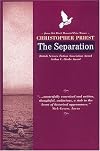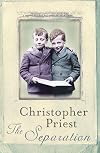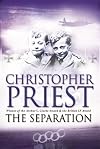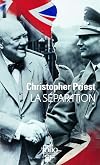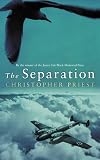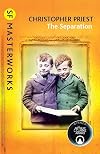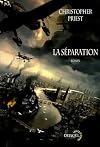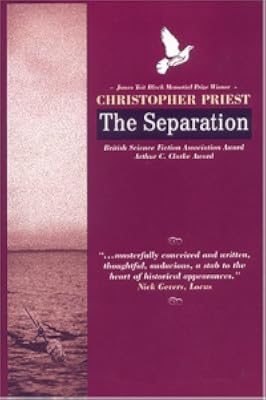
The Separation
by Christopher Priest
On This Page
Description
THE SEPARATION is the story of twin brothers, rowers in the 1936 Olympics (where they met Hess, Hitler's deputy); one joins the RAF, and captains a Wellington; he is shot down after a bombing raid on Hamburg and becomes Churchill's aide-de-camp; his twin brother, a pacifist, works with the Red Cross, rescuing bombing victims in London. But this is not a straightforward story of the Second World War: this is an alternate history: the two brothers - both called J.L. Sawyer - live their lives show more in alternate versions of reality. In one, the Second World War ends as we imagine it did; in the other, thanks to efforts of an eminent team of negotiators headed by Hess, the war ends in 1941. THE SEPARATION is an emotionally riveting story of how the small man can make a difference; it's a savage critique of Winston Churchill, the man credited as the saviour of Britain and the Western World, and it's a story of how one perceives and shapes the past. show lessTags
Recommendations














Member Reviews
In my memorial catch-up read to bring myself up to date with all of Christopher Priest's books, I came to The Separation. I am a sucker for alternate histories and this did not disappoint. (Warning: some spoilers may follow.)
On a dismal March afternoon in 1999, a military historian is doing a signing session in a bookshop in the Derbyshire spa town of Buxton, in the Peak District. A customer comes into the shop and offers him her father's wartime memoirs, detailing his experiences in RAF Bomber Command. But we find that the account in the memoir seems to be from an alternate reality.
The author researches further and uncovers a story of two identical twins, Joe and Jack Sawyer, both known (confusingly) as J.L. Sawyer. In their day, they show more won medals at the 1936 Berlin Olympics for rowing; but war separates them. One becomes a bomber pilot; the other a conscientious objector, who ends up working for the Red Cross. Both become embroiled with the defection to Britain of the Deputy Führer, Rudolf Hess - but each has a very different experience of the same event.
But the two timelines aren't irretrievably separated; although their differing attitudes to war cause a rift between the two brothers, their separation and those of the timelines aren't total. Things are complicated by their relationship with Birgit, a Jewish refugee that the two brothers smuggle out of Germany after the Olympics. Both love her; one marries her. Events take tragic turns in each timeline; yet the timelines are intertwined, leading to dislocating events for both brothers.
The themes of identity and duplication re-appear here, as in Priest's earlier novel The Prestige. We also see themes of dislocation and whether what an individual is experiencing at any one time is real or not. At the same time, Priest's grasp of detail is very good; I detected only a handful of minor errors or omissions, no more than you would get in any other memoir of historical events written in our reality by a real person. We are treated to pen portraits of Churchill and Hess; the pacifist brother's reaction to Churchill is interesting, as he considers Churchill to be a despicable warmonger, and yet when he hears him speak he cannot but fail to be moved by his determination and steadfastness. (There is also an account, as from the official minutes, of a key meeting of Churchill's War Cabinet which I found very amusing.) Even these major characters display separations; Churchill uses body doubles so that he can appear be in two places at the same time, whilst JL (the pilot) sees two different instances of Hess' flight to Britain, though there are different explanations for the events he sees.
As the novel was set, partly, in places I know well (Buxton, Bakewell and Lincolnshire), it started by giving me a great sense of presence which persisted for me through the rest of the book. There is also an account of the drafting of a major international treaty which struck me as a very likely depiction of how these things happen in real life. (I suspect that one of Priest's sources was the diary of John Colville, Churchill's private secretary during the war years, as he is namechecked in the book.) There is a minor loose end which isn't adequately explained, but it's incidental to the story and doesn't really impact on the narrative.
Perhaps the thing that I was most worried about as the book drew to a close was the instance of Priest's framing device, the military historian. I could not see how that was going to be closed; yet it was, in an ingenious way. I said that the alternate histories were intertwined instead of being discrete, and that might cause some readers expecting a literal or more science-fictional approach to the subject to have trouble with this book. Yet I am often struck, on looking at old films or photographs of cities, or travelling by train to another town or even another country, by all the individuals I see in passing. They all have their own lives, which I know nothing about. I see them once, and then they are gone from my view. From their viewpoint, the same could be said of me. Is not each of these lives a separate alternate reality, a parallel history affected in different ways by the same events?
The intertwining timelines in this novel have a certain inevitability about them; the parts fit together with elegance even if the impacts on the two protagonists are life-changing. I found this a most intriguing exploration of history and the effects of separations on both private lives and great events. show less
On a dismal March afternoon in 1999, a military historian is doing a signing session in a bookshop in the Derbyshire spa town of Buxton, in the Peak District. A customer comes into the shop and offers him her father's wartime memoirs, detailing his experiences in RAF Bomber Command. But we find that the account in the memoir seems to be from an alternate reality.
The author researches further and uncovers a story of two identical twins, Joe and Jack Sawyer, both known (confusingly) as J.L. Sawyer. In their day, they show more won medals at the 1936 Berlin Olympics for rowing; but war separates them. One becomes a bomber pilot; the other a conscientious objector, who ends up working for the Red Cross. Both become embroiled with the defection to Britain of the Deputy Führer, Rudolf Hess - but each has a very different experience of the same event.
But the two timelines aren't irretrievably separated; although their differing attitudes to war cause a rift between the two brothers, their separation and those of the timelines aren't total. Things are complicated by their relationship with Birgit, a Jewish refugee that the two brothers smuggle out of Germany after the Olympics. Both love her; one marries her. Events take tragic turns in each timeline; yet the timelines are intertwined, leading to dislocating events for both brothers.
The themes of identity and duplication re-appear here, as in Priest's earlier novel The Prestige. We also see themes of dislocation and whether what an individual is experiencing at any one time is real or not. At the same time, Priest's grasp of detail is very good; I detected only a handful of minor errors or omissions, no more than you would get in any other memoir of historical events written in our reality by a real person. We are treated to pen portraits of Churchill and Hess; the pacifist brother's reaction to Churchill is interesting, as he considers Churchill to be a despicable warmonger, and yet when he hears him speak he cannot but fail to be moved by his determination and steadfastness. (There is also an account, as from the official minutes, of a key meeting of Churchill's War Cabinet which I found very amusing.) Even these major characters display separations; Churchill uses body doubles so that he can appear be in two places at the same time, whilst JL (the pilot) sees two different instances of Hess' flight to Britain, though there are different explanations for the events he sees.
As the novel was set, partly, in places I know well (Buxton, Bakewell and Lincolnshire), it started by giving me a great sense of presence which persisted for me through the rest of the book. There is also an account of the drafting of a major international treaty which struck me as a very likely depiction of how these things happen in real life. (I suspect that one of Priest's sources was the diary of John Colville, Churchill's private secretary during the war years, as he is namechecked in the book.) There is a minor loose end which isn't adequately explained, but it's incidental to the story and doesn't really impact on the narrative.
Perhaps the thing that I was most worried about as the book drew to a close was the instance of Priest's framing device, the military historian. I could not see how that was going to be closed; yet it was, in an ingenious way. I said that the alternate histories were intertwined instead of being discrete, and that might cause some readers expecting a literal or more science-fictional approach to the subject to have trouble with this book. Yet I am often struck, on looking at old films or photographs of cities, or travelling by train to another town or even another country, by all the individuals I see in passing. They all have their own lives, which I know nothing about. I see them once, and then they are gone from my view. From their viewpoint, the same could be said of me. Is not each of these lives a separate alternate reality, a parallel history affected in different ways by the same events?
The intertwining timelines in this novel have a certain inevitability about them; the parts fit together with elegance even if the impacts on the two protagonists are life-changing. I found this a most intriguing exploration of history and the effects of separations on both private lives and great events. show less
Classic Christopher Priest.
With one caveat: Don't start here if you're new to him!
His Prestige is a great novel on its own, but that popular novel doesn't come all that near to the wide-wide ranging preoccupation with the Other place described in most of his other novels. And to be sure, there's a common theme in this one with those others.
Never-ending war. Lies and propaganda. Twins. Faulty memory. Strange, unexplainable events. Airplanes.
And above all, HISTORY. We *might* be spending some time in that other place. That alternate reality so hauntingly like our own. But in this past around WWII, all the names and people are pretty much the same... however... I think this is where the real separation happens between our history and the show more Other happens. I'm guessing because Priest never puts us in the shoes of people who ever really KNOW anything. They're just living their lives and surviving as they can. But for us, the Readers, we're locked in a hellishly fascinating struggle with separating OUR history with what THEIR history is doing.
Priest is kinda masterful here. He knows and has researched an AMAZING amount to give us this. But nothing is very obvious. Except for when it is, of course. :) All this is fantastic icing on the cake. At the core of it, we have our estranged twin brothers who devote themselves to living very different lives. One is a pro-war Bomber for England and the other is a Conscientious Objector working for the Red Cross. Their own separation and the similar wounds and circumstances they find themselves in at various points seem custom-made to paste them back together no matter how much they strive to separate themselves.
Their story is rather awesome all by itself, but it only gets better when we tick off all the fantastic mirroring techniques going on across all History, alternate dimensions, and the author's own predilections. :) As with all those other books I mentioned. :) They shine like signposts to us in this novel, giving us all the hints we need...
As long as we don't START here. :)
I'm rather flabbergasted. :) It's always a treat. :) A very, VERY smart treat. :) show less
With one caveat: Don't start here if you're new to him!
His Prestige is a great novel on its own, but that popular novel doesn't come all that near to the wide-wide ranging preoccupation with the Other place described in most of his other novels. And to be sure, there's a common theme in this one with those others.
Never-ending war. Lies and propaganda. Twins. Faulty memory. Strange, unexplainable events. Airplanes.
And above all, HISTORY. We *might* be spending some time in that other place. That alternate reality so hauntingly like our own. But in this past around WWII, all the names and people are pretty much the same... however... I think this is where the real separation happens between our history and the show more Other happens. I'm guessing because Priest never puts us in the shoes of people who ever really KNOW anything. They're just living their lives and surviving as they can. But for us, the Readers, we're locked in a hellishly fascinating struggle with separating OUR history with what THEIR history is doing.
Priest is kinda masterful here. He knows and has researched an AMAZING amount to give us this. But nothing is very obvious. Except for when it is, of course. :) All this is fantastic icing on the cake. At the core of it, we have our estranged twin brothers who devote themselves to living very different lives. One is a pro-war Bomber for England and the other is a Conscientious Objector working for the Red Cross. Their own separation and the similar wounds and circumstances they find themselves in at various points seem custom-made to paste them back together no matter how much they strive to separate themselves.
Their story is rather awesome all by itself, but it only gets better when we tick off all the fantastic mirroring techniques going on across all History, alternate dimensions, and the author's own predilections. :) As with all those other books I mentioned. :) They shine like signposts to us in this novel, giving us all the hints we need...
As long as we don't START here. :)
I'm rather flabbergasted. :) It's always a treat. :) A very, VERY smart treat. :) show less
https://fromtheheartofeurope.eu/?p=25998
excellent stuff, dopplegangers, altered timelines and the second world war, as if Philip K Dick had been English and sober.
https://fromtheheartofeurope.eu/?p=45983
Again, I don't feel the need to revise my opinion much, especially since I've now read a few more alternate-WW2 novels. (Good ones: The Man in the High Castle, by Philip K. Dick, Jo Walton's trilogy Farthing, Ha'penny and Half a Crown; so-so: Timewyrm: Exodus, by Terrance Dicks, Dominion, by C.J. Sansom; less good: The Sound of his Horn, by Sarban, SS-GB, by Len Deighton.) I think it's a really well put together exploration of several different timelines, involving the crucial choices of a pair of identical twins, one in the RAF, the show more other a pacifist, and the possibility of an early end to the war with a Jewish homeland in Madagascar. There aren't any clear answers, even the questions may not be all that clear, but it really keeps one reading; the alternate-WW2 novel to end all others. Great stuff. show less
excellent stuff, dopplegangers, altered timelines and the second world war, as if Philip K Dick had been English and sober.
https://fromtheheartofeurope.eu/?p=45983
Again, I don't feel the need to revise my opinion much, especially since I've now read a few more alternate-WW2 novels. (Good ones: The Man in the High Castle, by Philip K. Dick, Jo Walton's trilogy Farthing, Ha'penny and Half a Crown; so-so: Timewyrm: Exodus, by Terrance Dicks, Dominion, by C.J. Sansom; less good: The Sound of his Horn, by Sarban, SS-GB, by Len Deighton.) I think it's a really well put together exploration of several different timelines, involving the crucial choices of a pair of identical twins, one in the RAF, the show more other a pacifist, and the possibility of an early end to the war with a Jewish homeland in Madagascar. There aren't any clear answers, even the questions may not be all that clear, but it really keeps one reading; the alternate-WW2 novel to end all others. Great stuff. show less
I’ve just finished reading this and I must admit that I’m a bit confused… I’m confused but I’m also pretty sure that I haven’t enjoyed – no wait, I think I can say – loved a SF book this way in a very long time.
The Separation is the story of twins during the WWII; Joe and Jack known as JL. It starts in 1936, as they both leave for Berlin to participate in the Olympic Games. On their journey back, they bring back a young Jewish woman who they are both madly in love with… until she marries Joe. Priest provides us two (or perhaps even more) stories as Joe and JL both deal with the war and its consequences separately. JL becomes a pilot in the RAF while Joe, a pacifist joins the Red Cross. From then on, their paths go show more different way though they can never free themselves of this special bond that links as twins. However, History itself goes its own way as well and the reader is never quite sure which reality he is in and exactly how many realities there are. Is Joe dead or alive? Or is JL the one who’s dead? Did the war truly end on May 11th 1941 when Churchill signed a separate peace treaty with Rudolf Hess, Hitler’s dophin?
The Separation can be classified as an “uchronie‿ (that would be the French term, perhaps in English you just stick to alternative history) but I would even go further than that and say that it’s an “uchronie‿ about “uchronie‿ because unlike other novels of the genre, the author doesn’t change on particular event so as to end up in a completely different world. There isn’t a clear distinction between our world and the world(s) in which the characters evolve.
Priest also uses this to explore the various possibilities offered by History. He raises the question of interpretation and perception of event and how people witnessing the same event never quite have the same point of view on what truly did happen… from then on, what is the truth?
I was particularly interested by the twin’s awkward love-hate-envy relationship and how in the end even though they were separated both because of the war and because of their opposite views of the war, their actions were often defined by their relationship… but then I’ve always found twins fascinating and I suppose Priest knows what he’s talking about since he’s got two of his own.
Some will love and others will hate, my point is that I don’t think you can remain indifferent to this novel. Some will find it brilliant while others will find that it completely missed the point but then, isn’t that what the entire novel is about? Interpretation.
I was immediately caught up in the twin’s everyday life. Here, the battles are mostly inner turmoil and the author uses SF to concentrate and analyse his characters.
This is a novel I would recommend to all even those who don’t usually read SF because they sometimes have the feeling that there’s more science than fiction. Here it is not the case. If you aren’t afraid of unexpected turn than go read it! Why are you still here? show less
The Separation is the story of twins during the WWII; Joe and Jack known as JL. It starts in 1936, as they both leave for Berlin to participate in the Olympic Games. On their journey back, they bring back a young Jewish woman who they are both madly in love with… until she marries Joe. Priest provides us two (or perhaps even more) stories as Joe and JL both deal with the war and its consequences separately. JL becomes a pilot in the RAF while Joe, a pacifist joins the Red Cross. From then on, their paths go show more different way though they can never free themselves of this special bond that links as twins. However, History itself goes its own way as well and the reader is never quite sure which reality he is in and exactly how many realities there are. Is Joe dead or alive? Or is JL the one who’s dead? Did the war truly end on May 11th 1941 when Churchill signed a separate peace treaty with Rudolf Hess, Hitler’s dophin?
The Separation can be classified as an “uchronie‿ (that would be the French term, perhaps in English you just stick to alternative history) but I would even go further than that and say that it’s an “uchronie‿ about “uchronie‿ because unlike other novels of the genre, the author doesn’t change on particular event so as to end up in a completely different world. There isn’t a clear distinction between our world and the world(s) in which the characters evolve.
Priest also uses this to explore the various possibilities offered by History. He raises the question of interpretation and perception of event and how people witnessing the same event never quite have the same point of view on what truly did happen… from then on, what is the truth?
I was particularly interested by the twin’s awkward love-hate-envy relationship and how in the end even though they were separated both because of the war and because of their opposite views of the war, their actions were often defined by their relationship… but then I’ve always found twins fascinating and I suppose Priest knows what he’s talking about since he’s got two of his own.
Some will love and others will hate, my point is that I don’t think you can remain indifferent to this novel. Some will find it brilliant while others will find that it completely missed the point but then, isn’t that what the entire novel is about? Interpretation.
I was immediately caught up in the twin’s everyday life. Here, the battles are mostly inner turmoil and the author uses SF to concentrate and analyse his characters.
This is a novel I would recommend to all even those who don’t usually read SF because they sometimes have the feeling that there’s more science than fiction. Here it is not the case. If you aren’t afraid of unexpected turn than go read it! Why are you still here? show less
The wonderfully confusing parallel stories of twin brothers during WWII. The book is peppered with doubles and is very focused on the shifting of identity and time.
I felt confident that I understood what was going on, right up to about three quarters of the way through this book, but then began to spiral into confusion and found myself flicking back and forth to investigate different interpretations of events.
I won't pretend to understand the true version of events Priest writes about. I'm guessing the point is that there's never a true version, just different interpretations which merge and overlap, but which are ultimately very enjoyable to read.
I felt confident that I understood what was going on, right up to about three quarters of the way through this book, but then began to spiral into confusion and found myself flicking back and forth to investigate different interpretations of events.
I won't pretend to understand the true version of events Priest writes about. I'm guessing the point is that there's never a true version, just different interpretations which merge and overlap, but which are ultimately very enjoyable to read.
As in The Prestige, Priest uses confusion of events and individuals, as well as imperfect memories,
To great effect, crafting a tale that changes in its very plot as the reader hears the point of view of different characters. This is helped a great deal by the use of identical twin brothers, both with the same initials, who cause some confusion with the people with whom they interact, as well as the use of doubles for political figures in dangerous situations.
At times, things are rather confusing, and on occasion, it’s only when there’s a mention of flying or ambulances that the reader can fathom which of the brothers is currently narrating, but this serves to heighten the tension in several situations where the outcome is never show more certain, and often, on seeing the same event from another’s perspective, the outcome shown the second time round conflicts with the original, giving a sense of “you had to be there.”
It’s packed with excellent characters who are fleshed out very nicely, as well as some unusual portrayal of historical figures and the roles they played during WWII as it might have been (it's a slightly altered, alternative history), but with a lot of jumping about and switching back and forth between different memory streams. I get the feeling that this would be better after a second reading, but even with the confusion on a first reading, it's rather enjoyable. show less
To great effect, crafting a tale that changes in its very plot as the reader hears the point of view of different characters. This is helped a great deal by the use of identical twin brothers, both with the same initials, who cause some confusion with the people with whom they interact, as well as the use of doubles for political figures in dangerous situations.
At times, things are rather confusing, and on occasion, it’s only when there’s a mention of flying or ambulances that the reader can fathom which of the brothers is currently narrating, but this serves to heighten the tension in several situations where the outcome is never show more certain, and often, on seeing the same event from another’s perspective, the outcome shown the second time round conflicts with the original, giving a sense of “you had to be there.”
It’s packed with excellent characters who are fleshed out very nicely, as well as some unusual portrayal of historical figures and the roles they played during WWII as it might have been (it's a slightly altered, alternative history), but with a lot of jumping about and switching back and forth between different memory streams. I get the feeling that this would be better after a second reading, but even with the confusion on a first reading, it's rather enjoyable. show less
A writer of oral histories about World War II is fascinated by the mysterious J. L. Sawyer who is listed as an RAF pilot and a conscientious objector. He soon finds out there were two J. L. Sawyers; twin brothers. He receives a journal attributed to J. L. Sawyer that paints a very different picture of the war and its aftermath. Through the historian’s research we learn about the lives of these brothers and how they influenced the outcome of the conflict.
The story is told through journal entries and various government documents. It’s as though we are reading the historians research materials.
There are a number of separations in the story. The first is the physical separation of the main characters, Joe and Jack Sawyer. They are show more separated by the love they have for the same women and then by their differing ideologies. Jack is an RAF pilot and Joe is a conscientious objector working for the Red Cross. Another separation is the separate peace Britain negotiates with Germany. show less
The story is told through journal entries and various government documents. It’s as though we are reading the historians research materials.
There are a number of separations in the story. The first is the physical separation of the main characters, Joe and Jack Sawyer. They are show more separated by the love they have for the same women and then by their differing ideologies. Jack is an RAF pilot and Joe is a conscientious objector working for the Red Cross. Another separation is the separate peace Britain negotiates with Germany. show less
Members
- Recently Added By
Lists

Best Science Fiction Novels
816 works; 430 members

Best Alternate History
111 works; 60 members

Top Five Books of 2015
811 works; 240 members

Arthur C. Clarke Award Winners and Shortlisted Books
219 works; 14 members

Broderick and Di Filippo's Science Fiction: The 101 Best Novels 1985-2010
103 works; 7 members

Recommended AltHist
24 works; 1 member

SF Masterworks
193 works; 8 members
Author Information

63+ Works 11,856 Members
Some Editions
Awards and Honors
Awards
Distinctions
Notable Lists
Series
Belongs to Publisher Series
Work Relationships
Is contained in
Common Knowledge
- Canonical title*
- La séparation
- Original title
- The Separation
- Original publication date
- 2002
- People/Characters
- Jacob Lucas Sawyer; Joseph Leonard Sawyer; Birgit Heidi Sattmann Sawyer; Stuart Gratton; Winston Churchill; Rudolf Hess
- Important events
- World War II
- Dedication
- To Paul Kincaid
- First words
- The rain was falling steadily on Buxton that Thursday afternoon in March, the town veiled by drifting low clouds, grey and discouraging.
- Last words
- (Click to show. Warning: May contain spoilers.)I clung to my life, forcing myself to breathe, without anxiety, watching Phyllida sleep and dreaming of waking to a better future.
- Canonical DDC/MDS
- 823.914; 813.5
- Canonical LCC
- PR6066.R55
*Some information comes from Common Knowledge in other languages. Click "Edit" for more information.
Classifications
Statistics
- Members
- 640
- Popularity
- 45,590
- Reviews
- 23
- Rating
- (3.78)
- Languages
- English, French, Polish, Spanish
- Media
- Paper, Audiobook, Ebook
- ISBNs
- 21
- ASINs
- 3