On This Page
Description
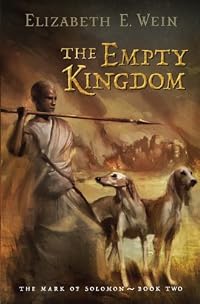
Imprisoned by Abreha and forced to help plan Aksum's invasion, Telemakos desperately tries to regain his freedom Telemakos, descendent of British and Aksumite royalty, has been accused of treason by Abreha, ruler of Himyar, and imprisoned on the upper levels of his twelve-story palace. Not only is Telemakos forbidden to see his beloved younger sister, Athena, but he is also forced to reproduce Aksumite maps in order to help Abreha plan an invasion. Lacking any way to communicate with his show more family in faraway Aksum, Telemakos must use all of his subtle talents to regain his freedom. This ebook features an illustrated biography of Elizabeth Wein including rare images from the author's personal collection. show lessTags
Recommendations


























Member Recommendations
Member Reviews
Elizabeth Wein's The Empty Kingdom, second in the Mark of Solomon cycle and fifth in the overall series, completes the plot begun in The Lion Hunter with Telemakos and Athena in the court of Abreha, najashi of Himyar. Telemakos was sent there for his safety, but he soon finds himself in more danger than ever as he learns of a plot against Aksum. Abreha is not to be trifled with.
What really comes to the forefront in this installment is Wein's skill with complex characters and relationships. She makes everything believable: Abreha's quiet death sentence on Telemakos should he send home any word of his stolen knowledge, Telemakos's determination to outmaneuver the terrifying najashi, and the unspoken loyalty of the Scions, the royal show more children of Himyar's provinces orphaned by the plague, to Telemakos. I spent half the book in terror of Abreha right alongside Telemakos, until I began to wonder about Abreha's reasons, his seeming inconsistency. I don't want to spoil it, but there's a great twist at the end.
I love how Wein never falls into stereotypes. One of Telemakos's desires is for Athena to call him by his name rather than "Boy" or "Tena's boy." It's mentioned a couple times but it's never made into a big emotional moment of triumph to have her pronounce his name (in fact, I don't think she even does). Just like real life.
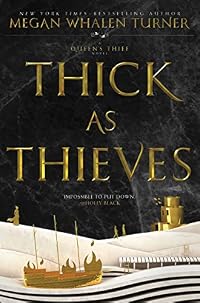
Telemakos is reminding me more and more of Eugenides from Megan Whalen Turner's Attolia series. Both are resourceful, intelligent young men near the throne who are involved in the various intrigues of their respective courts. Both are fiercely loyal; both are physically handicapped (Gen loses a hand; Telemakos, an arm). Telemakos is far less boastful than Gen, but both have the same instinct for careful plots and intuitive discoveries. They are counterparts worthy of one another.
Is this really the last book of the series? Not that it ends on a cliffhanger, but I want to know more of Telemakos's story and the beautifully imagined world that Wein has brought to life. I don't understand why her work is not better known; she's brilliant. I thoroughly enjoyed this series and would recommend it to anyone who enjoys deftly written historical fiction with compelling characters and carefully woven plots. show less
What really comes to the forefront in this installment is Wein's skill with complex characters and relationships. She makes everything believable: Abreha's quiet death sentence on Telemakos should he send home any word of his stolen knowledge, Telemakos's determination to outmaneuver the terrifying najashi, and the unspoken loyalty of the Scions, the royal show more children of Himyar's provinces orphaned by the plague, to Telemakos. I spent half the book in terror of Abreha right alongside Telemakos, until I began to wonder about Abreha's reasons, his seeming inconsistency. I don't want to spoil it, but there's a great twist at the end.
I love how Wein never falls into stereotypes. One of Telemakos's desires is for Athena to call him by his name rather than "Boy" or "Tena's boy." It's mentioned a couple times but it's never made into a big emotional moment of triumph to have her pronounce his name (in fact, I don't think she even does). Just like real life.
Telemakos is reminding me more and more of Eugenides from Megan Whalen Turner's Attolia series. Both are resourceful, intelligent young men near the throne who are involved in the various intrigues of their respective courts. Both are fiercely loyal; both are physically handicapped (Gen loses a hand; Telemakos, an arm). Telemakos is far less boastful than Gen, but both have the same instinct for careful plots and intuitive discoveries. They are counterparts worthy of one another.
Is this really the last book of the series? Not that it ends on a cliffhanger, but I want to know more of Telemakos's story and the beautifully imagined world that Wein has brought to life. I don't understand why her work is not better known; she's brilliant. I thoroughly enjoyed this series and would recommend it to anyone who enjoys deftly written historical fiction with compelling characters and carefully woven plots. show less
Sequel to the Lion Hunter, this takes up the story of Telemakos, the biracial descendant of Arthur. Now in Himyar (south Arabia) he has to deal with intrigues by the ruler Abreha (the historic Abraha the Ethiopian) who plots to conquer Aksum.
7/10
Political intrigue and a good wrap-up to the series.
Political intrigue and a good wrap-up to the series.
Ratings
Members
- Recently Added By
Author Information

25+ Works 10,108 Members
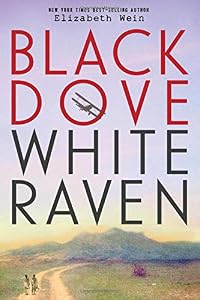
Elizabeth Wein was born in New York City in 1964. She went to the University of Pennsylvania in Philadelphia where she earned a PhD in Folklore and held a Javits Fellowship. Elizabeth Wein first five books for young adults are set in Arthurian Britain and sixth century Ethiopia. The Mark of Solomon, was published in two parts as The Lion Hunter show more (2007) and The Empty Kingdom (2008). The Lion Hunter was short-listed for the Andre Norton Award for Best Young Adult Fantasy and Science Fiction in 2008. Elizabeth's novel for teens, Code Name Verity, published by Egmont UK, Disney-Hyperion and Doubleday Canada in 2012, is a World War II thriller in which two young girls, one a Resistance spy and the other a transport pilot, become unlikely best friends. Code Name Verity has received widespread critical acclaim including being shortlisted for the CILIP Carnegie Medal, it is a Michael Printz Award Honor Book, a Boston Globe/Horn Book Awards Honor Book, and an SCBWI Golden Kite Honor Book. It is also a New York Times Bestseller in young adult fiction. She is also the author of Black Dove, White Raven. (Bowker Author Biography) show less

Elizabeth Wein is a LibraryThing Author, an author who lists their personal library on LibraryThing.
Awards and Honors
Awards
Series


Work Relationships
Common Knowledge
- Canonical title
- The Empty Kingdom
- Original publication date
- 2008
- People/Characters
- Telemakos; Medraut; Abreha Anbessa; Athena Meder
- Epigraph
- Set me as a seal upon your heart, as a seal upon your arms; for love is as strong as death.
- Song of Solomon 8:6 - Dedication
- For Christopher Marcus Santos (because before Telemakos, there was Chris)
- First words
- The Red Sea had never seemed so wide, nor Aksum so far away.
- Last words
- (Click to show. Warning: May contain spoilers.)She did not walk. She ran.
- Blurbers
- Williams-Garcia, Rita
Classifications
Statistics
- Members
- 102
- Popularity
- 315,819
- Reviews
- 3
- Rating
- (3.73)
- Languages
- English
- Media
- Paper, Ebook
- ISBNs
- 3
- ASINs
- 2