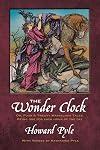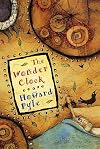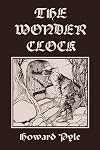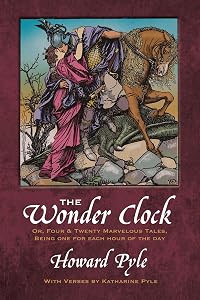
The Wonder Clock
by Howard Pyle
On This Page
Description
Here we are! And now I will wind the clock. Gurr! gurr! gurr! Tick-tock! tick-tock!I PUT on my dream-cap one day and stepped into Wonderland.
Along the road I jogged and never dusted my shoes, and all the time the pleasant sun shone and never burned my back, and the little white clouds floated across the blue sky and never let fall a drop of rain to wet my jacket. And by and by I came to a steep hill.
I climbed the hill, though I had more than one tumble in doing it, and there, on the show more tip-top, I found a house as old as the world itself. That was where Father Time lived; and who should sit in the sun at the door, spinning away for dear life, but Time's Grandmother herself; and if you would like to know how old she is you will have to climb to the top of the church steeple and ask the wind as he sits upon the weather-cock, humming the tune of Over-yonder song to himself.
"Good-morning," says Time's Grandmother to me.
"Good-morning," says I to her.
"And what do you seek here?" says she to me.
"I come to look for odds and ends," says I to her.
"Very well," says she; "just climb the stairs to the garret, and there you will find more than ten men can think about."
. Juvenile Literature. Juvenile Fiction. show less
Tags
Recommendations


















Member Reviews
Completely charming, both the stories and the illustrations. In some ways this is an early example of a "mash-up," because Pyle borrows and re-combines story elements from many sources. Bright young readers and adults should enjoy the book equally. The stories are good for reading aloud, too; the droll repetitive patterns (many groups of three!) are very effective orally.
The Kindle version is riddled with misprints and lacks illustrations. I'm fond of the quasi-arcane diction; I'm guessing the stories are Pyle's variations on traditional folk tales; they aren't as brutal as the traditional versions, although there is one anti-Semitic line, and Angela Carter would have a good time subverting the female roles. Ah, but the prose is so pretty. I would read a story or two as a break from more serious stuff. i'll add a print version with illustrations to my wish list. Recommended, but not as an e-book.
A collection of fairy tales written as only Howard Pyle can write. Of course they are extremely politically incorrect, full of witches, dwarves and such, but morally they are right on. Love triumphs over greed and kindness wins all.
Dover reprint of 1888 book of child's stories.
Ratings
Members
- Recently Added By
Lists

Ambleside Books
459 works; 18 members

CCE 1000 Good Books List
1,033 works; 12 members

Written and Illustrated By
805 works; 1 member

HMS: Make Your Child a Lover of Books, Ages 7-9
52 works; 2 members

HMS: Make Your Child a Lover of Books, Books for Boys
28 works; 2 members
Author Information

191+ Works 22,652 Members
Howard Pyle was born March 5, 1853 in Wilmington, Delaware. Pyle was a Quaker and attended the Friends' School in Wilmington. At sixteen he began three years of daily commutes to Philadelphia in order to study under the Belgian artist Van der Weilen. After three years of study, he set up a studio in Wilmington and helped his father in his leather show more business while beginning his fledgling career as an illustrator. His earliest work was published in Scribner's Monthly in 1876. He moved to New York, where he was associated to some extent with the Art Students' league of New York City during 1876-77. His early illustrations, short stories and poems appeared in the leading New York periodicals in 1876-79. He was also an artist and writer for Harpers Weekly. Pyle's color pictures appeared in issues of Century, Everybody's and Harpers monthly magazines from 1900 to 1911. Pyle devoted his art work almost entirely to the production of illustrations which appeared in periodicals and books. He also shared his views and skills with the student body at his 1896 classes at the Drexel Institute of Arts and Sciences in Philadelphia, his summer classes at Chadds Ford, Pennsylvania, and at his own school in Wilmington, Delaware - started in 1903. Pyle's students were to revolutionize the illustration world. Today they are collectively known as The Brandywine School. Pyle is the author and illustrator of the following works: The Merry Adventures of Robin Hood of Nottinghamshire published in 1883; Within the Capes published in 1885; Pepper and Salt, or Seasoning for Young Folk published in 1887; The Rose of Paradise also published in 1887; The Wonder Clock or Four and Twenty Marvelous Tales published in 1888; Otto of the Silver Hand also published in 1888; A Modern Aladdin published in 1891); Men of Iron, a Romance of Chivalry published in 1892; Jack Ballister's Fortune published in 1894; Twilight Land published in 1895; and The Garden Behind the Moon published in 1895. In 1910, Howard Pyle relocated his family to Florence, Italy where he hoped to study and pursue the painting of murals. It was his second trip abroad. On November 9 of 1911, he suddenly became ill and died of a kidney infection at the age of 58. His ashes were interred there. (Bowker Author Biography) show less
Series
Belongs to Publisher Series
Work Relationships
Is contained in
Common Knowledge
- Canonical title
- The Wonder Clock
- Original publication date
- 1887
Classifications
- Genres
- Fiction and Literature, Children's Books
- DDC/MDS
- 398.2 — Society, government, & culture Customs, etiquette & folklore Folklore & Folktales Folk literature
- LCC
- PZ7 .P993 .W — Language and Literature Fiction and juvenile belles lettres Fiction and juvenile belles lettres Juvenile belles lettres
- BISAC
Statistics
- Members
- 560
- Popularity
- 52,932
- Reviews
- 6
- Rating
- (3.94)
- Languages
- English
- Media
- Paper, Ebook
- ISBNs
- 27
- UPCs
- 1
- ASINs
- 26