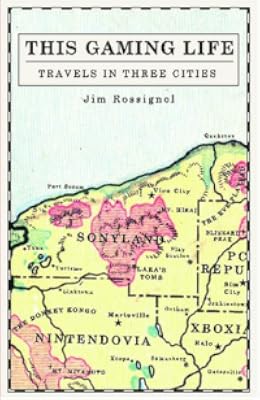
This Gaming Life: Travels in Three Cities
by Jim Rossignol
On This Page
Description
So begins this story of personal redemption through the unlikely medium of electronic games. Quake, World of Warcraft, Eve Online, and other online games not only offered author Jim Rossignol an excellent escape from the tedium of office life. They also provided him with a diverse global community and a job—as a games journalist. Part personal history, part travel narrative, part philosophical reflection on the meaning of play, This Gaming Life describes Rossignol’s encounters in three show more cities: London, Seoul, and Reykjavik. From his days as a Quake genius in London’s increasingly corporate gaming culture; to Korea, where gaming is a high-stakes televised national sport; to Iceland, the home of his ultimate obsession, the idiosyncratic and beguiling Eve Online, Rossignol introduces us to a vivid and largely undocumented world of gaming lives. Torn between unabashed optimism about the future of games and lingering doubts about whether they are just a waste of time, This Gaming Life also raises important questions about this new and vital cultural form. Should we celebrate the “serious” educational, social, and cultural value of games, as academics and journalists are beginning to do? Or do these high-minded justifications simply perpetuate the stereotype of games as a lesser form of fun? In this beautifully written, richly detailed, and inspiring book, Rossignol brings these abstract questions to life, immersing us in a vibrant landscape of gaming experiences. show lessTags
Recommendations








Member Recommendations
Member Reviews
I never quite glommed onto videogames. When I was in late grade school/early high school, I tried to-- I played a few games, mostly Star Trek, but also a bit of Command & Conquer, Civilzation II, and Sid Meier's Alpha Centauri. I bought a few others, but often would not play them beyond the first few levels. I did have a subscription to PC Gamer. But the interest faded, and I haven't bought a videogame in eight years, though I of course enjoy the occasional round of Mario Kart or Super Smash Brothers. Plus, the Wii is awesome. But I've never even been a fan of Tetris. I suspect my lack of interest is because I've got no hand-eye coordination-- I'm just not any good at videogames.
Still, I'm somewhat vaguely aware of videogames. At the show more same time I got into them briefly, my brother also got into them. And while I pulled back out, he's of course slid in deeper, becoming one of those people with a compulsion to replace their graphics cards every three months. So I found the idea of reading This Gaming Life, an account of the gaming cultures of three different cities-- London, Seoul, and Reykjavik-- an interesting one.
The title is somewhat of a misnomer. The three cities are really just springboards for Rossignol to talk about a wide variety of ideas relating to videogames. We get very little of London's gaming culture-- mostly just an account of what Rossignol himself has done-- and none at all of Reykjavik's. There is a whole lot of Seoul's, which is because Korea, with its PC baangs, has an almost entirely unique way of looking at gaming. I found the exploration of this quite fascinating. Due to restrictive tariffs on Japanese imports, console gaming has never really gained a foothold in Korea, resulting in most gaming being done in baangs (Internet cafes). And being done by everyone: Rossignol states that Korea doesn't really have a youth bar culture; when people go out, they go out to game. And with the exception of StarCraft, most Western games haven't made much of an impact on Korea. Games are so popular that the country actually supports five television networks devoted to games-- in the States, keeping one show about gaming on the air has been a struggle.
But as fascinating as this glimpse into another reality is, it's just a jumping-off point for Rossignol's ruminations on the future of gaming. Is Korea the way of the future for the rest of the world? Will videogaming become a spectator sport, played by professionals with fan clubs numbering in the tens of thousands? Rossignol doesn't think so-- the circumstances that led to Korea's gaming culture are fairly unique. What he rather sees is how Korea's gaming culture has reached out to encompass everyone, and how it has brought people together. Online gaming, Rossignol claims, is new and exciting platform for human social interaction.
This is no grand cultural revolution: it is a subtle wave, a gradual tectonic shift in the way we live, which will only make its true effects known over the course of many years. Games are growing, spreading, changing; and like the proliferation of TV, mobile phones, or automobiles, it's a change that will have far-reaching effects that cannot be easily predicted or defined. Chasing headlines that read "Game Are the New Sport" or "Kids Who Play Games for a Living" makes a crude statement about what really matters within gaming. The important changes will come from those smaller ripples that change how millions of people live, think, and socialize on a daily basis, not just the hard-core niches. (79)
This is the core of Rossignol's book-- the ability of gaming to create a new and unique socialization, a power that is only just beginning to be tapped. He talks about it in a number of different lights, starting from when he was fired from his job as a finance journalist because he was devoting more time to coaching his team in Quake III Arena to his work, because what he did with his teammates in Q3A was more important and, in some ways, more real than what he did at his work. This thread goes all the way to the book's end, culminating in the playing of EVE Online, a massively multiplayer space game that simulates the inhabitants of an entire galaxy.
The depiction of EVE Online made me want to play, though I probably never will. He spends some time discussing how it's a game that let's you do anything (and is hence extremely daunting because of that), and the repercussions that has had. What I found most fascinating was his tales of the social structures that have sprouted up within the game, including a guild of assassins that spent over a year infiltrating an in-game corporation to claim a bounty on its CEO. They worked its way up to its highest levels, reached positions of authority and trust within the corporation, and then performed the assassination of the CEO by one of her own directors-- actually a member of the assassins' guild. They then raided the corporate coffers, making off with 30 billion units of ingame currency (against which the original bounty was just a drop in the bucket), which on eBay at that time could be sold for over 16 thousand dollars. And the game's developers were perfectly cool with this. Sure, the assassins may have violated the law within the game, but they never broke the rules of the game. In fact, they encourage such ingenuity.
Rossignol ties the emergence of videogaming to the increasing tendency to boredom in modern society, and he applauds its ability to stop boredom. And there's nothing wrong with that, he says. Games might come under fire for just being an enjoyable pastime-- but what's wrong with having an enjoyable pastime? Nothing. There's some citation of Steven Johnson's Everything Bad Is Good for You to explain how gaming can be of benefit, but the real benefit, he says, is the pleasure people derive from gaming. People of all different sorts playing all different sorts of videogames for all different sorts of reasons. From those who invest years of their life elaborate "mods" for games to those who play WarioWare on the Wii with their friends while doing a little bit of drinking, gaming offers something for everyone, way to connect, and a way of entertaining.
Rossignol sees a lot of potential in gaming, and it's impossible not to get caught up in his enthusiasm. And as he points out, videogaming is only really just getting started-- where it might eventually go is somewhere no one can predict. Things like Second Life and Spore are only the tip of the iceberg of where gaming will go next, and as he points out, no one in the 1960s could have even predicted computer games and the Internet, so how can we even imagine where things are going to go next?
The book itself is well written-- Rossignol is an engaging writer, and as you can tell by this review, I quite frequently got caught up in what he has to say. If the book has any downside, it's that the title is somewhat misleading, but you come to terms with that as soon as the "London" section has finished after fifty pages and you've barely learned a thing about London's gaming culture. If there's any complaint you might muster, it's that he says almost nothing about the "negative" aspects of gaming, but then, as he says, "Games are not a blight on society, but they aren't a panacea either. Perhaps games, like most other human inventions, are tools--tools that we are very slowly learning to use for all kinds of new purposes" (201). Videogames, like anything, are as positive or negative as the uses you make of them, and it feels churlish to criticize him for not including any negativity when there's so much potential out there, waiting to be tapped.
I'd highly recommend this book to anyone interested in videogames, but more people than that. It's for anyone who's interested in the potentials of where modern technology will take socialization and creativity in our increasing digital world. It's a fascinating, fun, involving, persuasive read. Heck, it almost made me want to play a videogame. Almost. show less
Still, I'm somewhat vaguely aware of videogames. At the show more same time I got into them briefly, my brother also got into them. And while I pulled back out, he's of course slid in deeper, becoming one of those people with a compulsion to replace their graphics cards every three months. So I found the idea of reading This Gaming Life, an account of the gaming cultures of three different cities-- London, Seoul, and Reykjavik-- an interesting one.
The title is somewhat of a misnomer. The three cities are really just springboards for Rossignol to talk about a wide variety of ideas relating to videogames. We get very little of London's gaming culture-- mostly just an account of what Rossignol himself has done-- and none at all of Reykjavik's. There is a whole lot of Seoul's, which is because Korea, with its PC baangs, has an almost entirely unique way of looking at gaming. I found the exploration of this quite fascinating. Due to restrictive tariffs on Japanese imports, console gaming has never really gained a foothold in Korea, resulting in most gaming being done in baangs (Internet cafes). And being done by everyone: Rossignol states that Korea doesn't really have a youth bar culture; when people go out, they go out to game. And with the exception of StarCraft, most Western games haven't made much of an impact on Korea. Games are so popular that the country actually supports five television networks devoted to games-- in the States, keeping one show about gaming on the air has been a struggle.
But as fascinating as this glimpse into another reality is, it's just a jumping-off point for Rossignol's ruminations on the future of gaming. Is Korea the way of the future for the rest of the world? Will videogaming become a spectator sport, played by professionals with fan clubs numbering in the tens of thousands? Rossignol doesn't think so-- the circumstances that led to Korea's gaming culture are fairly unique. What he rather sees is how Korea's gaming culture has reached out to encompass everyone, and how it has brought people together. Online gaming, Rossignol claims, is new and exciting platform for human social interaction.
This is no grand cultural revolution: it is a subtle wave, a gradual tectonic shift in the way we live, which will only make its true effects known over the course of many years. Games are growing, spreading, changing; and like the proliferation of TV, mobile phones, or automobiles, it's a change that will have far-reaching effects that cannot be easily predicted or defined. Chasing headlines that read "Game Are the New Sport" or "Kids Who Play Games for a Living" makes a crude statement about what really matters within gaming. The important changes will come from those smaller ripples that change how millions of people live, think, and socialize on a daily basis, not just the hard-core niches. (79)
This is the core of Rossignol's book-- the ability of gaming to create a new and unique socialization, a power that is only just beginning to be tapped. He talks about it in a number of different lights, starting from when he was fired from his job as a finance journalist because he was devoting more time to coaching his team in Quake III Arena to his work, because what he did with his teammates in Q3A was more important and, in some ways, more real than what he did at his work. This thread goes all the way to the book's end, culminating in the playing of EVE Online, a massively multiplayer space game that simulates the inhabitants of an entire galaxy.
The depiction of EVE Online made me want to play, though I probably never will. He spends some time discussing how it's a game that let's you do anything (and is hence extremely daunting because of that), and the repercussions that has had. What I found most fascinating was his tales of the social structures that have sprouted up within the game, including a guild of assassins that spent over a year infiltrating an in-game corporation to claim a bounty on its CEO. They worked its way up to its highest levels, reached positions of authority and trust within the corporation, and then performed the assassination of the CEO by one of her own directors-- actually a member of the assassins' guild. They then raided the corporate coffers, making off with 30 billion units of ingame currency (against which the original bounty was just a drop in the bucket), which on eBay at that time could be sold for over 16 thousand dollars. And the game's developers were perfectly cool with this. Sure, the assassins may have violated the law within the game, but they never broke the rules of the game. In fact, they encourage such ingenuity.
Rossignol ties the emergence of videogaming to the increasing tendency to boredom in modern society, and he applauds its ability to stop boredom. And there's nothing wrong with that, he says. Games might come under fire for just being an enjoyable pastime-- but what's wrong with having an enjoyable pastime? Nothing. There's some citation of Steven Johnson's Everything Bad Is Good for You to explain how gaming can be of benefit, but the real benefit, he says, is the pleasure people derive from gaming. People of all different sorts playing all different sorts of videogames for all different sorts of reasons. From those who invest years of their life elaborate "mods" for games to those who play WarioWare on the Wii with their friends while doing a little bit of drinking, gaming offers something for everyone, way to connect, and a way of entertaining.
Rossignol sees a lot of potential in gaming, and it's impossible not to get caught up in his enthusiasm. And as he points out, videogaming is only really just getting started-- where it might eventually go is somewhere no one can predict. Things like Second Life and Spore are only the tip of the iceberg of where gaming will go next, and as he points out, no one in the 1960s could have even predicted computer games and the Internet, so how can we even imagine where things are going to go next?
The book itself is well written-- Rossignol is an engaging writer, and as you can tell by this review, I quite frequently got caught up in what he has to say. If the book has any downside, it's that the title is somewhat misleading, but you come to terms with that as soon as the "London" section has finished after fifty pages and you've barely learned a thing about London's gaming culture. If there's any complaint you might muster, it's that he says almost nothing about the "negative" aspects of gaming, but then, as he says, "Games are not a blight on society, but they aren't a panacea either. Perhaps games, like most other human inventions, are tools--tools that we are very slowly learning to use for all kinds of new purposes" (201). Videogames, like anything, are as positive or negative as the uses you make of them, and it feels churlish to criticize him for not including any negativity when there's so much potential out there, waiting to be tapped.
I'd highly recommend this book to anyone interested in videogames, but more people than that. It's for anyone who's interested in the potentials of where modern technology will take socialization and creativity in our increasing digital world. It's a fascinating, fun, involving, persuasive read. Heck, it almost made me want to play a videogame. Almost. show less
 This review was written for LibraryThing Early Reviewers.
I really enjoyed this book for the window it opened into the online gaming world - something I've read a bit about but never experienced first-hand. (For this reason, the appendix of games at the back was much appreciated.)
Rossignol's descriptions of gaming culture in different cities and his constant debate about whether games contribute 'more' to society rather than only being ways to stave off boredom, are compelling. I like the fact that he never really gives a definitive answer to the 'what games are good for' question (or even the 'does it matter whether games are good for anything more than staving off boredom' question, for that matter) but simply provides different arguments based on his own experience and conversations with show more others. I had read Allyson Beatrice's book 'Will the Vampire People Please Leave the Lobby' (about her experiences as a member of the Buffy and Angle fan forum communities) not long before reading This Gaming Life, and one thing that jumped out at me were the similarities in both books regarding the benefits provided by online gaming/ fan forums: building social ties across geographic distance, developing skills that translate into the 'real world', and of course the all-important saving oneself from boredom/loneliness. show less
Rossignol's descriptions of gaming culture in different cities and his constant debate about whether games contribute 'more' to society rather than only being ways to stave off boredom, are compelling. I like the fact that he never really gives a definitive answer to the 'what games are good for' question (or even the 'does it matter whether games are good for anything more than staving off boredom' question, for that matter) but simply provides different arguments based on his own experience and conversations with show more others. I had read Allyson Beatrice's book 'Will the Vampire People Please Leave the Lobby' (about her experiences as a member of the Buffy and Angle fan forum communities) not long before reading This Gaming Life, and one thing that jumped out at me were the similarities in both books regarding the benefits provided by online gaming/ fan forums: building social ties across geographic distance, developing skills that translate into the 'real world', and of course the all-important saving oneself from boredom/loneliness. show less
This review was written for LibraryThing Early Reviewers.The reviews of this book have been decidedly mixed. It's impossible to characterize all of the criticisms, so I won't even try. But I thoroughly enjoyed this book and found it to be an important contribution to understanding "gaming culture" as it has emerged over the past few decades.
"This Gaming Life" starts with the brilliant lines: In May 2000 I was fired from my job as a reporter on a finance newsletter because of an obsession with a video game. It was the best thing that ever happened to me."
From there, author Jim Rossignol takes the reader through the many and complex subcultures that exist in the gaming world. Everything from Eve Online fanatics to Korean Starcraft players is covered here. Since Rossignol is a gamer himself, he show more manages to portray these groups sympathetically, but can also cast a critical eye when necessary. Importantly, he never categorizes gamers the way the John McCain camp seems to -- cheetoh munching losers who live in their parents' basements.
Instead, one sees the intricate and meaningful experiences games create for people. He takes great pains to show that games can be important but also refuses to bow down to the more didactic uses of games (especially in a chapter entitled "Propaganda"). Ultimately, he believes that games are an antidote to modern boredom. At first glance, it seemed a rather banal conclusion to reach, but upon reflection, I understood just how meaningful that connection is. Boredom, as he points out, is one of those universal things that is also universally ignored by thinkers. We are so close to it that we fail to acknowledge it as having any existence, yet there it is and there it always has been.
There are fascinating things going on in the gaming world and "This Gaming Life" gracefully introduces them to a general audience. show less
"This Gaming Life" starts with the brilliant lines: In May 2000 I was fired from my job as a reporter on a finance newsletter because of an obsession with a video game. It was the best thing that ever happened to me."
From there, author Jim Rossignol takes the reader through the many and complex subcultures that exist in the gaming world. Everything from Eve Online fanatics to Korean Starcraft players is covered here. Since Rossignol is a gamer himself, he show more manages to portray these groups sympathetically, but can also cast a critical eye when necessary. Importantly, he never categorizes gamers the way the John McCain camp seems to -- cheetoh munching losers who live in their parents' basements.
Instead, one sees the intricate and meaningful experiences games create for people. He takes great pains to show that games can be important but also refuses to bow down to the more didactic uses of games (especially in a chapter entitled "Propaganda"). Ultimately, he believes that games are an antidote to modern boredom. At first glance, it seemed a rather banal conclusion to reach, but upon reflection, I understood just how meaningful that connection is. Boredom, as he points out, is one of those universal things that is also universally ignored by thinkers. We are so close to it that we fail to acknowledge it as having any existence, yet there it is and there it always has been.
There are fascinating things going on in the gaming world and "This Gaming Life" gracefully introduces them to a general audience. show less
I am not a Gamer, though I have been known to fall into days of playing The Sims or Civilization. So I understand the allure of immersing yourself in a fantasy world, especially one where the rules and goals are more explicit than they are in the Real World.
This is the personal story of of Jim Rossignol, who turned away from a boring life as a business journalist and found a life writing about computer gaming. He started out playing Quake, a first person shooter, that was originally written for personal computers. But his fascination was not in beating the game or his personal best times, but in playing online with others in choreographed missions of increasing complexity. Eventually he was able to translate his knowledge of this game show more and others into articles for gaming magazines. This led to trips throughout England talking to game developers and marketers, a trip to Seoul, Korea, to view the overheated world of professional gamers, and a trip to Iceland to join others enthralled by the game EVE Online. During his travels he writes descriptively about gamers, developers, bloggers, and philosophers. Although he tries to justify his life of gaming, he is always ambivalent about his activities, which many people including gamers themselves still see as a "waste of time".
Although the book is well written, I think it will have a hard time finding a general audience in the United States. It is particularly European biased. it concentrates on PC games, not console games, which are much more prevalent in the US. Although he describes the worldwide appeal of gaming, the author never manages to embrace the life of gamers as meaningful. He never manages to convey why gaming is so addictive. The most useful part of the book is The Playlist at the end, where he describes various games and their individual appeal. Most gamers will find the description of gaming in Korea interesting, but I doubt it will find a wider audience. show less
This is the personal story of of Jim Rossignol, who turned away from a boring life as a business journalist and found a life writing about computer gaming. He started out playing Quake, a first person shooter, that was originally written for personal computers. But his fascination was not in beating the game or his personal best times, but in playing online with others in choreographed missions of increasing complexity. Eventually he was able to translate his knowledge of this game show more and others into articles for gaming magazines. This led to trips throughout England talking to game developers and marketers, a trip to Seoul, Korea, to view the overheated world of professional gamers, and a trip to Iceland to join others enthralled by the game EVE Online. During his travels he writes descriptively about gamers, developers, bloggers, and philosophers. Although he tries to justify his life of gaming, he is always ambivalent about his activities, which many people including gamers themselves still see as a "waste of time".
Although the book is well written, I think it will have a hard time finding a general audience in the United States. It is particularly European biased. it concentrates on PC games, not console games, which are much more prevalent in the US. Although he describes the worldwide appeal of gaming, the author never manages to embrace the life of gamers as meaningful. He never manages to convey why gaming is so addictive. The most useful part of the book is The Playlist at the end, where he describes various games and their individual appeal. Most gamers will find the description of gaming in Korea interesting, but I doubt it will find a wider audience. show less
This review was written for LibraryThing Early Reviewers.This one really livened up a boring, early-early-morning desk shift, two days in a row. This book didn't arrive in my mail until *months* after I requested it, and I admit I resisted reading for yet a further period of time because of my own stupid error. When I requested a review copy, I thought it was about tabletop gaming, something many of my friends love, and I was interested in learning more about the subject. I was therefore a little bit dispirited when I found the book to be about video gaming, something I engage in very, very infrequently, and haven't had any significant interest in since I was about 12. Again, I've got friends who love video games, but I figured any examination of the topic would be more about the trends of show more development and marketing than any sort of social study. Boy, was I wrong.
Although I had to just sort of nod my way through Rossignol's initial anecdotes of sabotaging his job to take up gaming journalism, once he got into actually examining the culture I was hooked. The section on London was probably the most pedestrian, yet necessary to offer some comparisons with the more unexpected gaming cultures of both Reykjavik and (especially) Seoul. Since I did, as an early teen, dabble with text-based MMORGs, I was really interested to read about their development into full-on graphical communities, and I found the development of "alternative" gaming - such as gaming designed to educate or propagandize - really, really interesting. I completely sped through the book.
Perhaps my biggest disappointment was how, as a journalist, Rossignol asks some questions about our social development into gaming communities, without either answering some of those questions or even proposing theories. I got the definite impression he didn't *want* to answer some of those questions, because they would work against his own belief that giving your life over to gaming is completely natural and worthwhile. (And I'm speaking mostly of his own choices, here; he never confronts the idea that allowing his gaming habit to ruin his stable job is an incredibly childish thing to do.) As a result, the book - while a fascinating social snapshot - is significantly one-sided. Overall, however, I found it a quick and pleasantly surprising read, if demanding of a little more realistic contemplation than the author was willing to give. show less
Although I had to just sort of nod my way through Rossignol's initial anecdotes of sabotaging his job to take up gaming journalism, once he got into actually examining the culture I was hooked. The section on London was probably the most pedestrian, yet necessary to offer some comparisons with the more unexpected gaming cultures of both Reykjavik and (especially) Seoul. Since I did, as an early teen, dabble with text-based MMORGs, I was really interested to read about their development into full-on graphical communities, and I found the development of "alternative" gaming - such as gaming designed to educate or propagandize - really, really interesting. I completely sped through the book.
Perhaps my biggest disappointment was how, as a journalist, Rossignol asks some questions about our social development into gaming communities, without either answering some of those questions or even proposing theories. I got the definite impression he didn't *want* to answer some of those questions, because they would work against his own belief that giving your life over to gaming is completely natural and worthwhile. (And I'm speaking mostly of his own choices, here; he never confronts the idea that allowing his gaming habit to ruin his stable job is an incredibly childish thing to do.) As a result, the book - while a fascinating social snapshot - is significantly one-sided. Overall, however, I found it a quick and pleasantly surprising read, if demanding of a little more realistic contemplation than the author was willing to give. show less
This review was written for LibraryThing Early Reviewers.I was kind of surprised to see this book in my mailbox; I definitely couldn't remember having asked for it. I'm not a gamer by any stretch of the imagination, but that's without a doubt Rossignol's target audience. Frankly, the book comes across as a justification for the recent Peter Pan trend we've been hearing so much about: boys who play forever at the expense of developing the responsibilities of adulthood. The book starts with the author professing his boredom with his job and his preferring to play video games instead; unsurprisingly he is fired. The rest of the book is a paen to the wonders of gaming; Rossignol repeatedly comes across as self-centered and childish in his Rent-like refusal to be one of the three piece show more suits.
Saving grace: Rossignol has a decent style and a way with words. A pity he couldn't have found a "real job" that allowed him to use them. show less
Saving grace: Rossignol has a decent style and a way with words. A pity he couldn't have found a "real job" that allowed him to use them. show less
This review was written for LibraryThing Early Reviewers.This Gaming Life is an enjoyable and endlessly fascinating read. The book is billed as the story of Rossignol's own travels to the gaming centers of London, Seoul and Reykjavik, but it really just uses those examples as a jumping-off point for discussing gaming in general (both for itself and its effect on Rossignol's own life).
Among the topics he examines are: the development of both games themselves and gaming culture, possible futures for the same, how games can both entertain and carry a message and particularly the effect gaming has had on people, as relationships are formed through and because of games. (The section on PC baangs in South Korea, which has developed a gaming atmosphere almost unique from the rest of the world, is show more particularly interesting).
These individual essays (as Rossignol calls them) can be overly scholarly in tone at times -- and it's really not a travel book -- but overall, Rossignol writes in a knowledgeable and approachable style. His passion for the subject shines through on every page.
As someone yet to venture much beyond Mario or Zelda in the gaming world, I found this book an excellent introduction to a much wider and more intricate world that I have yet experienced. show less
Among the topics he examines are: the development of both games themselves and gaming culture, possible futures for the same, how games can both entertain and carry a message and particularly the effect gaming has had on people, as relationships are formed through and because of games. (The section on PC baangs in South Korea, which has developed a gaming atmosphere almost unique from the rest of the world, is show more particularly interesting).
These individual essays (as Rossignol calls them) can be overly scholarly in tone at times -- and it's really not a travel book -- but overall, Rossignol writes in a knowledgeable and approachable style. His passion for the subject shines through on every page.
As someone yet to venture much beyond Mario or Zelda in the gaming world, I found this book an excellent introduction to a much wider and more intricate world that I have yet experienced. show less
This review was written for LibraryThing Early Reviewers.Members
- Recently Added By
Author Information
3 Works 161 Members
Common Knowledge
- Original publication date
- 2008-05
- People/Characters
- Henry Jenkins; Brody Condon; Paul Wedgwood; Jonathan Smith
- Important places
- Seoul, South Korea; Reykjavik, Iceland; London, England, UK; Bath, Somerset, England, UK
Classifications
- Genres
- Nonfiction, General Nonfiction, Biography & Memoir, Technology
- DDC/MDS
- 794.8 — Arts & recreation Recreation, sports, and performing arts Indoor games of skill Electronic games
- LCC
- GV1469.34 .S52 .R67 — Geography, Anthropology and Recreation Recreation. Leisure Recreation. Leisure Games and amusements Indoor games and amusements Computer games. Video games. Fantasy games
- BISAC
Statistics
- Members
- 144
- Popularity
- 227,435
- Reviews
- 53
- Rating
- (3.30)
- Languages
- English
- Media
- Paper, Ebook
- ISBNs
- 4
- ASINs
- 2