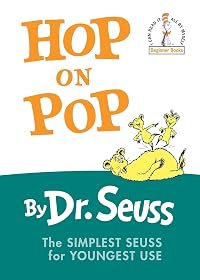
Hop on Pop
by Dr. Seuss
On This Page
Description
Pairs of rhyming words are introduced and used in simple sentences, such as "Day. Play. We play all day. Night. Fight. We fight all night."Tags
Recommendations


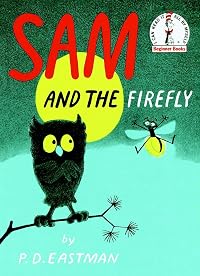
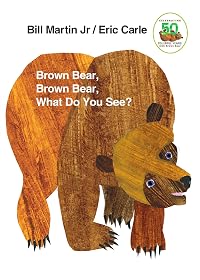

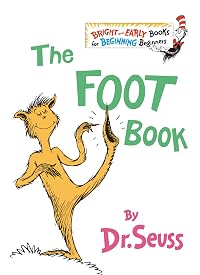
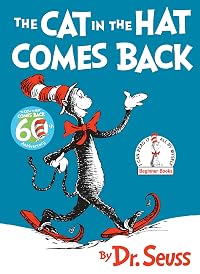






Member Reviews
This is the book that taught me how to read.
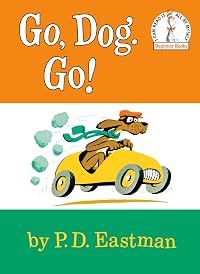
I can remember being curled up with my dad in bed, him reading this to me until I could start to figure out the words. I remember flipping through the book on my own, drunk on massive words such as Timbuktu. I was so happy when I could get through this and [b: Go, Dog, Go!|460548|Go, Dog. Go!|P.D. Eastman|https://images.gr-assets.com/books/1333578440s/460548.jpg|887311] there was such a sense of accomplishment! And both books were just ridiculous, and so entertaining.
Then I learned Hop on Pop was banned. Due to violence.
Did someone really hop on their pop?
The world may never know.
I can remember being curled up with my dad in bed, him reading this to me until I could start to figure out the words. I remember flipping through the book on my own, drunk on massive words such as Timbuktu. I was so happy when I could get through this and [b: Go, Dog, Go!|460548|Go, Dog. Go!|P.D. Eastman|https://images.gr-assets.com/books/1333578440s/460548.jpg|887311] there was such a sense of accomplishment! And both books were just ridiculous, and so entertaining.
Then I learned Hop on Pop was banned. Due to violence.
Did someone really hop on their pop?
The world may never know.
Happily read a bunch of Dr. Seuss decades ago and read this now in support of books being banned currently at many local libraries and as a comeuppance to anyone historically who has sought to do the same. Proudly borrowed from our local library. Banned because it was thought to be too violent and might inspire children to hurt themselves or others. Settle down --it's a delightful romp.
This is such a perfect book for toddlers! I read it to my 1 1/2 year-old granddaughter yesterday while babysitting because she loves the word "hop". She calls bunnies "hop-hops". :D
Anyway, the book has funny illustrations, words that rhyme, and lots of things to talk about. When I told her daddy that I was leaving this book for her, he told me that she already had two other copies of it, one small and one big. Therefore I am taking it home to release soon to another young child.
Anyway, the book has funny illustrations, words that rhyme, and lots of things to talk about. When I told her daddy that I was leaving this book for her, he told me that she already had two other copies of it, one small and one big. Therefore I am taking it home to release soon to another young child.
I like Hop on pop for a couple reasons. The continuous rhyming that occurs makes it very easy to be able to predict how the up coming words and phrases are going to sound. For instance the page goes "Up pup, pup is up." Once you already get the idea of how "up" sounds you already have a sense how pup will sound since "up" is part of pup. The second thing I like about this book is the Illustrations. They are entertainingly bizarre. On one page you have a mouse carrying a house. The people are drawn with what seems like white furry faces. Another page has two bear looking things fighting on a bed like human kids. All of the illustrations are extremely unique, and fun to go through. The bid idea of Hop on Pop I feel is a fun way to learn show more the phonology of words through rhymes and illustrations. I like this concept because reading can be seen as boring by many young students. However if you can use easy rhymes and imagery to keep kids entertained as this book does, they will be much more likely to enjoy reading and greatly benefit from it. show less
“Hop on Pop” is one of many great books that Dr. Seuss has written. First, the book is full of simple rhymes and has a great flow to capture young readers attention. An example of how this book is very accessible to young readers is that each page has a list of words on it and under those given words is a sentence that uses those words. For example, the words “SAD, DAD, BAD, and HAD” are displayed on the page and under those given words the sentence, “Dad is sad. Very, very sad. He had a bad day. What a day Dad had!” is displayed. Next, each illustration throughout the book is unique and perfectly goes along with the given text on each page. Overall, the main idea of this book is the use of rhyming and to help young readers show more learn new words. show less
I like this book for one reason. Most of the book has simple words like hop, pop, and up for beginning readers to start with. When I was working with my English language learner she caught on by sounding out each letter and then combining the sounds to make a word. Ex. H-O-P is Hop. But with other words like Night and Fight were difficult. That is why I don't like this book for beginning readers. Some of the words are just too difficult and the pictures don't really help them make sense of the words in front of them.
Hop on Pop is a book full of simple rhymes with accompanying silly pictures. There isn't really a narrative plot at all, although each spread - and occasionally a full four to six pages - is related, encompassing a mini-story (i.e., "He is after me. Jim is after him.") Because of the lack of story, this isn't one of my most favorites Dr. Seuss books, although it is still funny enough to be engaging for many young children. The simple words also make a good starting place for emergent readers to begin on their own, especially considering how the illustrations can help them decode words they might not know.
Members
- Recently Added By
Lists

Favorite Childhood Books
1,651 works; 519 members
1001 Children's Books You Must Read Before You Grow Up
774 works; 101 members

Picture Book Library
49 works; 7 members

75 Books for Literacy Block: Fall 2016
17 works; 2 members

Brightly Beaming Curriculum Books
281 works; 8 members

Books Read in 2022
5,168 works; 114 members

BitLife
212 works; 4 members

Favorite Picture Books
479 works; 160 members

Written and Illustrated By
805 works; 1 member
Author Information

799+ Works 359,453 Members
Theodor Seuss Geisel was born in Springfield, Massachusetts on March 2, 1904. He wrote and illustrated more than 45 picture books under the pseudonym Dr. Seuss. His first picture book, And to Think That I Saw It on Mulberry Street, was published in 1937. His other books included The Cat in the Hat, The Butter-Battle Book, The Lorax, The Bippolo show more Seed and Other Lost Stories, Fox in Socks: Dr. Seuss's Book of Tongue Tanglers, What Pet Should I Get?, and Oh, the Places You'll Go. In 1984, he received a Pulitzer Prize for his contributions to children's literature. He died of oral cancer on September 24, 1991 at the age of 87. (Bowker Author Biography) show less
Some Editions
Series
Belongs to Publisher Series
Work Relationships
Is contained in
Has the adaptation
Is abridged in
Inspired
Has as a reference guide/companion
Common Knowledge
- Canonical title
- Hop on Pop
- Alternate titles
- Hop on Pop
- Original publication date
- 1963
- First words
- UP
PUP
Pup is up. - Last words
- (Click to show. Warning: May contain spoilers.)Ask me tomorrow but not today.
- Original language
- English
Classifications
Statistics
- Members
- 13,240
- Popularity
- 592
- Reviews
- 136
- Rating
- (3.94)
- Languages
- Chinese, Dutch, English, French
- Media
- Paper, Audiobook, Ebook
- ISBNs
- 51
- UPCs
- 3
- ASINs
- 43