On This Page
Description
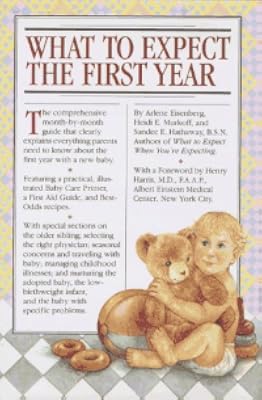
Some things about babies, happily, will never change. They still arrive warm, cuddly, soft, and smelling impossibly sweet. But how moms and dads care for their brand-new bundles of baby joy has changed—and now, so has the new-baby bible.Announcing the completely revised third edition of What to Expect the First Year. With over 10.5 million copies in print, First Year is the world's best-selling, best-loved guide to the instructions that babies don't come with, but should. And now, it's show more better than ever. Every parent's must-have/go-to is completely updated.
Keeping the trademark month-by-month format that allows parents to take the potentially overwhelming first year one step at a time, First Year is easier-to-read, faster-to-flip-through, and new-family-friendlier than ever—packed with even more practical tips, realistic advice, and relatable, accessible information than before. Illustrations are new, too.
Among the changes: Baby care fundamentals—crib and sleep safety, feeding, vitamin supplements—are revised to reflect the most recent guidelines. Breastfeeding gets more coverage, too, from getting started to keeping it going. Hot-button topics and trends are tackled: attachment parenting, sleep training, early potty learning (elimination communication), baby-led weaning, and green parenting (from cloth diapers to non-toxic furniture). An all-new chapter on buying for baby helps parents navigate through today's dizzying gamut of baby products, nursery items, and gear. Also new: tips on preparing homemade baby food, the latest recommendations on starting solids, research on the impact of screen time (TVs, tablets, apps, computers), and "For Parents" boxes that focus on mom's and dad's needs. Throughout, topics are organized more intuitively than ever, for the best user experience possible.
. show less
Tags
Recommendations






Member Reviews
Stylistically, I would have given this book 1 star, but I did learn some useful information, so that ups it to two.
I had two problems with this book. The smaller is that this book is well organized but badly structured. Everything is clearly labeled. Sections are concise. But the overall structure of the book is kind of random. Each monthly chapter has some special topics that it goes in depth on, but those topics could have really gone anywhere in a 4 month time period. Thus, their actual placement in the book becomes rather arbitrary.
The larger thing I dislike is that the book really focuses on risks and avoiding them. The advice is fairly sound, but if you took it all to heart, you would be constantly obsessing about how the world is show more going to hurt your child. As parents, it's important for us to understand what risks are worth protecting against actively, which are worth more passive protection, and which are not worth worrying about.
Overall, I do not quite regret reading this book, but I'm glad that I skimmed much of it. show less
I had two problems with this book. The smaller is that this book is well organized but badly structured. Everything is clearly labeled. Sections are concise. But the overall structure of the book is kind of random. Each monthly chapter has some special topics that it goes in depth on, but those topics could have really gone anywhere in a 4 month time period. Thus, their actual placement in the book becomes rather arbitrary.
The larger thing I dislike is that the book really focuses on risks and avoiding them. The advice is fairly sound, but if you took it all to heart, you would be constantly obsessing about how the world is show more going to hurt your child. As parents, it's important for us to understand what risks are worth protecting against actively, which are worth more passive protection, and which are not worth worrying about.
Overall, I do not quite regret reading this book, but I'm glad that I skimmed much of it. show less
I must admit, I was a noob at parenting. Being the youngest of two, I had absolutely no idea what it was like to take care of a baby. Fortunately, my wife was the oldest of her siblings, and as such, she had a little more parent-fu than I did. However, I found that books written by people on how to not be a noob parent tend to help.
While ultimately, I didn’t like Murkoff’s book, I felt that it (or even something like it) was indispensable for the first few months of parenthood, not for any other reason than the fact that Googling just about anything having to do with babies tends to lead to chat forums that are truly terrifying for somebody who thinks that his newborn is as fragile as a hydrogen-filled balloon.
The advice I heard, show more quoted by Cory Doctorow is: “Pick one book, any book, and only one book.” My take on this advice was that instead of reading every single book you can find in order to be a super parent, all I really needed was a life jacket to keep me afloat as I was hurled into the sea of parenthood. Eventually, though, my inner parent-fu would arise to the surface, and I’d start swimming. The first few weeks were fraught with “what do I do?”s. I’d madly flip through the book, using the index and my best ability to turn my question into something that might have and index entry. I would mark each entry with a finger until I ran out of index entries or fingers, and then read, read, read. Finally, I’d realize: “Oh, that’s natural.” And everybody would get on with their day.
So, as far as parenting books go, this book is possibly just as good as Dr. Spock’s book which is just as good as any other parenting book. Ideally, you should generally agree with the overarching premise of the book (that is, don’t read “A Secular Humanist’s Guide to Raising Offspring,” if you’re a devout Christian, or vice versa). After enough page turning and baby care, your parent muscles will start to come to life. You’ll no longer need diagrams for changing a diaper or burping a baby or knowing which cry means “I’m Hungry” or “I’m Tired” or “Entertain Me.”
That being said, while I owe this book a surmountable debt for helping keep me afloat during the wavy days of noobery (for at least myself and my daughter), in the end, it was not much more than jetsam when my inner parent took the helm.
As I read the book, no longer looking to it like the guru on the hill, but more like any other book of advice, I realized: this book is very preachy. While not taking a definitive stance on any parenting issue unless the APA has done so, the book occasionally uses its rhetoric to imply that certain modes of parenting are “better” than the alternative, which, when going against my inner parent (and more importantly, my wife’s inner parent) didn’t jive. That added to the fact that our baby’s cognitive development is outpacing that of even the exceptional babies in the book led us to wonder what other passages may just be appealing to the lowest common denominator. Like examining your life jacket’s innards and wondering: “how did this sludge save my life?”
It’s because you were kicking your feet and waving your arms.
If you are soon to be a brand-new parent, or looking for a gift for the brand-new parent, this is possibly the least risky path you can go. It wembles enough to not offend most people, but provides a comprehensive (if not logically grouped) coverage of the first year of baby’s life. While ultimately, I found it a good floatation device, your mileage may vary. You may find, however, that any book will do. The important thing is that you’re comfortable, you’re relaxed, and you remember to kick. show less
While ultimately, I didn’t like Murkoff’s book, I felt that it (or even something like it) was indispensable for the first few months of parenthood, not for any other reason than the fact that Googling just about anything having to do with babies tends to lead to chat forums that are truly terrifying for somebody who thinks that his newborn is as fragile as a hydrogen-filled balloon.
The advice I heard, show more quoted by Cory Doctorow is: “Pick one book, any book, and only one book.” My take on this advice was that instead of reading every single book you can find in order to be a super parent, all I really needed was a life jacket to keep me afloat as I was hurled into the sea of parenthood. Eventually, though, my inner parent-fu would arise to the surface, and I’d start swimming. The first few weeks were fraught with “what do I do?”s. I’d madly flip through the book, using the index and my best ability to turn my question into something that might have and index entry. I would mark each entry with a finger until I ran out of index entries or fingers, and then read, read, read. Finally, I’d realize: “Oh, that’s natural.” And everybody would get on with their day.
So, as far as parenting books go, this book is possibly just as good as Dr. Spock’s book which is just as good as any other parenting book. Ideally, you should generally agree with the overarching premise of the book (that is, don’t read “A Secular Humanist’s Guide to Raising Offspring,” if you’re a devout Christian, or vice versa). After enough page turning and baby care, your parent muscles will start to come to life. You’ll no longer need diagrams for changing a diaper or burping a baby or knowing which cry means “I’m Hungry” or “I’m Tired” or “Entertain Me.”
That being said, while I owe this book a surmountable debt for helping keep me afloat during the wavy days of noobery (for at least myself and my daughter), in the end, it was not much more than jetsam when my inner parent took the helm.
As I read the book, no longer looking to it like the guru on the hill, but more like any other book of advice, I realized: this book is very preachy. While not taking a definitive stance on any parenting issue unless the APA has done so, the book occasionally uses its rhetoric to imply that certain modes of parenting are “better” than the alternative, which, when going against my inner parent (and more importantly, my wife’s inner parent) didn’t jive. That added to the fact that our baby’s cognitive development is outpacing that of even the exceptional babies in the book led us to wonder what other passages may just be appealing to the lowest common denominator. Like examining your life jacket’s innards and wondering: “how did this sludge save my life?”
It’s because you were kicking your feet and waving your arms.
If you are soon to be a brand-new parent, or looking for a gift for the brand-new parent, this is possibly the least risky path you can go. It wembles enough to not offend most people, but provides a comprehensive (if not logically grouped) coverage of the first year of baby’s life. While ultimately, I found it a good floatation device, your mileage may vary. You may find, however, that any book will do. The important thing is that you’re comfortable, you’re relaxed, and you remember to kick. show less
This is probably as close to an instruction manual for babies as you can get. It covers a very diverse range of topics. While I didn't agree with all of the advice given, it is a great starting point and has lots of ideas on issues I hadn't thought of or encountered before. I would recommend it for new parents.
Lots and lots and lots of information here. Kinda like a "Baby Bible" of sorts. You can get trustworthy advice on just about any topic concerning your little one here ...beware though, it's a lot of info and for me, had me worrying about things I wouldn't have otherwise even thought about. Still, a great reference book I'll be referring to over the coming year.
Time Machine
4.0 out of 5 stars I Am Buying A Second Book..., May 12, 2005
I see that there has been a great deal written pro and con about this book. Let me then say just a little more in its favor as well as say why I am buying a second book for my family.
In its favor: We have quite a few baby/toddler/preschooler books on our shelves but this remains one of my favorites for the first year. The main reason is it's readability. It is easy to read and reread-which is something first-time moms tend to do (or at least it's what I did). In particular, I was absorbed by the milestones; alternately pleased or concerned as the months came and went. But what fun to be able enjoy this new aspect of life with my babies.
Book 2 Project: One of show more things I did as the months passed was to write down when my children reached their milestones. I am buying another book in order to copy my remarks so that I will have one to give to each of my children so that when they have their own babies they can compare and contrast their children's development with what is written in their personal books.
Summary: not all of the information in What to Expect is without controversy. Personally, I don't think that there is anything wrong with the family bed and extended breast feeding. We did one but not the other. In any case, my advice would be to not let any single book be your only source of information. Read, read, read. Go to the library with your newborn. A good habit to develop for later on. Include a healthy dose of Brazelton, Sears, Leach and even Spock in your diet.
And don't be afraid to add this excellent book to your shelves. show less
4.0 out of 5 stars I Am Buying A Second Book..., May 12, 2005
I see that there has been a great deal written pro and con about this book. Let me then say just a little more in its favor as well as say why I am buying a second book for my family.
In its favor: We have quite a few baby/toddler/preschooler books on our shelves but this remains one of my favorites for the first year. The main reason is it's readability. It is easy to read and reread-which is something first-time moms tend to do (or at least it's what I did). In particular, I was absorbed by the milestones; alternately pleased or concerned as the months came and went. But what fun to be able enjoy this new aspect of life with my babies.
Book 2 Project: One of show more things I did as the months passed was to write down when my children reached their milestones. I am buying another book in order to copy my remarks so that I will have one to give to each of my children so that when they have their own babies they can compare and contrast their children's development with what is written in their personal books.
Summary: not all of the information in What to Expect is without controversy. Personally, I don't think that there is anything wrong with the family bed and extended breast feeding. We did one but not the other. In any case, my advice would be to not let any single book be your only source of information. Read, read, read. Go to the library with your newborn. A good habit to develop for later on. Include a healthy dose of Brazelton, Sears, Leach and even Spock in your diet.
And don't be afraid to add this excellent book to your shelves. show less
I think this is one of those books that all moms to be read, memorize, and repeatedly turn to. Written in a very accessible form and not written to scare or chastise moms (like we need more stress).
Like the pregnancy book in the same series this was very useful and comprehensive. From reading it compulsively the first few months I stopped bothering at all by about 8 or 9 months, but it was really handy at times of tearing my hair out or when my daughter got ill etc.
Members
- Recently Added By
Lists

You Couldn't Pay Me to Read That (Take 2)
213 works; 87 members
Author Information

Heidi Murkoff is the author of the world's best-selling pregnancy and parenting series, What to Expect, that began with What to Expect When You're Expecting. She is also the creator of WhatToExpect.com and founder of the What to Expect Foundation. Time magazine named Heidi one of the 100 Most Influential People in the World for 2011. In 2005, she show more was inducted into the Books For A Better Life Hall of Fame. Heidi Murkoff conceived the idea for What to Expect When You're Expecting during her first pregnancy, when she couldn't find answers to her questions in the books she¿d turned to for advice. The The New York Times bestseller is now in its fourth edition, with more than 17 million copies in print. According to USA Today, What to Expect When You're Expecting is read by 93 percent of women who read a pregnancy book. USA Today also named What to Expect When You're Expecting one of the most influential books of the last 25 years. The sequel, What to Expect: The First Year, has sold over 10 million copies and is in its 2nd edition. Other titles in the series include What to Eat When You're Expecting, What to Expect Before You're Expecting (a complete preconception plan), and the newest member of the What to Expect series: What to Expect: the Second Year, the must-have guide for parents of toddlers. The What to Expect books have sold more than 34 million copies in the U.S. alone and are published in more than 30 languages. Murkoff's What to Expect Kids picture book series for preschoolers include What to Expect When Mommy's Having a Baby, What to Expect When the New Baby Comes Home, What to Expect When You Use the Potty, and What to Expect at Preschool. In 2005, Murkoff expanded the What to Expect (WTE) brand online with www.whattoexpect.com as a companion to the books. In 2009, WTE went mobile with the WTE Pregnancy Tracker (a popular pregnancy app), the WTE Fertility Tracker, the WTE Baby Name Finder, and the WTE First Year Tracker. (Bowker Author Biography) show less
All Editions
Some Editions
Series

Belongs to Publisher Series
Work Relationships
Common Knowledge
- Canonical title
- What To Expect the First Year
- Original title
- What To Expect The First Year
- Alternate titles*
- Da 0 a 365 giorni
- Original publication date
- 1989
- Dedication
- To Emma and Wyatt, Rachel and Ethan
for the magical, memorable first years each of you gave us
To our partners in parenting, Howard, Erik and Tim
without whom we couldn't have made it through those first years - First words
- A new baby is fun and exciting, but anxiety provoking, too. [Foreword, 1996 edition]
It seemed so simple and so certain. I would walk into the hospital pregnant and walk out a mother. [Introduction, 1996 edition]
After nearly nine months of waiting, there's finally a light at the end of the tunnel (perhaps, even, effacement and dilation at the end of the cervix). But with just weeks to go before B-Day arrives, have you yet come to ter... (show all)ms with your baby coming to term? [Chapter One, 1996 edition] - Last words
- (Click to show. Warning: May contain spoilers.)And you can expect these years, when you'll often feel more like a referee than a parent, to be a constant challenge to your patience and your ingenuity – as well as a joy. [Chapter Twenty-Six, 1996 edition]
- Original language
- English
*Some information comes from Common Knowledge in other languages. Click "Edit" for more information.
Classifications
- Genres
- Nonfiction, Health & Wellness, General Nonfiction
- DDC/MDS
- 649.122 — Applied science & technology Home economics & family management Child rearing; home care of people with illnesses and disabilities by family and friends Parenting Parenting Children by Age Babies
- LCC
- HQ774 .E47 — Social sciences The family. Marriage, Women and Sexuality The Family. Marriage. Women The family. Marriage. Home Children. Child development
- BISAC
Statistics
- Members
- 2,716
- Popularity
- 6,843
- Reviews
- 26
- Rating
- (3.62)
- Languages
- 11 — Catalan, Chinese, Dutch, English, French, German, Italian, Polish, Spanish, Turkish, Portuguese (Portugal)
- Media
- Paper, Audiobook, Ebook
- ISBNs
- 54
- UPCs
- 5
- ASINs
- 22