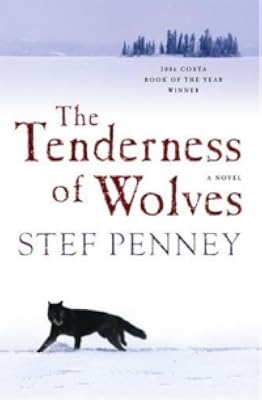
The Tenderness of Wolves
by Stef Penney
On This Page
Description
1867. Winter has just tightened its grip on Dove River, an isolated settlement in Canada's Northern Territory, when a man is brutally murdered. A local woman, Mrs. Ross, stumbles upon the crime scene and sees tracks leading from the dead man's cabin north toward the forest and the tundra beyond. But soon she makes another discovery: her son has disappeared and is now considered a prime suspect. A variety of outsiders are drawn to the crime and to the township--but do they want to solve the show more crime or exploit it? One by one, searchers set out to follow the tracks across a desolate landscape, variously seeking a murderer, a son, two sisters missing for seventeen years, and a forgotten Native American culture before the snows settle and cover the tracks of the past for good.--From publisher description. show lessTags
Recommendations


























Member Recommendations

Member Reviews
Set in 1860s Canada, this intriguing novel traces the interweaving paths of various Indian tribes, along with Scottish, French and Norwegian settlers, as searchers fight frostbite and competing loyalties in their hunt for a murderer. Penney explores her characters' sexual, familial and ethnic identities just as surely as they track each other's paths through the wilderness.
SCORE: A
SCORE: A
The Tenderness of Wolves is an immensely readable novel falling somewhere between historical, crime and "family" genres. Penney juggles multiple perspectives believably, and her plot sets a cracking pace that's easy to follow through to the end.
In the sleepy village of Dove River, local hunter Laurent is found dead. Mrs Ross - a prickly housewife with a checkered past - gets drawn into the mystery along with her loved ones.
This is an impressive debut: Penney writes with an assurance and self-discipline that's frequently missing from first novels. Her prose - at least, in this hot Australian summer - is wonderfully evocative of the chilly Canadian climes, and her characterisation is sometimes blunt, but very effective.
Writing multiple show more perspectives can be a challenge for any writer. It's easy to lose distinctive voice - or slip into caricature trying to avoid it. You can leave readers frustrated by a lack of closure for all your characters, or frustrated waiting for "favourites" to resurface. Penney manages to not only keep a medium-sized cast distinct, but she imbues each character with an arc of sorts, and a full suite of desires, fears and hopes. And they are all interesting, human, believable people.
Indeed, she does this so well, it's easy to forget quite how difficult it can be. One reason for this is the relentless narrative driving the book forward from nearly its opening page. Ostensibly a mystery, but frequently subsumed by the more urgent needs of the characters, this narrative captures a sense of fragility that the early immigrants would have felt.
Better yet, she wraps it up perfectly, eschewing easy answers for something satisfying, but not too neat or perfect. By the end of The Tenderness of Wolves, there remain nearly as many questions as at the start, but they are new questions for new stories.
A very entertaining read, this one. Slyly intelligent underneath its genre trappings. show less
In the sleepy village of Dove River, local hunter Laurent is found dead. Mrs Ross - a prickly housewife with a checkered past - gets drawn into the mystery along with her loved ones.
This is an impressive debut: Penney writes with an assurance and self-discipline that's frequently missing from first novels. Her prose - at least, in this hot Australian summer - is wonderfully evocative of the chilly Canadian climes, and her characterisation is sometimes blunt, but very effective.
Writing multiple show more perspectives can be a challenge for any writer. It's easy to lose distinctive voice - or slip into caricature trying to avoid it. You can leave readers frustrated by a lack of closure for all your characters, or frustrated waiting for "favourites" to resurface. Penney manages to not only keep a medium-sized cast distinct, but she imbues each character with an arc of sorts, and a full suite of desires, fears and hopes. And they are all interesting, human, believable people.
Indeed, she does this so well, it's easy to forget quite how difficult it can be. One reason for this is the relentless narrative driving the book forward from nearly its opening page. Ostensibly a mystery, but frequently subsumed by the more urgent needs of the characters, this narrative captures a sense of fragility that the early immigrants would have felt.
Better yet, she wraps it up perfectly, eschewing easy answers for something satisfying, but not too neat or perfect. By the end of The Tenderness of Wolves, there remain nearly as many questions as at the start, but they are new questions for new stories.
A very entertaining read, this one. Slyly intelligent underneath its genre trappings. show less
In this historical fiction set in the Canadian wilderness in the mid-19th century, a French-Canadian trapper living near an isolated village is found murdered in his bed. Our protagonist, Mrs. Ross, discovers the body and alerts the authorities. Upon returning home she finds that her seventeen-year-old son, Francis, a friend of the murdered man, has disappeared. Suspicion falls upon her son and a mixed-race tracker. After her husband searches, but fails to find Francis, she and the tracker set off to locate him and determine what happened. This book contains an intricately woven mystery, with several subordinate mysteries embedded into the main storyline. The Canadian legacy of fur-trapping and the Hudson Bay Company play an important show more role in the narrative.
This book is filled with striking characters, such as the ambitious and ruthless company-man in charge of the investigation, his inexperienced assistant whose heart is in the right place but makes questionable decisions, two daughters of the town magistrate that engender romantic feelings in the assistant, and a Native American guide serving as a personal protector. The author offers insight into human motivations, complexities and incongruities of character, and the yearning for answers, sometimes at the cost of inventing a solution.
It is divided into four sections with many short chapters using different narrative perspectives. The setting becomes a significant part of the story. The writing style is eloquent. The atmospheric descriptions of the harsh landscape of the Canadian winter deliver an almost palpable feeling of icy desolation. Like the titular wolf, people can be misunderstood or judged by their appearance. The author deftly explores this theme in subtle ways throughout the story, showing we are often wrong about that which we do not understand.
An amazing amalgamation of history, adventure, betrayal, tragic loss, and forbidden love, it is not solely a riveting mystery but also an impressive literary achievement. Highly recommended. show less
This book is filled with striking characters, such as the ambitious and ruthless company-man in charge of the investigation, his inexperienced assistant whose heart is in the right place but makes questionable decisions, two daughters of the town magistrate that engender romantic feelings in the assistant, and a Native American guide serving as a personal protector. The author offers insight into human motivations, complexities and incongruities of character, and the yearning for answers, sometimes at the cost of inventing a solution.
It is divided into four sections with many short chapters using different narrative perspectives. The setting becomes a significant part of the story. The writing style is eloquent. The atmospheric descriptions of the harsh landscape of the Canadian winter deliver an almost palpable feeling of icy desolation. Like the titular wolf, people can be misunderstood or judged by their appearance. The author deftly explores this theme in subtle ways throughout the story, showing we are often wrong about that which we do not understand.
An amazing amalgamation of history, adventure, betrayal, tragic loss, and forbidden love, it is not solely a riveting mystery but also an impressive literary achievement. Highly recommended. show less
I liked the pace of this novel -- a balance between activity and reflection. As I read it, a few linguistic anachronisms stood out, but in the end I don't think it matters. I don't believe this was meant to be first and foremost a historical novel.
The author's use of multiple narrators allows the reader to learn more than any single character in the book. The characters act based upon their individual perceptions and limited knowledge of situations or events, often lacking information that might have altered his or her course of action. The decisions the characters faced were more subtle than choosing between right and wrong; the characters had to identify their desired outcome, then choose the option most likely to achieve their show more desired outcome.
The novel reminded me that seemingly insignificant decisions I make may be of great consequence to someone else. It also reminded me to be charitable toward others who act differently than I think I would under the same conditions, because they may know something that I don't know. show less
The author's use of multiple narrators allows the reader to learn more than any single character in the book. The characters act based upon their individual perceptions and limited knowledge of situations or events, often lacking information that might have altered his or her course of action. The decisions the characters faced were more subtle than choosing between right and wrong; the characters had to identify their desired outcome, then choose the option most likely to achieve their show more desired outcome.
The novel reminded me that seemingly insignificant decisions I make may be of great consequence to someone else. It also reminded me to be charitable toward others who act differently than I think I would under the same conditions, because they may know something that I don't know. show less
The icy chill of a 19th century Canadian winter is palpable throughout British author Penney’s accomplished debut. Seventeen-year-old Francis Ross disappeared from the town of Dove River on the Georgian Bay the same day his mother discovers the scalped corpse of the boy’s friend Laurent Jammet, a fur trader and former employee of the all-powerful Hudson Bay Company. The sensational murder brings outsiders to the small community: young, earnest Company representative Donald Moody, who’s there to help investigate the crime; and aging former tracker and Native American sympathizer Thomas Sturrock, who hopes to recover a carved bit of bone that had been in the trapper’s possession and which might provide valuable archaeological show more proof of an ancient Native written language. Unfortunately for Mrs. Ross, there are no obvious suspects other than her missing son—until half-Native trapper William Parker is caught searching the dead man’s house. When Parker is released, Mrs. Ross enlists him to help her go after her son and whoever her son had followed into the wilderness, hoping to prove Francis innocent of the crime.
Atmospheric and complex, the intertwined stories of Penney’s vibrant cast of loners and outsiders are absorbing, and Penney’s choice of time and place is a perfect backdrop. show less
Atmospheric and complex, the intertwined stories of Penney’s vibrant cast of loners and outsiders are absorbing, and Penney’s choice of time and place is a perfect backdrop. show less
The tenderness of wolves
I love curling up with a good book, whatever the season.
You might find me on a sun lounger in summer or on a park bench in Autumn, but you'll never find me without a book in my hand and another in my bag. (You never know when you'll get Bonus Reading Time.)
In Winter I particularly enjoy snuggling up with books which have a properly cold setting. Recently this has included fantastic stories set in the Arctic Circle ('The One Memory of Flora Banks'), Antartica ('Devour'), Communist East Germany ('Stasi Child' - this cold may be more metaphorical!) and Canada - 'The Tenderness of Wolves'.
What's it about?
When a man is found brutally murdered and a seventeen year old boy goes missing, the boy's mother decides to find show more him in order to clear his name.
Their life in a frontiership town has always been tough, but the forest is a foreign and frightening place, and winter is closing in... Can Mrs Ross find her son before the Company hunters can? What exactly was his connection to the dead trapper? And can investigating this new mystery help resolve a decades old one?
Favourite quotes:
'She considers herself a well-traveled woman, and from each place she has been to, she has brought away a prejudice as a souvenir.'
'And so while my husband sleeps upstairs - we pack and I prepare to go into the wilderness with a suspected killer. What's worse, a man I haven't been properly introduced to.'
What's it like?
Slow paced. Lovely to read (the writing is beautiful). Deliciously evocative of life in the Canadian wilderness.
There's a panoramic quality to the writing which meant I wasn't surprised to learn that debut novelist Steph Penney had written and directed two films prior to writing this novel.
This is a mixture of genres - a dose of romance, a tale of life in the wilderness, a dash of mystery and more than a hint of Canadian Western. The resulting story does feel a little lacking in focus at times: a key plot device is finally reduced to little more than a macguffin, and whole characters have fully fleshed out storylines that are ultimately almost irrelevant to the main narrative thread (yes I mean you, Line, and you, entire population of Himmelvanger).
One of the many strengths of Penney's book is her evocation of place. The setting - especially the increasing coldness - is firmly felt throughout:
"The cold is like a hand that is laid with gentle but implacable force on the snow, telling it to stay."
Final thoughts
Ultimately, Penney captures the daily rigour of life on the seventeenth century Canadadian frontier by following the threads of disparate lives - where they've been, where they wanted to go, where they may yet go.
There's a certain sadness to all the endings which is wonderfully realistic without being too brutal. Not all the loose ends are tied up, but the central mystery is resolved. I found the conclusion of Mrs Ross' story particularly moving.
This book was such a resounding success with my entire book group - a rarity! - that no-one even noticed the occasionally rather modern dialogue.
("Geez. Keep a girl waiting, why don't you."
"Sorry. Um... it's just that, I'll have to speak to my Dad, to see if he wants me to work....first. Thanks though. It sounds nice."
To be fair to Penney, only the younger characters speak this way, so in that sense the dialogue is perfectly appropriate, which may be why such anachronisms passed by seasoned readers without comment.)
In fact my best efforts to stir up debate and dissension resulted in increasingly positive commentary from the entire group. And I was only drawing their attention to possible flaws in an effort to widen the scope of the discussion: I'd thoroughly enjoyed reading 'The Tenderness of Wolves' too.
(Note to self: seek out a batch of Steph Penney's second novel, 'The Invisible Ones', to see if it is possible to repeat this possibly unprecedented success.)
A gentle, delightful tale of harsh lives and harsher weather, wolves, furs, taboos, and the madness that is born of loneliness.
Recommended. show less
I love curling up with a good book, whatever the season.
You might find me on a sun lounger in summer or on a park bench in Autumn, but you'll never find me without a book in my hand and another in my bag. (You never know when you'll get Bonus Reading Time.)
In Winter I particularly enjoy snuggling up with books which have a properly cold setting. Recently this has included fantastic stories set in the Arctic Circle ('The One Memory of Flora Banks'), Antartica ('Devour'), Communist East Germany ('Stasi Child' - this cold may be more metaphorical!) and Canada - 'The Tenderness of Wolves'.
What's it about?
When a man is found brutally murdered and a seventeen year old boy goes missing, the boy's mother decides to find show more him in order to clear his name.
Their life in a frontiership town has always been tough, but the forest is a foreign and frightening place, and winter is closing in... Can Mrs Ross find her son before the Company hunters can? What exactly was his connection to the dead trapper? And can investigating this new mystery help resolve a decades old one?
Favourite quotes:
'She considers herself a well-traveled woman, and from each place she has been to, she has brought away a prejudice as a souvenir.'
'And so while my husband sleeps upstairs - we pack and I prepare to go into the wilderness with a suspected killer. What's worse, a man I haven't been properly introduced to.'
What's it like?
Slow paced. Lovely to read (the writing is beautiful). Deliciously evocative of life in the Canadian wilderness.
There's a panoramic quality to the writing which meant I wasn't surprised to learn that debut novelist Steph Penney had written and directed two films prior to writing this novel.
This is a mixture of genres - a dose of romance, a tale of life in the wilderness, a dash of mystery and more than a hint of Canadian Western. The resulting story does feel a little lacking in focus at times: a key plot device is finally reduced to little more than a macguffin, and whole characters have fully fleshed out storylines that are ultimately almost irrelevant to the main narrative thread (yes I mean you, Line, and you, entire population of Himmelvanger).
One of the many strengths of Penney's book is her evocation of place. The setting - especially the increasing coldness - is firmly felt throughout:
"The cold is like a hand that is laid with gentle but implacable force on the snow, telling it to stay."
Final thoughts
Ultimately, Penney captures the daily rigour of life on the seventeenth century Canadadian frontier by following the threads of disparate lives - where they've been, where they wanted to go, where they may yet go.
There's a certain sadness to all the endings which is wonderfully realistic without being too brutal. Not all the loose ends are tied up, but the central mystery is resolved. I found the conclusion of Mrs Ross' story particularly moving.
This book was such a resounding success with my entire book group - a rarity! - that no-one even noticed the occasionally rather modern dialogue.
("Geez. Keep a girl waiting, why don't you."
"Sorry. Um... it's just that, I'll have to speak to my Dad, to see if he wants me to work....first. Thanks though. It sounds nice."
To be fair to Penney, only the younger characters speak this way, so in that sense the dialogue is perfectly appropriate, which may be why such anachronisms passed by seasoned readers without comment.)
In fact my best efforts to stir up debate and dissension resulted in increasingly positive commentary from the entire group. And I was only drawing their attention to possible flaws in an effort to widen the scope of the discussion: I'd thoroughly enjoyed reading 'The Tenderness of Wolves' too.
(Note to self: seek out a batch of Steph Penney's second novel, 'The Invisible Ones', to see if it is possible to repeat this possibly unprecedented success.)
A gentle, delightful tale of harsh lives and harsher weather, wolves, furs, taboos, and the madness that is born of loneliness.
Recommended. show less
In this historical fiction set in the Canadian wilderness in the mid-19th century, a French-Canadian trapper living near an isolated village is found murdered in his bed. Our protagonist, Mrs. Ross, discovers the body and alerts the authorities. Upon returning home she finds that her seventeen-year-old son, Francis, a friend of the murdered man, has disappeared. Suspicion falls upon her son and a mixed-race tracker. After her husband searches, but fails to find Francis, she and the tracker set off to locate him and determine what happened. This book contains an intricately woven mystery, with several subordinate mysteries embedded into the main storyline. The Canadian legacy of fur-trapping and the Hudson Bay Company play an important show more role in the narrative.
This book is filled with striking characters, such as the ambitious and ruthless company-man in charge of the investigation, his inexperienced assistant whose heart is in the right place but makes questionable decisions, two daughters of the town magistrate that engender romantic feelings in the assistant, and a Native American guide serving as a personal protector. The author offers insight into human motivations, complexities and incongruities of character, and the yearning for answers, sometimes at the cost of inventing a solution.
It is divided into four sections with many short chapters using different narrative perspectives. The setting becomes a significant part of the story. The writing style is eloquent. The atmospheric descriptions of the harsh landscape of the Canadian winter deliver an almost palpable feeling of icy desolation. Like the titular wolf, people can be misunderstood or judged by their appearance. The author deftly explores this theme in subtle ways throughout the story, showing we are often wrong about that which we do not understand.
An amazing amalgamation of history, adventure, betrayal, tragic loss, and forbidden love, it is not solely a riveting mystery but also an impressive literary achievement. Highly recommended. show less
This book is filled with striking characters, such as the ambitious and ruthless company-man in charge of the investigation, his inexperienced assistant whose heart is in the right place but makes questionable decisions, two daughters of the town magistrate that engender romantic feelings in the assistant, and a Native American guide serving as a personal protector. The author offers insight into human motivations, complexities and incongruities of character, and the yearning for answers, sometimes at the cost of inventing a solution.
It is divided into four sections with many short chapters using different narrative perspectives. The setting becomes a significant part of the story. The writing style is eloquent. The atmospheric descriptions of the harsh landscape of the Canadian winter deliver an almost palpable feeling of icy desolation. Like the titular wolf, people can be misunderstood or judged by their appearance. The author deftly explores this theme in subtle ways throughout the story, showing we are often wrong about that which we do not understand.
An amazing amalgamation of history, adventure, betrayal, tragic loss, and forbidden love, it is not solely a riveting mystery but also an impressive literary achievement. Highly recommended. show less
Members
- Recently Added By
Published Reviews
ThingScore 75
I read The Tenderness of Wolves and fell into the story right away; the characters were well drawn and Penney is able to lead the reader from one page to the next.
added by mikeg2
There are few things like an endless vista to make a novel seem really gratifyingly contained. The novel itself comes to seem like a fragile bubble of consciousness beyond whose limits is a threatening void. (And that's what novels, in one essential manner, are.) And living in the rudimentary civilisation of mid 19th-century Canada must have been like living in a novel: there is nothing to show more concentrate on except the flawed characters of your fellow human beings, and the spoor left by their movements. And that, in a way, is all The Tenderness of Wolves is about. show less
added by souloftherose
Lists

Favourite Women's Prize for Fiction, Orange & Bailey's Prize contenders
132 works; 52 members

Historical Fiction
889 works; 89 members

Recommend the 20 best books you've read in the last five years
2,168 works; 606 members

Books Set in Canada
80 works; 16 members

Winter Books
127 works; 17 members

Female Author
1,235 works; 67 members

Majkia's Mystery/ Thriller TBR
86 works; 3 members

Carole's List
445 works; 13 members

Books Read in 2022
5,164 works; 113 members

5 Best 5 Years
71 works; 4 members

A Novel Cure
742 works; 23 members

Most Popular Books Tagged Canada
34 works; 1 member

Canada
42 works; 3 members
Canadian Historical Fiction 🇨🇦
157 works; 8 members

Elaina's
183 works; 1 member
Author Information

7+ Works 3,656 Members
Some Editions
Awards and Honors
Awards
Distinctions
Notable Lists
Series
Belongs to Publisher Series
Les ales esteses (260)
Common Knowledge
- Canonical title
- The Tenderness of Wolves
- Original title
- The Tenderness of Wolves
- Original publication date
- 2006
- People/Characters
- Mrs. Ross; Francis Ross (son of Mrs. Ross); William Parker; Donald Moody; Thomas Sturrock; Laurent Jammet (Quebecois trapper) (show all 13); Hudson's Bay Company; John Scott; Andrew Knox; Angus Ross; Maria Knox; Susannah Knox; Mr. Mackinley
- Important places
- Dove River (fictional town); Caulfield (fictional town); Upper Canada (present-day Ontario, Canada); Northern Ontario, Canada; Sault Ste. Marie, Ontario, Canada
- Dedication
- For my parents
- First words
- The last time I saw Laurent Jammet, he was in Scott's store with a dead wolf over his shoulder.
Laurenta Jammeta sem nazadnje videla v Scottovi trgovini z mrtvim volkom čez ramo. - Last words
- (Click to show. Warning: May contain spoilers.)For what else can any of us do?
- Blurbers
- Pyper, Andrew; Boyden, Joseph; Kantner, Seth; Quarrington, Paul
- Original language*
- Englisch
- Canonical DDC/MDS
- 823.92
- Canonical LCC
- PR6116.E58
*Some information comes from Common Knowledge in other languages. Click "Edit" for more information.
Classifications
Statistics
- Members
- 2,731
- Popularity
- 6,714
- Reviews
- 141
- Rating
- (3.77)
- Languages
- 15 — Catalan, Danish, Dutch, English, Estonian, Finnish, French, German, Greek, Italian, Norwegian (Bokmål), Slovenian, Spanish, Swedish, Portuguese (Portugal)
- Media
- Paper, Audiobook, Ebook
- ISBNs
- 45
- ASINs
- 14