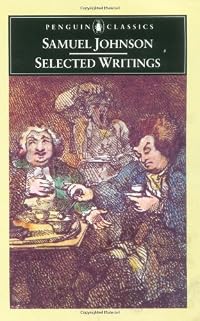
Selected Writings (Penguin Classics)
by Samuel Johnson 
On This Page
Description
Thanks to Boswell's monumental biography of Samuel Johnson, we remember Dr. Johnson today as a great wit and conversationalist, the rationalist epitome and the sage of the Enlightenment. But in Johnson's own day, he was best known as an essayist, critic, and lexicographer. At the center of this collection are the periodical essays from the Rambler, Adventurer, and Idler. Together, these works - allied in their literary, social, and moral concerns - are the ones that continue to speak show more urgently to readers today. show lessTags
Recommendations















Member Reviews
I'm finding it a very good brain workout to clamber through Johnson's magisterial Augustan prose and figure out his meaning; usually still very apt and wise. Human nature doesn't change much; Johnson appears to have predicted Brexit:
"How rarely reason guides the stubborn choice,
Rules the bold hand, or prompts the suppliant voice;
How nations sink, by darling schemes oppress'd,
When vengeance listens to the fool's request"
(Vanity of Human Wishes)
and the downside of social media:
"That the highest degree of reverence should be paid to youth, and that nothing indecent should be suffered to approach their eyes or ears..... the same kind, though not the same degree, of caution, is required in every thing which is laid before them, to secure show more them from unjust prejudices, perverse opinions, and incongruous combinations of images"
(The Rambler, 31 March 1750)
and the rise of Trump:
"The Roarer....has no other qualification for a champion of controversy than a hardened front and strong voice. Having seldom so much desire to confute as to silence, he depends rather upon vociferation than argument, and has very little care to adjust one part of his accusation to another, to preserve decency in his language, or probability in his narratives. He has always a score of reproachful epithets and contemptuous appellations, ready to be produced as occasion may require, which by constant use he pours out with resistless volubility."
(The Rambler, 3 August 1751) show less
"How rarely reason guides the stubborn choice,
Rules the bold hand, or prompts the suppliant voice;
How nations sink, by darling schemes oppress'd,
When vengeance listens to the fool's request"
(Vanity of Human Wishes)
and the downside of social media:
"That the highest degree of reverence should be paid to youth, and that nothing indecent should be suffered to approach their eyes or ears..... the same kind, though not the same degree, of caution, is required in every thing which is laid before them, to secure show more them from unjust prejudices, perverse opinions, and incongruous combinations of images"
(The Rambler, 31 March 1750)
and the rise of Trump:
"The Roarer....has no other qualification for a champion of controversy than a hardened front and strong voice. Having seldom so much desire to confute as to silence, he depends rather upon vociferation than argument, and has very little care to adjust one part of his accusation to another, to preserve decency in his language, or probability in his narratives. He has always a score of reproachful epithets and contemptuous appellations, ready to be produced as occasion may require, which by constant use he pours out with resistless volubility."
(The Rambler, 3 August 1751) show less
Nobody reads [a:Samuel Johnson|22191|Samuel Johnson|https://d202m5krfqbpi5.cloudfront.net/authors/1209488222p2/22191.jpg] anymore. There are a lot of misconceptions about his conservatism that tend to make moderns think his scribbles irrelevant nowadays. This is unfortunate because a lot of what he says is sensible and the way he states it is still lively even today. I guess I'm used to archaic language so that makes it easier for me sometimes.
The present volume contains selections from journalism, the Dictionary, Shakespeare, Lives of the poets, poetry, journals, letters. I'm not knowledgeable enough to know if the selection is truly "the best."
The main thing about Johnson is not so much what he is saying but how he says it. I wish I show more could wrap my feeble vocabulary around things as concisely and as incisively as Johnson does. The real pleasure in reading it is the words themselves and how they are constructed as much as the message. Admittedly you have to be into the language as language itself to appreciate Johnson in this way and it is true that many of his notions are irrelevant or old fashioned by today's standards.
The only problem with a book like this is it only gives a taste of each aspect of Johnson's life and writings. The complete longer pieces: London and Life of Savage whet the appetite but the rest of the book is just excerpts and leaves one longing for the entire. I would say that in this volume the most interesting piece is the excerpt from [b:A Journey to the Western Islands of Scotland and The Journal of a Tour to the Hebrides|341292|A Journey to the Western Islands of Scotland and The Journal of a Tour to the Hebrides|Samuel Johnson|https://d202m5krfqbpi5.cloudfront.net/books/1389141282s/341292.jpg|679562] and I would seek out the complete edition plus Boswell's [b:A Journey to the Western Islands of Scotland and The Journal of a Tour to the Hebrides|341292|A Journey to the Western Islands of Scotland and The Journal of a Tour to the Hebrides|Samuel Johnson|https://d202m5krfqbpi5.cloudfront.net/books/1389141282s/341292.jpg|679562] companion volume of the same journey.
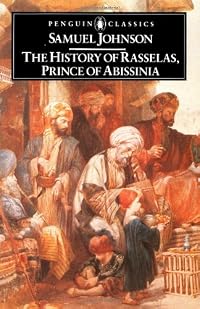
The only other criticism I have is there is nothing from [b:The History of Rasselas, Prince of Abissinia|1941055|The History of Rasselas, Prince of Abissinia|Samuel Johnson|https://d202m5krfqbpi5.cloudfront.net/books/1349059844s/1941055.jpg|920095]. show less
The present volume contains selections from journalism, the Dictionary, Shakespeare, Lives of the poets, poetry, journals, letters. I'm not knowledgeable enough to know if the selection is truly "the best."
The main thing about Johnson is not so much what he is saying but how he says it. I wish I show more could wrap my feeble vocabulary around things as concisely and as incisively as Johnson does. The real pleasure in reading it is the words themselves and how they are constructed as much as the message. Admittedly you have to be into the language as language itself to appreciate Johnson in this way and it is true that many of his notions are irrelevant or old fashioned by today's standards.
The only problem with a book like this is it only gives a taste of each aspect of Johnson's life and writings. The complete longer pieces: London and Life of Savage whet the appetite but the rest of the book is just excerpts and leaves one longing for the entire. I would say that in this volume the most interesting piece is the excerpt from [b:A Journey to the Western Islands of Scotland and The Journal of a Tour to the Hebrides|341292|A Journey to the Western Islands of Scotland and The Journal of a Tour to the Hebrides|Samuel Johnson|https://d202m5krfqbpi5.cloudfront.net/books/1389141282s/341292.jpg|679562] and I would seek out the complete edition plus Boswell's [b:A Journey to the Western Islands of Scotland and The Journal of a Tour to the Hebrides|341292|A Journey to the Western Islands of Scotland and The Journal of a Tour to the Hebrides|Samuel Johnson|https://d202m5krfqbpi5.cloudfront.net/books/1389141282s/341292.jpg|679562] companion volume of the same journey.
The only other criticism I have is there is nothing from [b:The History of Rasselas, Prince of Abissinia|1941055|The History of Rasselas, Prince of Abissinia|Samuel Johnson|https://d202m5krfqbpi5.cloudfront.net/books/1349059844s/1941055.jpg|920095]. show less
Ratings
Members
- Recently Added By
Published Reviews
ThingScore 75
added by Shortride
Lists

Books talked about in Pamela Dean's Tam Lin
74 works; 1 member
Author Information

491+ Works 9,446 Members
Samuel Johnson was born in 1709, in Lichfield, England. The son of a bookseller, Johnson briefly attended Pembroke College, Oxford, taught school, worked for a printer, and opened a boarding academy with his wife's money before that failed. Moving to London in 1737, Johnson scratched out a living from writing. He regularly contributed articles and show more moral essays to journals, including the Gentleman's Magazine, the Adventurer, and the Idler, and became known for his poems and satires in imitation of Juvenal. Between 1750 and 1752, he produced the Rambler almost single-handedly. In 1755 Johnson published Dictionary of the English Language, which secured his place in contemporary literary circles. Johnson wrote Rasselas in a week in 1759, trying to earn money to visit his dying mother. He also wrote a widely-read edition of Shakespeare's plays, as well as Journey to the Western Isles of Scotland and Lives of the Poets. Johnson's writing was so thoughtful, powerful, and influential that he was considered a singular authority on all things literary. His stature attracted the attention of James Boswell, whose biography, Life of Johnson, provides much of what we know about its subject. Johnson died in 1784. (Bowker Author Biography) show less
Samuel Johnson has a Legacy Library. Legacy libraries are the personal libraries of famous readers, entered by LibraryThing members from the Legacy Libraries group.
Series
Belongs to Publisher Series
Classifications
- Genres
- Fiction and Literature, Literature Studies and Criticism
- DDC/MDS
- 828.609 — Literature & rhetoric English & Old English literatures English miscellaneous writings English miscellaneous writings 1745-1799
- LCC
- PR3522 .M25 — Language and Literature English English Literature 17th and 18th centuries (1640-1770)
- BISAC
Statistics
- Members
- 235
- Popularity
- 137,994
- Reviews
- 2
- Rating
- (4.36)
- Languages
- English
- Media
- Paper, Ebook
- ISBNs
- 4
- ASINs
- 5