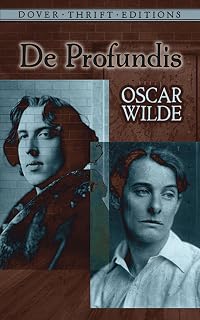
De Profundis
by Oscar Wilde 
On This Page
Description
This short work of Wilde's was written during his two year incarceration for "gross indecency". This work is a letter which sorts out his life, and his love toward Lord Alfred Douglas. Wilde wrote this as a farewell letter to Douglas.Tags
Recommendations



























Member Recommendations

Cecrow Symonds' work predated Wilde's trial by only a few years and could not be widely published at the time.
Member Reviews
Oscar Wilde found himself in prison in 1895 on what amounted to a charge of homosexuality. From there he wrote this eighty page letter to the primary cause, a young Lord Alfred Douglas. As Wilde characterizes it, he had always empathized with Douglas but could not shake him loose as a hanger-on and leech, who introduced on his time as an artist and spent his money in a profligate manner. Reading between the lines - and more explicitly at the end - love played a factor in the relationship.
Reading gave me the discomforting feeling at times of being the third wheel in a room filled with the cacophony of a fight between two lovers. We can't hear Lord Alfred Douglas' whining defence, but it isn't difficult to imagine. Some relationships are show more like a sea lamprey and a fish. Oscar Wilde was the fish in this case, but one of the most articulate fish imaginable, and when he set pen to paper in the jail cell he occupied he did not hold back. He must have had an amazing memory, or been hurt indeed, to recall so many exact dates and details in his litany. He retained a strong streak of pride while he accepted some measure of the blame for the outcome. It was his foremost concern, however, to ascertain whether Douglas accepted his.
In the later half, Wilde ruminates upon the importance of accepting his fate if he is to carry on, and addresses the story of Christ as a model. Speaking as a man of little faith myself, I got more than I bargained for here. Wilde's argument is compelling. He says that even if you were to take Jesus as merely a man, consider how his story of sacrifice for all the world's sins - past, present, future, in all that enormity - outshines any plot Shakespeare could invent. Wilde writes that Jesus was an individualist, not merely an altruist. His was not the message of self-sacrifice for others that appears on the surface. It was a message about saving one's own soul, however you define it. Jesus pitied the rich as much as the poor. He urged them to give of themselves not to help others, but to save themselves from what their wealth was doing to them. I find that take fascinating, less guilt-laden and more respectable than the norm. show less
Reading gave me the discomforting feeling at times of being the third wheel in a room filled with the cacophony of a fight between two lovers. We can't hear Lord Alfred Douglas' whining defence, but it isn't difficult to imagine. Some relationships are show more like a sea lamprey and a fish. Oscar Wilde was the fish in this case, but one of the most articulate fish imaginable, and when he set pen to paper in the jail cell he occupied he did not hold back. He must have had an amazing memory, or been hurt indeed, to recall so many exact dates and details in his litany. He retained a strong streak of pride while he accepted some measure of the blame for the outcome. It was his foremost concern, however, to ascertain whether Douglas accepted his.
In the later half, Wilde ruminates upon the importance of accepting his fate if he is to carry on, and addresses the story of Christ as a model. Speaking as a man of little faith myself, I got more than I bargained for here. Wilde's argument is compelling. He says that even if you were to take Jesus as merely a man, consider how his story of sacrifice for all the world's sins - past, present, future, in all that enormity - outshines any plot Shakespeare could invent. Wilde writes that Jesus was an individualist, not merely an altruist. His was not the message of self-sacrifice for others that appears on the surface. It was a message about saving one's own soul, however you define it. Jesus pitied the rich as much as the poor. He urged them to give of themselves not to help others, but to save themselves from what their wealth was doing to them. I find that take fascinating, less guilt-laden and more respectable than the norm. show less
Wilde’s letter to Lord Alfred Douglas (known affectionately as the l’enfant terrible Bosie), penned during his incarceration and hard labour at Reading Gaol for ‘gross indecency’ (or homosexuality), is more than a contemplation of a relationship fated for demise, or the irreparable ruins of his life. With sharp turns of wit specifically Wildean, its beginnings are laced with the elegance of bitterness, where candour relates Douglas’ cruel ambivalence and hedonistic whims. Exposed amidst is the one-sidedness of devotion abound the insatiable material excesses of this doomed affair. The extravagant wining-and-dining and the monetary support Wilde provided, whereas Bosie remain vain and self-indulgent, are recollected in detail. show more As such, Wilde doesn’t mince words. Even a person with the highest pain tolerance will wreathe and flinch after reading such paragraphs:
"Your defect was not that you knew so little about life, but that you knew so much." (p4)
"Between myself and the memory of joy lies a gulf no less deep than that between myself and joy in its actuality. Had our life together been as the world fancied it to be, one simply of pleasure, profligacy and laughter, I would not be able to recall a single passage in it. It is because it was full of moments and days tragic, bitter, sinister in their warnings, dull or dreadful in their monotonous scenes and unseemly violences, that I can see or hear each separate incident in its detail, can indeed see or hear little else." (p22)
"I need not ask you what influence I had over you. You know I had none. It was one of your frequent boasts that I had none, and the only one indeed that was well-founded. What was there, as a mere matter of fact, in you that I could influence? Your brain? It was underdeveloped. Your imagination? It was dead. Your heart? It was not yet born." (p122)
Every page of De Profundis is fraught with impassioned hurt, set ablaze by a feverish, forbidden, rotten romance which destroyed Wilde’s marriage, dissolved his parental rights, and damaged his reputation. It also effaced his identity in ways that only such a relationship effaces: in only thinking of and for itself. Towards the end, Wilde seeks consolation in things his mind and heart can continue to hold—spirituality, nature, art and literature, even imprisonment itself. Partly generous this is on examining the workings Art too:
"Every single work of art is the fulfilment of a prophecy. For every work of art is the conversion of an idea into an image. Every single human being should be the fulfilment of a prophecy. For every human being should be the realisation of some ideal, either in the mind of God or in the mind of man." (p94)
"In art good intentions are not the smallest of value. All bad art is the result of good intentions." (p115)
But, perhaps, its most universally resonant and poignant surmise—besides the solace Art bestow and the soul-aching after of any relationship—is the immense capacity of such a love to give. And in this giving, there is often the lost self, there is often sorrow. So Wilde mulls, "Now it seems to me that Love of some kind is the only possible explanation of the extraordinary amount of suffering that there is in the world." (p82) If so, sorrow, perhaps, can be alchemised to strength, just as love can spring from it.
Society wronged some of its brilliant individuals throughout history. This case is no different. For Wilde to be only posthumously pardoned around 5 years ago only affirms his remark, that the road to the abolishment of homosexuality as a crime is a "road long and red with monstrous martyrdoms." (excerpt from his letter to early homosexual law reform campaigner, George Cecil Ives) show less
"Your defect was not that you knew so little about life, but that you knew so much." (p4)
"Between myself and the memory of joy lies a gulf no less deep than that between myself and joy in its actuality. Had our life together been as the world fancied it to be, one simply of pleasure, profligacy and laughter, I would not be able to recall a single passage in it. It is because it was full of moments and days tragic, bitter, sinister in their warnings, dull or dreadful in their monotonous scenes and unseemly violences, that I can see or hear each separate incident in its detail, can indeed see or hear little else." (p22)
"I need not ask you what influence I had over you. You know I had none. It was one of your frequent boasts that I had none, and the only one indeed that was well-founded. What was there, as a mere matter of fact, in you that I could influence? Your brain? It was underdeveloped. Your imagination? It was dead. Your heart? It was not yet born." (p122)
Every page of De Profundis is fraught with impassioned hurt, set ablaze by a feverish, forbidden, rotten romance which destroyed Wilde’s marriage, dissolved his parental rights, and damaged his reputation. It also effaced his identity in ways that only such a relationship effaces: in only thinking of and for itself. Towards the end, Wilde seeks consolation in things his mind and heart can continue to hold—spirituality, nature, art and literature, even imprisonment itself. Partly generous this is on examining the workings Art too:
"Every single work of art is the fulfilment of a prophecy. For every work of art is the conversion of an idea into an image. Every single human being should be the fulfilment of a prophecy. For every human being should be the realisation of some ideal, either in the mind of God or in the mind of man." (p94)
"In art good intentions are not the smallest of value. All bad art is the result of good intentions." (p115)
But, perhaps, its most universally resonant and poignant surmise—besides the solace Art bestow and the soul-aching after of any relationship—is the immense capacity of such a love to give. And in this giving, there is often the lost self, there is often sorrow. So Wilde mulls, "Now it seems to me that Love of some kind is the only possible explanation of the extraordinary amount of suffering that there is in the world." (p82) If so, sorrow, perhaps, can be alchemised to strength, just as love can spring from it.
Society wronged some of its brilliant individuals throughout history. This case is no different. For Wilde to be only posthumously pardoned around 5 years ago only affirms his remark, that the road to the abolishment of homosexuality as a crime is a "road long and red with monstrous martyrdoms." (excerpt from his letter to early homosexual law reform campaigner, George Cecil Ives) show less
This slim volume accomplishes so much in so few words, which shouldn't come as a surprise when the author is Oscar Wilde. It is an incredible takedown of Lord Alfred "Bosie" Douglas, his on-again, off-again lover who's father ultimately managed to get Wilde imprisoned. It's an intimate look at creativity, and philosophy, and religion. But more than anything, it's a deeply personal look into Oscar Wilde's mind and the transformation two years of imprisonment wrought on him.
This is fiery, thoughtful, insightful, scintillating work.
This is fiery, thoughtful, insightful, scintillating work.
On an almost imperceptible scale, I can identify with the release of writing a well crafted sentence. DE PROFUNDIS was written mostly while Oscar Wilde was in prison—initially denied the ability to write, Wilde was suffocated by the words he couldn’t express. Ostensibly a letter to his lover Lord Alfred Douglas (look up a picture of Douglas online and you will want to start slapping him and never stop), De Profundis becomes an explosion of Oscar Wilde’s heart and soul and mind. He emerges as a man largely transformed by his experience (the spoiled rich like himself that were sentenced to hard labor rarely survived their imprisonment). He doesn’t dismiss his past “sins”, instead the libertine excesses were necessary to get show more him to prison which was necessary to get him to a more enlightened state. Imprisoned partly because of his own arrogance and partly because of being under the spell of Douglass (again, keep slapping), Wilde weaves a narrative of his relationship with God and the inseparable link between religion and art—art as an expression of nature which is an expression of God. While occasionally redundant or hyperbolic, Wilde expresses his self-discovery with jaw dropping beauty. Eloquent and graceful, like looking at a vast lake where the water is so smooth and glass like it reflects a glorious sky without a flaw. I consider myself spiritual without being religious, but I was genuinely moved by several passages decrying our failures as people to aspire to the beauty of art and God. I don’t want to scare anyone off by making this sound like a born again pamphlet you’ll find stuck on your front door when you get home. It is not that at all. Instead it is a last blast of creative glory from a wildly talented writer—like a fireball flaring out before it falls into oblivion. This is Wilde’s last published prose—he would die a couple years after his release from prison. show less
Wilde wrote this book-length letter while he was imprisoned at Reading Gaol for sodomy and gross indecency, in short for homosexual behavior. The letter, whose title means “from the depths,” is addressed to Lord Alfred Douglas. Under advisement from Lord Alfred, Wilde brought libel charges against Lord Alfred’s father, the Marquess of Queensberry, who had called Wilde a Sodomite. The whole situation got turned on its head when Queensberry provided proof that his allegations were true, and Wilde ended up in prison. This is a bit of an oversimplification, but Wilde himself discloses the whole history in the letter.
Wilde recounts his whole relationship and history with Lord Alfred in the first half of the letter. It’s gut-wrenching show more to read, honestly. The relationship is so toxic from the very start, that it’s not so much full of red flags as full of giant red banners pulled by airplanes. Lord Alfred used Wilde for money and fame, and clearly didn’t care about Wilde at all. The best example of this is during a vacation abroad when Lord Alfred came down with the flu and Wilde nursed him back to health: when Wilde himself caught the flu, Alfred straight up left, saying that Wilde was boring when he was sick. Lord Alfred seems a textbook case of narcissist behavior. It broke my heart reading this book and knowing that Wilde was stuck in such an unhealthy relationship.
The latter part of the letter is more uplifting. Here, Wilde discusses his own spiritual growth while in prison. He talks about his suicidal period, yes, but also how he has moved beyond that. He also likens Christ to a poet, perhaps the greatest poet who ever lived. This is the part where Wilde really hits is stride and the beauty of his writing truly shines. Oscar Wilde was posthumously pardoned in 2017. show less
Wilde recounts his whole relationship and history with Lord Alfred in the first half of the letter. It’s gut-wrenching show more to read, honestly. The relationship is so toxic from the very start, that it’s not so much full of red flags as full of giant red banners pulled by airplanes. Lord Alfred used Wilde for money and fame, and clearly didn’t care about Wilde at all. The best example of this is during a vacation abroad when Lord Alfred came down with the flu and Wilde nursed him back to health: when Wilde himself caught the flu, Alfred straight up left, saying that Wilde was boring when he was sick. Lord Alfred seems a textbook case of narcissist behavior. It broke my heart reading this book and knowing that Wilde was stuck in such an unhealthy relationship.
The latter part of the letter is more uplifting. Here, Wilde discusses his own spiritual growth while in prison. He talks about his suicidal period, yes, but also how he has moved beyond that. He also likens Christ to a poet, perhaps the greatest poet who ever lived. This is the part where Wilde really hits is stride and the beauty of his writing truly shines. Oscar Wilde was posthumously pardoned in 2017. show less
The end of Oscar Wilde’s life was so sad it makes me shiver to think about. The world was his oyster, and he was a highly successful playwright and wit at the height of his powers when he was convicted of “gross indecency”, and then sentenced to two years in prison. Humiliated, jeered at by crowds, not allowed to read or write for portions of his imprisonment, scrubbing floors and performing other menial tasks so ridiculously beneath such a brilliant, eloquent mind, losing his children as well as a lot of weight, suffering injuries that would later contribute to his early death, and becoming a pauper – all for essentially being gay.
How appropriate to have bought this book in Dublin after seeing the Pride parade march through show more the streets there. Never again, and always remember.
De Profundis, or, ‘From the Depths’, is a long letter Wilde was allowed to write but not send to his lover, Lord Alfred Douglas, towards the end of his imprisonment. When he was released in 1897 he gave the letter to Robert Ross, instructing him to give it to Douglas, which may or may not have ever happened. Over the objections of the families on both sides, Wilde did meet Douglas again for short intervals in France and Italy, but died a few years afterwards in 1900, disgraced and impoverished. The letter was then published posthumously five years later.
There is a pervasive feeling of overwhelming sadness in De Profundis, as well as Wilde’s attempts to come to terms with the absurdity and cruelty of it all. Prison was so damaging to his sensitive, artistic soul, and yet he tried to make sense of it, find meaning, and become a better person for having been there. His words flow so beautifully, and while the content at times was not all that interesting, such as the Christian themes and likening Christ to an artist, one cannot help but feel sadness for the condition he was in, and the tragedy of his life and career being cut short so senselessly.
Unfortunately, while finding the first edition from 1905 was very cool, it came with a significant drawback, for when the book was first published, large portions of the letter were suppressed – in particular, Wilde’s recounting of his personal time with Douglas, and everything that led up to his arrest – and it’s worse for it, losing the ‘feel’ of a letter and the stories from his life. Gone are the passion and myriad feelings towards Douglas, who had influenced Wilde into a playboy lifestyle and then encouraged him to sue his father for libel, which of course ended in the disastrous U-turn of events and Wilde’s own arrest. It’s for this reason I knock down the review score a bit, though it may be a bit unfair, not having the full text which appeared in later editions.
Quotes:
On beauty:
“…merely to look at the world will be always lovely. I tremble with pleasure when I think that on the very day of my leaving prison both the laburnum and the lilac will be blooming in the gardens, and that I shall see the wind stir into restless beauty the swaying gold of the one, and make the other toss the pale purple of its plumes so that all the air shall be Arabia for me.”
On prison, and the charity of the poor:
“The poor are wise, more charitable, more kind, more sensitive than we are. In their eyes, prison is a tragedy in a man’s life, a misfortune, a casualty, something that calls for sympathy in others. They speak of one who is in prison as of one who is ‘in trouble’ simply. It is the phrase they always use, and the expression has the perfect wisdom of love in it. With people of our own rank it is different. With us, prison makes a man a pariah. I, and such as I am, have hardly any right to air and sun. Our presence taints the pleasures of others. We are unwelcome when we reappear. To revisit the glimpses of the moon is not for us. Our very children are taken away. Those lovely links with humanity are broken. We are doomed to be solitary, while our sons still live. We are denied the one thing that might heal us and keep us, that might bring balm to the bruised heart, and peace to the soul in pain…”
On regret:
“The gods had given me almost everything. But I let myself be lured into long spells of senseless and sensual ease. I amused myself with being a flaneur, a dandy, a man of fashion. I surrounded myself with the smaller natures and the meaner minds. I became the spendthrift of my own genius, and to waste an eternal youth gave me a curious joy. Tired of being on the heights, I deliberately went to the depths in the search for new sensation. What the paradox was to me in the sphere of thought, perversity became to me in the sphere of passion. Desire, at the end, was a malady, or a madness, or both. I grew careless of the lives of others.”
On the other hand: (love the poetry in this one)
“I don’t regret for a single moment having lived for pleasure. I did it to the full, as one should do everything that one does. There was no pleasure I did not experience. I threw the pearl of my soul into a cup of wine. I went down the primrose path to the sound of flutes. I lived on honeycomb.”
Lastly, on solitude, this at the book’s end:
“Society, as we have constituted it, will have no place for me, has none to offer; but Nature, whose sweet rains fall on unjust and just alike, will have clefts in the rocks where I may hide, and secret valleys in whose silence I may weep undisturbed. She will hang the night with stars so that I may walk abroad in the darkness without stumbling, and send the wind over my footprints so that none may track me to my hurt: she will cleanse me in great waters, and with bitter herbs make me whole.” show less
How appropriate to have bought this book in Dublin after seeing the Pride parade march through show more the streets there. Never again, and always remember.
De Profundis, or, ‘From the Depths’, is a long letter Wilde was allowed to write but not send to his lover, Lord Alfred Douglas, towards the end of his imprisonment. When he was released in 1897 he gave the letter to Robert Ross, instructing him to give it to Douglas, which may or may not have ever happened. Over the objections of the families on both sides, Wilde did meet Douglas again for short intervals in France and Italy, but died a few years afterwards in 1900, disgraced and impoverished. The letter was then published posthumously five years later.
There is a pervasive feeling of overwhelming sadness in De Profundis, as well as Wilde’s attempts to come to terms with the absurdity and cruelty of it all. Prison was so damaging to his sensitive, artistic soul, and yet he tried to make sense of it, find meaning, and become a better person for having been there. His words flow so beautifully, and while the content at times was not all that interesting, such as the Christian themes and likening Christ to an artist, one cannot help but feel sadness for the condition he was in, and the tragedy of his life and career being cut short so senselessly.
Unfortunately, while finding the first edition from 1905 was very cool, it came with a significant drawback, for when the book was first published, large portions of the letter were suppressed – in particular, Wilde’s recounting of his personal time with Douglas, and everything that led up to his arrest – and it’s worse for it, losing the ‘feel’ of a letter and the stories from his life. Gone are the passion and myriad feelings towards Douglas, who had influenced Wilde into a playboy lifestyle and then encouraged him to sue his father for libel, which of course ended in the disastrous U-turn of events and Wilde’s own arrest. It’s for this reason I knock down the review score a bit, though it may be a bit unfair, not having the full text which appeared in later editions.
Quotes:
On beauty:
“…merely to look at the world will be always lovely. I tremble with pleasure when I think that on the very day of my leaving prison both the laburnum and the lilac will be blooming in the gardens, and that I shall see the wind stir into restless beauty the swaying gold of the one, and make the other toss the pale purple of its plumes so that all the air shall be Arabia for me.”
On prison, and the charity of the poor:
“The poor are wise, more charitable, more kind, more sensitive than we are. In their eyes, prison is a tragedy in a man’s life, a misfortune, a casualty, something that calls for sympathy in others. They speak of one who is in prison as of one who is ‘in trouble’ simply. It is the phrase they always use, and the expression has the perfect wisdom of love in it. With people of our own rank it is different. With us, prison makes a man a pariah. I, and such as I am, have hardly any right to air and sun. Our presence taints the pleasures of others. We are unwelcome when we reappear. To revisit the glimpses of the moon is not for us. Our very children are taken away. Those lovely links with humanity are broken. We are doomed to be solitary, while our sons still live. We are denied the one thing that might heal us and keep us, that might bring balm to the bruised heart, and peace to the soul in pain…”
On regret:
“The gods had given me almost everything. But I let myself be lured into long spells of senseless and sensual ease. I amused myself with being a flaneur, a dandy, a man of fashion. I surrounded myself with the smaller natures and the meaner minds. I became the spendthrift of my own genius, and to waste an eternal youth gave me a curious joy. Tired of being on the heights, I deliberately went to the depths in the search for new sensation. What the paradox was to me in the sphere of thought, perversity became to me in the sphere of passion. Desire, at the end, was a malady, or a madness, or both. I grew careless of the lives of others.”
On the other hand: (love the poetry in this one)
“I don’t regret for a single moment having lived for pleasure. I did it to the full, as one should do everything that one does. There was no pleasure I did not experience. I threw the pearl of my soul into a cup of wine. I went down the primrose path to the sound of flutes. I lived on honeycomb.”
Lastly, on solitude, this at the book’s end:
“Society, as we have constituted it, will have no place for me, has none to offer; but Nature, whose sweet rains fall on unjust and just alike, will have clefts in the rocks where I may hide, and secret valleys in whose silence I may weep undisturbed. She will hang the night with stars so that I may walk abroad in the darkness without stumbling, and send the wind over my footprints so that none may track me to my hurt: she will cleanse me in great waters, and with bitter herbs make me whole.” show less
Una carta de doscientas páginas. Parece imposible tener tanta paciencia como tiene Wilde al escribir esto. La carta va dirigida a su amante, llamado Bosie, al que recrimina sus malas acciones durante el tiempo que pasaron juntos. La carta está escrita desde la cárcel, donde el pobre Wilde dio con sus huesos por su condición de homosexual. El tal Bosie era un mal bicho, por cierto. Malo, malo, malo. Un cabrón, un enfant terrible, un mimado y un gilipollas. Wilde, que era la estrella del ingenio y el brillo social, tuvo que aguantar y pasar por miserias y penurias, tanto económicas como psicológicas, por culpa de su amante. La carta en sí es bellísima; el estilo de Wilde en prosa es maravilloso. Gran libro.
Members
- Recently Added By
Lists

501 Must-Read Books
529 works; 72 members

Epistolary Books
105 works; 27 members

Pre-1969 LGBTQ Literature
182 works; 69 members

Books Read in 2023
5,638 works; 147 members

Books Read in 2025
4,128 works; 98 members
Author Information

1,783+ Works 121,334 Members
Flamboyant man-about-town, Oscar Wilde had a reputation that preceded him, especially in his early career. He was born to a middle-class Irish family (his father was a surgeon) and was trained as a scholarship boy at Trinity College, Dublin. He subsequently won a scholarship to Magdalen College, Oxford, where he was heavily influenced by John show more Ruskin and Walter Pater, whose aestheticism was taken to its radical extreme in Wilde's work. By 1879 he was already known as a wit and a dandy; soon after, in fact, he was satirized in Gilbert and Sullivan's Patience. Largely on the strength of his public persona, Wilde undertook a lecture tour to the United States in 1882, where he saw his play Vera open---unsuccessfully---in New York. His first published volume, Poems, which met with some degree of approbation, appeared at this time. In 1884 he married Constance Lloyd, the daughter of an Irish lawyer, and within two years they had two sons. During this period he wrote, among others, The Picture of Dorian Gray (1891), his only novel, which scandalized many readers and was widely denounced as immoral. Wilde simultaneously dismissed and encouraged such criticism with his statement in the preface, "There is no such thing as a moral or an immoral book. Books are well written or badly written. That is all." In 1891 Wilde published A House of Pomegranates, a collection of fantasy tales, and in 1892 gained commercial and critical success with his play, Lady Windermere's Fan He followed this comedy with A Woman of No Importance (1893), An Ideal Husband (1895), and his most famous play, The Importance of Being Earnest (1895). During this period he also wrote Salome, in French, but was unable to obtain a license for it in England. Performed in Paris in 1896, the play was translated and published in England in 1894 by Lord Alfred Douglas and was illustrated by Aubrey Beardsley. Lord Alfred was the son of the Marquess of Queensbury, who objected to his son's spending so much time with Wilde because of Wilde's flamboyant behavior and homosexual relationships. In 1895, after being publicly insulted by the marquess, Wilde brought an unsuccessful slander suit against the peer. The result of his inability to prove slander was his own trial on charges of sodomy, of which he was found guilty and sentenced to two years of hard labor. During his time in prison, he wrote a scathing rebuke to Lord Alfred, published in 1905 as De Profundis. In it he argues that his conduct was a result of his standing "in symbolic relations to the art and culture" of his time. After his release, Wilde left England for Paris, where he wrote what may be his most famous poem, The Ballad of Reading Gaol (1898), drawn from his prison experiences. Among his other notable writing is The Soul of Man under Socialism (1891), which argues for individualism and freedom of artistic expression. There has been a revived interest in Wilde's work; among the best recent volumes are Richard Ellmann's, Oscar Wilde and Regenia Gagnier's Idylls of the Marketplace , two works that vary widely in their critical assumptions and approach to Wilde but that offer rich insights into his complex character. (Bowker Author Biography) show less
Oscar Wilde has a Legacy Library. Legacy libraries are the personal libraries of famous readers, entered by LibraryThing members from the Legacy Libraries group.
Some Editions
Awards and Honors
Series
Belongs to Publisher Series
Work Relationships
Is contained in
Opere by Oscar Wilde
Selected Works : The picture of Dorian Grey ; De Profundis ; The Canterville ghost ; The importance of being Ernest ; Lady Windermere's fan by Oscar Wilde
Common Knowledge
- Canonical title
- De Profundis
- Original title
- De Profundis
- Original publication date
- 1905
- People/Characters
- Lord Alfred Douglas; Oscar Wilde
- Important places
- Reading Gaol
- Dedication*
- A Lord Alfred Douglas.
Prisión de Su Majestad.
Reading.
Enero-Marzo 1897 - First words
- Dear Bosie, After long and fruitless waiting I have determined to write to you myself, as much for your sake as for mine, as I would not like to think that I had passed through two long years of imprisonment without ever havi... (show all)ng received a single line from you, or any news or message even, except such as gave me pain.
- Quotations
- Suffering is one very long moment. We cannot divide it by seasons.
Most people are other people. Their thoughts are someone else's opinions, their lives a mimicry, their passions a quotation.
It is always twilight in one's cell, as it is always midnight in one's heart.
I was a man who stood in symbolic relations to the art and culture of my age. I had realised this for myself at the very dawn of my manhood, and had forced my age to realise it afterwards. Few men hold such a position in thei... (show all)r own lifetime and have it so acknowledged. It is usually discerned, if discerned at all, by the historian, or the critic, long after both the man and his age have passed away.
I amused myself with being a flaneur, a dandy, a man of fashion. I surrounded myself with the smaller natures and the meaner minds. I became the spendthrift of my own genius, and to waste an eternal youth gave me a curious jo... (show all)y. Tired of being on the heights I deliberately went to the depths in the search for new sensations.
Truth in art is the unity of a thing with itself: the outward rendered expressive of the inward: the soul made incarnate: the boy instinct with spirit. - Last words
- (Click to show. Warning: May contain spoilers.)Perhaps I am chosen to teach you something much more wonderful, the meaning of Sorrow, and its beauty. Your affectionate friend, Oscar Wilde
- Original language*
- Inglés
- Disambiguation notice
- Please do not combine works with this unless They ONLY contain De Profoundis
*Some information comes from Common Knowledge in other languages. Click "Edit" for more information.
Classifications
Statistics
- Members
- 1,912
- Popularity
- 11,187
- Reviews
- 28
- Rating
- (4.00)
- Languages
- 20 — Catalan, Chinese, Czech, Danish, Dutch, English, Finnish, French, German, Greek, Italian, Japanese, Lithuanian, Polish, Portuguese, Romanian, Russian, Spanish, Swedish, Turkish
- Media
- Paper, Audiobook, Ebook
- ISBNs
- 205
- UPCs
- 1
- ASINs
- 82