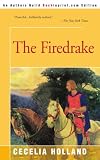
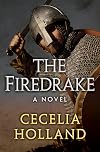
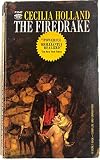
The Firedrake
by Cecelia Holland
On This Page
Description
In The Firedrake, an Irish mercenary knight in the eleventh century, in a constant personal battle with the rest of the world, joins William of Normandy for the invasion of England. There at Hastings he has to choose between power and wealth, and his personal demons of pride and honor. The New York Times called Cecelia Holland "a literary phenomenon" in its review of this book, recognizing a stellar creative achievement by a young writer in her first published work.
Tags
Recommendations


















Member Reviews
Laeghaire of the Long Road, from Tralee, no less, an Irish mercenary knight, a devil of a fighter and, well, a devil in general, finds his way, indirectly, into the employ of William of Normandy. The two make an impression on each other in the course of a Summer campaign, but to say much more than that might give things away, though I'm sure even the most casual student of history will work out where it's all headed.
This is Holland's first novel, and it shows a bit as in her first pages of terse, short sentences she's grappling with her craft and learning the difference between short sentences that are monotonous and repetitive, and short sentences interspersed with sentences of more varied length leading to an effect that would be show more praised as 'hard-boiled' in a crime novel, but which suits descriptions of deadly but prosaic men going about the business of warfare and statecraft. Laegharie is an intense, morose, driven, haunted man who is beating off bandits one minute and buying peasant girls the next; pillaging a landscape one minute, doting on his son by the bought peasant girl the next; but on the whole, Laeghaire is not destined for happiness, whether by mischance or his own love of violence, and if a happy life eludes him, then violence he gets a-plenty, waiting for him on a hill outside Hastings.
Anyway, it's superb. show less
This is Holland's first novel, and it shows a bit as in her first pages of terse, short sentences she's grappling with her craft and learning the difference between short sentences that are monotonous and repetitive, and short sentences interspersed with sentences of more varied length leading to an effect that would be show more praised as 'hard-boiled' in a crime novel, but which suits descriptions of deadly but prosaic men going about the business of warfare and statecraft. Laegharie is an intense, morose, driven, haunted man who is beating off bandits one minute and buying peasant girls the next; pillaging a landscape one minute, doting on his son by the bought peasant girl the next; but on the whole, Laeghaire is not destined for happiness, whether by mischance or his own love of violence, and if a happy life eludes him, then violence he gets a-plenty, waiting for him on a hill outside Hastings.
Anyway, it's superb. show less
Holland's brilliant first novel, which immediately established her as a first-rank historical novelist. The hero Laegaire is an Irish mercenary who enlists with William the Conqueror and fights at Hastings but decides afterwards for personal reasons to leave instead of enjoying William's rewards. The hero, like most of Holland's early heroes, has an attractive air of wry competence and independence.
I picked this up because Kim Stanley Robinson recommended Holland in an interview. I hate to admit I was a little disappointed. Any character the protagonist didn't love or hate was just a blur, so long stretches of the novel were little more than a tedious shuffling of minor players around the irascible centerpiece. Maybe 10 of the 243 pages really engaged me ... the rest felt like trudging over the Long Road. Maybe, it being the Dark Ages, that was the point ... but I might lay off the historical fiction for a while.
Ratings
Members
- Recently Added By
Author Information

52+ Works 3,326 Members
Born in Henderson, Nevada, Cecelia Holland was educated at Pennsylvania State University and Connecticut College, where she received her B.A. degree. She has served as a visiting professor of English at Connecticut College since 1979. Holland's historical novels have received broad critical acclaim. According to one critic, she "proves that there show more can be more to historical thrillers than swordplay and seduction." (Time) Among her novels is City of God (1979), which is set in Rome during the period of the Borgia family. Told from the point of view of Nicolas, a secretary to the Florentine ambassador to Rome, this novel brings to life the period of the Renaissance, including the political intrigue that characterized Rome at the time. Other works include Until the Sun Falls (1969), a story of the ancient Mongols and their empire, The Firedrake (1966), her first published novel, Great Maria (1974), The Bear Flag (1990), and Pacific Street (1991). Holland is very adept at capturing the period she writes about, including the clothing, furnishings, and customs of the time. One critic has noted that Holland "is never guilty of the fatuity which plagues most historical fiction: she never nudges the reader into agreeing that folks way back then were really just like you and me, only they bathed less often." (Bowker Author Biography) show less
Awards and Honors
Notable Lists
Common Knowledge
- Original publication date
- 1965
- Dedication
- To Miss Susan Harris
- First words
- In the trees it had been very dark.
Classifications
Statistics
- Members
- 87
- Popularity
- 367,532
- Reviews
- 3
- Rating
- (3.72)
- Languages
- English
- Media
- Paper, Ebook
- ISBNs
- 7
- ASINs
- 2