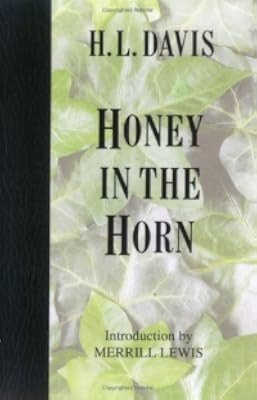
Honey in the Horn
by H.L. Davis
On This Page
Description
Classic Literature. Fiction. Literature. HTML:Set in Oregon in the early years of the twentieth century, H. L. Davis's Honey in the Horn chronicles the struggles faced by homesteaders as they attempted to settle down and eke out subsistence from a still-wild land. With sly humor and keenly observed detail, Davis pays homage to the indomitable character of Oregon's restless people and dramatic landscapes without romanticizing or burnishing the myths.Clay Calvert, an orphan, works as a hand show more on a sheep ranch until he stumbles into trouble and is forced to flee. Journeying throughout the state, from the lush coastal forests, to the Columbia Gorge, to the golden wheat fields east of the Cascades, he encounters a cast of characters as rich and diverse as the land, including a native Tunne boy and a beautiful girl named Luce.
Originally published in 1935, Honey in the Horn reveals as much about the prevailing attitudes and beliefs of H. L. Davis' lifetime as it does about the earlier era in which it is set. It transcends the limitations of its time through the sheer power and beauty of Davis' prose. Full of humor and humanity, Davis's first novel displays a vast knowledge of Pacific Northwest history, lore, and landscape.
An essential book for all serious readers of Northwest literature, this classic coming-of-age novel has been called the "Huckleberry Finn of the West." It is the only Oregon book that has ever won a Pulitzer Prize for fiction. With a new introduction by Richard W. Etulain, this important work from one of Oregon's premier authors is once again available for a new generation to enjoy. show less
Tags
Recommendations




















Member Reviews
There was a run-down old tollbridge station in the Shoestring Valley of Southern Oregon where Uncle Preston Shiveley had lived for fifty years, outlasting a wife, two sons, several plagues of grasshoppers, wheat-rust and caterpillars, a couple or three invasions of land-hunting settlers and real-estate speculators, and everybody else except the scattering of old pioneers who had cockleburred themselves onto the country at about the same time he did.
Honey in the Horn starts off with this shaggy, homespun sentence that sets the tone for the whole pioneer-themed story. H. L. Davis's classic coming-of-age novel about homesteading in Oregon in the early 1900s has charm enough to still win over readers with its continuous movement and steady show more introduction of quirky characters.
The story follows orphan Clay Calvert on a series of adventures around Oregon, from his first job on a sheep ranch, through the forests of the rain-sodden Columbia Gorge, to high deserts and wheat fields east of the Cascade Mountains. Davis celebrates the beauty of the Pacific Northwest and the diversity of her citizens and settlers.
Honey in the Horn won the 1936 Pulitzer Prize -- the only Pulitzer for an Oregon novel. Some of its social views don’t fly today, but it captures the pioneering spirit and history of its time. The new reprint edition from OSU Press features an introduction by Richard W. Etulain. show less
Honey in the Horn starts off with this shaggy, homespun sentence that sets the tone for the whole pioneer-themed story. H. L. Davis's classic coming-of-age novel about homesteading in Oregon in the early 1900s has charm enough to still win over readers with its continuous movement and steady show more introduction of quirky characters.
The story follows orphan Clay Calvert on a series of adventures around Oregon, from his first job on a sheep ranch, through the forests of the rain-sodden Columbia Gorge, to high deserts and wheat fields east of the Cascade Mountains. Davis celebrates the beauty of the Pacific Northwest and the diversity of her citizens and settlers.
Honey in the Horn won the 1936 Pulitzer Prize -- the only Pulitzer for an Oregon novel. Some of its social views don’t fly today, but it captures the pioneering spirit and history of its time. The new reprint edition from OSU Press features an introduction by Richard W. Etulain. show less
I used to have this long speech I'd give about 'literature' and how much more concerned with quality of content I am than the topic of the content. I used to say that I'd read a 1,000 page book written on the history of a couch, if the writing was done interestingly enough, because I am not typically very concerned with plots, suspense or other manipulative techniques that are typically used to make me forget / not notice that the writing is sub par.
It's been a long time since that speech and a long time since I've read something on a topic that bored me to tears, yet I remained completely absorbed. This book did manage to do that for me though.
Honey in the Horn takes place in the Pacific Northwest, when it was still half overrun by show more indigenous people and almost everyone in the area was transient. There was a lot of farming business, killing of people business and jail-breaking business. None of these topics are ones that I'm ever particularly interested in, but H.L. Davis held my attention well.
I am typically anti-flowery descriptions in books. I am typically anti-two-pages-of-description-about-a-character-we're-only-going-to-read-one-line-of-dialogue-from-and-then-never-see-again. However, H.L. Davis could write a 1,000 page book about the history of a couch and I'd read it.
What I'm trying to tell you is that the man has his chops and I dug it. show less
It's been a long time since that speech and a long time since I've read something on a topic that bored me to tears, yet I remained completely absorbed. This book did manage to do that for me though.
Honey in the Horn takes place in the Pacific Northwest, when it was still half overrun by show more indigenous people and almost everyone in the area was transient. There was a lot of farming business, killing of people business and jail-breaking business. None of these topics are ones that I'm ever particularly interested in, but H.L. Davis held my attention well.
I am typically anti-flowery descriptions in books. I am typically anti-two-pages-of-description-about-a-character-we're-only-going-to-read-one-line-of-dialogue-from-and-then-never-see-again. However, H.L. Davis could write a 1,000 page book about the history of a couch and I'd read it.
What I'm trying to tell you is that the man has his chops and I dug it. show less
This book won the Pulitzer just 4 years before Grapes of Wrath (1936/1940). Which is really kind of amazing, as these books have a lot in commonäóîthey look at migrations of people and what led them there. Obviously Grapes of Wrath looks at a much larger migration in a different time and place and a much worse human-induced climatic catastrophe. But though this book is dated (esp when discussing the various Indian tribesäóîthough Davis does go into detail about who is who, there are not just "Indians"), Davis does have some opinions about speculators (from town site sellers to work crew leaders), gossipy families, unsatisfiable settlers, etc etc.
While the focus of this book is Clay Calvert, an orphan who grew up on a farm show more that took in a fair number of orphans, the story is really about Oregon. It is about a semi-settled country and those trying to get rich on what is left. You meet orphans, Indians of various tribes and upbringings, settlers of varying competencies, an outlaw, a horse trader, itinerant workers, land speculators, and settlers who cannot quite be happy so keep moving looking for something better. Of course, this takes place 1904-1906äóîthe best land has been taken and used for decades, and what is left is borderline.
I can see why this won the Pultizer when it did. It is about the generation that saw Oregon go from frontier to settled and American, though not everyone was quite ready for that. He actively mocks many of the sorts of settlers you learn about in history classesäóîland speculators that want to sell lots and get out before the town never gets built; gossipy families who can't quite manage to be successful as quick as they want, so the keep moving and never achieve that success; workgang "bosses" preying on immigrants adnd the not-so-bright.
Definitely an interesting read, the second half is stronger than the first. show less
While the focus of this book is Clay Calvert, an orphan who grew up on a farm show more that took in a fair number of orphans, the story is really about Oregon. It is about a semi-settled country and those trying to get rich on what is left. You meet orphans, Indians of various tribes and upbringings, settlers of varying competencies, an outlaw, a horse trader, itinerant workers, land speculators, and settlers who cannot quite be happy so keep moving looking for something better. Of course, this takes place 1904-1906äóîthe best land has been taken and used for decades, and what is left is borderline.
I can see why this won the Pultizer when it did. It is about the generation that saw Oregon go from frontier to settled and American, though not everyone was quite ready for that. He actively mocks many of the sorts of settlers you learn about in history classesäóîland speculators that want to sell lots and get out before the town never gets built; gossipy families who can't quite manage to be successful as quick as they want, so the keep moving and never achieve that success; workgang "bosses" preying on immigrants adnd the not-so-bright.
Definitely an interesting read, the second half is stronger than the first. show less
548. Honey in the Horn by H. L. Davis (read 19 July 1958) (Pulitzer fiction prize for 1936) This won the Pulitzer prize for fiction for 1936 so I read it. I liked it well enough, I think.
Ratings
Members
- Recently Added By
Lists

Pulitzer Prize Winners for Fiction
102 works; 54 members

Set in the Pacific Northwest
136 works; 7 members

Best Books of 1926-1935
403 works; 10 members
Author Information

13+ Works 381 Members
Some Editions
Awards and Honors
Series
Belongs to Publisher Series
Common Knowledge
- Original title
- Honey in the Horn
- Original publication date
- 1935
- Epigraph
- ". . . He met her in the lane and he laid her on a board
And he played her up a tune called Sugar in the Gourd,
Sugar in the gourd, honey in the horn,
Balance to your partners, honey in the horn. . . ." - First words
- There was a run-down old tollbridge station in the Shoestring Valley of Southern Oregon where Uncle Preston Shiveley had lived for fifty years, outlasting a wife, two sons, several plagues of grasshoppers, wheat-rust, and cat... (show all)erpillars, a couple or three invasions of land-hunting settlers and real-estate speculators, and everybody else except the scattering of old pioneers who had cockleburred themselves onto the country at about the same time he did.
- Last words
- (Click to show. Warning: May contain spoilers.)"Go on, show those bush-settlers that our men know how to handle horses."
Classifications
- Genres
- Fiction and Literature, General Fiction, Historical Fiction
- DDC/MDS
- 813.52 — Literature & rhetoric American literature in English American fiction in English 1900-1999 1900-1945
- LCC
- PS3507 .A7327 .H66 — Language and Literature American literature American literature Individual authors 1900-1960
- BISAC
Statistics
- Members
- 270
- Popularity
- 119,590
- Reviews
- 4
- Rating
- (3.42)
- Languages
- English
- Media
- Paper, Ebook
- ISBNs
- 8
- ASINs
- 18