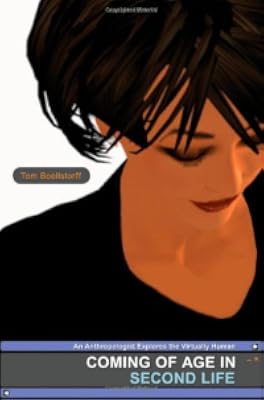
Coming of Age in Second Life: An Anthropologist Explores the Virtually Human
by Tom Boellstorff
On This Page
Description
Millions of people around the world today spend portions of their lives in online virtual worlds. Second Life is one of the largest of these virtual worlds. The residents of Second Life create communities, buy property and build homes, go to concerts, meet in bars, attend weddings and religious services, buy and sell virtual goods and services, find friendship, fall in love--the possibilities are endless, and all encountered through a computer screen. At the time of its initial publication show more in 2008, Coming of Age in Second Life was the first book of anthropology to examine this thriving alternate universe. Tom Boellstorff conducted more than two years of fieldwork in Second Life, living among and observing its residents in exactly the same way anthropologists traditionally have done to learn about cultures and social groups in the so-called real world. He conducted his research as the avatar "Tom Bukowski," and applied the rigorous methods of anthropology to study many facets of this new frontier of human life, including issues of gender, race, sex, money, conflict and antisocial behavior, the construction of place and time, and the interplay of self and group.Coming of Age in Second Life shows how virtual worlds can change ideas about identity and society. Bringing anthropology into territory never before studied, this book demonstrates that in some ways humans have always been virtual, and that virtual worlds in all their rich complexity build upon a human capacity for culture that is as old as humanity itself. Now with a new preface in which the author places his book in light of the most recent transformations in online culture, Coming of Age in Second Life remains the classic ethnography of virtual worlds. show lessTags
Recommendations











































Member Reviews
Before I read Boellstorff, I registered for Second Life and spent a few hours in the last week just to see what it was about. I remain absolutely clueless. I'm trying to imagine what real life circumstances would attract me to spending any significant amount of time in this world, and I suppose I can think of a few. If I were confined to a bed, socially isolated, or stuck in a truly miserable job with plenty of free time at my desk, or if I wanted to have a virtual affair, I suppose Second Life would offer something. But my experience in a few hours (very limited, to be sure) is that it is possible to carry on mind-numbingly awkward "chats" with outlandishly curvaceous and lightly clad avatars. I have found these conversations to be show more just as awkward as I might find any conversation with a friendly random person who seems to have left some of her clothes at home or who is returning from a Renaissance fair in sparkling high heels. I have nothing to say after a few minutes, and neither in my experience do they. We share a virtual space and a few moments of mutual curiosity drifting off into boredom, until one of us blissfully teleports to another world.
Well I suppose THAT is an advantage of Second Life. When the conversation slows, you hit a button and the people you are talking to just vanish. But why spend time in a world whose most interesting characteristic is an easy escape from the vapid and boring conversations that it otherwise offers?
If you get serious about Second Life you can buy property and build objects and sell stuff and decorate your avatar with fancy skins... and then you can hang around in your fancy skin and still have boring conversations with people. But while wearing really cool virtual clothes! Am I not getting this? I am not getting this. Yes, I gather that virtual sex is a pretty big part of Second Life, and you can see the possibilities. Maybe that is what people are really doing in Second Life. I haven't gone there, so I can't say.
Boellstorff treats Second Life as its own culture. He gives it a serious anthropological once over and does a good job of it. If you care about Second Life, this could serve as a theoretical, but also practical, introduction to the norms and habits of the world. It seems to be a little dated however.
I've also heard that Second Life is not quite the hot property or hot world that it was a few years ago. But the best way to explore Second Life is just to sign up and poke around, and I don't regret doing so. I suppose I can imagine life circumstances where it would be a wonderful place to go. I'm just not in those circumstances. show less
Well I suppose THAT is an advantage of Second Life. When the conversation slows, you hit a button and the people you are talking to just vanish. But why spend time in a world whose most interesting characteristic is an easy escape from the vapid and boring conversations that it otherwise offers?
If you get serious about Second Life you can buy property and build objects and sell stuff and decorate your avatar with fancy skins... and then you can hang around in your fancy skin and still have boring conversations with people. But while wearing really cool virtual clothes! Am I not getting this? I am not getting this. Yes, I gather that virtual sex is a pretty big part of Second Life, and you can see the possibilities. Maybe that is what people are really doing in Second Life. I haven't gone there, so I can't say.
Boellstorff treats Second Life as its own culture. He gives it a serious anthropological once over and does a good job of it. If you care about Second Life, this could serve as a theoretical, but also practical, introduction to the norms and habits of the world. It seems to be a little dated however.
I've also heard that Second Life is not quite the hot property or hot world that it was a few years ago. But the best way to explore Second Life is just to sign up and poke around, and I don't regret doing so. I suppose I can imagine life circumstances where it would be a wonderful place to go. I'm just not in those circumstances. show less
Not a popular-science book but a serious ethnographical treatise. As a non-user, I think I gleaned a worthwhile knowledge of the Second Life virtual world, which I nuttily wish were a primitive-to-the-nth-power precursor of a future milieu into which people's minds could be fully uploaded. (Boellstorff isn't interested in such posthuman possibilities, though.)
While inelegantly written this is a fascinating book because of the material. There are a lot of redundancies but when describing the "neighborhood" the author is compelled to give us descriptions which would be about as fascinating as a description of how town governments work. But it is, if anything a testimony to what we humans do, like spy on each other, like buy land and then defend it and all the other various tendencies and controversies we bring to life. Nonetheless there are sufficient quotes to indicate that for many people the relationships between their avatars has meaning. It was also wild just how much sex people are up to, and like someone asked in the book, why would you have a kitchen in your Second Life house? Because show more the origin of this is academic, he spends a lot of time, I thought unnecessarily, defending the notion that you could do an ethnographic study of a virtual world and his approach to being a participant observer. Another aspect which seems to haunt anthropology is the need to create a technical term that apparently you hope would be adopted by the larger anthropological community. In his case that would be techne which he wants us to believe is something different from knowledge in that it is newly created. Didn't impress. show less
Ratings
Members
- Recently Added By
Lists

Books Cited in Blueprint by Nicholas Christakis
261 works; 1 member
Author Information

6+ Works 315 Members
Tom Boellstorff is an associate professor of Anthropology at the University of California, Irvine.
Awards and Honors
Common Knowledge
- Important places
- Second Life
Classifications
- Genres
- Anthropology, Nonfiction, Technology, General Nonfiction
- DDC/MDS
- 305.8 — Society, government, & culture Social sciences, sociology & anthropology Social group - Age, Gender, Ethnicity Ethnic and national groups
- LCC
- GN307.65 .B64 — Geography, Anthropology and Recreation Anthropology Anthropology Ethnology. Social and cultural anthropology
- BISAC
Statistics
- Members
- 165
- Popularity
- 197,941
- Reviews
- 3
- Rating
- (3.81)
- Languages
- English, French
- Media
- Paper, Ebook
- ISBNs
- 8
- ASINs
- 1