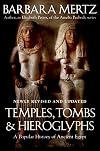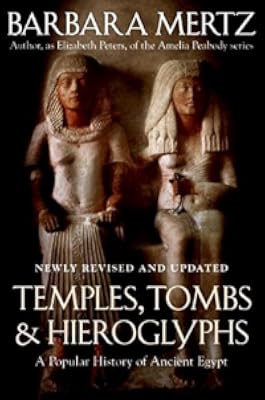
Temples, Tombs, and Hieroglyphs: A Popular History of Ancient Egypt
by Barbara Mertz
Egyptological Non-fiction by Barbara Mertz
On This Page
Description
Archarologist Mertz casts light on a remarkable civilization that, even after thousands of years, still stirs the human imagination and inspires awe with its marvelous mysteries and amazing accomplishments. This chronicle brings ancient Egypt to life as never before, from the first Stone Age settlements through the reign of Cleopatra and the Roman invasions. Illustrated with pictures, maps, photographs, and charts, it offers glimpses into Egyptian society and everyday life; stories of the show more pharaohs and the rise and fall of great dynasties; religion and culture; folklore and fairy tales; stories of the explorers, scientists, and unmitigated scoundrels who sought to unravel or exploit the ageless mysteries; and insights into the magnificent architectural wonders that rose up from the desert sands. Revised and updated to include the results of the most recent historical research and archaeological finds, Dr. Mertz's lively writing is unhampered by stuffy prose and dry academic formality.--From publisher description. show lessTags
Recommendations














Member Recommendations

themulhern Both books present the establishing of the chronology of their subjects very well. There is a bit of overlap in the time scales, so both discuss radiocarbon dating. Both actually put a lot of effort into discussion how we know what we know, although the subjects are different.
The History of the Ancient World: From the Earliest Accounts to the Fall of Rome by Susan Wise Bauer
themulhern Opinionated histories of the ancient world by female writers. Both have attitude about the interesting question of how or whether we know what we think we know.
themulhern One is primarily a history for adults, but draws on Egyptian tales to illustrate the history; the other is primarily Egyptian tales and myths, but draws on the history to explain the changing character of the stories.
Member Reviews
Probably the most readable history of ancient Egypt available (especially when coupled with the parallel Red Land, Black Land). Barbara Mertz graduated from the University of Chicago with a PhD in Egyptology in the 1950s and promptly discovered the market for female Egyptologists was not exactly bullish (there is a rumor that, In sort of a sad tradition, she helped her husband get his degree and he turned around and dumped her. I have no idea if that’s true). She tried to make a living as a writer – probably for every 1000 people who try to make it as writers, 999 end up as waitstaff. She’s the 1000th, writing romance/mystery novels under the name Barbara Michaels, and mystery/romance novels under the name Elizabeth Peters. (The show more novels, by the way, are very erudite, historically accurate, and highly recommended).
Her writing talent is part of the reason this is a good book – the other part is it’s highly idiosyncratic; she admittedly and unabashedly writes about those parts of Egyptian history that interest her and skims over – but with references – those that don’t. Thus the Predynastic, the pyramids, Hatshepsut, and the Amarna period get a lot of coverage. I especially liked her explanation of how William Flinders Petrie did pottery sequence dating – every other Egyptian history mentions pottery sequence dating, but this is the only one that actually explains how it works.
Conventional histories usually gloss over uncertain topics – I suspect because the authors stick to their own opinions. Mertz is happy to point out that Egyptologists don’t agree on a lot of things – the exact classification of Predynastic cultures, who was Menes, Kurt Sethe’s theories about Hapshesut (and the question of who started chiseling Hatshepsut off monuments), how many Montuhoteps and Osorkons there were, and so on. Unfortunately, she had a very strong opinion on one of the controversies – who’s buried in KV55 – and, according to recent DNA evidence, she was wrong (to be fair, she was taking the view supported by almost all the evidence – that it was Smenkhkare – while the contrary position, that it was Ahkenaton, was only held by armwaving fringe Egyptologists). The armwaving fringe turned out to be right, and it’s doubling unfortunate because this is a revised edition of a book published 40 years ago and if she had waited just a little longer the DNA data would have been in.
It’s especially unfortunate because otherwise Mertz’s handling of the Amarna period is outstanding. You might expect a romance novelist to go a little overboard – Amarna, after all, is the only period in Egyptian history where there is any hint of royal romance. Perhaps because of that Mertz does a terrific job of summarizing the facts (at least as known at the time of her writing). Fun to read, informative, gives a real feel for “warts and all” Egyptology, and recommended. show less
Her writing talent is part of the reason this is a good book – the other part is it’s highly idiosyncratic; she admittedly and unabashedly writes about those parts of Egyptian history that interest her and skims over – but with references – those that don’t. Thus the Predynastic, the pyramids, Hatshepsut, and the Amarna period get a lot of coverage. I especially liked her explanation of how William Flinders Petrie did pottery sequence dating – every other Egyptian history mentions pottery sequence dating, but this is the only one that actually explains how it works.
Conventional histories usually gloss over uncertain topics – I suspect because the authors stick to their own opinions. Mertz is happy to point out that Egyptologists don’t agree on a lot of things – the exact classification of Predynastic cultures, who was Menes, Kurt Sethe’s theories about Hapshesut (and the question of who started chiseling Hatshepsut off monuments), how many Montuhoteps and Osorkons there were, and so on. Unfortunately, she had a very strong opinion on one of the controversies – who’s buried in KV55 – and, according to recent DNA evidence, she was wrong (to be fair, she was taking the view supported by almost all the evidence – that it was Smenkhkare – while the contrary position, that it was Ahkenaton, was only held by armwaving fringe Egyptologists). The armwaving fringe turned out to be right, and it’s doubling unfortunate because this is a revised edition of a book published 40 years ago and if she had waited just a little longer the DNA data would have been in.
It’s especially unfortunate because otherwise Mertz’s handling of the Amarna period is outstanding. You might expect a romance novelist to go a little overboard – Amarna, after all, is the only period in Egyptian history where there is any hint of royal romance. Perhaps because of that Mertz does a terrific job of summarizing the facts (at least as known at the time of her writing). Fun to read, informative, gives a real feel for “warts and all” Egyptology, and recommended. show less
Charmingly written history of Egypt’s ancient rulers from what we can and can’t know from their artifacts. Not very much about ordinary life or details of how pyramids were built, but gossipy discussion of various rulers and of the nature of knowledge of/speculation about the distant past.
Though I had heard of Elizabeth Peters the mystery writer, I never knew that Peters was only the pen name for a woman whose first vocation was as an academic Egyptologist. In fact, this was her first published book. Mertz's fascinating introduction to Egypt and the people who study it, first written in 1964 and revised 2007, was like reading Carl Sagan's Cosmos. Yes, it may be somewhat dated in terms of current finds, but the basic info is there, and presented so appealingly that I want to read more.
Mertz is a joy to listen to, whether she is describing ancient Egyptian science and architecture, the imposing Queen Hapshetsut, the religious fanaticism of Akenahten, the grandiose monuments of Ramses, the ubiquitous tomb pots, or the show more villainous and rage-inducing tomb robbers of centuries ago. But more humorously, she is not afraid to take cheap shots at her fellow Egyptologists, poking fun at the inanity of certain scholarly debates. I only wish she had discussed more Egyptian myth and religion in addition to history and archaeology. I also wish I had read the book instead of listened to the audio because I missed out on images and maps I hear are in the real thing!
Still, I really enjoyed this book, and now I want to read more. show less
Mertz is a joy to listen to, whether she is describing ancient Egyptian science and architecture, the imposing Queen Hapshetsut, the religious fanaticism of Akenahten, the grandiose monuments of Ramses, the ubiquitous tomb pots, or the show more villainous and rage-inducing tomb robbers of centuries ago. But more humorously, she is not afraid to take cheap shots at her fellow Egyptologists, poking fun at the inanity of certain scholarly debates. I only wish she had discussed more Egyptian myth and religion in addition to history and archaeology. I also wish I had read the book instead of listened to the audio because I missed out on images and maps I hear are in the real thing!
Still, I really enjoyed this book, and now I want to read more. show less
An enjoyable book and a good companion to Mertz's "Red Land, Black Land", as well as to her Amelia Peabody series. It is almost as if the Amelia Peabody character had written the book herself; "Temples, Tombs, and Hieroglyphs" contains so much of the archaeological opinions expressed in the novels, or vice-versa. The maps aren't frequent enough and are not very well drawn and there are just a few color plates so I borrowed a number of supplementary books better illustrated with photographs and maps in order to make up the deficiency. I feel that I get more enjoyment from reading the novels in the Amelia Peabody series since I have acquired the archaeological background from this book and I have a better grasp of Ancient Egyptian history show more as well. show less
If only public schools would teach Egyptian history from books like this! Chatty, assuming without being superior that you don't know much, it is such an easy, fun read. Regrettably, Barbara Mertz is no longer with us, but she's left a one-of-a-kind legacy we can all enjoy. Too bad there's not a 5+, this one deserves it.
If you don't know anything about ancient Egypt, this is the first book to read on the subject. It made me fall in love with Egyptology. Ms. Mertz guides the reader through this civilization's 3,000-year-long history with grace and humor. She makes it seem like an easy read, and yet, when you finish the book you realize how much you have learnt about ancient Egypt.
It's been a good book for dipping in occasionally. I like the enthusiasm and breezy assertiveness. But I find I distrust her confident conclusions. Maybe I'll try another more recent take on the ancient Egyptians.
Members
- Recently Added By
Lists

Books Read in 2012
816 works; 34 members

Books Read in 2012 (Numbered)
168 works; 6 members
Author Information

Barbara Mertz was born on September 29, 1927 in Astoria, Illinois. She received a bachelor's degree in 1947, a master's degree in 1950 and doctorate in Egyptology in 1952 from the University of Chicago. She wrote a few books using her real name including Temples, Tombs and Hieroglyphs (1964), Red Land, Black Land (1966), and Two Thousand Years in show more Rome (1968). She also wrote under the pen names Barbara Michaels and Elizabeth Peters. She made her fiction debut, The Master of Blacktower, under the name Barbara Michaels in 1966. She wrote over two dozen novels using this pen name including Sons of the Wolf, Someone in the House, Vanish with the Rose, Dancing Floor, and Other Worlds. Her debut novel under the pen name Elizabeth Peters was The Jackal's Head in 1968. She also wrote the Amelia Peabody series and Vicky Bliss Mystery series using this name. She died on August 8, 2013 at the age of 85. (Bowker Author Biography) show less
Some Editions
Series

Common Knowledge
- Canonical title
- Temples, Tombs, and Hieroglyphs: A Popular History of Ancient Egypt
- Original title
- Temples, Tombs, and Hieroglyphs: A Popular History of Ancient Egypt
- Original publication date
- 1964
- People/Characters
- Sekenenre
- Important places
- Egypt; Valley of the Kings, Egypt
- Dedication
- To John A. Wilson
1899-1976
Scholar, teacher, humanist - First words
- My affair de coeur with ancient Egypt began in remote childhood, when I first encountered James Henry Breasted's History of Egypt at the local library; it is still flourishing, although many years and many distractions... (show all) have intervened. (Foreword to the First Edition)
When I first set out to revise this book, I was naïve enough to believe several kindly friends, who must have been blinded by affection, because they assured me that I wouldn't need to do very much. (Foreword to the Second E... (show all)dition)
One bright summer afternoon in the year 5263 B.C., a man stood on the cliffs high above the Nile valley. - Quotations
- The problem of Diffusion versus Independent Invention is still being debated by scholars, and also by people whose scholarship is, to put it nicely, goofy. The latter believe in a single source, but they don't agree on what i... (show all)t was. Some give the credit to the hypothetical geniuses of the lost continent of Atlantis. However the most popular current theory favors visitors from outer space. I don't want to get started on this, because it makes me lose my temper.
A slightly more believable version of the Diffusion scenario holds that all advanced civilizations derived from a single terrestrial source, with Egypt being the leading contender. It is only slightly more believable, really. Despite superficial similarities, such as pyramids and sun worship, the advanced civilizations of the Americas have no provable, direct connection with the much older civilizations of the Middle East.
(pp.18-19)
Because people like simple answers, scholars once postulated a "dynastic race" whose people entered Egypt at the end of the prehistoric period, bringing with them the gift of civilization. They unified the land and, like the ... (show all)Normans in England, ruled the conquered indigenes as racially distinct noble class, before interbreeding produced a single people. The dynastic race came from Asia - a large place, but one cannot summarize the conflicting theories of origin more precisely than that. They spoke a Semitic language, which mingled with the Hamitic (African) tongue of the natives to produce the Egyptian speech.
The term "race" is out of favor, and rightly so. ... Often the evidence for a "race of invaders" consists of cultural changes, which in prehistoric societies primarily means new kinds of pots. I have a prejudice against this sort of argument. I get idiotic mental images of invading armies brandishing pots, which they thrust threateningly into the trembling hands of the conquered indigenes.
(pp.20 - 21)
The savage reader (to plagiarize Mark Twain) may reasonably ask at this point, "Why talk about it then?" There are several good, logical answers to this question. One is that the radiocarbon process is very useful in dealing ... (show all)with Egyptian prehistory; another is that carbon 14 is only one of a number of related methods, the great gift of the physical sciences to history, which deserve a more than cursory treatment. But the real reason I want to discuss carbon 14 is because it delights me by its inherent improbability. Eighty years ago, the suggestion that a physicist could tell an archaeologist the age of a piece of wood by purely physical, laboratory techniques would have struck said archaeologist as completely preposterous. This is the real excitement of archaeology, and of life in general: that the horizon of what may be known is not bounded by what is known. And, of course, the development of the radiocarbon process is a fascinating intellectual adventure in itself.
Admiring students of Ancient Egypt have credited the Egyptians with the invention of many interesting and useful pursuits, but no one has ever given them their due as the originators of the pernicious habit of scribbling on t... (show all)ourist attractions.
(p. 56)
One of the reasons why the ancient Egyptians have interested so many people is that they are a rather amiable set of human beings. We are seldom shocked by their activities, as we are by the cold-blooded ferocity of the Assyr... (show all)ians or the sickening brutality of the Aztecs. We sometimes think of the Egyptians as being preoccupied with death, but actually the converse is true. They enjoyed life so much that they took every means possible to continue its pleasures after that change which men call dying.
(p. 79)
Our Sekenenre died a violent death; his mummy is a ghastly sight, with several gaping holes still visible in the skull, and the face contorted in a frightful grimace of pain. The wounds were inflicted in battle, by an ax or a... (show all) club. The first, on the jaw, would have been sufficient to send the warrior king reeling to the ground; his adversary finished him off with at least four crashing blows that split his skull wide open. The king's death threw his men into confusion and probably lost that particular battle for Thebes; for several days the royal corpse lay untended where it had fallen. At last it was recovered and given a proper, if hasty, burial. The dead and withered face still seems to hold the emotions that were the last to animate the dying brain - fury and pain and the knowledge of defeat.
(p. 131)
This is not to disparage, nor to disregard, the uniqueness of history.The richness and variety of the attempted solutions to man's various problems are marvelous and appalling, and a lifetime is not long enough to begin to co... (show all)mprehend their manifold complexities.
(p. 306)
After the transitory reflection of greatness which appeared during the Twenty-sixth Dynasty, the aging giant on the Nile stumbled ever faster down the ignominious path to annihilation. It is a depressing subject for Egyptophi... (show all)les and very confusing; for those reasons, most general works, including this one, tend to pass rapidly over the details.
(p. 303)
Let us leave this depressing subject and proceed to view, with comfortable detachment, the decline and fall of someone else.
(p. 299)
We have a more personal need, in our time, to dissect the past in search of its pathology, for according to some historians our own culture is showing disturbing signs of disease. However you define the developmental stages o... (show all)f civilization, and upon whatever step you put us here, in this twenty-first century of the Christian Era, it seems unlikely that we are at the beginning of a process. This leaves us with the dismal possibility that we may be nearing the end. If so, it behooves us to discover, insofar as we are able, where we are, and why. If there are universal causes, and if we are able to see them plainly, we may learn how to avoid their more disastrous consequences.
(p. 299)
This has been a very superficial, limited probing of some of the types of problems we encounter when we talk about causes in history. We have not even settled the important question of whether there are causes. Yet we will pr... (show all)obably go right on looking for them, and talking about them. The intellectual climate of our own era asks for explanations. We would like, if we could, to reduce all phenomena to systems of logical sequence. In part this is the effect of the prestige of the physical sciences, and this effect is not always for the good. ... the disciplines that deal with man and his peculiar affairs cannot expect to use the methods, or anticipate the results, of the physical sciences. The human experiment will not reproduce itself under laboratory conditions; we can never control our specimens to such a degree that we can isolate a pertinent stimulus or determine a specific conclusion. My personal antipathy toward the use of the term "scientific" in the humanistic disciplines is that the very application of the word sometimes suggests to the user that such isolation and such determination are possible. Sometimes I wish they were.
(pp.298 - 299)
The fact that acceptable theories of causation fluctuate is a disturbing phenomenon if we would like to believe that real reasons really exist. A number of theories have come in and gone out in the past century, in addition t... (show all)o the will of God. Causality is a dangerous word for a historian to play with; if he presses it too far he finds himself, sooner or later, locked in a death-grapple with a philosopher. Historians - and who can blame them? - try to avoid such encounters. Their causes are not philosophical profundities, as a rule, but prosaic, matter-of-fact explanations that are comprehensible to any well-read person. But historical causes are inevitably affected by the cultural climate of the times. We no longer accept supernatural explanations - God and the devil are equally out of style - because our present worldview does not include a belief in the direct intervention of such forces in man's affairs. Economic explanations are still respectable...but most historians would not regard them as valid exclusive causes.
(p. 296)
An appeal to "the fatal something" in a nation's psychology is not an explanation of anything, only an admission of the inability of the commentator to produce an explanation.
(p. 296) - Last words
- (Click to show. Warning: May contain spoilers.)The lament for a dead child, the demand for justice, the lover's yearning for his beloved - before our recognition of the universality of human emotion, time and distance shrink, the barriers of language, color, and nationality go down; we look into the mind of a man three millennia dead and call him "brother."
- Blurbers
- Albright, William F.
- Original language
- English
- Disambiguation notice
- The eBook does not include and color insert of illustrations, but it does include the maps. The index includes the terms, but not page numbers.
Classifications
Statistics
- Members
- 841
- Popularity
- 32,801
- Reviews
- 15
- Rating
- (4.06)
- Languages
- English, German
- Media
- Paper, Audiobook, Ebook
- ISBNs
- 25
- ASINs
- 17